Guidelines


Submission Guidelines: Send 1-3 unpublished poems in the body of an email (NO ATTACHMENTS) to nvneditor[at]gmail.com. No simultaneous submissions. Use "Verse News Submission" as the subject line. Send a brief bio. No payment. Authors retain all rights after 1st-time appearance here. Scroll down the right sidebar for the fine print.
Showing posts with label hive. Show all posts

Sunday, September 18, 2022

THE BEES RESPOND TO BEING TOLD THE QUEEN IS DEAD

by Pepper Trail


John Chapple, the beekeeper at Buckingham Palace, reportedly informed Queen Elizabeth II’s bees of her death. Credit Dan Kitwood/Getty Images via The New York Times, September 15, 2022


The rituals must be respected

But we do not pause the work

Choice is not a word we know


These corridors are splendid

Glowing, aromatic, and endless

Leading to the golden treasuries


It is our life to keep them filled

We will do what we were born to do

But it will no longer be sweet, for a King


Pepper Trail is a poet and naturalist based in Ashland, Oregon. His poetry has appeared in Rattle, Atlanta Review, Spillway, Kyoto Journal, Cascadia Review, and other publications, and has been nominated for Pushcart and Best of the Net awards. His collection Cascade-Siskiyou was a finalist for the 2016 Oregon Book Award in Poetry.

Sunday, August 02, 2020

TWO DEGREES

by Ralph James Savarese


Murder hornet photo tweeted by @Elvis_Trump

                                                                                           
Let us now praise the Japanese honey bee, Apis cerana,
which alone cannot defeat the much larger

and more vicious “murder hornet,” Vespa mandarinia.
Just one or two of the latter can destroy an entire hive,

moving in like winged, up-armored Cossacks.
After decapitating the honey-makers, they stuff

their yellowish-orange mouths with larvae and pupa.
Yet a miracle, not so much on ice as in the oven,

sometimes occurs. The honey-makers practice a technique
called “bee-balling,” which involves swarming

their attacker and collectively cooking it alive.
The bees move their flight muscles to generate heat;

they can withstand temperatures two degrees higher
than the hornet…. How about we try this with that predator

in the White House? Surround him with human warmth;
kindle him, you might say, with kindness? Of course,

the American honey bee hasn’t yet developed such a defense,
perhaps because it’s insufficiently eusocial and maybe

even indifferent to the fate of the hive. (“I’m not gonna
wear a mask, and there’s nothing you can do to make me!”)

As the seas rise and infection marauds the planet,
can you not hear the soft buzzing of wings, the earth balling

to save itself?


Ralph James Savarese is the author of two books of prose, Reasonable People and See It Feelingly, and one collection of poetry, Republican Fathers, due out in October.

Monday, May 01, 2017

QUEEN

by Scot Siegel


Image source: Pinterest


for Melania


One hundred days the Queen hibernates,
burrowed deep in a cavern of bark.

Every day, a star blinks on, or off,
birth of another scientist, or murderer,

and someone loses his or her job.
Every day is someone's first

at something, waking up married, burying
the dog, eating dinner alone as a widow.

Every spring, the earth gets back to work.
Queen searches for a dry place, a loft or shed,

a wedge of light between truss and stud,
someplace warm and undisclosed,

close to the source: Wood she'll strip from lap
or fence, chew and mix with saliva.

She works fast, connects petiole to rafter.
Spins the nest about the center stalk, weaves

combs for drones whose eggs take five to eight
days to incubate. Then they get to work.

Everything they do is for the Queen.
She never returns to the same nest.


Scot Siegel, Oregon poet and city planner, is the author of five books of poetry, most recently The Constellation of Extinct Stars and Other Poems (2016) and Thousands Flee California Wildflowers (2012), both from Salmon Poetry of Ireland. His poetry is part of the permanent art installation along the Portland, Oregon Light Rail Transit ‘Orange Line.’

Thursday, July 11, 2013

MOURNING THE BEES

by Tricia Knoll


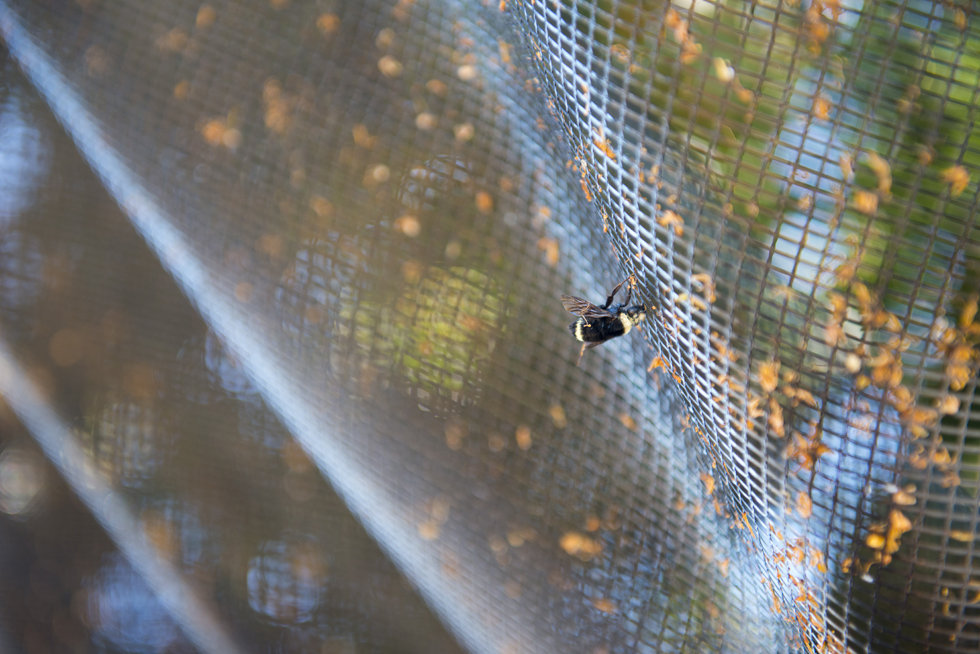
WILSONVILLE, OREGON - June 30, 2013 - A bumblebee is caught in the protective netting draping the trees in a Wilsonville Target parking lot. An estimated 50,000 bees were killed when the trees in the parking lot were sprayed with the insecticide Safari on June 15. Molly J. Smith/The Oregonian, June 30, 2013.


Fifty-thousand is a medium-sized town
     Loveland, Colorado
     Pocatello, Idaho
     Lacrosse, Wisconsin
     Milford, Connecticut
wiping out any one is a slaughter

for bees,
50,000 might be five hives,
maybe one.

Dead bees dry up like cicada husks,
furred legs pump,
torsos circle directing
toward a hive they’ll never go home to.

They came for linden pollen,
the heart-shaped leaves, abundance.
and writhed in piles in a Target parking lot
wanderers, sojourners, victims
of Safari sprayed for aphids no one worried about.
The scientists wrapped the trees in baggies,
closing the juice bar
after the liquor turned lethal.

The people worried on those pollinators,
the canaries, busy-bodies on fruit.
Come to Target to mourn, carry your signs
Bee The Change
for bees who feed us

not knowing poison
as convenience.
Poison as death knell,
the dripping of our tears.

We have so little time
without the bees.


Tricia Knoll is a Portland, Oregon poet. As a master gardener who specializes in native plants, she grows some plants just for the pollinators. A righteous bunch of pearly everlasting is in bloom right now.