Guidelines


Submission Guidelines: Send 1-3 unpublished poems in the body of an email (NO ATTACHMENTS) to nvneditor[at]gmail.com. No simultaneous submissions. Use "Verse News Submission" as the subject line. Send a brief bio. No payment. Authors retain all rights after 1st-time appearance here. Scroll down the right sidebar for the fine print.
Showing posts with label pogrom. Show all posts

Thursday, March 26, 2026

A DIFFERENT KIND OF KOSHER

by Todd Friedman


Dirt under your fingernails, backbone straight,

you would be the New Jew.


Clearing the swamp, rifle ready,

no more lambs to the slaughter.


The world was with you, Israel,

Buchenwald’s emaciated ghosts still searing.


My grandmother shouted through tears for you

in a jam-packed Madison Square Garden.


You were our Samson fighting

the entire Philistine army.


When you captured Jerusalem, shofars blowing,

it was the Red Sea parting anew.


Who can forget that photo of your “crying paratroopers”

standing in front of the Wailing Wall?


But now every day your settlers descend the hills masked:

smashing cars, bashing heads, burning villages.


And like Joshua’s sun your army stands still—

or even aids in the slaughter.


This is what my grandfather fled from in Russia—

only there it was called a pogrom.


So here you are, the New Jew,

with ancient real estate “deed” and a different kind of kosher.


We now know that Samson

was blind to begin with—


and so were we.


Todd Friedman is a retired  NYC high school English teacher who now revels in having time to write.  His poems have been published in Tikkun, The Reform Jewish Quarterly, Brooklyn Daily Eagle, Haight Ashbury Literary Journal, Blue Collar Review, and Vox Populi.

Tuesday, March 01, 2022

ANOTHER FALSE NARRATIVE

by Catherine Gonick


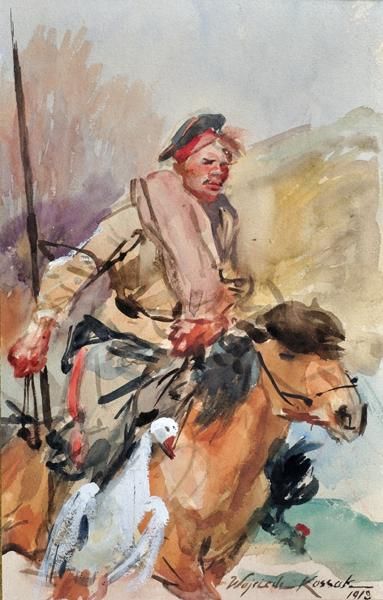
Wojciech Kossak "Cossack on Horseback", 1918, watercolour on paper, 24 x 14.5 cm


My Cossacks just left, taking with them
everything they could carry.
As usual, my books, notebooks,
my rubber crutch. I can’t even climb
the walls. But deep in my closet,
a locust swarm gathers. I ride it
back to the desert, scan for signs,
a dung-beetle track, ripple of sand,
to find an oasis of laughing doves.
 
Scribbling again has meaning, yet certain
as ink on paper, as bullies’ lies
on social media, these scimitared
thugs will return. In a garden
of sunflowers outside Odessa, my aunt
fell in love with one of the Cossacks
on horseback passing her house.
 
She was only a child, but her story
reminds me not to be fooled
if now and then, they are handsome.
A pogrom against words is still a pogrom.
 

Catherine Gonick’s poetry has appeared in publications including Beltway Poetry Quarterly, Notre Dame Review, Forge, and Sukoon, and in anthologies including in plein air, Grabbed, and Dead of Winter 2021.  She is part of a company that fights  global warming through climate repair and restoration projects around the world. Pogroms early in the last century drove her grandparents and their first two children from Odessa to California, where her aunt painted sunflowers and worked in the San Francisco Public Library, and her uncle was a leader in the Longshoremen's Strike of 1933 and a lifelong activist. 

Tuesday, May 08, 2018

BETWEEN THE LINES

by Dennis DuBois


A demonstrator uses a racket to return tear gas canisters fired by Israeli troops during a protest where Palestinians demand the right to return to their homeland, at the Israel-Gaza border in the southern Gaza Strip, May 4, 2018. REUTERS/Ibraheem Abu Mustafa


Not to worry, my friend, nothing
will be asked of you,
but for a moment with your ears open,
to read between the lines.
it is only an intellectual exercise, something
one does to feel good
about oneself, and if you can have it
without risking the moral station
you occupy or an iota
of your accumulated wealth,
all the better. Rest easy
and breathe. Listen:
acre by acre they steal our homeland,
parsed into Bantustans, residence by residence,
they evict or bulldoze our homes.
They destroy our infrastructure, our mosques,
our schools, sanitation facilities.
Denied medical care, we die at the turnstiles,
Our organs transplanted into their people.
The men hide as they are marked.
The women march, children throw stones.
Snipers react with bullets. Tear gas canisters
aimed and fired intentionally
mangle protestors’ faces, eyes go black.
State of the art weapons and bombs
are dropped on us. The air reeks
of what has been lost, of unrecovered bodies,
buried in bombed out buildings.
Our celebrated youth disallowed
travel to collect awards.
Fisherman are attacked
to cut off food supplies.
They reroute and confiscate
aide-bearing ships.
Near and far they track and assassinate
our leaders.They denigrate us,
call us rats, and kill us with impunity
They pull up the roots, set alight
three hundred year old olive trees.
They arrest, jail, and torture our children.
They poison our drinking water, bomb our hospitals.
They remind us of the German pogroms
Even as they do the same to us—
They want it all, all of it,
and they don’t care where we go, but not here,
not in our historical homeland.
What have I to lose? Have I not
already lost everything?
If your heart breaks, or if a feeling of helplessness
overtakes you, it is a start,
a place to cleave toward one another.
The world sometimes offers a lukewarm shoulder,
but solidarity without shared pain,
an intellectual exercise.


Dennis Dubois holds a Master’s Degree in social work and has worked to help others for decades, while writing poems along the way. He has published poems in Bee Museum, Curved House, The Projectionist’s Playground, Runcible Spoon, and MessageinaBottle. He is preparing a collection of poems and a first work of fiction. He is an American expatriate living in Copenhagen.

Thursday, August 07, 2014

SNEAKING ACROSS THE BORDER

by Linda Lerner


The author's father's family.


He never spoke of what it was like
those three years in Amsterdam
waiting to get to America

and I never asked….
I heard about it from her, not him

he & I lived in separate countries;
there was no crossing over, not then;
day after day I read about those thousands
of migrant children…. many 17 and younger…

and I hear my mother’s voice from
before I was ready to listen, only 17 when his father
forced him to join a group of youths
fleeing Russian pogroms…

In an album she left me are photos of
the family he’d never see again…

using their story I sneak across the border;
among the children coming thru Mexico,
Central America, some drowning or getting shot

I see that Russian boy
standing with others who made it here
forced to explain  WHY  what
he’ll be asking himself his whole life


A chapbook of Linda Lerner’s poems using nursery rhymes as a taking off place Ding Dong The Bell Pussy in the Well, illustrated by Donna Kerness was published by Lummox Press, in Feb. 2014. Her next full length collection Yes, the Ducks Were Real will be published by New York Quarterly books in Fall 2014.