Guidelines


Submission Guidelines: Send 1-3 unpublished poems in the body of an email (NO ATTACHMENTS) to nvneditor[at]gmail.com. No simultaneous submissions. Use "Verse News Submission" as the subject line. Send a brief bio. No payment. Authors retain all rights after 1st-time appearance here. Scroll down the right sidebar for the fine print.
Showing posts with label songbirds. Show all posts

Tuesday, February 20, 2024

CAGED BIRDS SINGING

by Lynn White


Songbirds have long been popular among Gaza’s population for their colour and song, but now they’re natural soothers against the thunder of Israel's relentless war [Mohamed Soleimane/Al Jazeera] February 17, 2024


She asked me why the caged birds sang.
I couldn’t tell her,
not for sure.
No mate will arrive this year,
just like last year.
I wonder if they remember,
perhaps they still
live in hope. 

She asked me if they heard the bombs falling
and if they felt fear.
I couldn’t tell her, 
not for sure.
Perhaps peace will arrive this year,
unlike last year.
I wonder if they remember peace,
perhaps they still
live in hope
as we all do here 
where the bombs never stop falling. 

She asked me if they knew
they brought us comfort.
“I think that’s why 
they still sing,”
I said.


Lynn White lives in north Wales. Her work is influenced by issues of social justice and events, places and people she has known or imagined. She is especially interested in exploring the boundaries of dream, fantasy and reality and writes hoping to find an audience for her musings. She was shortlisted in the Theatre Cloud 'War Poetry for Today' competition and has been nominated for a Pushcart Prize, Best of the Net and a Rhysling Award. Her poetry has appeared in many publications including: Apogee, Firewords, Peach Velvet, Light Journal, and So It Goes.

Tuesday, March 08, 2022

INTERNATIONAL WOMEN'S DAY
8 MARCH 2022

by Mary K O'Melveny


Today, please celebrate all
the women we have lost.
In every war and cease fire.
On slaver’s ships. On thirsty
desert treks to walled borders.
In back-alley rooms without
anesthesia. Locked in basements,
without papers or escape routes.
Asleep in bed. Hitching a ride.
Nursing bruises or starving babies.
 
Our losses rise like mountain peaks.
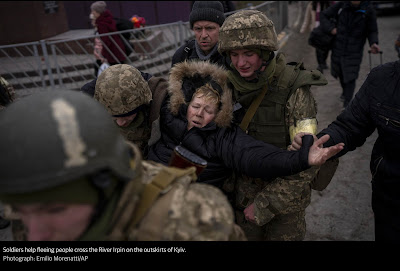
Ukrainian women huddle in subways,
clutch children, family pets, a few
hastily gathered objects from lives
they will likely never know again
or tattered photographs of loved ones
they may never see again. Even in
safer worlds, friends die of causes
that repurposed money, refocused
attention could have remedied.
 
Some fade away from neglect,
inattention, dreams downsized
by school guidance counselors,
religious zealots, patriarchy.
Others drop dead without a whimper
on a sun-dappled afternoon. One friend’s
memories vanished by midnight
stroke; another’s by subtle daily
erasures. Open our mouths wide in
praise of all. Let songbirds loose.


Mary K O'Melveny is a recently retired labor rights attorney who lives in Washington DC and Woodstock NY.  Her work has appeared in various print and on-line journals. Her most recent poetry collection is Dispatches From the Memory Care Museum, just out from Kelsay Books. Her first poetry chapbook A Woman of a Certain Age is available from Finishing Line Press. Mary’s poetry collection Merging Star Hypotheses was published by Finishing Line Press in January, 2020.

Friday, July 16, 2021

MORTALITY EVENT

by Erin Murphy


Scientists Still Searching for the Pathogen Behind the East's Songbird Epidemic: In a new report, experts ruled out a range of causes, but they still recommend taking down feeders until the source of the disease is identified. —Audubon, July 8, 2021. Photo: A young Blue Jay admitted to the Blue Ridge Wildlife Center in Virginia with an unknown illness. Credit: Blue Ridge Wildlife Center via Audubon.


Songbirds stumble,  
crusty eyes gunked shut  
with conjunctivitis.  
 
Out of an abundance  
of caution, we remove  
feeders where they cluster  
 
like us to cluck about  
the latest scuttlebutt.  
Hands gloved, we dump  
 
the double-bagged dead,  
muttering that it’s redundant.  
We who have too much  
 
do not fund hungry children  
but grumble when unable  
to fuss over cardinals  
 
in lush gardens. We suffer  
from an abundance  
of abundance. 


Erin Murphy’s latest book, Human Resources, is forthcoming from Salmon Poetry. Her work has appeared or is forthcoming in Diode, The American Journal of Poetry, Southern Poetry Review, The Georgia Review, Women’s Studies Quarterly, and elsewhere. Her awards include the Dorothy Sargent Rosenberg Poetry Prize, The Normal School Poetry Prize, and a Best of the Net award. She is Poetry Editor of The Summerset Review and Professor of English at Penn State Altoona.