Guidelines


Submission Guidelines: Send 1-3 unpublished poems in the body of an email (NO ATTACHMENTS) to nvneditor[at]gmail.com. No simultaneous submissions. Use "Verse News Submission" as the subject line. Send a brief bio. No payment. Authors retain all rights after 1st-time appearance here. Scroll down the right sidebar for the fine print.
Showing posts with label aid. Show all posts

Monday, January 26, 2026

MY AMAZING INVESTMENT

by Pat Davis


I think they are sheep at first
but they’re corpses
wrapped and tied in white shrouds.


I wish they were low clouds
laid out in a row

but they’re my purchases,
femur, tibia, wrist
tied up for delivery.

I bought the rubble,
the bulldozers, too.

Israel lets in chips 
and Coke.

Children are dying of hunger.
Children are dying of cold.

Our papers blame the wind.
Blame the rain. 
Aid is blocked, the doctors

forced out.
By the toe-end of a corpse 
as long as my forearm 

is a puddle of muddy water in which a star
was lost


Patricia Davis’ poems appear in Smartish PaceImageSouthern Humanities ReviewHayden’s Ferry Review, and other journals. Also a playwright, she earned her MFA from American University. She is translations editor for the literary journal Poet Lore and lives in the Washington, DC area, where she works in human rights advocacy.

Wednesday, January 08, 2025

A HAUNTING AND A CURSE

by Patricia Smith Ranzoni


     Came a land with no children but many flowers. 

Weeded out by ground thieves, God-given, they thought 

and said. Their right, being most moral to themselves.


     In mothers’ wombs slaughtered sons and daughters. 

In incubators denied power. Refused milk, starved, no matter 

their wails, no rescue or slightest mercy even water.


     Survived to toddle, shot in their heads. Walk or run, 

in knees hobbling for life. Life? Called lawn to be mowed.

At mid-youth, still alive, picked off, 


     thought of as rats on forbidden dumps. And grass 

to be cut. Bombed and drone-shot day and night til nothing

but chunks rolled in dirt like fish in flour 


     from nets also forbidden. Came a land with no 

children, a foot, arm, patch of flesh while rubble baked and 

blew away in the sun, then the absolute misery of winter 

without shelter not a dry or safe space to be had not a meal 

     and the people who wanted it that way, staked and 

claimed, liking it with no children or only childrens’ bones, 

congratulating themselves. No humanitarian aid allowed! 

No humanity for Christ’s sake!


     Came a time their stolen olive trees turned blood red 

fruiting with the colors of newborn eyes watching them.


     Their soiled window boxes boasted the lushest 

greens ever seen, breaking out with poison petals 

startlingly splendid but quick to rot. 


     Their gardens made them sick. Trees never 

stopped boiling over with tears. Yet still, they praised

themselves, thanking their gods. 


     The map to the land with no children can be found 

by the cries the wind is made of. World ‘round, it is named 

shame in laments whispered and screamed forever.


Outback Maine native Patricia Smith Ranzoni is a child veteran of WWII and retired educator nearing the land of 85. Daughter of a woodsworking paper mill rigger and farm woman, she and her second generation Italian-American husband met and married while working their way through the University of Maine (1962). With their three children they have devoted their lives to keeping the family G.I. Bill homestead for three more generations. They were the last on both sides to keep a family cow. Her mostly self-taught poetry has been published across the country and abroad, including numerous times in The New Verse News where she goes for solace.

Monday, May 27, 2024

WHAT IS LEFT?

by Peter F. Crowley


Waiting for rations from an outdoor kitchen in Khan Younis this month. Hunger is now most acute in the southern Gaza Strip.
Credit...Agence France-Presse — Getty Images via The New York Times, May 24, 2024Credit...Agence France-Presse — Getty Images via The NewYork Times, May 24, 2024


     The language you speak has soured, become melancholy, chokes eyelids. Its tendrils lay flaying in dusty streets near occupation crossings in the gated night. Your eyes have grown sallow, as your children's stomachs distended, swollen, as you swat flies from their brow. The streets are your anguish, running, forever running from apartment home to tent back to bombed out abode. Hope was sapped with the last morsel of cat food, finished for yesterday’s only meal, while the powerful stick their blindfolded, deaf eyes deep into the sand, purchasing bulldozers to roll over you.
     You now avoid aid trucks, should they ever appear out of shackled nothingness, to avoid getting gunned down by those fighting terror. 


As a prolific author from the Boston area, Peter F. Crowley writes in various forms, including short fiction, op-eds, poetry and academic essays. His writing can be found in 34th Parallel, Pif MagazineGalway ReviewDigging the FatAdelaide’s Short Story and Poetry Award anthologies (finalist in both) and The Opiate. He is the author of the poetry books Those Who Hold Up the Earth and Empire’s End, and the short fiction collection That Night and Other Stories.

Friday, September 01, 2023

CHANNELING CASSANDRA

by George Salamon


The Daily Tar Heel, August 30, 2023


All values are fleeing,
there's no home for
them in a world run 
by power and money.
Only one principle
remains to which we
owe loyalty, the cry
for help, screamed
or whispered.
If we give aid, arrival
of our downfall may be
delayed.


George Salamon channels Cassandra only once in a while; doing it too often would be too depressing.

Sunday, October 03, 2021

THE USHERS OF AID

a villanelle by Jeannie E. Roberts


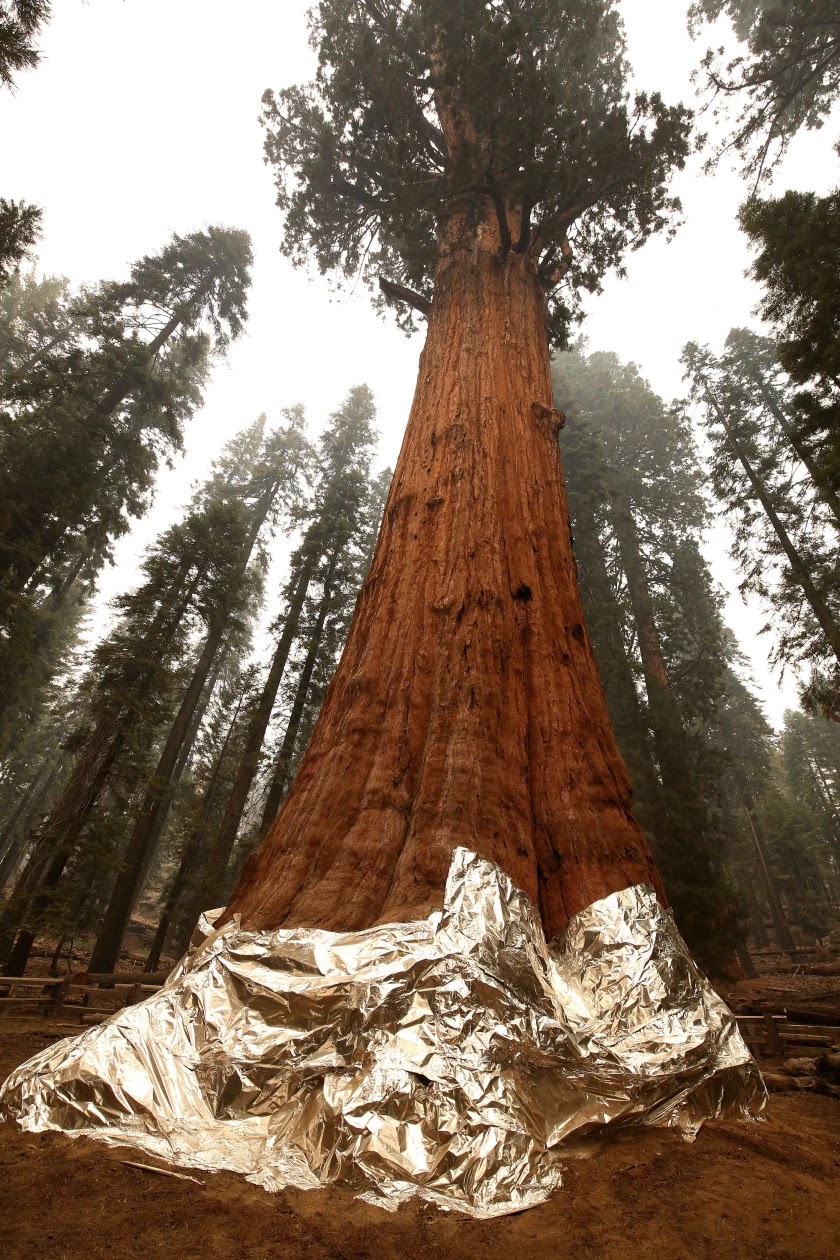
“Giant sequoias are hardy souls. They have stood their ground in California for as long as thousands of years, surviving drought, earthquakes and wildfire. With their thick bark and seemingly sky-high crowns, they have generally defied any fire that would turn them into kindling—and even thrived after a burn. The heat causes the trees’ pine cones to burst open and release seeds to the ground. But as hotter blazes like the KNP Complex fire—ignited by lightning on Sept. 9 and still uncontained—headed into the Sequoia and Kings Canyon National Parks in the Sierra Nevada, the trees needed some extra help. And they got it in the form of aluminum foil. Now, the largest tree, by volume, in the world is cradled in shiny, silvery wrap.” Carla Hall, Los Angeles Times, September 26, 2021. Photo: The historic General Sherman tree is wrapped in protective aluminum foil at Sequoia National Park in California. (Gary Kazanjian / AFP via Getty Images via Los Angeles Times)


The world is on fire, flames fill our home. 
The Earth’s rising heat ignites global burn. 
The ushers of aid fall to humans alone.

The forest floors smolder as embers roam. 
Infernos scorch fauna, flora, and fern. 
The world is on fire, flames fill our home.

Some trees are stalwart, persist as if stone—
most render ash, where Earth serves as urn. 
The ushers of aid fall to humans alone.

Encircled in tin, from large base to loam, 
General Sherman stood strong, ever firm.
The world is on fire, flames fill our home.

The famous sequoia thrived, held its own—
it beat the fierce grind, conquered the quern. 
The ushers of aid fall to humans alone.

Envision our planet polished like chrome, 
where vigor exists with each gleaming turn. 
The world is on fire, flames fill our home. 
The ushers of aid fall to humans alone.


Jeannie E. Roberts has authored five poetry collections and two illustrated children's books. Her work appears in Sky Island Journal, The New Verse News, Verse-Virtual, and elsewhere. Her newest collection, As If Labyrinth—Pandemic Inspired Poems, was released by Kelsay Books in April of 2021. She is a Best of the Net award nominee.

Sunday, August 15, 2021

REBUILDING

by Indran Amirthanayagam


I did not want to write right after the crack, letting my mind fill slowly,
Caribbean and North American plates, moving side by side, whiplashing
each other for a moment, causing walls and roofs to tumble and Fortuné
to lose his bet, just one of several hundred dead already, thousands
with open wounds, tropical storm on the way. But there are some
cheerful consequences, the truce called by gangs so rescue trucks
and supplies can move south from Port Au Prince, heroism everywhere,
doctor performing surgeries on the tarmac, a man lending his propeller
plane to lift wounded to hospitals in the capital, hundreds digging
with pick axes, shovels, hands, to free family trapped under concrete,
sparing of human life at my friend's family compound, although
the famed swimming pool full of holy water has cracked and will
require repair, but faith remains in place, survivors have nowhere else
to turn but to internal (and external) resources. Aid ships are flying,
trucks rolling, but if only money I give can assuage pain, even if it buys
no pardon, if it means just that someone will get medicine, food, a blanket.
As for the political cyclone, early morning murder of the president,
and now systematic killing of investigators of the crime, these too must
be resolved. Murderers cannot be allowed to wipe away tracks, and
the memory of this latest natural beating can only be honored by building
with bricks, leaving space within foundation pillars, to allow for swaying
with the plates when they come together again the next time.


Indran Amirthanayagam writes in English, Spanish, French, Portuguese, and Haitian Creole. He has 19 poetry books, including The Migrant States (Hanging Loose Press, 2020) and Sur l'île nostalgique (L'Harmattan, 2020). Indran Amirthanayagam's Blue Window/ Ventana Azul, translated by Jennifer Rathbun,  is about to be published by Lavender Ink/Diálogos Books. In music, he recorded Rankont Dout. He edits The Beltway Poetry Quarterly, is a columnist for Haiti en Marchewon the Paterson Prize, and is a 2020 Foundation for the Contemporary Arts fellow.

Thursday, June 20, 2019

INTERTWINED

by Marguerite Guzman Bouvard


The highly publicized federal case against humanitarian aid worker Scott Warren, who was accused of helping migrants at the US-Mexico border, ended in a mistrial on June 11. Warren, a volunteer with the humanitarian aid group No More Deaths, was charged with one count of conspiracy to transport and two counts of harboring undocumented immigrants following a 2018 arrest. He was facing up to 20 years in prison. —“The Trump Administration Is Trying to Use the Scott Warren Case to Scare Activists. It’s Not Working,” Mother Jones, June 15, 2019. Photo: Scott Warren (center) speaks after his high-profile court case ends in a mistrial. Astrid Galvan/AP via Mother Jones.

            for Scott Warren on World Refugee Day


Banks of snow in early June with overflowing
rivers is a story of destruction and
becoming; chunks of water borne earth
still sprouting grass and flower buds

in the middle of the fast moving
river, and then on the banks, roots
of dead trees braid the rocks
together, and higher up the glow

of blue gentians rising from
the cold earth, tiny sparks
of light that always appear,
like the desert in Arizona where

migrants trek, dehydrated,
famished and terrified, fleeing
criminal gangs, drought, and
then border guards, only to find

a hand reaching out to give them
food, water and shelter where
they can rest for a few days,
find hope in their inner selves,

and continue on their arduous journey,
guided through the darkness
of hate, and divisiveness
by sparks of light.


Marguerite Guzman Bouvard is the author of 11 poetry books, two of which have won awards and non-fiction books on social justice and human rights. She teaches online at Archipel U. in Haiti.