Guidelines


Submission Guidelines: Send 1-3 unpublished poems in the body of an email (NO ATTACHMENTS) to nvneditor[at]gmail.com. No simultaneous submissions. Use "Verse News Submission" as the subject line. Send a brief bio. No payment. Authors retain all rights after 1st-time appearance here. Scroll down the right sidebar for the fine print.
Showing posts with label planet. Show all posts

Thursday, March 12, 2026

I WEEP FOR THE WORLD

by Mary Saracino


I weep for the world,
for women and girls
for boys and men,
living and dying at the mercy
of those without mercy,
the merciless misers,
the autocrats who have sold
their empathy for power,
their compassion for money,
who have sacrificed their souls
for privileges they did not earn—or deserve.
The world they manifest burns
with injustice, oppression, war.
I weep for the planet,
Her essence assaulted,
decimated by greed,
and insatiable lust
for all that is unholy.
I weep for our non-human kin,
all creatures, great and small
all vegetation, too,
that seeks to live and thrive
under the sunlit sky,
bathed in the moonlit darkness,
moving through the seasons
with grace, grit, and gratitude.
We humans have lost our way.
The path is strewn with
obstacles to peace and prosperity,
the carnage of millennia,
the debris of lost memories
of how it should be,
how it could be
if we joined forces and
reclaimed our roots,
celebrated our ancient origins,
honored our connections
to all that is, and ever will be.


Mary Saracino is a novelist, memoir writer, and poet. Her book of poetry, Motherlines, was published by Pearlsong Press (February 2026). She is the author of four novels: Heretics: A Love Story (Pearlsong Press 2014), The Singing of Swans (Pearlsong Press 2006), No Matter What (Spinsters Ink 1993), and Finding Grace (Spinsters Ink 1999), and the memoir, Voices of the Soft-bellied Warrior (Spinsters Ink 2001). She co-edited (with Mary Beth Moser) She Is Everywhere! Volume 3: An anthology of writings in womanist/feminist spirituality (iUniverse 2012), which earned the 2013 Enheduanna Award for Excellence in Women-Centered Literature from Sofia University.

Monday, January 13, 2025

FIRE

by Gil Hoy


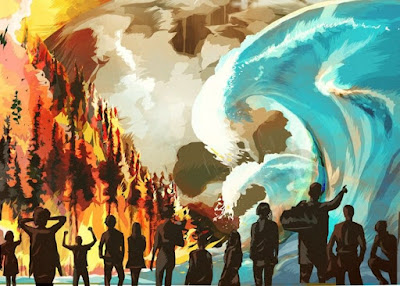
AI-generated graphic by NightCafé for The New Verse News.


The hawk

Soars high

in the sky. Humans
Soar higher,
Faster, 
Farther. 

The fish
Swims majestically 
Through the currents 
of the sea. Humans
Swim faster,
Deeper,
Farther. 

Bats,
Whales, 
Dolphins,
Rabbits,
Don’t destroy

the planet.
 
It’s getting hotter outside.

The fires rage and

There’s not enough water. 


Gil Hoy is a Best of the Net nominated Tucson, Arizona poet and writer who studied fiction and poetry at The Writers Studio in Tucson, Arizona and at Boston University. Hoy is a semi-retired trial lawyer and a former four-term elected Brookline, MA Selectman. His poetry and fiction have previously appeared in Third Wednesday, Flash Fiction Journal, Tipton Poetry Journal, Unlikely Stories Mark V, Chiron Review, The Galway Review, Right Hand Pointing, Rusty Truck, Mobius: The Journal of Social Change, The Penmen Review,  Last Stanza Poetry Journal, Bewildering Stories, Literally Stories, The New Verse News and elsewhere.

Friday, November 29, 2024

LET’S DROP THE BALM

by Melanie Choukas-Bradley


AI-generated graphic by Shutterstock for The New Verse News.


Salve for the whole planet
Nuclear, to the last atomic particle
A wind so obliterating it removes all hate
Leaving a fallout of divine love with no half-life
Across all lands, all cells, all souls
 

Melanie Choukas-Bradley is a naturalist and award-winning author of eight nature books, including Wild Walking—A Guide to Forest Bathing Through the Seasons, City of Trees, A Year in Rock Creek Park, and Finding Solace at Theodore Roosevelt Island. She has had three previous poems published in the New Verse News and many poems published by Beate Sigriddaughter’s Writing in a Woman’s Voice, including four that have won “Moon Prizes.” 

Friday, August 16, 2024

THE ASTRONAUTS SEEK TO REASSURE ME OF THEIR SAFETY

by Kathleen McIntosh


In a news conference from aboard the International Space Station, Butch Wilmore and Suni Williams said they had confidence in the troubled spacecraft to get them home. (NY Times, July 10, 2024)


I know in their place I would worry, seeing earth whole

––oceans, continents, poles––

and they themselves . . .


No, says NASA, the astronauts are not in danger, not stuck in space; they’re just doing some additional testing of the thrusters. But the questions continue, variations on a theme:  How confident are you that the Starliner will get you home safely? Butch and Suni are patient, though they have taken time out of their work for this. A reporter persists: Can you give us examples...  about the status of Starliner as far as being able to bring you back to earth safely?  Suni smiles, bats away his concern:  It’s great to be up here.  Her casual manner seems grounded in certainty; her wavy hair flies out from her head in all directions, wiry, Medusa-like––will we be turned to stone for questioning the logic of this optimism? 


I know about the vanishing rain forest,

melting ice sheets, spreading desert and yet,

how thrilling it would be to see it all as they do:

our one and only         so fragile         suspended out there... 

Horn of Africa,

Malay Archipelago,

Isthmus of Panama––delicate waist of America,

the poet called it. Hell on earth

say those crossing the Darien Gap     

from Peru, Ecuador, Venezuela, Brazil, Haiti, Ethiopia, India, China,

Democratic Republic of the Congo––

no, from up there I wouldn’t see the ant-like procession,

ragged, polyglot,

on any given day a planet worth’s sampling, citizens

of nowhere-on-earth-that-is-safe–


Yes, the astronauts confirm, they were able to watch the hurricane that became Beryl. The question gets more personal: What have you heard from your family? Was there any damage to your house?  Still smiling, they pass a mike back and forth between them or allow it to float free for a few seconds. Well, says Butch, we’ve got some downed trees like most people...  but thankfully we’ve got good church folks and good neighbors that are coming by... 

The news conference is coming to an end.  In Texas, concludes Suni, everybody pulls together. She launches herself into a weightless backward flip.


Author’s note:  NASA is now considering bringing the astronauts home on a Dragon SpaceX capsule, an option which would mean that Wilmore and Williams would need to remain on the space station for six more months. A decision about this will be needed, says NASA, by the end of August.


Kathleen McIntosh moved to New England following a peripatetic childhood.  She remained there, teaching language and literature for many years. Now retired, she lives in Connecticut where she writes poetry and serves on the Board of the Connecticut Poetry Society.

Wednesday, July 10, 2024

A NEW DAWN

by Dick Altman 


As the poet might have awakened to it…


After an historic,
all-night zoom
with world’s leadership,
she—America’s new president—
stood on California’s shore,
sun rising directly behind her,
ray’s emanating
from her silhouette,
as from the Statue
of Liberty’s crown,
to announce America’s
new proclamation
of emancipation.
 
An emancipation,
she exclaimed,
that would usher in
a new era
of global freedom,
not imposed,
but welcomed,
in every corner,
and at every level,
of humanity.
 
We need to fight,
she said,
not each other,
but for each other,
for the planet,
to sustain and nourish
each other,
for the world of work
to offer dignity
and opportunity,
for economies to thrive,
as they compete,
with best ideas,
realized at best price.
 
We need to recognize,
she went on,
to honor
our collective individuality,
our shared commonalties,
the dissonant music
that entwines,
and enriches our lives,
rather than fractures,
if we let it.
To recognize the need,
she stressed,
for borders of heritage,
rather than walls
of defense,
for borders of possibility,
rather than denial.
 
We can all wish
for a perfect world,
she said,
in that dream
we all inhabit,
each in our own measure,
loving thy neighbor,
and the flowers
always in bloom.
Yet it is imperfection
that permeates life,
and the striving
to overcome it.
In that we are all joined.
 
Let America,
once again,
by word and deed,
by shake of hand,
hug or clap on shoulder,
remind we breathe
the same breath,
share the same night,
wake to the same sun,
shining on similarity
and difference,
without exception.


Dick Altman writes in the high, thin, magical air of Santa Fe, NM, where, at 7,000 feet, reality and imagination often blur. He is published in Santa Fe Literary Review, American Journal of Poetry, riverSedge, Fredericksburg Literary Review, Foliate Oak, Blue Line, THE Magazine, Humana obscura, The Offbeat, Haunted Waters Press, Split Rock Review, The RavensPerch, Beyond Words, The New Verse News, Sky Island Journal, and others here and abroad. His work also appears in the first edition of The New Mexico Anthology of Poetry, published by the New Mexico Museum Press. Pushcart Prize nominee and poetry winner of Santa Fe New Mexican’s annual literary competition, he has authored some 250 poems, published on four continents.

Wednesday, June 19, 2024

BLOOD ISLAND

by Sheikha A.


Mohammed Hajjar/Associated Press


''The [US-sponsored proposal for a] ceasefire would evolve into a permanent end to hostilities and the release of all hostages in a second phase. A final stage would see the launch of a major reconstruction effort.'' —The Guardian, June 12, 2024


This planet will become a museum;
the future nodes of our past karma
will live in corridors without walls, 
where displayed in liquid sunsets 
will be an imagined version of blood 
because it will no longer exist: extinct 
artefact impossible to save for relic. 
Humans will be dissolved vapour 
from a combustion that was meant 
to enforce power; and, neutralists 
chose to write words to write-off
histories. Our veins will be draped
like decorative tinsel over our future. 
The dominant climate being eternal 
outrage, and no one to alter the code 
to turn back time to halt the rockets 
in the skies. Ahlan wa Sahlan, we 
greeted ourselves into their homes, 
and then eviscerated. Ma’afi mushkela
we will now help rebuild it from scratch.


Sheikha A. is from Pakistan and United Arab Emirates. Her work appears in a variety of literary venues, both print and online, including several anthologies by different presses. Her poetry has been translated into Spanish, Vietnamese, Greek, Arabic, Polish, Italian, Albanian and Persian.

Wednesday, May 31, 2023

LETZTE GENERATION

by David Chorlton


A scream circumnavigates the world.

Is anybody listening


when the police arrive to sweep away

those for whom the last resort

is blocking traffic


to impress upon their fellow citizens

the planet is on life support

and the drivers only have a mile to go


before the ground opens up

and swallows them.


Does anybody care?


Call it Freedom; say Democracy

until it hurts; write to the highest authority

and the mail comes back 

as undeliverable.  

The future’s not the future


anymore. And yet it is still beautiful

when a day begins with a mountain

spreading its wings


and the sun breaking into song.


David Chorlton lives in Phoenix where he writes and occasionally paints watercolors. While his writing is usually poetry, his newest book is a true life account of a murder story from 1960s Vienna (where he lived for several years) in which one of his cousins was wrongly convicted: The Long White Glove published by New Meridian Arts.


Editor’s Note: Listen to David talk about his new book on the Word podcast (about 10 minutes in) from WJZZ.

Thursday, May 11, 2023

ONE BIG GULP

by Barbara Simmons


Watching it disappear, 
this planet gobbled up
by something so much smaller,
the very star it circled swallowed it,
reminds me of that ancient feeling, 
vanishing into another,
brought into being by my insecurity,
my inability to feel complete unless
submerged, immersed, subsumed
into another’s orbit.
 
Those days are gone, my learning
not to be absorbed so fully that
I’d lose myself in someone else’s space.
It’s taken time, not fifteen thousand years
astronomers are saying it took 
the star to nibble up its planet, though
decades in my earthly life I often 
count as infinite.
 
What I have learned the planets must:
circle stars more safely, 
spend time while wheeling 
looking back and in,
insuring you understand
both apogee and perigee, 
assuring you’ll be fine
both with, without, and by yourself.
 
Nothing’s as dark as orbiting gone awry,
nothing as lonely as losing who and where you are.


Barbara Simmons grew up in Boston, resides in California—both coasts inform her poetry. A graduate of Wellesley College, she received an MA in The Writing Seminars from Johns Hopkins, and an MA in Education and Counseling from Santa Clara University. A retired educator, she continues to savor life and language, exploring words as ways to remember, envision, celebrate, mourn, and try to understand. Publications have included Boston Accent, The NewVerse News, Topical Poetry, DoubleSpeak, Soul-Lit, 300 Days of Sun, Capsule Stories – Summer Edition, Swimming, Journal of  Expressive Writing,  and her recently published book Offertories: Exclamations and Disequilibriums from Friesen Press.

Saturday, August 20, 2022

THE HOLLER

by Tricia Knoll


The flood of July 28, 2022 was not a natural disaster. To imply this flood, along with so many other weather-borne catastrophes plaguing our world, is a natural disaster is to say three things: We don’t know why it happened, we don’t know how it happened and we don’t know how to prevent the next one. But we do know the answers to these questions. We’ve known them for some time. A combination of unfettered capitalism, environmental degradation through extraction economies and government indifference or plain inaction have borne a land in these hills ripe for weather related disasters and left behind communities with little to no defenses against them. Charles Calhoun, Courier Journal, August 16, 2022


Since 1958, the amount of precipitation during heavy rainstorms has increased by 27 percent in the Southeast, and the trend toward increasingly heavy rainstorms is likely to continue. – What Climate Change Means for Kentucky, EPA, August 2016


When you have always lived in the holler
and the mortgage come due or the river
trickles your worries downstream, you accept
barking dogs, loose chickens in the road
and rusted trucks in the side yard. Kittens
thrive for a while. You know the business
and love affairs of neighbors and grandmothers.
Who has work and who doesn’t. 
Children know barefoot, few strangers,
and security in familiar. Ponies
run lean and the women leaner, 
mountains tall and a gravel lane narrow
—funnels for floodwater.  
 
You could say the name came from hollows
but you don’t. You honor salty talk while
a warming planet has its say with
record rains few had time to measure.
 
Refrigerators float and homes sweep down
to wrap around trees. You can scrabble
up a hillside, but like so many places
what grandparents built is gone. 
The holler has only one way out
 
and yours will never be the same. 


Tricia Knoll does not live in a holler but knows that everywhere is vulnerable to climate change.

Monday, June 20, 2022

SEQUEL

by Susan Barry-Schulz


we’ve started
already
 
marring Mars
with our glittering
litter
 
dotted earth debris
in the form
of blended aluminized
specialty fabrics
 
first wind-blown
across a dusty landscape
 
now lodged
in the rugged rocks
of an ancient river delta
on another planet
 
how capable
how culpable


Susan Barry-Schulz grew up just outside of Buffalo, New York. She is a licensed physical therapist living with chronic illness and an advocate for mental health and reducing stigma in IBD. Her work has appeared in The New Verse News, SWWIM, Barrelhouse online, Nightingale & Sparrow, Shooter Literary Magazine, Kissing Dynamite, The Wild Word, Bending Genres, Feral, Quartet, Wordgathering, Gyroscope Review, Harpy Hybrid Review, West Trestle Review, and elsewhere.

Wednesday, January 05, 2022

OH, MALCONTENT CHANGING CLIMATE

by Earl J. Wilcox


All the great ones say something about it.
Poets speak of climate because it’s nearby
While they write or sleep or laugh, weep.
Snow, rain, sunshine, hail—even blustery
Tornadoes may flourish in dramatic lines.
In thrall of climate change—like poems—
our weather evolves not just by seasons
but by an hour or day, from lovely, cum
placid, toward splendid feverish havoc.
Myopic romantic writers—like climate
Naysayers-- still focus on sunshine
And blue skies, cloudless balmy days,
Like times we cherish in spring or summer.
It seems fair and realistic to believe
our climate hunches, predictions, history,
great climate-driven works of art and literature
will forever evolve as human cycles change
perhaps subdue even poets, the last and most
Changeless chroniclers of life on this planet
Await nature’s next course, whither we go.


Earl Wilcox awaits nature's next course in South Carolina. 

Sunday, October 03, 2021

THE USHERS OF AID

a villanelle by Jeannie E. Roberts


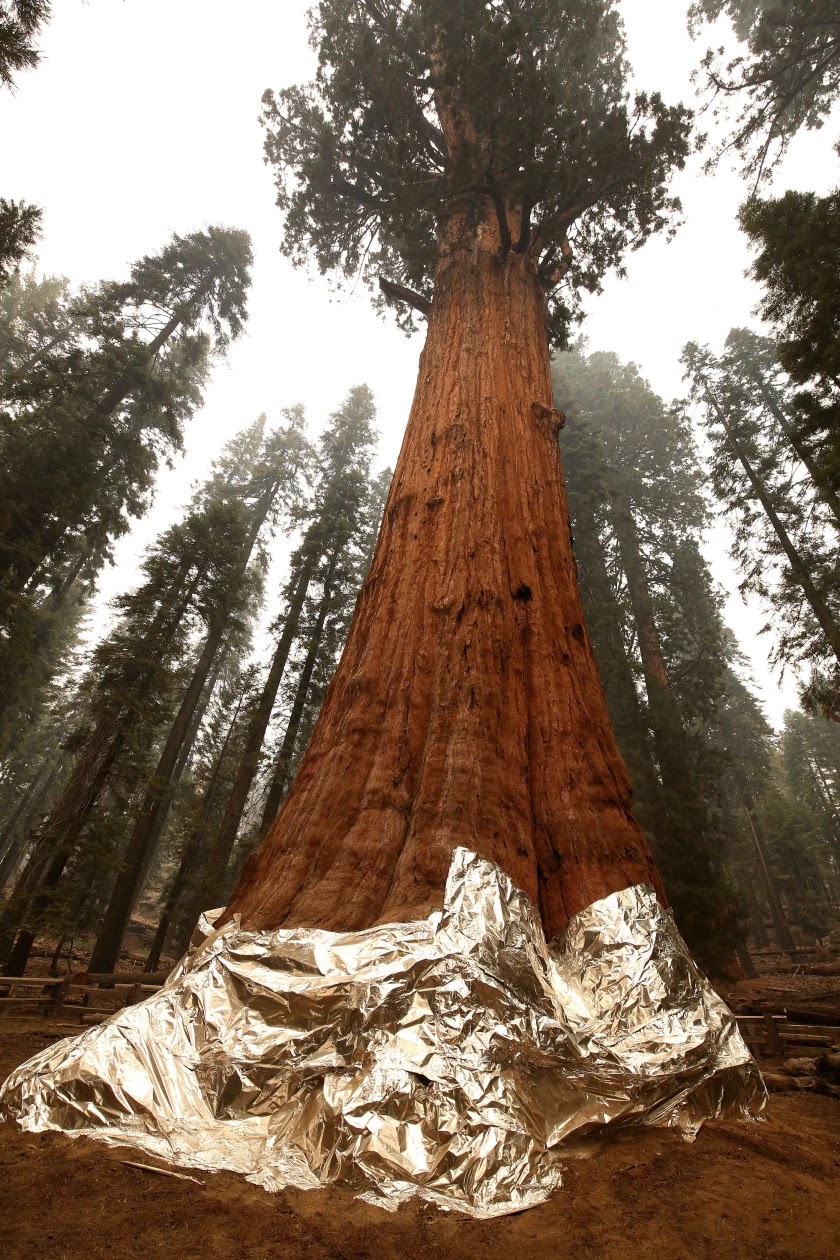
“Giant sequoias are hardy souls. They have stood their ground in California for as long as thousands of years, surviving drought, earthquakes and wildfire. With their thick bark and seemingly sky-high crowns, they have generally defied any fire that would turn them into kindling—and even thrived after a burn. The heat causes the trees’ pine cones to burst open and release seeds to the ground. But as hotter blazes like the KNP Complex fire—ignited by lightning on Sept. 9 and still uncontained—headed into the Sequoia and Kings Canyon National Parks in the Sierra Nevada, the trees needed some extra help. And they got it in the form of aluminum foil. Now, the largest tree, by volume, in the world is cradled in shiny, silvery wrap.” Carla Hall, Los Angeles Times, September 26, 2021. Photo: The historic General Sherman tree is wrapped in protective aluminum foil at Sequoia National Park in California. (Gary Kazanjian / AFP via Getty Images via Los Angeles Times)


The world is on fire, flames fill our home. 
The Earth’s rising heat ignites global burn. 
The ushers of aid fall to humans alone.

The forest floors smolder as embers roam. 
Infernos scorch fauna, flora, and fern. 
The world is on fire, flames fill our home.

Some trees are stalwart, persist as if stone—
most render ash, where Earth serves as urn. 
The ushers of aid fall to humans alone.

Encircled in tin, from large base to loam, 
General Sherman stood strong, ever firm.
The world is on fire, flames fill our home.

The famous sequoia thrived, held its own—
it beat the fierce grind, conquered the quern. 
The ushers of aid fall to humans alone.

Envision our planet polished like chrome, 
where vigor exists with each gleaming turn. 
The world is on fire, flames fill our home. 
The ushers of aid fall to humans alone.


Jeannie E. Roberts has authored five poetry collections and two illustrated children's books. Her work appears in Sky Island Journal, The New Verse News, Verse-Virtual, and elsewhere. Her newest collection, As If Labyrinth—Pandemic Inspired Poems, was released by Kelsay Books in April of 2021. She is a Best of the Net award nominee.

Wednesday, March 17, 2021

DAYLIGHT SAVING TIME

by Frances Davis


What does it matter?

When lighted days 

are shingled with dread

and hullabaloos have shifted

to groans and smirks?


We could capture it in a teacup

time’s familiar wastage, not of the essence.

Our measurements, dots on a dial

foolish in the planetary run.

Who will count the hours

When the sea rises to cover all?


Frances Davis is a journalist living in California where sea level rise is eating away at cliffs and buttresses hauled in to stop its encroachment. Harsh realities in hard times and we're wasting time with our clocks? Her essays, poetry and short stories have been published in The New Verse News and numerous journals and anthologies. See her latest short story in the enviro journal The Hopper.

Thursday, November 05, 2020

WHY BLUE

by Catherine Gonick

“Animated Water” by Dragonlord-Daegen at DeviantArt

of all the light sent by the sun, blue scatters the most in all directions

to be seen by everyone 


it fills our sky and waters, most of our planet when seen from space,

yet in the rest of nature blue is rare,  


hard to find in minerals and plants, or food, except in blueberries 

and cheese, and difficult to make, ask any chemist


O blue of lapis lazuli, sleep and twilight, moon and Monday, ribbon

and blood, of medieval cathedral windows, glaciers, and forget-me-nots


O blue warm and cool, in hues of indigo, ultramarine and aquamarine,

turquoise and teal


blue that lowers our pulse rate, warns of poisons, protects against

the evil eye when used in pendants, painted on doors and houses


there is a blue of stability and distance, of peace and sadness, 

eyes of people who survived ice


a blue of harmony, seen in the flag of the United Nations,

a blue of storms, in uniforms for soldiers and police


but for the most part blue is everywhere we’re not—and invites

us to join it


of all the light that reaches Earth, blue is the sun’s favorite 


Catherine Gonick's poetry has appeared in literary magazines including Notre Dame Review, Beltway Poetry Quarterly, and Sukoon, and in anthologies including in plein air and GrabbedShe works in a company that mitigates the effects of climate change.

Thursday, October 29, 2020

WAITING FOR THE ELECTION TO BE OVER WITH

by Penelope Scambly Schott


“Frost on the grass,” photograph by Vladimir Axenov.


The man is asleep,
his arm flung back
toward the headboard of their bed.
He snores lightly.
The dog curls warm and small
at the foot of the quilt.
The dog’s ribs move up
and down under fur.
The woman is awake.
She slips out
from under the quilt
and walks to the window.
She pushes back
the white curtain.
Orion is rising over the shed,
his sword tickling
the top branches
of the neighbor’s cottonwood.
The man is still sleeping.
The woman stands at the window.
She knows Mars has moved west
past where she can see it
from this side of the house.
Winter is approaching.
The man’s hair gleams white
in starlight.
The dog’s fur gleams white.
Frost glazes the lawn.
The woman is ready
to step through the glass
in her long white nightgown.
She would lie on her back
in the white frost,
lie there a long time
under stars,
the flesh of her shoulders,
her buttocks,
the heels of her bare feet
feeling the spin of her planet.


Penelope Scambly Schott is a past recipient of the Oregon Book Award for Poetry. Her newest book is On Dufur Hill, poems about the cycle of the year in a small wheat-growing town.