Guidelines


Submission Guidelines: Send 1-3 unpublished poems in the body of an email (NO ATTACHMENTS) to nvneditor[at]gmail.com. No simultaneous submissions. Use "Verse News Submission" as the subject line. Send a brief bio. No payment. Authors retain all rights after 1st-time appearance here. Scroll down the right sidebar for the fine print.
Showing posts with label babies. Show all posts

Wednesday, March 11, 2026

TO TELL YOU THE TRUTH, I’M NOT SO SURE ABOUT THE VENT

by Eric Oak


A government handout photograph showed weapon remnants displayed on a table near the ruins of the Shajarah Tayyebeh elementary school, where a precision strike reportedly killed 175 people, mostly children, on Feb. 28. The remnants have been identified by The Times as components of a modern, U.S.-made Tomahawk missile. Credit...IRIB, via Telegram


It was not the Israelis, after all,

who triple tapped the school in Minab.

It was US, according to the Times

our bombs 


that blasted babies into doll parts, 

scattered them among the concrete-

silica dust of their classrooms.


But it was always our bombs, really–

Arab Salim and Jabalia, Biden’s

red line to Rafah. Bombs with

our names on them. Cruz and 


Haley chickenhawked in Sharpie, 

mine and yours scratched san-serif 

onto the shells in bolder relief with 

each paycheck deposited.


I read the article about Minab 

during my planning period, and

it lingers with me now around


this crater-quiet classroom.

The kids are taking a test, but I 

don’t care whether they pass it. 


I just want to talk to them.

I just want to believe that it's 

not too late to talk, that it’s 

not too late to believe.


Something about the way the 

big vent grumbles when 

the air kicks on reminds me:

the surprise lockdown drill


has to be this week or next. 

They’re quiet, like now,

the drills at least. 

The kids are used to them.


Winder and Uvalde, Gaza and Minab.

Maybe bullets stop when bombs do.


I remember now why that vent rattles—  

I took out most the screws that hold

it to the wall, and a few more outside. 

The maintenance guy showed me how


to kick and climb our way out there

in case we ever need to flee, to run

outside, unafraid as we are of a 

brush smoke sky.


Eric Oak is the pseudonym of a teacher of social studies at a middle school near Chattanooga, TN. He sometimes asks people to read the things he writes so that they may exist.

Saturday, February 28, 2026

IN THE MARKET


by Angie Minkin


Here we are again, 

an unseasonably warm day at the end of February

and San Francisco’s Alemany Farmer’s Market

bursts with early blueberries and babies, 

the first pink tulips and yellow ranunculus. 

A three-year-old in ruffles, her white dress tied

with a sash, smiles as she pushes her brother

in his stroller, her mama close by in case of trouble. 

I imagine markets in Iran, babies and strollers, 

mamas in hijabs buying dates and radishes. 

Little girls playing with their brothers. 

I imagine bombs and blood.

These babies.

This market. 

Here we are again.


A poetry reader for The MacGuffin, Angie Minkin stands on her head for inspiration. Her poems are widely published and she is honored to be named the 2025 Passager Poet. Her chapbook, Balm for the Living, was published in 2023.  She is a co-author of Season Lightly with Salt.


Sunday, June 30, 2024

ON THE DEBATE STAGE

by Anna Evans


via The Washington Post


He states (quite earnestly, for what it’s worth)
that Dems want babies murdered after birth.

The question on the Capitol disorder
he answers, “On Jan 6 we’d a great border.”

Opioid crisis? Claims the demagogue,
“We solved it when we purchased the best dog”

then boasts, although the stakes are very high,
about how far he makes a golf ball fly

and adds another lie that’s as bizarre:
no European drives an American car.

Yet somehow, all we’re saying the next day
is that the other guy is not okay.


Anna M. Evans is the lone Democrat on her five person Township Council. Her poems are widely published and she teaches poetry at West Windsor Art Center and English at Rowan College at Burlington County. Her new collection States of Grace is forthcoming from Able Muse Press in the fall of 2024.

Wednesday, December 20, 2023

LET THEM DRINK WATER!

by Amy Wolf


Last Thursday [December 14], on the eighth night of Hanukkah, JVP members shut down eight bridges and highways in eight cities across the U.S. to demand an end to the genocide of Palestinians. Thousands of Jews and allies protested in Philadelphia, Washington, D.C., Atlanta, Chicago, Minneapolis, Seattle, Portland, Los Angeles, and San Diego — eight cities symbolizing the eight candles lit on the final night of Hanukkah, plus the shamash, or “helper” candle. JVP members blocked traffic for hours, singing, chanting, carrying giant menorahs, and holding signs reading “Jews says ceasefire now” and “Let Gaza live.” Hundreds were arrested. —Jewish Voice For Peace


Let them drink water!
As you protest, and shut down bridges
As you congratulate each other on your solidarity 
And stop traffic
They are dying of thirst, and of dysentery,
And a dozen water-borne diseases.
The bombs are killing far fewer
Than thirst, hunger, bacteria.
Don’t look away.

Rather than chanting prayers 
With our street-borne menorahs,
Rather than snarling the evening commute,
Should we not be commandeering boats,
And airplanes 
And jeeps
And our cousins and relatives in the Knesset, 
In the State Department,
To bring water to the Gazans?

To give a cup of life to those who thirst,
The babies, the children, the adults alike?
And now food.
Do you know that over a million are starving?
That none know where their next meal is coming from?
In these circumstances, it is little more than a week 
Before that next bomb will not matter.

I am tired of marching.
I do not believe the merchants of Pike Place Market 
Control the foreign policy here
Let alone the War Cabinet of Eretz Yisrael.
Principled Jews the world over have prayed and demonstrated,
Occupied, chanted and sung.
Not a morsel of food have we been able to bring over that border,
Not a cup of water.

"Nation shall not lift sword against nation;
Neither shall they study war anymore" 
Gave me such hope, in the beginning, as my relatives sang it
In Grand Central Station, in Capitol Buildings, in the street, in Hebrew.
It's an important prayer, straight out of liturgy, out of Torah.
I grew up singing it.
Surely this would work!
Surely when the President and the Congress saw
That Jews ourselves condemned this indiscriminate massacre,
They would prevail on Israel to stop.

Catch the murderers, catch the rapists, execute them,
But leave the population alone.
Their answer, an unqualified, inelegant, "We can't."
Mixed in with a mind-bending, gas-lighting, "We are!"
Pretending to be cautious of non-combatant deaths
While leveling whole city blocks on top of the heads of babes,
In full view of the whole world.

Those blinded by the narrative say, "But the images coming out of Gaza
Are only what Hamas wants you to see. I don't believe them."
True, to the extent that the images don't show us weapons amassed in tunnels,
Soldiers in uniform plotting their next strike, or hoarding supplies,
Untrue in that those buildings are truly flattened, those babies dead,
Filmed by iPhone and uploaded by stunned and defeated citizens. 

I am tired of marching.
Where are the convoys of boats full of Americans,
Heading to the Gaza coast with water and food?
Where are the airdrops of sustenance from private planes,
Where are the means by which we might feed the starving?
In Sudan as well, in Syria, in other lesser-known conflicts,
I look at us out in the street, closing bridges and highways,
And see a feel-good exercise.

Show me one person who has changed their mind on the urgency
Or right of an issue, because they were stuck in traffic one extra hour,
While their little ones and spouse waited at home.
I'll show you two who were run over while protesting,
One dead in her twenties, the other badly hurt.

Sign me up for the convoy, the jeeps, boats, and planes
Flying an American flag, daring the Israeli army to stop us
From bringing food and water.
Oh wait. Rachel Corrie.
This experiment has been run before.
They would not hesitate to fire on us either.
They rolled a bulldozer over her young body
As she stood between it and a Palestinian house
They were intent on demolishing.

24 years old, from Olympia, Washington.
Dead in 2003.
This is why we close bridges and march against our own merchants.
Israel is too deadly a place to demonstrate.


Amy Wolf is an LMT and energy worker who resides in Seattle, WA, and is studying writing.

Tuesday, June 06, 2023

THE WIND SWEPT AWAY

by Jan Zlotnik Schmidt

After viewing photographs of destroyed towns in the Ukraine


The wind swept away 

father’s humming 

mother’s crooning 

her cleared throat  soft lullabies 

her rosaries and prayers. 


The wind swept away 

babies’ babbling 

children’s puzzled cries 

scalded and scarred hopes 

wheat fields turned to blackened earth.    


The wind swept away 

unfinished stories 

hushed words   secrets 

that once wormed their way 

into corners of rooms. 


The wind swept away 

mud planked floors  foundations 

cracked plaster walls  

shattered window panes 

bombs exploding like falling comets 


In a fierce whirl of fire and ash   

the wind swept away    

histories, memories, time 

present or to be known     unfettered dreams      

Only voices of survivors remain  

asking in garbled tongues:    


What is the difference between 

dying and living?  Where do our shadows take us? 


Editor’s Note: This poem arrived at The New Verse News just as we heard news of the dangerous breaching of the dam near Kherson. Although the poem’s central image is wind, it might just as well, we fear, be water.


Jan Zlotnik Schmidt  is SUNY Distinguished Teaching Professor Emerita at SUNY New Paltz where she taught creative writing, memoir, creative nonfiction courses as well as American Literature, Women’s Literature, the Literature of Witnessing, and Holocaust Literature. Her poetry has been published in over one hundred journals including The Cream City Review, Kansas Quarterly, The Alaska Quarterly Review,  Phoebe, The Chiron Review, Memoir(and), The Vassar Review, The Westchester Review, and Wind. Her work has been nominated for the Pushcart Prize. She had two volumes of poetry published by the Edwin Mellen Press (We Speak in Tongues, 1991; She had this memory, 2000). Her chapbook The Earth Was Still was published by Finishing Line Press and another, Hieroglyphs of Father-Daughter Time,  by Word Temple Press. Her volume of poetry, Foraging for Light,  was published by Finishing Line Press in 2019.

Wednesday, March 08, 2023

WHEN MY GRANDSON LEARNS ABOUT JIMMY CARTER

by Jane Patten


But for a photo

Neither of you will remember

That day in front of Maranatha Baptist Church—

He, because he had held so many babies,

And you were one of many in 

Such a long and layered life. 

And you, because you were so new

That your life was in the moment.

But we others there rejoiced

How he reached out to hold you,

The aged hands against your soft ones,

His white hair in contrast to your brown,

His wide smile at your

Wide eyes.


You did not know then

How we traveled down the Georgia roads

Of open fields and flatter ground

Just to hear him teach 

And to shake his hand,

Or that that this elder holding you

Had made each numbered day

In a long life count—

Sage, peacemaker, 

Man of the earth,

Man of the people,

Who rolled up his sleeves

To work.


A little later, just a little later,

You will learn more about the man who

Showed the world how to live:

Use knowledge.

Have compassion.

Give.

Be present.

Be fair.

Have courage.

Care.


And with a photo we will begin:

There you are.

You’re with him.


After retiring and moving to Huntsville, Jane Patten decided to write about her adventures, including growing up in Delaware and her career as a teacher in rural Georgia. Her writings have been published in Out Loud HSV: A Year in Review anthologies, The New Verse News, and Reckon.

Tuesday, March 08, 2022

INTERNATIONAL WOMEN'S DAY
8 MARCH 2022

by Mary K O'Melveny


Today, please celebrate all
the women we have lost.
In every war and cease fire.
On slaver’s ships. On thirsty
desert treks to walled borders.
In back-alley rooms without
anesthesia. Locked in basements,
without papers or escape routes.
Asleep in bed. Hitching a ride.
Nursing bruises or starving babies.
 
Our losses rise like mountain peaks.
Ukrainian women huddle in subways,
clutch children, family pets, a few
hastily gathered objects from lives
they will likely never know again
or tattered photographs of loved ones
they may never see again. Even in
safer worlds, friends die of causes
that repurposed money, refocused
attention could have remedied.
 
Some fade away from neglect,
inattention, dreams downsized
by school guidance counselors,
religious zealots, patriarchy.
Others drop dead without a whimper
on a sun-dappled afternoon. One friend’s
memories vanished by midnight
stroke; another’s by subtle daily
erasures. Open our mouths wide in
praise of all. Let songbirds loose.


Mary K O'Melveny is a recently retired labor rights attorney who lives in Washington DC and Woodstock NY.  Her work has appeared in various print and on-line journals. Her most recent poetry collection is Dispatches From the Memory Care Museum, just out from Kelsay Books. Her first poetry chapbook A Woman of a Certain Age is available from Finishing Line Press. Mary’s poetry collection Merging Star Hypotheses was published by Finishing Line Press in January, 2020.

Tuesday, March 01, 2022

FOUND POEM OF WAR

by Ellen Austin-Li


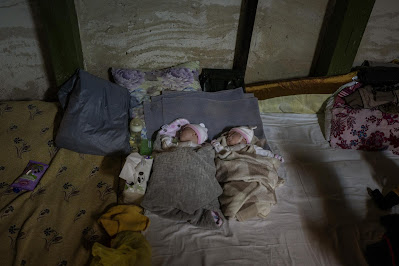
Newborn twin brothers sleep in a basement used as a bomb shelter at the Okhmadet children's hospital in central Kyiv, Ukraine, Monday, Feb. 28, 2022. (AP Photo/Emilio Morenatti)


A line from Yeats’ poem that reverberates
like a bass chord that becomes a strum,
combined with an image of babies 
kept alive in a bomb shelter, underground,
each breath bagged by ambu into tiny lungs.
This hum an undercurrent—under, under, under
my thumb. This rough beast lumbering, a ton,
a hundred years running, but truly thousands before, 
more’s the sum of history in a new poem—not new, 
but old. What crumbling humans, such endless war.
My hands weary as if I’m delivering each breath.
I know what this means—we cannot take a rest
or the children expire. I tire, but the poem is found.
The cannon, the fodder: explosions of sound. 


Ellen Austin-Li’s work has appeared in Artemis, Thimble Literary Magazine, The Maine Review, Pine Mountain Sand & Gravel, Rust + Moth, and other places. Her two chapbooks were published by Finishing Line Press—Firefly (2019) and Lockdown: Scenes From Early in the Pandemic (2021). She is a Best of the Net nominee. A recipient of the Martin B. Bernstein Fellowship, she earned an MFA in Poetry at the Solstice Low-Residency Program. Ellen lives with her husband in a newly empty nest in Cincinnati, Ohio.

Thursday, January 20, 2022

WOMEN OF GHŌR

by Steven Croft


In twilight we stare into our deaths
like we are the coming darkness

Our harrowed babies cry
but we dare not sing to them

The flour is gone in days
even tea is scarce

Our colorful dresses long hidden
or already burned for warmth

A bird calls a melody from a snowy tree
like joy trapped by the coming darkness

Warlords with stern faces walk the streets
with whips, rifles,

Whip-march a head-bent man with hands
bound behind by thick layers of rope

They tell us we have now what the hands
of the people have earned

And there is nowhere else to go, just
a cold valley, hill passes snowed for winter

If allowed to sing, we would moan a dirge
now even the night-bird is quiet

Nowhere is even a seed of relief
markets, kiosks, shops, silent and empty

They say our sins haunt us now—
girls wanting work and education

In the cold schools boys recite the Quran
Ameen

But how many times, O Knower of the Unseen,
until all our sins are erased

In our dreams of spring we see green trees
goat's milk and markets full of vegetables

In our dreams of spring we dance and sing
in our colorful dresses


Steven Croft lives on a barrier island off the coast of Georgia. He is the author of New World Poems (Alien Buddha Press, 2020).  His poems have appeared in Willawaw Journal, San Pedro River Review, The New Verse News, North of Oxford, Anti-Heroin Chic, Soul-Lit, and other places, and have been nominated for the Pushcart Prize and Best of the Net.

Saturday, July 06, 2019

HUNGRY, SCARED, AND SICK

an erasure poem by James Penha
from "Inside the Migrant Detention Center in Clint, Texas," 
The New York Times, July 6, 2019


Clint is known for holding what agents call U.A.C.’s, or unaccompanied alien children—children who cross the border alone or with relatives who are not their parents. Ilana Panich-Linsman for The New York Times


the stuff of nightmares
scabies
shingles
chickenpox
stench
orders to take beds away
from children to make more space
"unaccompanied alien children"
as young as 3
as young as 5 months old
lacking diapers
toothbrushes
toothpaste
soap
children crammed into
a prison environment
My God, these are babies
They are keeping babies here


James Penha edits TheNewVerse.News.

Monday, November 23, 2015

VETTING THE REFUGEES

by Amit Majmudar


Image source: CBC Radio


Under the vest, something was ticking.
It ticked, ticked, ticked. A heart?
The faces all were human faces,
Salt-stained from the trail of tears
And the sea spray of their middle passage.
Their God was not our God,
But their children were our children
Discovered face down on the strand.
Treasures, buried in the sand.
In their passports we saw the faces
We recognized, or thought we did,
From last night’s news. The same? A match?
Anger, anguish, both unshaven
And praying in the same direction
To God, their God, the same, a match.
And there were babies, yes, and widows,
And gray professors speaking English—
No tests for mercy. No, the test
Was the twenty-year-old man whose face
We recognized, or thought we did;
Whose passport might encode an omen
Like scripture, entrails, curling smoke.
And so, interrogating those
Who came to us for mercy, we
Interrogated mercy in a chair:
Can hatred hide in suffering?
Can wisdom hide in fear?
And so the line became a lineup
Eyed through a two-way mirror.


Amit Majmudar is a widely published poet, novelist, and essayist. His next book of poetry, Dothead, is forthcoming from Alfred A. Knopf in March 2016.

Saturday, January 18, 2014

SPENT

by Winston H. Plowes


An omen lost at birth.
This island on the edge of light and secrets.
This stretch of sound
less-visited, still and unclaimed.

A hart guarded
like a freshly cut trench
surrounded by layers of love.

Something in the tiny pine coffins
sounds like summer had stopped beating.

Lifeless in part,
afraid of burying the detail.


Author’s Notes: This is a transcription of a found poem in the erasure style where all the above words appear in an article in The Times (of London) on 17th January 17,  2014 "New Yorkers demand access to mass graves on convict island". Original article by Will Pavia addresses the concern over access rights to bodies of young children buried by convicts on Hart Island.

Editor’s Note: More information at The Hart Island Project.


Winston H.Plowes writes his words on a narrowboat on England’s inland waterways. His compositions have been widely published, hopefully making people pause and ponder the magical details of life.