Guidelines


Submission Guidelines: Send 1-3 unpublished poems in the body of an email (NO ATTACHMENTS) to nvneditor[at]gmail.com. No simultaneous submissions. Use "Verse News Submission" as the subject line. Send a brief bio. No payment. Authors retain all rights after 1st-time appearance here. Scroll down the right sidebar for the fine print.
Showing posts with label Syria. Show all posts

Thursday, December 26, 2024

A LESSON FROM SYRIA

by Indran Amirthanayagam


AI-generated graphic by NightCafé for The New Verse News.


At some point on the road you understand
that nothing can stop you from walking ahead,
from drinking the sap of each tree, feeding
the animals and birds, loving each and every 
companion on the planet, even if some want 

to skin, burn and rape you, this is not 
their fault, the murderous rage has a cause, 
a root, and you must do what you can to plug 
the bottle from which the malicious genies
are flying out. So go ahead, vote, write

to the paper, get the school board to listen,
be active, react, take the punch and remain
standing. This may be easy to say but it is
the only way to reply to the tyrant who
will become a bully and then a coward

and will leave by the cover of darkness.
It took twenty four years for Assad, but 
those years are gone and now the chance 
to rebuild. Take it. Look ahead. You are 
alive still and able to teach, to write, to make.


Indran Amirthanayagam has just published Seer (Hanging Loose Press) and The Runner's Almanac (Spuyten Duyvil). El bosque de deleites fratricidas is forthcoming from RIL Editores. He is the translator of Origami: Selected Poems of Manuel Ulacia (Dialogos Books). Mad Hat Press published his love song to Haiti: Powèt Nan Pò A (Poet of the Port). Ten Thousand Steps Against the Tyrant (BroadstoneBooks) is a collection of Indran's poems. He edits The Beltway Poetry Quarterly and helps curate Ablucionistas. He hosts the Poetry Channel on YouTube and publishes poetry books with Sara Cahill Marron at Beltway Editions.

BASHAR’S BOUDOIR

by Salma Amrou


Physicists are born when bombs fall 

on heads like apples. According to the law of inertia,

once a dictator falls he never stops falling

flat on his face in Homs and Aleppo and Damascus

and Deraa, on graffitied walls invoking broken Hippocratic oaths

and stripped bare down to his underwear in a leaked

boudoir shoot and photos by the pool, 

skin draped taut across collar bones like tent poles,

albums showing all the skin where the sun never shone:

girls raped and children raised in prison cells

and corpses crushed between metal, dead rose

pressed between the pages of a ledger, each pose

for the camera a little sassier than the other. In the second law

of motion, the greater the suffering, the greater

the force needed to suppress it. Sednaya’s red wing walls 

varnished in the most sensual shade of blood

a shrine where the mouths of praying prisoners

are forced to swallow his name in place of God’s. Starving 

for some form of salvation, a country cannibalizes itself,

a dietary regimen to sate the appetite of the regime: detainees

swallowed and digested in the guts beneath ground.

In the third law of motion, revolt is regurgitation, 

bowels of bloodlust rising in an upchuck reflex, 

streaked across his tongue like the sweet nothings 

and the blush in his wedding pictures, too shy to look his bride 

or his people in the eye, fleeing from the gravity of his vows,

from the fact that he’s been falling 

and falling–


One of the photos of Bashar Assad discovered by rebels and posted on social media.


Editor's note: You can help the White Helmets rebuild lives and hope in Syria.


Salma Amrou is a former Youth Poet Laureate of Southeastern Virginia and an undergraduate student at the College of William & Mary. An Egyptian-American poet and aspiring novelist, her work explores themes of identity, belonging, and the experiences of the Arab and Muslim diaspora. Her work will be featured in the forthcoming issue of Zhagaram Literary.

Wednesday, February 14, 2024

BOTH SIDES NOW, or THE THREE D’S

by Maria Lisella


Smoke rises following an Israeli bombardment in the Gaza Strip, as seen from southern Israel, on Dec. 16, 2023. (AP via Arab News)


"The plumes of smoke from tanks, artillery and the planes of the air force will continue to cover the sky over the Gaza Strip until we will achieve our goals," Defense Minister Yoav Gallant said. —NPR, January 21, 2024


Destruction, displacement, death;

the toll soars past 28,000 on one side
1,400 on the other; hostages by the
hundreds spark nonstop defiant
 
statements from the father whose
tech savvy son posts incendiary
messages from the warm rays
of the Florida sun. Like father, like son,
 
they ignite destruction, displacement, death.
Brethren in Lebanon, Syria, Iraq, Yemen
rise to actions of the heart mind: force
meeting force, clamoring to save and
 
sacrifice sons, daughters. More destruction,
displacement, death. Deaf to calls for a ceasefire
postwar plans promising a two-state solution,
they focus only on Israel’s future credit rating.  
 
Standing Together, Jews and Palestinians post:
“We are aching, all of us… It seems we are
not allowed to hurt for both.”
Now is the moment, “to hurt for both.”


Maria Lisella is the sixth Queens Poet Laureate and an American Academy Fellow; her work includes Thieves in the Family (NYQ Books), Amore on Hope Street (Finishing Line Press) and Two Naked Feet (Poets Wear Prada). She is a member of the Thursday Morning Poets, Brevitas and co-curates the Italian American Writers Assoc. literary readings.

Wednesday, February 07, 2024

OUR ENEMIES SUTRA

by Laurence Musgrove


AI generated graphic from Shutterstock


This evening, the Buddha and I 
sat and scrolled through our phones
before retiring for the night.

I read to him about the latest
retaliation strikes in Syria and Iraq,
and he read to me about our deportation
flights of refugees deep into Mexico
designed to discourage their return
and the hopes of those now streaming
to our razor-wired border.

“It was Thich Nhat Hanh,” he said,
“who wrote our enemies are not people,
but our ideologies, fears, and attachments
to views that justify our ignorance
of cause and effect with absolutely
no guarantee of freedom or peace.

The fires we spread always burn us, too.”


Laurence Musgrove is the author of three poetry collections Local Bird, The Bluebonnet Sutras, and A Stranger's Heart. He teaches creative writing and literature from a Buddhist perspective at Angelo State University in West Texas.

Saturday, February 11, 2023

HELPLESS

by Anne Harding Woodworth


Support the rescue efforts of the White Helmets.


     a prayer of sorts, Tuesday, February 7, 2023, 4:30 a.m.


In the quiet of this early morning, he’s left our bed
and walked into the hall, then to the kitchen
 
probably to get a “swig of klim,” as he calls it.
I move my foot over to his side just to feel the warmth

he’s left behind. At that moment, I know how survivors
in Turkey and Syria are shivering, reaching for warmth

where there is none, no lingering vestige of a spouse,
parent, child, no body next to them that said, “I’ll be right back.”

Buildings have fallen, din deafened, and then silent,
as snow passes into illicit spaces, upside down rooms,

and chairs drop into cold chasms of confusion,
terror, and pain with no one there to explain

what has happened. This is nightmare, a woman thinks,
held down in darkness between two concrete blocks

with one leg bent the wrong way. I tell her I am coming
with a blanket and lamp, but that too is dream

and will never happen. When he comes back to bed,
sweet-smelling of milk, I move closer to him

for his warmth, seeking comfort and more air
for those still breathing, buried deep in the rubble.


Anne Harding Woodworth is the author of eight books of poetry and four chapbooks. Her recent collection is GENDER: Two Novellas in Verse, which was a Literary Titan Silver Award Winner. Her chapbook The Last Gun won the COG Poetry Award and was subsequently animated (at https://vimeo.com/193842252). Anne is a member of the Board of Governors at the Emily Dickinson Museum in Amherst, MA, which is opening soon after two years of restoration.

Monday, March 14, 2022

MY BIASED DREAMS

by Cindy Hill


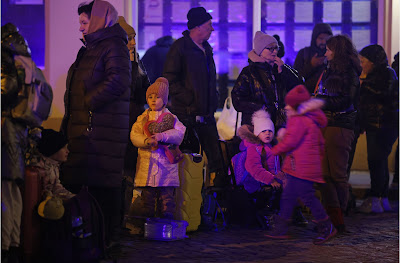
People who have arrived from Ukraine wait to board a bus outside the main railway station in Przemysl, Poland, on March 12. Credit: Sean Gallup/Getty Images via The Washington Post, March 13, 2022.


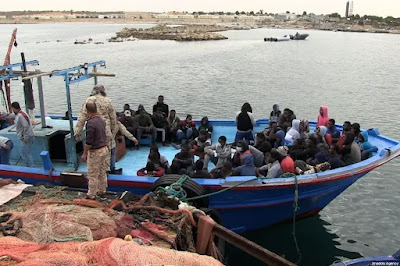
A boat carrying around two dozen migrants capsized in the Mediterranean Sea off the coast of Libya on Saturday, with at least 19 people missing and presumed dead, authorities said. Libya’s coast guard said that a group of 23 migrants—both Egyptians and Syrians—set off from the eastern city of Tobruk earlier in the day. Three migrants were rescued and taken to hospital. Only one body was retrieved and search efforts were ongoing, the agency said. The shipwreck is the latest tragedy at sea involving migrants trying to cross the Mediterranean from the North African nation in a desperate attempt to reach European shores. Libya has emerged as the dominant transit point for migrants fleeing war and poverty in Africa and the Middle East, hoping for a better life in Europe. —The Washington Post, March 13, 2022. Photo: Migrants in Tripoli, Libya on 19 October 2021. Credit: Stringer/Anadolu Agency via Middle East Memo, March 14, 2022.


I dreamt about a girl, thirteen years old,
walking from Kyiv wearing a dark teal down
puffer coat, a white knit hat with pompom,
and her cousin’s moon boots, which kept the cold
away, though they’d seen better days. She rolled
her eyes and tugged her earbuds out, then frowned
and waited for her brother. She sat down
on tumbled piles of broken concrete, scrolled
through her phone, then arms-length, took a selfie.
 
I never dreamt a girl in Syria
was walking to the border of Turkey,
or of a girl escaping Libya
by boat, destined to sink in storms of dread,
though each had been alive, and now was dead.
 
My deep-sleeping brain may have remembered
how my great-grandmother’s remaining kin—
slaughtered by Ceausescu on a mountain
pass—were not so far away, as black birds
fly; and those wheat fields that I’ve seen pictured
on the news called to mind her deep-scarred shins,
sliced by brother’s scythe as they dropped grain in
sheaves then stacked in golden stooks. English words
could not console her for what had happened.
 
I dreamt about a girl whose looks I knew,
whose patterns were the same as those I’ve drawn
in cross-stitch on a pillowcase in blue
and gold or black and red, in sheaves of wheat
I’ve etched with cotton thread. I never dreamt
of girls whose stories I have never read,
though they had been alive, and now are dead.


Cindy Ellen Hill is an attorney, writer, musician and obsessed gardener living in Middlebury VT. She is that author of Wild Earth, a collection of sonnets from Antrim Press, and Elegy for the Trees, a book of sonnets upcoming from Kelsay Books. Her poetry has been published in Vermont Magazine, the Minison Project, PanGaia, Sagewoman, WildEarth, Vermont Life, Measure, the Classical Poets Society online, Ancient Paths online, The Lyric, and the National Public Radio Themes and Variations program. She is presently an MFA student at the Vermont College of Fine Arts.

Sunday, March 13, 2022

HUNGER

by Rose Mary Boehm


I just read about it again, I saw
a video. Or two, or three.
TON 618 is the largest black hole in the known
universe and estimated at 66 billion solar masses…
these figures are beginning to be incomprehensible.
It’s hungry. About to gobble up whole worlds.
Is it hungry? Or is it just doing what black
holes do. A simple question of astrophysics.
 
I remember being hungry alright,
but that was about 80 years ago.
‘There is a war on, you know…’
 
The biggest black hole on this planet is hungry.
Is Putin just hungry or is it something that comes naturally,
a sickness that can’t be cured, a greed
that knows no satisfaction.
 
It seems as though my war was only yesterday.
And there, once more, tanks are rolling, fighter planes are strafing,
buildings are being bombed, whole families perish, the stench
of dead flesh under rubble will soon fill the streets.
The numbers again incomprehensible.
 
And—as in my memories—children will be looking for potato peels
thrown-away apple cores and sorrel in the field – if they make it that far.
We eat guineapigs in Peru—they say rats are acceptable. Siege food.
 
Another promise broken, another convoy
of refugees bombed.
I see old women on canvas bags and suitcases in the back
of trucks holding small children, the parents falling towards
the border, their feet working through the loamy earth
or tripping over ripped open asphalt.
Wasn’t there Kosovo? Syria? Afghanistan?
But so far away is almost incomprehensible.
The black hole has pulled us close. Pushing back,
will we be swallowed? Starving it, will it recede?
I am hungry for peace—or is this a thought too trite?


A German-born UK national, Rose Mary Boehm lives and works in Lima, Peru. Author of two novels and four poetry collections to date, her work has been widely published, for the great part in US online and print journals.

Sunday, February 27, 2022

LOVE THAT CANNOT LIVE LONG ENOUGH

by Kalpna Singh-Chitnis


Fact Check by Reuters, February 25, 2022: Photos of explosions show Israeli-Palestinian conflict, not Ukraine. Social media users have mislabeled images of overnight explosions in urban areas, claiming they are from Ukraine amid the Russian invasion. However, the images show the Israeli-Palestinian conflict in the Gaza Strip and were taken in 2018 and 2021. One picture (above by MAHMUD HAMS/AFP via Getty Images) shows Israeli air strikes on Gaza in response to a barrage of rockets fired by the Islamist movement Hamas amid spiraling violence sparked by unrest at Jerusalem's Al-Aqsa Mosque compound.


Not long ago,
I was Kosovo,

then became Baghdad
by the river Tigris.

Then I turned into Syria
and Ukraine,

crippled and bled to death.
Only to wake up again,

without any eyes or limbs,
without any heart or soul.

And today, I'm Gaza,
covered in ashes.
 
And Kyiv—
siphoning rockets and bullets.

You can call me hatred
or hope that cannot die.

Or love that cannot live
long enough.


Kalpna Singh-Chitnis is a Pushcart Prize nominated, Indian-American poet, writer, filmmaker, and author of four poetry collections. Her poetry, essays, and translations have appeared World Literature Today, Columbia Journal, California Quarterly, Indian Literature, Silk Routes Project (IWP) at The University of Iowa, and Stanford University's Life in Quarantine. Poems from her award-winning book Bare Soul and poetry film River of Songs included in the "Nova Collection" and the "Polaris Collection" Lunar Codex time capsules are set to go on the moon with NASA's missions" in 2022 and 2023. Forthcoming is her poetry collection Trespassing My Ancestral Lands.

Saturday, February 05, 2022

DUCK AND COVER

by Indran Amirthanayagam


The sound of helicopters was nothing new. They often arrived to ferry out Turkish troops stationed near Ahmed’s town, a stone’s throw from Syria’s border with Turkey. But this was different. “The sound was horrible,” he said, describing the swarm of U.S. military helicopters that descended on a home less than two miles away from Ahmed’s house early Thursday, on a mission to kill ISIS leader Abu Ibrahim al-Hashimi al-Qurayshi. Ahmed, who for safety reasons spoke on the condition that he be identified by only his first name, went up to his roof, he said in a telephone interview. The thunder of the helicopters was eclipsed by a terrible clatter of gunfire “from the sky,” he said… At least a dozen people, including six children, were killed along with Qurayshi, according to local first responders. The Pentagon said that three members of his family were killed when Qurayshi detonated an explosive device on the top floor of the building, along with a child who was killed on the floor below in circumstances that remained unclear. The first responders, known as the White Helmets, said survivors of the night’s violence included a man who lived near the house and a young girl whose entire family was killed. For a time, they said, the girl was unable to speak, from the shock. The group was not sure how the other people died. “Truthfully all the bodies were largely covered in blood, sometimes it could not be discerned if it was bullets or explosions,” a spokesman said in a message. —The Washington Post, Februaryj 4, 2022. Photo: The scene after an overnight raid by US special operations forces against suspected jihadists in north-west Syria. Photograph: Aaref Watad/AFP/Getty via The Guardian, February 3, 2022.


It is hard to palaver on the verandah, or bake bread in the kitchen,
or step out for a drive while helicopters fly above preparing to strike...
One moment you, human and humane, are alive, the next pulverized,
and that evening a headline, made famous instantly until the next drone
in the neighboring country shatters, or a kid shoots into classmates
somewhere, or a young girl is slaughtered by her brother for the family's
honor in a country that ends with 'stan (or states), no country immune
from trafficking in honor, and I declare I am most certainly politically
correct. That said, let us get down to the heart of this body otherwise
split by shards scissoring from the drone that dropped out of the sky
to finish political differences by means of a battering ram, an oxen
head, a threat, then action against what remains of order and grace,
ordinary representatives debating bills, showing the family around
the hallowed halls, certifying an election in these United States.


Indran Amirthanayagam's newest book is Ten Thousand Steps Against the Tyrant (BroadstoneBooks). Recently published is Blue Window (Ventana Azul), translated by Jennifer Rathbun.(Dialogos Books). In 2020, Indran produced a “world" record by publishing three new poetry books written in three languages: The Migrant States (Hanging Loose Press, New York), Sur l'île nostalgique (L’Harmattan, Paris) and Lírica a tiempo (Mesa Redonda, Lima). He writes in English, Spanish, French, Portuguese, Haitian Creole and has twenty poetry books as well as a music album Rankont Dout. He edits The Beltway Poetry Quarterly and helps curate Ablucionistas. He won the Paterson Prize and received fellowships from The Foundation for the Contemporary Arts, New York Foundation for the Arts, US/Mexico Fund For Culture, and the MacDowell Colony. He hosts the Poetry Channel on YouTube.

Saturday, June 05, 2021

WIFE OF IDLIB

by Steven Croft


Hammers echo now from the rebuilding of houses,
pounding at my heart as I carry tea to the patio, stare
down at the tiles you laid. Tear-filled eyes raise—
who moves through the terraced almond trees on the hill,
their clouds of white flowers? Alas, it is only today's dream.
If Allah allows, may you one day walk into this daily dream
of your return. You were no terrorist, only a man
who loved the warmth of the land, wheat and barley,
the green joy of lettuce. When the planes bombed the fields
you ran to the town square to tell the protesters. Then,
the security men knocked at the door, and I kneeled before God,
but they dragged you out while my heart stopped.

Now, I wait in bed for the creak of our door, a call, again,
from the kitchen that you are leaving for the fields, anything
to bring you back into existence. My soul is a leaden weight.
Our country is a corpse. How can hammers sound? How can hope
trouble us anymore? Let our dead hearts rot. Just let our loneliness,
like the bombs' fires, burn us away.


Steven Croft lives on a barrier island off the coast of Georgia. He is the author of New World Poems (Alien Buddha Press, 2020). His poems have appeared in Willawaw Journal, San Pedro River Review, The New Verse News, North of Oxford, Anti-Heroin Chic, and other places, and have been nominated for the Pushcart Prize and Best of the Net.

Wednesday, February 10, 2021

LUXURIOUS FEAR

by Rebecca Leet


Source: We Do Geek


My head sinks into the pillow
and fear floats forward
like a ghoul set to stalk my dreams
 
so easy to keep ghosts
tautly moored when sun shines,
before night ingests hope.
 
I worry past the present pandemic
past the wild, sad souls ensnared
by visions of prurient perfidies
 
to a time closer than we dare declare
when swelling seas, infernos of forests,
acres of arid, fallow farmlands
 
push civilization to survival of the fittest
and my newborn grandchild, one day,
must claw over others or succumb.
 
Then morning comes and as I sip tea
news reports speak of children suffocating
from poison gas in Syria        girls kidnapped
 
by Boko Haram in Nigeria      a boy killed
in a random shooting five miles away.
And I realize my fear, today, is a luxury.
 

Rebecca Leet lives a stone's throw from Washington, DC.  Her collection Living with the Doors Wide Open was published in 2018.

Tuesday, January 26, 2021

PRAYER FOR SYRIA'S TRASH PEOPLE

by Steven Croft


Plastic bottles, aluminium cans, clothes, sometimes spaghetti. When a tractor tows in new rubbish at a dump in northeast Syria, men, women and children rush to find the best pickings. Photo credit: Delil Souleiman/AFP via Aljazeera, January 20, 2021


In a land where dreams are invaded
by nightmare year after year,

houses broken,

families fled, 

buried, 

this is the worst shadow
of living, amidst the slough
of better lives

May you patch together a world
in these heaps and spillways,
everything you can build

from this crumbling

find some reason, like a trash bag
of moldering fruit and meat pies,

for sudden joy

as we pinch our nose
and look away


Steven Croft lives on a barrier island off the coast of Georgia. He is the author of New World Poems (Alien Buddha Press, 2020).  His poems have appeared in Willawaw Journal, Canary, The New Verse News, The Dead Mule, Anti-Heroin Chic, and other places, and have been nominated for the Pushcart
Prize and Best of the Net.

Wednesday, July 08, 2020

GHOSTS

by Steven Croft


Syrian pro-government forces and their jihadist opponents flagrantly violated the laws of war during the battle for Idlib province, UN investigators say. Civilians endured "unfathomable suffering" when the Syrian military launched a campaign late last year to retake the area, according to a report. They were subjected to indiscriminate air strikes and ground shelling, as well as arrests, torture and pillaging. Hundreds of civilians were killed before a ceasefire was agreed in March. Almost one million were displaced by the fighting and many were forced to live in dire conditions in overcrowded camps or open fields. Now, the investigators warn, "a perfect storm is in the making" as the war-torn country faces both the coronavirus pandemic and an economic crisis. More than 380,000 people have been killed and 13.2 million others - half of Syria's pre-war population - have been displaced inside and outside the country since an uprising against President Bashar al-Assad began in 2011. —BBC, July 7, 2020


In a Syria that should have died of its wounds
years ago, still, the white noise howl of low-flying jets
bombing the rubble for any survivors

In a basement a mother cradles a child and screams
to the percussive palsy of cold dark stones
The jets pound the ground with deafening fists

Wanting to soothe her crying baby's fear, only screams
slip past her tongue, wails of surrender, she tastes
tears from lips, the corners of her mouth

These screams an echo of others, today's question:
"Who said I must lose this child, who?!"  The demons
of war give, again, yesterday's answer: BAROOOM!!!


Steven Croft lives on a barrier island off the coast of Georgia.  He has recent poems in San Pedro River Review, Red Eft Review, Poets Reading the News, TheNewVerse.News, Synchronized Chaos, Gyroscope Review, Anti-Heroin Chic, and other places.

Tuesday, October 29, 2019

THIS IS HOW WE DO WHAT WE DO NOW

by Alan Catlin


A dead dolphin was found washed ashore in Westerly RI, Oct. 27, 2019. Photo: Zac Perrin, Channel 10 Providence.


Kill things
                 Dolphins
                 Seals
                 Birds
                 Endangered species
                 Separated from parents children
                 Allies

Then we send troops into the country
we betrayed to defend the oil fields


Author’s note: Written after finding a full grown dolphin washed ashore on an offshore island


Alan Catlin has published dozens of chapbooks and full-length books, most recently the chapbook Three Farmers on the Way to a Dance (Presa Press), a series of ekphrastic poems responding to the work of German photographer August Sander who did portraits of Germans before, during, and after both World Wars.

Wednesday, October 16, 2019

SHAME

by George Held

Trump Provides Cover For the Kurds by Pia Guerra at The Nib
Full story by Jennifer Griffin and Melissa Leon at Fox News.


The last vestige of shame
our Special Forces feel
for abandoning the Kurds,
our ablest warrior allies,

is pure attar in the rose
of battle grown in the garden
of the temporary victory
over ISIS and their allies.

That rose has faded and died
on orders from our supreme leader
to betray and abandon
our loyal Kurdish brothers.

In future where can shame
bloom? Who now will share
the arid earth where Kurd
and Special Forces bled

Out their lives in hard-earned
mutual trust? The old words
—trust and shame and loyalty—
have wilted and died.


George Held, a longtime contributor to TheNewVerse.News, has a new poetry chapbook out, Second Sight (Poets Wear Prada, 2019).

Monday, October 14, 2019

THE PHOTOS DON'T DO JUSTICE

by Tricia Knoll


QAMISHLI, Syria – "Eight-year-old Sara Yousif has become a symbol of the Turkish war on northeast Syria, which has caused the death of around 40 civilians, according to a war monitor." —The Independent (UK), October 13, 2019. "Sara lost her leg when Turkish shells rained down on her neighborhood of Qudurbag, eastern Qamishli on Thursday, killing her brother 11-year-old Mohammed and wounding her mother and brother Ahmad." —Rudaw (Kurdish media network), October 13, 2019.  Below, Sara's father Yousif Gharib speaks to reporters at the funeral for his son. Credit Rudaw for photos.


to the glory light on sober gold
of Vermont’s falling leaves

or for the places we’ve seen
Ansel Adam’s Yosemite

now smothered in wildfire smoke.
Those people we remember –

the Afghani girl’s blue eyes
the minister on the hotel balcony

the monk in flames or the man
with a flower facing a rolling tank

the father’s arm holding daughter
Valeria on the banks of the Rio Grande

and now Sara, age eight,  a Kurd, who lost
her leg to a fast-moving Turkish bomb

and her father sobbing over the body
of his dead son, not yet pointing his finger

to the betrayal of a man in Washington
whose soldiers she may have once trusted.

The photos do not do justice, let them
remind us justice could be done.


Tricia Knoll’s most recent poetry collection How I Learned To Be White (Antrim House) received the Gold Prize in the Poetry Book Category for Motivational Poetry in the Human Relations Indie Book Prize for 2018.

Saturday, October 12, 2019

HIS FOREIGN POLICY

by Jan D. Hodge


He's rather hard pressed to explain,
however stupendous his brain,
      giving Kurds to the Turks
      and to Putin (with smirks)
Crimea and Eastern Ukraine.


Jan D. Hodge's poems have appeared in many print and online journals, several being awarded prizes in open national competitions. Two of his books, Taking Shape (a collection of carmina figurata) and The Bard & Scheherazade Keep Company (double-dactyl renderings of Shakespeare, tales from the Arabian Nights, and Reynard the Fox) have been published by Able Muse Press.

Sunday, December 30, 2018

BIRDS OF WINTER 2018

by Mary K O'Melveny


"US withdrawal from Syria will endanger Kurds, Arabs, Christians," —by Amy Austin Holmes, The Hill, December 27, 2018. Photo: Kurdish demonstrators gather to protest near the border wall separating Turkey from Syria in the western Syrian countryside of Ras al-Ain. (AFP Photo/Delil souleiman via Yahoo, December 20, 2018)


This year there is only
rain. Birds, bedraggled by
blowing wind and soggy
air, take no solace in
pumpkin seeds or suet.
Even squirrels have turned
away from our handouts,
as if they know better

than to accept comfort
from temporary stores
of millet and cracked corn,
knowing that our tenure
here is short, that we will
leave these feeders empty
soon enough. Nuthatches,
Jays, Sparrows, Woodpeckers

used to be reliable
friends. Their antics pleased us
as we dispatched more treats,
watched them from our windows
in warmth and safety. Though
we feigned otherwise, we
owned both feast and famine.
How we must have amused

those who watched us place each
scrap and kernel into
wooden boxes and tin
containers, dangle them
from porches and branches,
so sure of flocks to come.
We were eager for praise,
shocked when no one believed.


Mary K O'Melveny is a recently retired labor rights attorney who lives in Washington DC and Woodstock NY.  Her work has appeared in various print and on-line journals. Her first poetry chapbook A Woman of a Certain Age is available from Finishing Line Press.

Sunday, December 23, 2018

AMERICAN SOLSTICE

by Peleg Held


Wednesday's surprise announcement that the U.S. will quickly withdraw all its troops from Syria is the stuff of nightmares for many of the Kurds living under the protection of U.S forces and the American-backed Syrian Democratic Forces (SDF). “Everyone is upset, sad and afraid,” one SDF member from the Kurdish-dominant Syrian city of Kobane told Fox News. “It’s a historic mistake. We wanted to be part of America. We are surrounded by enemies, and ISIS isn’t even finished yet.” “Everyone is confused and scared. This will mean that Turkey will likely attack us. We are in shock because we thought the U.S. would help us achieve peace after ISIS. We didn’t think that they would help us defeat the terrorists and then leave us alone to face the horror of Turkish forces and its extreme factions,” lamented Mazloum Kurdy, a 33-year-old father and teacher from Kobane. “Now people are thinking to displace themselves from their homes here again, but nobody knows where a safe place to go is.” In his words, it is an ultimate betrayal by the United States. —Fox News, December 20, 2018. 


 . . . only when the mountains are no more, only when Ocalan’s solitary resistance no longer lights our way is the day we should say “Kurds are no more” . . .    —Hawzhin Azeez


You waver, thinning wisp of a republic,
as the smoke of betrayal is drawn into our chests.
Drift into infamy. You say you are freedom itself
and now no longer owe any promise to liberty.
In Kobane they will grip their fate in their own hands,
in Rojava they will look to the mountains as their only friends.
A great people will once again be backed to the wall
while cowards rub their heels and take
the bows for the sacrifices of others. The watchers
on the walls tonight see you turn your back. Resigned
but not surprised. The only Empire that does not betray
is the one that, clutching the stone of its own delusions
finally sinks under. When your time comes,
as it will, for the last sparks to go cold into the black
earth, no one will come to sing over your ash.
Under a red flag the last architects of Armenia
march to mark your enduring work of this day.
Waver, thinning wisp of a republic
as the smoke of betrayal is drawn into our chests.


Peleg Held lives in Portland, Maine with his partner and his dog Emitt. There is also the semi-feral cat, Smudge. And a kid or two. pelegheld(at)gmail.com.

Thursday, May 17, 2018

WE BECAME FRAGMENTS

by Tricia Knoll


The video: a Syrian boy, Ibraheem, says he has seen
everything. We come to believe he has. The bombs and skies
blew one of his legs into shriveled tags. His mother died.
His siblings died. He and his father found a way to Canada.

We became fragments. Let me not usurp what it means
to pivot on crutches that carry his thin leg along with him.
Let me not pretend I have suffered as he has. Let me hope
that over time his life will coalesce. He will feel safe.

The bits and pieces of our fractured world are myriad,
scattered across so many continents and living next door.
In this time we must sew, knit, darn, secure, bind, mend,
link, weave, patch together, perhaps heal.


Tricia Knoll is an Oregon writer whose poetry book How I Learned to Be White (an investigation of how white privilege has impacted her life and how she has come to understand it) is now available from Antrim House.