Guidelines


Submission Guidelines: Send 1-3 unpublished poems in the body of an email (NO ATTACHMENTS) to nvneditor[at]gmail.com. No simultaneous submissions. Use "Verse News Submission" as the subject line. Send a brief bio. No payment. Authors retain all rights after 1st-time appearance here. Scroll down the right sidebar for the fine print.
Showing posts with label bears. Show all posts

Tuesday, January 23, 2024

A FABLE

by Kevin Carey


Shutterstock A-I generated image


A long, long time ago a very bad wolf,
probably the worst wolf ever,
did some very bad things to some lambs,
some of the worst things ever done to
lambs anywhere. As a matter of fact, this
very bad wolf had wanted to eliminate all the lambs.
The lambs who were saved from elimination
made a pact with some very big bears
(who helped save them from the wolf)
 and together they decided to push  
some rabbits from their nests so the lambs could have a land
to call their own. It’s worth noting that these rabbits
had nothing to do with the very bad deeds of the very bad wolf.
.
So the lambs took a mile,
but then they wanted two, then three and so on and so on.
The rabbits who were being pushed from their nests fought
back and were called very bad rabbits.
The lambs who wanted even more land
made even more big bear friends
and this gave them even more power,
which they used to keep pushing more rabbits from their nests.
The rabbits had no bear friends
so they fought back again,
and they were called very very bad rabbits.

And so the story goes. But this story
has no end. The lambs are still pushing the rabbits
from their nests and soon they will
have eliminated all the rabbits
and when that happens
the lambs will have done  
what the very bad wolf had wanted to do to them.

The moral of the story: a rabbit with no big bear friends is easy to push from a nest.


Kevin Carey is Coordinator of Creative Writing at Salem State University. Books include: The Beach People, The One Fifteen to Penn Station, Jesus Was a Homeboy, Set in Stone, Murder in the Marsh, and a new novel Junior Miles and the Junkman (September 2023 from Regal House / Fitzroy Books) and a new co-written poetry collection Olympus Heights (October 2023 – Lily Poetry Review). He is the co-founder of Molecule: a tiny lit mag.

Tuesday, March 15, 2022

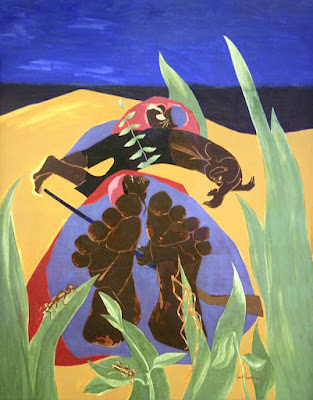
A TIME TO REST

by Tina M. MWP

after Jacob Lawrence’s "Daybreak - A Time to Rest," 1967.


"Daybreak—A Time to Rest" (tempera on hardboard) by Jacob Lawrence (September 7, 1917 – June 9, 2000) is one in a series of panel paintings that tell the story of Harriet Tubman (c. 1820–1913), the famed African-American woman who freed the enslaved using a fragile network of safe houses called the Underground Railroad. This abstracted image emphasizes Tubman's bravery in the face of constant danger. Lying on the hard ground beside a couple and their baby, she holds a rifle. Her face, pointing upward to the sky, occupies the near center of the canvas, her "body" surrounded by purple. Tubman's enormous feet, grossly out of proportion, become the focal point of the work. The lines delineating her toes and muscles look like carvings in a rock, as if to emphasize the arduous journeys she has made. Reeds in the foreground frame the prone runaways. Three insects(walking stick, beetle, and ant) are signs of activity at daybreak. —Africology: The Journal of Pan African Studies, vol.9, no.3, June 2016


Blue bears down on the black horizon as twilight arrives
awakening an ant, a beetle and a walking stick.

The sandy bank of the lake, cooling all night from the days
harsh heat, offers a place to rest among the green reeds.

A family at last finds respite after trekking across perilous
terrain, the whites of their eyes disappear as the light rises.

But can they rest, people fleeing, trying to break free
from anvils strapped to their ankles? 

Even she, with resilient legs, brawny feet, calloused toes, 
toes that hold the silhouette of a mother cradling a baby,

half lays in the golden dunes, eyes to the sky, rests 
her fingers around the neck of the rifle.


Tina M. MWP (she/her) is committed to serving others through her professional life as an engineer and innovator in public health, and in her personal life, as a volunteer and tutor, and now, as a writer. She writes creative nonfiction and poems about belonging, identity, the power of language, and nature. She lives with her family in Rockville, MD.  

Friday, August 31, 2018

THE BEARS KNOW

by Linda Lerner


what the politicians & others don’t who
haven’t heard them scratching at their doors,
                         screamed when they looked out and
kept screaming after the bears, who’ve
come to warn them, are gone. 
And  isn’t it pretty to think so?

The bears don’t mean us harm when they come
into our backyards, dig in trash cans,
peer into open car windows looking for food,
the bears aren’t thinking about us at all;

If they 🐻 could create emojis we’d see
the sun filtered through dust particles,
small fires 🔥 starting up, 😰 teary eyed
bewilderment at the browning grass, lack of berries,
and bugs, a hotter, dryer climate

We’d see a human face through a bear’s,
now one, then the other


Source: EarthJustice


Linda Lerner's A Dance Around the Cauldron, Lummox Press, 2017 is her most recent collection. She is the author of Yes, the Ducks Were Real and Takes Guts and Years Sometimes (NYQ Books) and a chapbook of poems inspired by nursery rhymes, Ding Dong the Bell Pussy in the Well. She previously published thirteen collections of poetry and twice been nominated for a Pushcart Prize. Her next collection, tentatively called, Taking the F Train, will be published by NYQ books in late 2018 or early 2019.

Monday, January 23, 2017

THE PARK CLOSES AT DUSK

by CL Bledsoe & Michael Gushue


The problem is bears in the classroom.
The problem is bears who don't know
which utensil is for the pâté, which
is for olives.
The problem is that I'm right.
The problem is our tax dollars at work.
Ask all the questions you want. Questions are free.
Answers require donations.
The problem is bears who don't speak proper English.
The problem is bears stealing jobs.
The problem is union bears.
The problem is the lack of bear vouchers.
Bears should be left up to the states,
the largest donors.
Bears eating pâté. Bears who can spell their government
representatives' names and use a touch-tone phone.
The problem is bears who don't know how to stitch
their own wounds.
The problem is bears on death panels,
bears running internment camps.
The problem is bears as Uber drivers.
Bears want to take away our pâté knives.
The problem is bears don't eat pâté
and the ones who do don't vote.
The problem is bears taking our guns and making them into backscratchers.
Russian bears who've invaded our classrooms after the arctic ice melted.
The problem is what's going on behind the bears' backs
while we're watching their teeth.


CL Bledsoe is the assistant editor for The Dead Mule and author of fourteen books, most recently the poetry collection Trashcans in Love. He lives in northern Virginia with his daughter.

Michael Gushue is co-founder with Dan Vera of Poetry Mutual and Poetry Mutual Press. He co-curates the intermittent reading series Poetry at the Watergate with Deborah Ager. His chapbooks are Gathering Down Women, Conrad, and Pachinko Mouth. He lives Washington, D.C.