Guidelines


Submission Guidelines: Send 1-3 unpublished poems in the body of an email (NO ATTACHMENTS) to nvneditor[at]gmail.com. No simultaneous submissions. Use "Verse News Submission" as the subject line. Send a brief bio. No payment. Authors retain all rights after 1st-time appearance here. Scroll down the right sidebar for the fine print.
Showing posts with label baby. Show all posts

Tuesday, September 22, 2026

MARKING TERRITORY

by Nan Meneely

No offense to the lions and tigers, I swear,
Who mark what is theirs with a wee.
Our cretin, his g(u)ilt and his name everywhere
(No mammal more worthy than he),
Tags his kingdom with arches and, hubris untamed, 
Prints his features on banners unfurled,
But his big baby claim to his rivals' domains
Has him peeing all over the world.


Nan Meneely retired to the relative peace and beauty of Connecticut after 20 electric years with FEMA. Her first book Letter from Italy, 1944 (Antrim House) was noted by the Hartford Courant as one of thirteen important books by Connecticut writers in 2013. It provided the libretto for an oratorio performed twice by Connecticut choruses and symphony orchestras. Her second book Simple Absence (Antrim House) was nominated for The National Book Award and placed as a grand prize finalist in The Next Generation Indie Awards and the 2021 Eric Hoffer Award. Her work has been both accepted and rejected by The New Verse News.

Monday, June 08, 2026

TALKING ABOUT TREES

by Bonnie Naradzay
 
 
Father of Baby Shot Dead by IDF in Hebron: I Stopped When Asked, Then They Opened Fire. 'The soldier was about ten meters away from me. He saw me, he saw my wife and the children. The car windows were not dark, it was daylight and everything was clear. You can't say he didn't see that it was a family,' Fahed Abu Haykal told Haaretz, June 6, 2026.
 

I’d like to write like Tu Fu, whose poems
are like branches of trees reflected in water –
 
the branches of trees.  Like a group of trees seen
through clouds or mist, they appear, then disappear.
 
But I learned that today Israeli forces murdered
a Palestinian baby, in the West Bank, in Hebron.
 
He was in his mother’s arms, in a car the soldiers
shot into. They’d ordered the driver, the baby’s father,
 
to stop, and he did as they said, and raised his hands
in submission. The baby’s mother sustained shrapnel
 
injuries near her heart, may not survive.  The soldiers
had been standing idly in the street. After firing
 
into the car, they walked unconcernedly away from
their carnage. Today in Gaza City, Israelis aimed
 
a drone at the Jawazat camp for people who’d been
displaced. The drone killed seven, wounded 15 others. 
 
How can I honor the lives of Palestinians?  Like a group
of olive trees, they are destroyed and made to disappear.


Bonnie Naradzay is the author of Invited to the Feast (Slant Books, 2025). Her poems have appeared in AGNI, The American Journal of Poetry, Birmingham Poetry Review, Cider Press Review, The Georgia Review, Cumberland River Review, Dappled Things, New Letters, Poet Lore, Rhino, Innisfree, and many other journals.  While at Harvard University’ graduate program, she was in Robert Lowell’s class on “The King James Bible as English Poetry.”  She was a winner of the University of New Orleans Poetry Prize (a month’s stay in the South Tyrol castle of Ezra Pound’s daughter Mary). Three of her poems have been nominated for a Pushcart prize. She is a 2017 graduate of the St John’s College Graduate Institute. She has led poetry classes at the DC Women’s Jail and currently leads weekly poetry sessions at Street Sense and at a retirement community both in Washington, DC.   

Thursday, August 21, 2025

WHAT THE LIVING HAVE SEEN

by Lynne Rappaport


Donate here.


How many days has it been now, since 10/7,

that those Israelis held captive in tunnels in Gaza

have been without their freedom,

separated from all of life?


Their faces are plastered onto giant posters

for passersby in Tel Aviv to see,

burning these hostages’ plight into memory,

their country longing for it to end.


What can the prisoners know of the crisis above the tunnels?

The violence, devastation, rubble, blocked aid trucks, hunger,

children’s lives cut short.

Failed attempts at a lasting ceasefire.

Instead, more retaliations, an eye for an eye,

an endless war.


Bring them safely home.

Let them begin healing.


The Palestinian family I’m sending money to in Gaza—

Home destroyed, living in a tent,

subsisting on lentils and hot salt water—

Had a moment of joy welcoming a baby boy,

Husband venturing out to buy overpriced flour

for his wife and 2-year-old son. 

She needed medication to prevent blood clots,

needs nourishment to sustain their newborn child. 

They all need superhuman strength.


Almost 500 online donors, sending funds for a year,

trying to keep this family going, give them some hope. 

Will they rebuild their home in Gaza someday? How will they manage until then?

Will Gaza even still exist for them? Will they be displaced again?

Will these two children who’ve survived ever know a free Palestine?

What can the Gazans know of the air raid sirens, during the night,

Families hurrying to bomb shelters and safe rooms

In Tel Aviv apartment buildings?


Bring all safely home. 

End the occupation,

The unholy bloodshed.


The ghosts of the lost ones permeate the ashen air. 

Restless dreams, nightmares, 

and oh,

what the living have seen,

have seen,

have endured.


Author’s note: This poem came out of a freewrite session to the poem “Beannacht” by John O’Donahue, in Kathryn Santana Goldman’s Your Write to Resilience OLLI class, summer 2025.


Lynne Rappaport is a 72-year-old woman originally from New York who has lived in San Francisco for over 50 years. Retired from teaching ESL to immigrant adults, she enjoys poetry, nature, music, and Tai Chi. She dedicates this poem to her late cousin, Canadian poet Bobbie Ogletree, and to our late grandfather Jacob B. Sacks, born in Palestine (Jerusalem) in 1888. He immigrated to New York in 1912. 

Wednesday, December 18, 2024

BABY JESUS ON A KEFFIYEH

by Catherine Gonick


Beyond the manger sounds the roar—of politics,

revisionist history, replacement theology. Of

Palestinian identity and Jewish. Pogroms,

resistance, genocide. Cultural heritage, 

21st century swastika. Hope, love, and peace

to an overheated world. What the Pope

really meant. What it means when Christmas

coincides with the first day of Chanukah.


As a baby, Jesus can’t yet speak about symbols

or freedom of the artist. And no one mentions

on His behalf that to children, parents, even if one

of them is God, are only accidents of fate.

No child asks to be born or arrives knowing

its name. All are divine. The rest is learned.


Catherine Gonick has published poetry in a wide range of journals, including The New Verse News, Notre Dame Review, Beltway Poetry Quarterly, and The Orchards Poetry Journal, and in anthologies including Support Ukraine, in plein air, and Rumors, Secrets and Lies: Poems about Pregnancy, Abortion and Choice. She works in a business that seeks to lower the rate of global warming.

Friday, May 17, 2024

ROUH (ARABIC FOR SOUL)

by Jane Edna Mohler


A premature Palestinian baby, who was saved from her mother’s womb after she was killed in an Israeli attack in the Gaza Strip, has died after days in an incubator. Sabreen al-Rouh Jouda died in a Gaza hospital on Thursday after her health deteriorated and medical teams were unable to save her, said her uncle, Rami al-Sheikh Jouda. [Photo: Mohammed Salem/Reuters via Al Jazeera, April 26, 2024


You were red and blind as a just-hatched robin
when they cut you from your silent mother.
 
On the news, your curled form was cradled
by a doctor who needed you to live
 
even more than me. I hope
your nakedness didn’t shame you.
 
It made me love you.
 
They named you Sabreen al-Rouh, prescient,
as you had too much soul for the three pounds
 
your mother had time to give you.
Her name was Sabreen al-Sakani.
 
They call her a martyr.
You call her Mama.
 
At five days old you still knew the cadence
of her heartbeat. You flew to her
 
while your body rests under the mud of sorrow
that tears have made of Gaza’s dust.


Jane Edna Mohler is a Bucks County Poet Laureate Emeritus (Pennsylvania). Recent publications include Gargoyle, Gyroscope, and One Art. Her collection Broken Umbrellas was published by Kelsay Books. She is the Poetry Editor of the Schuylkill Valley Journal in Philadelphia.

Sunday, January 07, 2024

2024 CAN BE A YEAR OF DELIGHT, PROMISES A TIMES COLUMNIST

by Devon Balwit


Quilter Delight Painting by Karla Gerard


The basic premise of a delight practice (which I learned about in the essay collection “The Book of Delights” by Ross Gay) is simple: You make a point to notice things in your everyday life that delight you… Then whenever you notice something that delights you, you lift your arm, raise your index finger in the air and say, out loud and with enthusiasm, “Delight!” (Yes, even if you’re alone.) —Catherine Price, The New York Times, December 31, 2023


I hold up a finger and say Delight!—two shelf mushrooms

in a hollow tree, a squirrel hanging by its feet. I zoom

in on the electric green of moss, a red leaf peeking

from wood chips. Always the teacher’s pet, if seeking

wonder is the task, I’ll find it, if only for the gold

star next to my name on the chart. Behold

the shining face of a baby at the bar, the daffy

hound, a Beethoven riff that makes me laugh! 


Expressing simple gratitude does get old—

the litany of health, family, shelter—but marvels

are singular. Even the same street shifts

with the light. I read the essay to the end sold,

ready to dash out and see what’s revealed

as the world sheathes its terrors and bares its gifts.


Devon Balwit walks in all weather and has rediscovered her love of cartooning. Her most recent collection, Spirit Spout [Nixes Mate Books, 2023], storms through Melville’s Moby Dick.

Saturday, May 07, 2022

WHAT IS THERE TO DO

by Jan Harris


Valeria Hlodan, her baby daughter Kira, and Valeria’s mother Liudmila died in the missile strike on 23 April. (Picture: @myroslavapetsa; Rex via Metro.)


after seeing the photograph from Odesa
of a mother and her new baby girl
killed by a missile-strike
 
but lay down the bread
your throat will no longer swallow
and rest your eyes
 
on the bird that alights
on the sweet-smelling lilac 
by your door,
 
notice his glossy black cap,
yellow breast glowing
in warm April sun,
 
how he stays for a moment,
how swiftly
he flickers away.
 
 
Jan Harris’s poetry has appeared in various literary journals, including Acumen, Atrium, and Poetry Wales, and in anthologies, including several e-books published by Poetry Kit. She received third place in the Wales Poetry Award, 2019. Her first collection, Mute Swans on the Cam, was published by Oversteps Books in July 2020.

Thursday, March 24, 2022

WHAT IN GOD'S NAME?

by Marilyn Peretti


‘


I say Jesus Christ 
when I’m not supposed
to say Jesus Christ.


Jesus / Ukraine flag

Published: 


I said Jesus Christ
when the pregnant woman
was carried on a stretcher
from the bombed maternity
hospital, her hip and leg 
hanging to the side,
and her baby died.


I said Jesus Christ
when the magnificent
Mariupol theater building 
was smashed, burying
hundreds of people
sheltering there.


I said Jesus Christ
when there were 7 fires
burning unchecked at
Chernobyl  Nuclear Plant.


I said Jesus Christ
when they displayed 
109 empty strollers 
representing the children 
who died — so far.


I said Jesus Christ
as Russia stepped up attacks
on Mariupol when it was
already reduced to ashes,
with thousands of survivors
left there, starving.


Jesus Christ


Marilyn Peretti from near Chicago has been published in various journals over the years, including The New Verse News, Kyoto Journal, Gray Sparrow Journal, Christian Science Monitor, Highland Park Poetry, Snowy Egret. Her most recent book is Behind the Mask in 2020... 2021... .

Sunday, March 20, 2022

HERE, WHERE NOT EVEN THE LEAVES FLUTTER

by Devon Balwit


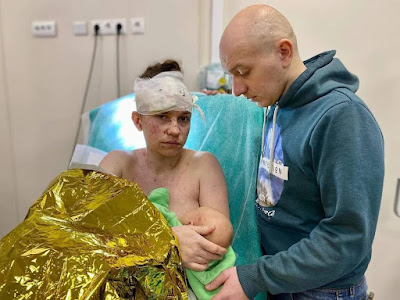
Bandaged and bloodied, a mum nurses the baby she saved from Russian shellfire by shielding the tot with her own body. Brave Olga—badly injured by shrapnel in Putin’s blitz on Kyiv—cradles her month-old child as a man thought to be her partner comforts them. Amazingly, the baby was believed to be unhurt thanks to the quick-thinking courage of its Ukrainian mother. The two were being cared for yesterday at Kyiv’s Ohmatdyt children’s hospital. Journalist Anastasiia Lapatina, who works on English-language newspaper the Kyiv Independent, said the baby was well. —The U.S. Sun, March 19, 2022. See also story at Infobae.


Ratatatat—no bullets—just a flicker
making a morning ruckus on a chimney cap.
History is happening elsewhere. There
people breathe its stink, tweeze its shrapnel
from their skin, like the bloodied mother nursing her baby
on a hospital gurney. Even the old poet
has refugees blanketing his living room and library.
Post-barrage, survivors salvage what
they can. Each moment presents its immediate problem
to be solved—more life always the answer.
Here, the flicker quiets in slanted columns
of rain so gentle that not even the leaves flutter.
As in a fairy tale, I fight ensorcellment,
straining towards that distant bombardment.


Devon Balwit walks in all weather. Her most recent collections are Rubbing Shoulders with the Greats [Seven Kitchens Press 2020] and Dog-Walking in the Shadow of Pyongyang [Nixes Mate Books, 2021].

Tuesday, March 15, 2022

A TIME TO REST

by Tina M. MWP

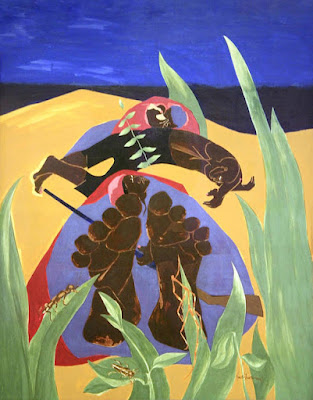
after Jacob Lawrence’s "Daybreak - A Time to Rest," 1967.


"Daybreak—A Time to Rest" (tempera on hardboard) by Jacob Lawrence (September 7, 1917 – June 9, 2000) is one in a series of panel paintings that tell the story of Harriet Tubman (c. 1820–1913), the famed African-American woman who freed the enslaved using a fragile network of safe houses called the Underground Railroad. This abstracted image emphasizes Tubman's bravery in the face of constant danger. Lying on the hard ground beside a couple and their baby, she holds a rifle. Her face, pointing upward to the sky, occupies the near center of the canvas, her "body" surrounded by purple. Tubman's enormous feet, grossly out of proportion, become the focal point of the work. The lines delineating her toes and muscles look like carvings in a rock, as if to emphasize the arduous journeys she has made. Reeds in the foreground frame the prone runaways. Three insects(walking stick, beetle, and ant) are signs of activity at daybreak. —Africology: The Journal of Pan African Studies, vol.9, no.3, June 2016


Blue bears down on the black horizon as twilight arrives
awakening an ant, a beetle and a walking stick.

The sandy bank of the lake, cooling all night from the days
harsh heat, offers a place to rest among the green reeds.

A family at last finds respite after trekking across perilous
terrain, the whites of their eyes disappear as the light rises.

But can they rest, people fleeing, trying to break free
from anvils strapped to their ankles? 

Even she, with resilient legs, brawny feet, calloused toes, 
toes that hold the silhouette of a mother cradling a baby,

half lays in the golden dunes, eyes to the sky, rests 
her fingers around the neck of the rifle.


Tina M. MWP (she/her) is committed to serving others through her professional life as an engineer and innovator in public health, and in her personal life, as a volunteer and tutor, and now, as a writer. She writes creative nonfiction and poems about belonging, identity, the power of language, and nature. She lives with her family in Rockville, MD.  

Tuesday, March 31, 2020

THIRTEEN WAYS OF LOOKING AT LIFE BEFORE THE VIRUS

by Lesléa Newman


I.
I remember shaking hands:
damp, sweaty hands and dry, scratchy hands,
bone-crushing handshakes and dead-fish handshakes,
two-handed handshakes, my hand sandwiched
between a pair of big beefy palms.
I remember hairy hands and freckled hands,
young smooth hands and old wrinkled hands,
red polished fingernails and bitten jagged fingernails,
stained hands of hairdressers who had spent all day dying,
dirty hands of gardeners who dug down deep into the good earth.

II.
Thousands of years ago, a man stuck out his right hand
to show a stranger he had no weapon.
The stranger took his hand and shook it
to make sure he had nothing up his sleeve.
And that is how it began.

III
I remember sharing a bucket
of greasy popcorn with a boy
at the movies
(though I no longer remember
the boy or the movie)
the thrill of our hands
accidently on purpose
brushing each other in the dark.

IV
I remember my best girlfriend
and I facing each other to shriek,
“Miss Mary . . . Mack! Mack! Mack!”
and the loud satisfying smack!
as our four palms slapped.

V.
I remember high fives
and how we’d laugh when we missed
and then do a do-over.

 VI.
I remember the elegant turn
of shiny brass doorknobs
cool to the touch.

VII.
I remember my mother’s hands
tied to the railings of her hospital bed
and how I untied them
when the nurse wasn’t looking
and held them in my lap.

VIII.
I remember holding my father’s hand
how the big college ring he wore
rubbed against my birthstone ring
irritating my fourth finger
but I never pulled away.

IX.
I remember the joy of offering
my index finger to a new baby
who wrapped it in her fist
as we gazed at each other in wonder.

X.
I remember tapping a stranger
on the shoulder and saying,
“Your tag is showing.
Do you mind if I tuck it in?”
She didn’t mind. I tucked it in.

XI.
I remember salad bars and hot bars.
I remember saying, “Want a bite?”
and offering a forkful
of food from my plate.
I remember, asking, “Can I have a sip?”
and placing my lips
on the edge of your cold frosty glass.

XII.
I remember passing around the Kiddush cup,
each of us taking a small sip of wine.
I remember passing around the challah,
each of us ripping off a big yeasty hunk.
I remember picking up a serving spoon
someone had just put down
without giving it a second thought.

XIII.
I remember sitting with a mourner
at a funeral, not saying a word,
simply taking her hand.


Lesléa Newman is the author of 75 books for readers of all ages including the poetry collections I Carry My Mother and October Mourning: A Song for Matthew Shepard. Her newest poetry collection I Wish My Father is forthcoming in  January 2021 from Headmistress Press.

Saturday, December 21, 2019

WHEN NAPTIME GOES PRIMETIME IN THE USA

by Jen Schneider


The holes left by 14 bullets that tore through their house during the nearly 8-hour police standoff in North Philly on August 15, 2019—which saw six officers shot but no one killed—were being patched up for free. Finally, their home would no longer serve as an unwanted reminder of the terror and trauma he felt after being trapped inside while more than 100 rounds were fired from directly across the street. Photo: Mayor Jim Kenney talks to Cynthia Muse, block captain on the 3700 block of N. 15th Street, and other neighbors LAYLA A. JONES / BILLY PENN November 7, 2019.
Police remained on the scene after a gunman was apprehended following the standoff on August 15, 2019, in Philadelphia. —WHYY


Late afternoon, right before naptime, the troubled marksman paced in a first-floor apartment. On the second floor, baby’s dog-eared picture book dropped, then bounced, on the hardwood floor. Fan whirrs stifled ground floor hollers. Gunshots sliced heavy air.  Bang. Crack. Thud. Momentary silence. More fire. Help. First-floor situation. Second-floor fear. Voices drifting through vents roused all. Four pairs of eyes, arms, legs, and sweat-drenched ears hid under freshly laundered-cotton sheets. Specks of yellow daffodils sprinkled among confetti bursts of green, red, and turquoise streamers shielded bodies that retreated into each other. Silence, then creaks in the back window.  Tap. Crink. Clank. Glass pane rose. “Police. This way. It’s okay. Baby first.”  Drops of tears, questions, and relief pooled on the hardwood floor. Four pairs of eyes, arms, legs, and sweat-drenched ears slid to safety, down freshly laundered cotton sheets. Bare soles—and souls—touched searing concrete. Block on lockdown.

Prayers for police. Salvation. No more guns. Questions. Unanswered. Sirens continued to roar.

Hours later, right before bedtime, we returned home. The television flickered. New nightmares. Naptime. On primetime. Our prayers. Our faces. Recorded. Replayed. All in 10-second clips.


Jen Schneider is an educator, attorney, and writer. She lives, writes, and works in small spaces throughout Philadelphia. Her work appears in The Coil, The Popular Culture Studies Journal, unstamatic, Zingara Poetry Review, 42 Stories Anthology (forthcoming), Voices on the Move (forthcoming), Chaleur Magazine, LSE Review of Books, and other literary and scholarly journals.

Tuesday, January 01, 2019

SHORT POEM FOR THE NEW YEAR


John Guzlowski's writing appears in Garrison Keillor’s Writer’s Almanac, Rattle, Ontario Review, North American Review, and other journals.  His poems and personal essays about his Polish parents’ experiences as slave laborers in Nazi Germany and refugees in Chicago appear in his memoir Echoes of Tattered Tongues. Echoes received the 2017 Benjamin Franklin Poetry Award and the Eric Hoffer Foundation's Montaigne Award for most thought-provoking book of the year.  He is also the author of two Hank Purcell mysteries and the war novel Road of Bones.

Wednesday, December 26, 2018

JOHN KELLY!

by Cody Walker


White House Chief of Staff John Kelly, left, reacts as he and First Lady Melania Trump listen to President Trump speak at U.N. headquarters on Sept. 19, 2017. (AP Photo/Mary Altaffer via The Washington Post)

Well, he
was a racist and a liar and a bit of a baby,
but maybe
not an outright crook.
Waiting now for the book!


Cody Walker is the author of three poetry collections, all from the Waywiser Press. He lives and teaches in Ann Arbor.

Monday, November 12, 2018

LITTLE THINKING

by Kathleen A. Lawrence


Source: Boedaq Lieur


Little boy man
with hair of straw
and bubble gum cheeks
hollers at the crack of dawn
for not coming when he called,
orders the morning plans changed
so he can ride his Flintstone car
for 9 holes of golf instead of work,
but pouts if the clouds don't shade
his eyes from happy, babbling brooks.
(he hates the sound of laughing water,
“stop laughing at me” he bellows)

Little big shot
with sticky hands
in ill-fitted Brooks Brothers suit
snaps at the afternoon sun
for not shining bright enough
to polish his dull and tarnished lies,
screeching at the nap time hour
refusing to quiet down
to let the world sleep.
(“shut up” he squawks like a magpie
awake and wanting attention
through the autumn air)

Little baby boss
with sleep in eyes
red helicopter cap
wails at the Man-in-the-moon
calling him names, mocking his craters
blaming him for not casting
a longer shadow
on his tiny little form,
turning his back on the North Star
for stealing his limelight.
(“Damn, stupid moon”
who said it could orbit his earth?)

Little brat-in-chief
with mouth full of teeth
to chew his candy lips
stomps around the penthouse
screeching to the shimmering stars
for sparkling too much,
cursing out the rotating planets
for moving too quickly
and without his permission,
“I get to sign the documents.”
(Swatting at the constellations
like he was bringing down
pesky spider webs that had startled him)

Little monster boy
with orange mask
concealing scary supervillan
who rages at the grass
for growing too soft and green,
and screams against the mountains
for looming tall, purple, and majestic
and breaking the view
from his expensive toy plane.
(in a tantrum he insists that
“everybody sit down, sit down,
so I’m the tallest!”)

Little baby man
with giant demands
snaps his tiny, itty-bitty fingers
demanding the help clean up
his messes while fixing more food,
gobbling treats and tonguing
disapproval he claims his greatness
“I’m big— really, really big”
and the rest of us are just losers.
(he folds his arms and turns away
saying "you're fired" and “dumb,
really really dumb”)


Kathleen A. Lawrence likes the idea of writing poetry under a Cortland apple tree on a crisp afternoon, lifted by a scented autumnal breeze. She longs to write of love and beauty inspired by the loveliness of the world. However, she typically is compelled to write while watching the news explode reality across her flat screen, in her small suburban bungalow, painted an optimistic shade of periwinkle blue. 

Saturday, August 25, 2018

ON DUTY

by Pam Davenport


Celeste Ayala: “Police officer who breastfed ‘smelly and dirty’ malnourished baby is PROMOTED for incredible gesture” —The Mirror (UK) 23 August 2018

Headline says dirty
though I don’t see dirty,
I see baby,
I see lines in Celeste’s brow
between her dark eyes above shadows––
for she is a mother.
Baby is dark and pure,
latched fast onto a policewoman’s
creamy bursting breast.
Hungry and malnourished,
we grasp this picture.
We lie in filth,
cockroaches burrow into our ears,
rats gnaw our limp arms,
none of our mothers want this.
A TV station displays the wrong
soul singer, may think all babies
are the same if unclean.
All babies are the same.
All babies are exactly different.
It is hard to latch onto anything,
so much we cannot grasp,
yet this baby knows what to do.
Celeste knows what to do.


Pam Davenport dreams of being a cowboy. Or cowgirl. Luckily, she lives in Arizona. Sadly, she is too old. Her poems have been published in Nimrod, Tinderbox, Poetry of the American Southwest, Chiron, Snapdragon, Rougarou, Pittsburgh Poetry Review, Four Chambers and Bared: An Anthology of Bras and Breasts.

Sunday, December 11, 2016

ADVENT

by Buff Whitman-Bradley


for Nina Ciel Norgeot

Soon again
The baby will be born
The angels will sing
The shepherds
Grateful for the distraction
On a cold uneventful night
Will visit the poor family
In the stable
The magi will observe
An astronomical anomaly
Pack up their camels
And head toward its light
And we will be reminded once more
Of the news we so easily and often forget
That every newborn child
Redeems our ruined world


Buff Whitman-Bradley's poetry has appeared in many print and online journals, including Atlanta Review, Bryant Literary Review, Concho River Review, Crannog, december, Hawai'i Review, Pinyon, Rockhurst Review, Solstice, Third Wednesday and others. He has published several collections of poems, most recently, To Get Our Bearings in this Wheeling World. His interviews with soldiers who refused to fight in Iraq and Afghanistan became the book About Face: Military Resisters Turn Against War. He lives in northern California with his wife Cynthia.

Thursday, August 13, 2015

EMANUEL

by Ed Gold


We asked the red bottle-brushes blooming off the back porch,
we asked the woman who was singing and writing parking tickets,
we asked the colossal white blossoms of the magnolia tree,
we asked the cashier named Wilnetta at the Harris Teeter,
we asked the cedar waxwings swarming the holly berries,
we asked the new baby, Helena Wren Silverman,
we asked the hailstones striking west of the Ashley,
we asked the oil truck that overturned and blocked I-26,
we asked the helicopter circling the neighborhood,

we asked the couple holding hands under a maroon umbrella,
we asked the two mourning doves sitting close on the wire,
we asked the cardinal who placed a millet seed in his mate’s mouth,
we asked the aviator sunglasses forgotten on the porch table,
we asked the smudgy smoke of the citronella candle,
we asked the blue flowers on the Kleenex box,
we asked the juice glass with a decal from a moose hall,
we asked the first brown clutch of leaves in the green of the pin oak,
we asked the empty hammock on the porch next door,

we asked the crow we thought was an eagle until he cawed,
we asked the green anole who hopped on a branch and turned brown,
we asked the hawks whose chick refused to leave the nest,
we asked the loquat tree that didn’t blossom and fruit this year,
we asked the mutant sunflowers sprouting under the bird feeders,
we asked our neighbor whose throat is healing from radiation,
we asked the house finch on the sconce with his eye crusted over,
we asked the little boy who played dead under the pew,
we asked the mockingbird who sang for five minutes before starting over.


Author’s note: This is a poem I wrote after the massacre at the Emanuel AME church. We live three blocks away.

Ed Gold has a chapbook Owl and poems in the New York Quarterly, Kakalak, Cyclamens and Swords, Poet Lore, Gargoyle, and many others. He is a grateful member of the Long Table Poets in Charleston, South Carolina. Ed Gold lives in Charleston with his wife Amy Robinson.

Saturday, August 01, 2015

REQUIEM FOR A DOOMED YOUTH

by James Penha


A one-and-a-half year-old Palestinian infant was burned to death and three of his family members were seriously wounded late Thursday night after a house was set on fire in the village of Douma, near Nablus. According to reports, settlers were those who set the house on fire after targeting it with firebombs and graffiti. The Israeli military called the attack "Jewish terror," while Prime Minister Benjamin Netanyahu and other Israeli officials echoed the claim, vehemently condemning the attack. —Haaretz, July 31, 2015


Rest
Ali Saad Daobasa (2014-2015)
In Peace


Ali had no GPS round his neck;
only the noose of the occupied.
Ali had no Oxford foundation,
only the ardent love of his family.

Ali had no arrow plunged into his heart,
no time even to scramble before he was killed;
only the shrill, demented firebombs of terror,
shouts of revenge and an invisible Messiah.

As the death of a lion is the pall
of all who allow the endangered
to die in powders prescribed for profits,
the ashes of a Palestinian baby settle
on this earth too silently before those who take
in the name of parties, apartheid,
and passing prophets.


James Penha edits TheNewVerse.News.

Thursday, January 22, 2015

TRAGEDY IN ELMO, MO

by Anne Harding Woodworth


ELMO, Mo. AP, January 20, 2015 • A 9-month-old northwestern Missouri boy is dead after his 5-year-old brother playing with a handgun accidentally shot him in the head. Nodaway County Sheriff Darren White says the baby was pronounced dead at Children's Mercy Hospital in Kansas City just before noon on Monday. The Kansas City Star reports that emergency responders were called to a home in Elmo around 9 a.m. Monday after a 5-year-old found a loaded .22 caliber handgun and apparently was handling it when it fired. White says the bullet struck the 9-month-old, who was in a playpen. The sheriff says there is no reason to believe the shooting was anything other than an accident. 


There was every reason.
Stupidity.

The father was not there.
Absence.

The mother was in the kitchen.
Multi-task.

The baby was in the playpen.
Safety.

The five-year-old found the 22-caliber Magnum revolver.
Curiosity.

It was near a bed.
Paranoia.

It was loaded.
Paranoia.

He pulled the trigger.
Imitation.

The baby died inside his microcosm.
Innocence.

A gun killed a baby brother.
Insanity.


Anne Harding Woodworth is the author of five books of poetry and three chapbooks. She lives part-time in Washington, D.C., where she is a member of the Poetry Board at the Folger Shakespeare Library. The rest of the time, she is in the mountains of Western North Carolina.