Guidelines


Submission Guidelines: Send 1-3 unpublished poems in the body of an email (NO ATTACHMENTS) to nvneditor[at]gmail.com. No simultaneous submissions. Use "Verse News Submission" as the subject line. Send a brief bio. No payment. Authors retain all rights after 1st-time appearance here. Scroll down the right sidebar for the fine print.
Showing posts with label Mariupol. Show all posts

Sunday, February 04, 2024

WE DIG TRENCHES

by Dmitriy Shandra

Translation by Denis Pinchuk and Bohdan Bondarchuk


 Servicemen of Separate 14th Regiment of Armed Forces of Ukraine dig a trench on the frontline in the Zaporizhzhia region. —The Guardian, November 7, 2023


We dig trenches
too tight to stand and walk in
we dig them nights and we dig them mornings
and evenings we dig them
we are swarm
 
There is death
we will tear out its eyes
cut out its heart
and strangle it with beautiful hair
 
Of
The girl from Mariupol
The girl from Irpin
The girl from Bucha
The girl from Gostomel
 
I promise


Dmitriy Shandra is a poet from Ukraine, Kyiv. He is a paramedic of the Armed Forces of Ukraine.

Wednesday, March 01, 2023

A YEAR AFTER THE CARPENTER AND AN NPR JOURNALIST HUDDLE BESIDE A WOOD-BURNING FIRE IN LVIV

by Ellen Sazzman


Bohdan Kulik served in the Soviet military in the early 1980s in Moscow. He's done a bunch of odd jobs over the years since, he says, but in essence, he's a carpenter. He loves to make staircases. Photo by Ryan Kellman. —NPR, March 17, 2022


1

“My true love is building staircases,” the carpenter explains.  

“You must understand the difficulties of crafting a staircase.   

First the wood must be stained. Next...” The journalist 

interrupts, asks if the carpenter is worried about the war.    


The carpenter mans a checkpoint. Without a gun but with a crate 

of Molotov cocktails. His job: to stop cars, look for saboteurs.  

He pulls out his phone and shows videos of Russian destruction 

farther east in Kharkiv and Mariupol.  


The journalist asks again if the carpenter is worried.  

The carpenter chops kindling, feeds the stove, puts a kettle on.  

He offers coffee, says he’s 62, a pensioner. The carpenter repeats 

the importance of what goes into making a staircase:  


collecting accurate measurements, calculating the slope, installing 

risers, treads, handrails. The carpenter pulls out his phone once more, 

shares photos of staircases he has built. The journalist compliments

the staircases:  “They’re beautiful, but about the war?”    


2

After one year, a long nightmare, try to 

imagine the beauty of staircases, 

the smell of coffee, the warmth of a stove.  

Not the blood of suffering. Not the bombing.  

Not the decision to stay put  

despite what staircases are made for—  

scaling, leaving, fleeing 

through fumes and smoke, through 

a fine ash that still invades Lviv from the East 

and shrouds all things with the salt 

of a terrible weeping before a mute god.  

Pray there is dust enough

to re-make wild birds and beasts, 

to re-form woman and man, to re-plant.


Ellen Sazzman is a Pushcart-nominated poet whose work has been recently published in Peregrine, Delmarva Review, Another Chicago Magazine, PANK, Connecticut River Review, Ekphrastic Review, Sow’s Ear, Lilith, Moment, Common Ground, and CALYX, among others. Her collection The Shomer was selected as a finalist for the 2020 Blue Lynx Prize and a semifinalist for the 2020 Elixir Antivenom Award and the 2019 Codhill Press Poetry Award.

Thursday, April 28, 2022

THE RELICS OF MARIUPOL

by Agnieszka Tworek


A Reuters photo shows the building of a theatre destroyed in the course of Ukraine-Russia conflict in the southern port city of Mariupol, Ukraine on April 10, 2022.


grey butterflies of ashes
rise and fall on Mariupol
after each missile or bomb
is dropped
 
bridges and roads
to safety are gone,
no way in or out
 
many can’t pass
the threshold to the other
world because even Death
is overwhelmed in Mariupol
 
ghosts help wounded
soldiers reload their guns
 
the lacerated land
bleeds into the sea
shadowed by the enemy fleet
 
sirens lull children
to sleep and wake them up
 
what is for breakfast?                         
a spoonful of air
 
what’s to drink?
a cup of rain
 
what is a house?                     
fire and smoke
 
what is a school?                    
a gaping hole
 
what are the walls?                
your mother’s arms
 
the city landmarks endure
on maps stored
in survivors’ hearts
 
grey butterflies of ashes
rise and fall on Mariupol
at dawn, noon, and dusk
 
a woman covered in dust
presses her hands on the ground,
as if trying to resuscitate
her hometown
 
wailing and blood
are spilling out
from the underground
 
does anybody know? 
everyone knows
does anybody come? 
nobody comes
except for bullets, rockets,
and bombs.


Agnieszka Tworek was born and raised in Poland. Her poems have been published in Ploughshares, The Sun, Best American Poetry, The Southern Review, Rattle (Poets Respond), and in other journals.  She lives on Staten Island.  

Wednesday, April 27, 2022

IN THE DAYS BEFORE I DIE, I RECALL THE LAST TIME I WAS HERE

by Dick Westheimer

                   for Vanda Semyonovna Obiedkova


A 91-year-old Holocaust survivor died while sheltering from Russian strikes during the siege of Mariupol, her daughter has said. Vanda Semyonovna Obiedkova died on 4 April while taking cover in a freezing basement without water, in a grim echo of how she had hidden in a basement from the Nazis when she was 10 years old, her daughter Larissa told Chabad.org. Obiedkova, the second Holocaust survivor known to have died during Russia’s war in Ukraine, “didn’t deserve such a death”, said Larissa, who was with her mother at the time. Larissa described the conditions in Mariupol as “living like animals”. Photograph: c/o Rabbi Mendel Cohen —The Guardian, April 19, 2022


"I see the world being slowly transformed into a wilderness;
I hear the approaching thunder that, one day, will destroy us too.”
—Anne Frank


The tongue of huddling in cellars is a forgotten one, a language 
only a few of us remember from the before times. But here I am, 
again, buried in this frigid basement beneath these same shamed streets. 

I should be home, folding laundry, making khrustykys for the little ones, 
maybe napping. Instead, I shiver away the last of what was me
covered only by my daughter’s thin coat.

I recall my father, gone to dust in the gulag days, his sure hand
firm over my small mouth, held my crying inside as Nazis hunted
for my kind in the homes above our blacked-out hiding place.

I beg for water but it’s really the dark that defeats me, steals these 
last shallow breaths of mine. I dream back to that time when 
10 year old me first learned the lightless dialect of cellar life, 

was forever drained of light. Since then, it has been the daily 
illuminated hours that have saved me—that made the thin link 
from one frightful night to the next—and without that dim lit bridge

I am already dead.


Dick Westheimer has—with his wife and writing companion Debbie—lived on their plot of land in rural southwest Ohio for over 40 years. His most recent poems have recently appeared or are upcoming in Rattle, Paterson Review, Chautauqua Review, RiseUp Review, Ekphrastic Review, Minyan, Gyroscope Review, and Cutthroat.

Monday, April 25, 2022

ANTIGONE IN MARIUPOL

by Bonnie Naradzay


Mariupol, Ukraine 17 April 2022. REUTERS/Alexander Ermochenko


I searched the ruined city for my brother
to consecrate him with a proper burial.
Snow was still falling in the cold spring then.
I stopped at a body pockmarked with bullets;
the fingers on each hand had been bent backwards.
I came upon a corpse without a head. 
Do I know him?  Oh, they are all my brothers,  
in mass graves everywhere, shoved into ditches, 
dead in the midst of life from this unholy invasion.
Now I myself am buried—in tunnels below the city,   
refusing to surrender to the enemy king who said
not even a fly will be allowed to leave alive.  
Sentries are everywhere, barricading the doors. 
Where oh where is the civilized world?
Some day, perhaps, Sophocles will create a tragedy
for people to witness—and make sense of this.


Bonnie Naradzay leads poetry salons at a day shelter for homeless people and also at a retirement community, both in Washington DC. Poems are in AGNI, New Letters (Pushcart nomination), RHINO, Kenyon Review online, Tampa Review, Florida Review online, EPOCH, The American Journal of Poetry, and others. While in graduate school, she took a class that Robert Lowell taught: “The King James Bible as English Poetry.” In 2010 she was awarded the New Orleans MFA poetry prize: a month’s stay with Ezra Pound’s daughter Mary in her castle in Northern Italy. While there, she had tea with Mary, heard cuckoos calling during mating season, and hiked in the Dolomites.

Monday, April 11, 2022

PREGNANT AND TRAPPED IN MARIUPOL, UKRAINE

by Claire Matturro


“Pregnant women moved from Mariupol hospital were sheltering in bombed theatre.” —Sky News, March 26, 2022. Photo: Mariana Vishegirskaya, an injured pregnant woman walks downstairs in a maternity hospital damaged by shelling in Mariupol, Ukraine, Wednesday, March 9, 2022. (AP Photo/Evgeniy Maloletka)


At first we acted brave as we hurried
Inside the theater to flee mortars.
We had food and water, but I worried
Heavy with child if I’d make the border
If buses didn’t come. We sang bold songs,
then our food ran out, the water was gone.
Missiles crushed the walls, so we ran for trees,
as if feeble branches could stop the siege.
My baby kicks as an old man stopping
By me in the forest offers toffee.
He says “don’t chew it. It is the last one.
Let it melt slowly upon your tongue.
Chocolate and mint, a bit of sweet cream,
like the bold songs we used to bravely sing.” 


Author's Note: This sonnet is a heart-felt response to recent news stories about the continuing ordeal of people in Mariupol. The first eight lines are based upon direct news accounts—including the shelling of the theater where many took refuge and the wait for the humanitarian relief via the Red Cross buses. However, the last six lines, after the turn in the sonnet about the man offering the pregnant woman the last piece of candy, are wholly imagined. I wanted to show something of the kindness and courage of the Ukrainian people, which is so often reflected in news stories, and to offer at least a hint of hope. 


Claire Matturro has been a journalist, a lawyer, and a legal writing teacher at Florida State University and University of Oregon. She is the author of seven novels, including a legal thriller series published by HarperCollins, and is the co-author of a recent novel. She is an associate editor at Southern Literary Review and lives in Florida.

Sunday, March 27, 2022

THE LAYOUT OF TWO STORIES

by Barbara Simmons


San Jose Mercury News, March 18, 2022


It strikes me first because I want
to replicate the cover story, its
filling up the top-half of page one with
students costumed for their roles in Beauty and
the Beast, and fill the bottom of this page, the
story line the same, but now removing it from San Leandro,
taking it to Mariupol, setting up production there for
the same play, with young Ukrainians in the roles of Belle,
The Beast, the talking Armoire and the flickering Lumiere, 
all taking turns rehearsing for the opening night. The local
story tells of students whose dramatic arc
had lost two years, pandemic’s having moved them away
from stages and onto screens. The story from another world
shows readers columns, perhaps Corinthian, now holding air,
the theater they adorned now roofless, the drama playing out
a theme of death and rubble, shrapnel-scarred skeletons, smoke
the scrim. Who may have played these roles we do not know, those
killed as they sought refuge in a theater basement. 
The layout
is the story: partitioned narratives reveal two worlds, one
where drama’s curtain rises to roles donned, 
the other where the drama is demise, 
where nothing’s left for anyone, for any of us, 
to understand.


Barbara Simmons, a native Bostonian residing in California, a graduate of Wellesley College and The Writing Seminars from Johns Hopkins, is a retired teacher and counselor.  She explores the communion of words as ways to remember and envision.  Publications include Boston Accent, The NewVerse News, Soul-Lit, and Capsule Stories. Offertories: Exclamations and Disequilibriums is her first book of poetry due in Spring 2022.

Saturday, March 26, 2022

WHO WILL BE LEFT

by Carol Alena Aronoff


when hands steepled in prayer 
open 
bloodstained palms 
in a last gesture 
to smoke-filled sky?

When ashes 
cover newly dug graves 
unfindable 
by those who wish 
a final goodbye 
before they flee?

Who will gather 
broken dolls 
to hold a funeral 
for childhood?

Cover the ears 
of shell-shocked 
dogs 
as their owners 
carry them?

Collect tears 
from empty bullet-
scarred wells? 

Grow sunflowers 
from torn limbs
and copper jackets?

Who will be left 
to push grandmothers 
in wheelbarrows 
nowhere safe?

Who?


Carol Alena Aronoff, Ph.D. is a psychologist, teacher and poet. Her work has appeared in numerous journals and anthologies and won several prizes. She was twice nominated for a Pushcart Prize. Carol has published 4 chapbooks (Cornsilk, Tapestry of Secrets, Going Nowhere in the Time of Corona, A Time to Listen) and 6 full-length poetry collections: The Nature of Music, Cornsilk, Her Soup Made the Moon Weep, Blessings From an Unseen World, Dreaming Earth’s Body (with artist Betsie Miller-Kusz) as well as The Gift of Not Finding: Poems for Meditation. Currently, she resides in rural Hawaii.

Thursday, March 24, 2022

WHAT IN GOD'S NAME?

by Marilyn Peretti


I say Jesus Christ 
when I’m not supposed
to say Jesus Christ.


Jesus / Ukraine flag

Published: 


I said Jesus Christ
when the pregnant woman
was carried on a stretcher
from the bombed maternity
hospital, her hip and leg 
hanging to the side,
and her baby died.


I said Jesus Christ
when the magnificent
Mariupol theater building 
was smashed, burying
hundreds of people
sheltering there.


I said Jesus Christ
when there were 7 fires
burning unchecked at
Chernobyl  Nuclear Plant.


I said Jesus Christ
when they displayed 
109 empty strollers 
representing the children 
who died — so far.


I said Jesus Christ
as Russia stepped up attacks
on Mariupol when it was
already reduced to ashes,
with thousands of survivors
left there, starving.


Jesus Christ


Marilyn Peretti from near Chicago has been published in various journals over the years, including The New Verse News, Kyoto Journal, Gray Sparrow Journal, Christian Science Monitor, Highland Park Poetry, Snowy Egret. Her most recent book is Behind the Mask in 2020... 2021... .

Tuesday, March 22, 2022

MRI

by Robin Wright

"Breathe in breathe out" poster  by Raphaella Vaisseau


A voice summons from somewhere outside this tube.
 
Breathe in, Breathe out, Breathe in, Hold your breath
 
No way to say I’ve been doing just that
ever since Putin invaded Ukraine.
 
Breathe in, Breathe out, Breathe in, Hold your breath
 
I study gray tape on the ceiling, a few inches
from my face. It’s long and straight, a runway, but
no planes, only torn spots in the shapes of tear drops.
 
Breathe in, Breathe out, Breathe in, Hold your breath
 
I lie still. When loud thuds like gunfire overpower U2
playing "With or Without You" on my headphones,
I squeeze my eyes tight, willing the noise to stop.
 
Breathe in, Breathe out, Breathe in, Hold your breath
 
I’m safe, tucked in a tube.
 
Breathe in, Breathe out, Breathe in, Hold your breath
 
A pregnant woman, bloody, swollen
thought she’d be safe inside the maternity ward
in Mariupol, but had to stumble through glass,
rubble, and labor pains to keep her body
and unborn baby from being torn to bits by bombs.
 
Breathe in, Breathe out, Breathe in, Hold your breath
 
How many families are with or without loved ones?
How many hide in basements with no food, water, electricity?
How many buried in mass graves? How many more?
 
Breathe in, Breathe out, Breathe in, Hold your breath
 
The machine done, the radiology tech
tells me I’m good at holding my breath.
 
I leave, await my fate and that of Ukrainians.
 
Breathe in, Breathe out, Breathe in, Hold my breath


Robin Wright lives in Southern Indiana. Her work has appeared in One Art, Young Ravens Literary Review, Olney Magazine, As it Ought to Be, Rat’s Ass Review, Sledgehammer Lit, Muddy River Poetry Review, Sanctuary, and others. Her first chapbook Ready or Not was published by Finishing Line Press in October of 2020.

Wednesday, March 16, 2022

MENDING NEWS

by Gilbert Allen


                          with apologies to Robert Frost


Something there is that doesn’t love a war—
European or wherever—on the tube
that, for a decade, hasn’t had a tube.
We need less breaking and more mending news.

Picture old Movietones run in reverse
where buildings reassemble magically,
crushed bodies levitating from debris,
the bullet a blunt needle stitching flesh,

a mushroom cloud intact Hiroshima
at dawn. And no, I’m not an advocate
for Happy News—feel-good finales that
follow the last commercial with a Fido

wagging his tail from Kharkiv to Lviv
after his westbound owners couldn’t find him
or the insouciant Persian seraphim
purring beneath Mariupol's rubble.

No, what I want is just a world made whole
after each so-called surgical attack. 
That would be good both going and coming back
for all us sorry old stone savages.


Gilbert Allen lives and writes in Travelers Rest, South Carolina. His most recent collection of poems is Believing in Two Bodies.

Friday, March 11, 2022

ANAPHORA: UKRAINE ENLIGHTENMENT

by Bonnie Naradzay


Cartoon by Nick Anderson


Asked about Ukraine, Trump talked about windmills
due to concern about his Scottish golf resort.
Asked about Ukraine, Don Jr. crowed that his dad
played Putin like a fiddle.
Asked about Ukraine, Alex Ovechkin said I am
not in politics.  I’m an athlete.
Asked about support for Ukraine, the House easily passed
another $1 billion to add to Palestinian suffering.
Asked about bombing Ukraine’s hospitals in Mariupol,
Russia’s foreign ministry said it’s fake information terrorism.
Asked about Ukraine, fans said they don't want to miss 
baseball season.
Asked about Ukraine, Paul Gosar said, I remain firmly convinced 
that our southern border security should take precedence.
Asked about Ukraine, Tucker Carlson of Fox News claimed Russian
buildup of troops on its border was about a simple border dispute.
Asked about Ukraine, Congressman Good said we should secure our border.
Asked about Ukraine, Congressman Norman said it’s too late
to help now that Russia has invaded.
Asked about Ukraine, Madison Cawthorne called its president a thug
and said its government is evil.
Asked about Ukraine, Ted Cruz, wearing Ray-Ban sunglasses, said truckers
want the government to leave them the hell alone and to keep their gas prices low.


Bonnie Naradzay's poems have appeared recently in AGNI, New Letters, RHINO, Kenyon Review Online, Tampa Review, Florida Review Online, EPOCH, Split This Rock, and her essay on friendship was published in 2020 in the anthology Deep Beauty.  For many years she has convened poetry salons with homeless people and with, residents of retirement communities in the Washington DC area.

Sunday, March 06, 2022

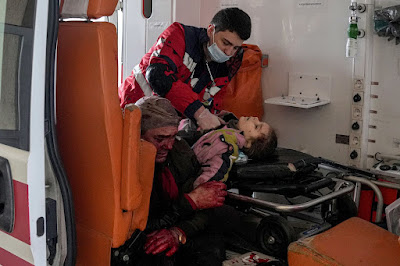
I IMAGINE FIRST LEAVING THE HOSPITAL

by Ying Wu


A wounded 6-year-old girl arrived at a hospital in Mariupol, Ukraine, on Sunday. Her mother wept outside the ambulance. Her father was at her side, covered in blood. The family was at a supermarket on the outskirts of the southeastern port city when Russian shelling started, according to the Associated Press. Now, a medical team was racing to save the young girl's life. "Take her out! Take her out! We can make it!" a hospital worker shouted. They placed her onto a gurney and wheeled her inside, where doctors and nurses fought to revive her. But she could not be saved. A doctor who was pumping oxygen into her looked into the camera of an Associated Press videojournalist in the room. "Show this to Putin," he said. "The eyes of this child, and crying doctors." Photo credit: Evgeniy Maloletka/AP —CNN, February 28, 2022


You step on the sidewalk.
 
Life breaks into pieces.
 
There are segments and thresholds.
 
Your child collapsed
when the missile exploded.
 
Your heel strikes the pavement.
 
Her body is there at the hospital, still—
but now, you’re outside.
 
Life crosses thresholds.
 
When your child was born,
you tasted forever.
 
But the sidewalk is sectioned.
Today, all the sections seem smaller.
 
Life is unknown.
It breaks into pieces—
 
and the space between heel strikes
can swallow you whole.


Ying Wu is a cognitive scientist at UC San Diego and executive editor of the Kids! San Diego Poetry Annual.  More examples of her work can be found online at Poetry & Art San Diego, Serving House Journal, Writers Resist, Poetry Pacific, and The New Verse News.  Her work is also featured in a permanent installation at the  San Diego Airport.  She leads research on insight, problem solving, and aesthetic experience and lives with her husband and daughter on a sailboat in the San Diego Bay.