Guidelines


Submission Guidelines: Send 1-3 unpublished poems in the body of an email (NO ATTACHMENTS) to nvneditor[at]gmail.com. No simultaneous submissions. Use "Verse News Submission" as the subject line. Send a brief bio. No payment. Authors retain all rights after 1st-time appearance here. Scroll down the right sidebar for the fine print.
Showing posts with label horror. Show all posts

Thursday, May 28, 2026

MASS SHOOTING #12

300 block of West Biddle Street, Jackson, MI, May 9, 2026

“Jackson Police investigate afternoon shooting that injured 4 locals.” —Mlive


by Ron Riekki


“watched his childhood;

Amid strange faces and strange forms.”

Mary Torrans Lathrap,

“The Wanderer's Grave”


“We're gonna draw a little bit of everybody's blood.”

—MacReady (played by Kurt Russell)

in The Thing (1982)


“freedom which is a crater

I keep falling in.”

Major Jackson,

“On Disappearing”


            i: Prologue


Between Fourth of July 2025 and Memorial Day 2026,

there have 837 separate shooting incidents in Michigan,

In 325 days, there have been 15 mass shootings here,

about one mass shooting every 22 days.  I started going


to mass shootings on July 4 last year.  On my birthday,

mid-May, we reached 1,000 people shot in Michigan in

just 11 months.  Currently, 1,042 people have been shot.

I have only one more month to go.  I can’t do it anymore.


            ii: Dialogue


On the way to Jackson, I pass a park, and a bail bonds office.

This is my first mass shooting I’ve gone to where the mass

shooter is a female, her bond set at a quarter of a million

dollars.  A May 9 headline reads “Attempted murder charges


against shooting suspect dropped shortly after her arraignment.”

The victims: a 21-year-old male shot twice in the chest and

once in the arm, 28-year-old male shot in the face and arm,

25-year-old female shot in the pelvis, and 23-year-old female


shot in the arm.  This doesn’t feel like a poem.  I don’t feel

like writing a poem.  I don’t feel sometimes driving to these

mass shootings.  The repetition.  The petitions that do nothing.

Worse.  It seems to be spreading to all of us.  A virus.  I feel


disgusted.  I discuss this with a woman who lives less than

a block from the shooting.  I’m talking to a female about

a female mass shooter who just shot two females in the arm

and, of all places, the pelvis.  The symbolism.  The city bright


green today.  I talk to her at the foot of her garden and

there are two men nearby.  Anna and Dan and an unnamed

man who reminds me of Seasick Steve (the musician whose

name I thought was Steve Gone Wild, but is actually Steve


Gene Wold, half-guitarist-wizard half-pirate); his doppel-

gänger floats in and out of the discussion of danger and

anger and it’s very city focused, talk of Romulus, Detroit,

Jackson.  And the three of them seem like they’d fit in with


the entourage of Action Bronson (of F*ck, That's Delicious

fame).  They tell me Jackson needs more community gardens.

On the way here, I passed a bike park, another park, a b-ball

court, and then the abandoned park near their home with its


rusty swings and weeds and graffitied slide and need of

upkeep and another basketball court, but this with no nets.

They tell me it’s the youth, that we didn’t do mass shootings

when we were young, tells me he handled a gun at age 8,


has a gun now, says “the problem is the access.”  Or is it

the excess?  Its infinity.  ∞.  I ask this.  He says they need gun safety.

I ask how gun safety is going to help a mass shooter.  It seems

gun safety is an oxymoron.  We talk more on how “it’s a vicious


cycle,” and when change is attempted “they get roadblocked

by the government.”  Anna says the problem is the chronic

violence of TV, video games, music, movies.  We’re not far

from Mount Evergreen Cemetery.  I don’t know about


the mount, but there’s green everywhere today.  I feel jaded.

It feels I’ve had this discussion before.  Gun owners telling me

there’s too much access to guns.  ?  They’re nice.  They’re open.

They’re enjoying the summer day.  One heard the gunshots.


One didn’t.  They tell me those who were shot know who did it,

but they don’t want to speak.  News says people are afraid

to talk, worried about getting protection.  There’s apparently

40 unsolved murders in Jackson.  We chitchat.  Wide open.


I worry America is guns.  Guns won.  Hell, it’s confusing.

It is Hell.  Kamala Harris, a Democrat, brags about owning

a Glock.  The Republican President can’t own a gun

due to his felony conviction.  They talk about how you’re


safe if you keep your nose clean, if you “stay away from

trouble,” from “people congregating.”  Perhaps we’re saying

you can prevent mass shootings by simply staying away

from people.  The myth that COVID reduced mass shootings.


We trade one virus for another.  I’m tired.  We don’t have any

solutions.  Or maybe we have too many solutions.  There’s no

silver bullet.  The conversations are triggering.  You try to offer

up solutions but get shot down.  We need to set our sites on


something better.  The language is gun-drowned.  Steve

tells me I need to go, that the dog wants to come out—

Zeus, their German Shephard.  He tells me the dog’s hairs

are standing on end, that he wants to come after me, that


it’s best to leave.  As I’m walking away, he shouts to my

backside, “If he doesn’t know you, he’s very aggressive!”


            iii: Epilogue


The realization, driving home, is that this wasn’t the only

mass shooting in Michigan on May 9, another in Muskegon.


And, on May 9, more mass shootings in Reddick, Florida,

and in Lake Charles, Louisiana.  We’re perfecting mass

shootings.  We’re teaching the normalization of mass

shootings.  Gun purchases increase after mass shootings.


The beauty is the ugliness.  Gun violence and capitalism

F*ck each other.  But there’s this strange revelation that it’s

the gun owners who get killed.  It’s gun owners who have

increased suicides in their homes.  It’s gun owners who have


increased homicides in their homes.  It’s gun owners who have

increased accidental shootings in their homes.  Safety comes from

actual safety.  It’s a horror film.  “Don’t go in!”  Guns are the thing.

And guns are The Thing.  It.  And It.  “The horror, the horror.”


Ron Riekki co-edited Undocumented: Great Lakes Poets Laureate on Social Justice.  

Tuesday, July 15, 2025

THE TIPPING POINT

by Jill Rachel Jacobs


(Ode to an Unseen Migrant During Perilous Times)


When evil comes a knocking, 

it may arrive with a vengeance, or 

incognito, like some 

Bible-thumping

good ol’ Joe, 

humping a flag.


("What we've got here is a failure to communicate")

When rage is sadness and 

sadness is rage, and it becomes

impossible to distinguish the two,

it’s not surprising we may recoil,

hidden in the shadows of the 

reality of what has become 

the new normal. 


("But I don’t want to go among mad people")

Like a cancer gone undetected, 

metastasized, 

cell by cell, 

dividing 

conquering,

licking wounds,

stealing secrets, 

tempted by madness,

trying to make sense of 

how we have now become 

that which we once loathed.


("Thank youSirMay I have another?")


When horror is contained, 

darkness has lifted, 

emerging from the underbelly,

dreams intact, 

still blinded by the 

innocence of children’s eyes, 

resting comfortably;

We wait.


("We have learned to see the world in gasps")


Unencumbered by reason,

justice now a luxury, 

in a world unrecognizable,

where compassion no longer prevails.


(How long? An hour, a year, a lifetime or two?)


When will we say when?

When prey becomes the predator,

When captors are held captive,

When cage doors are flung wide open.


Jill Rachel Jacobs is a New York based writer, poet whose poetry has been featured in numerous journals. Her features, commentaries, interviews have been published in The New York Times, Reuters, The Independent, The Washington Post, The Boston Globe, The Los Angeles Times, The San Francisco Chronicle, The New York Post, Newsday, The Philadelphia Inquirer, The Chicago Tribune, NPR’s Marketplace and Morning Edition.

Thursday, September 19, 2024

OPEN LETTER TO ‘WOMEN FOR TRUMP’

by Nancy Meneely


At least two dozen women have accused Trump of assaulting them or making unwanted sexual advances. The allegations against Trump run the gamut of groping, leering at underaged pageant contestants, forcibly kissing women without permission, and other instances of assault. —Daily Kos, September 7, 2024


We who have been raped
will not find words 
with gnarl enough
to let you know
how terrible it is
to face a rapist’s face 
on every screen,
to hate,
to know again the horror
felt as nausea
too deep to be expelled
and grief disguised as furious
for certainties that spilled
the moment when
the sudden stranger
pulled himself away,
grief for helpless,
never wholly safe again.
 
How little you must guess of us
when you cry love for him.
How careless you diminish me.


Nancy Meneely’s first book, Letter from Italy, 1944 (Antrim House) was noted by the Hartford Courant as one of thirteen important books by Connecticut writers in 2013. It provided the libretto for an oratorio of the same name, composed by Sarah Meneely-Kyder and performed twice by Connecticut choruses and symphony orchestras. Her second book, Simple Absence (Antrim House), was nominated for The National Book Award and placed as a grand prize finalist in The Next Generation Indie Awards and the 2021 Eric Hoffer Award.

Sunday, December 10, 2023

CASSANDRA SPEAKING AFTER OCTOBER 7, 2023

by Jan Zlotnik Schmidt


I huddle in a thicket  I have been through this for centuries 

Seeing   not stopping it  hearing screams  pleas  screeches  shots 


I still want to whisper to yell to stave off disasters 

but my words are ghost breath traveling down centuries 


I know about the arched spine in pain 

the bones whittled down thinned by loss 


I know the closed eyes that can’t stop seeing 

blue eyes brown eyes hazel ones drained of hope 


I know there are no sentences for horror for killing 

Just broken words like ankle bone breast bone thigh bone 


No dreaming flesh   no dreaming bodies 

No dreaming breath   always prophecies that come to pass 


No one listens to my warnings   just darkened earth  

withered grasses   stones of remembrance  


And the  blue thread of an empty story 

in an endless labyrinth of grief 


Jan Zlotnik Schmidt is a SUNY Distinguished Teaching Professor Emerita at SUNY New Paltz where she taught creative writing, memoir, creative nonfiction courses as well as American Literature, Women’s Literature, the Literature of Witnessing, and Holocaust Literature. Her poetry has been published in over one hundred journals including The Cream City Review, Kansas Quarterly, The Alaska Quarterly Review,  Phoebe, The Chiron Review, Memoir(and), The Westchester ReviewWind, and The Vassar Review. Her work has been nominated for the Pushcart Press Prize Series. She had two volumes of poetry published by the Edwin Mellen Press (We Speak in Tongues, 1991; She had this memory, 2000). Her chapbook The Earth Was Still was published by Finishing Line Press and another, Hieroglyphs of Father-Daughter Time,  by Word Temple Press. Her volume of poetry Foraging for Light was published by Finishing Line Press.  And her chapbook about Bess Houdini, the wife of Harry Houdini, entitled Over the Moon Gone: The Vanishing Act of Bess Houdini, recently was published by Palooka Press.   

Wednesday, March 16, 2022

ENDURANCE

by Martha Deed


" ...the appearance of Odessa is very handsome, the harbor is excellent."


He whistles “Yellow Submarine” as he passes by my window.
He is pushing a wheelbarrow loaded with large blocks of broken concrete.
Studied music in college, he tells me later. Now this (with a smile).

When they found the Endurance in 10,000 ft of water
videoed the stern still bright in red and gold, did they think
about the men who did not die there, but who now are long dead
or about what those seamen thought making their escape
across the living ice mindlessly crushing their ship, did that crew
have the peace of mind to consider the irony
of a shipwreck with no fatalities, the lifeboat journey
across a frigid ocean, the self-rescues, the endurance?

The digging continues—the rescue of a room less carefully
constructed than Shackleton's barquentine, the room
that did not endure, the room that is a small matter
in the universe although important to me, that may not
last 106 more years even if not sunk again, even if built
right this time like the shipbuilders of Marshfield
built the Smyrna, whose captain logged its voyage to Odessa,
the first American ship to anchor there in 1830,
the crew of 27 with a 5th cousin (6x removed) who
departed this life in 1887, said to be most proud
of the Mayflower ancestors that bind us into cousinhood,
could not have anticipated Putin's carnage in 2022.

All day, the wheelbarrows roll over wooden panels
laid across the spring mud yard from street to dig—
the thin young man with long black beard
now whistling the theme to Star Wars.


Martha Deed's poetry has appeared in The New Verse News and most recently in Moss Trill, Mason Street Blog, Autumn Sky Poetry Daily, Grand Little Things, The Skinny Poetry Journal.  Her poetry collections Under the Rock (2019) and Climate Change (2014) were both published by FootHills Publishing. She is a retired psychologist who makes trouble with poetry inspired by crises and other mishaps around her house on the Erie Canal in Western New York.

Thursday, March 10, 2022

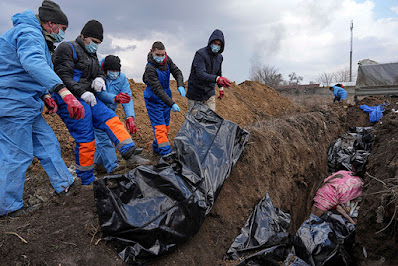
CONSIDERING WAR

by Amy Shimshon-Santo


Dead bodies are placed into a mass grave on the outskirts of Mariupol, Ukraine, on March 9. (Evgeniy Maloletka/AP)


considering that bombs 
leave craters in the earth
making it difficult
to mobilize hospitals,
carry pregnant mothers
across fields of rubble

comprehending the cold breath of sunday
broken bridges, 
families gathered beneath them 
without exact destinations
beyond a border

understanding that mammals with bombs
are cold hearted
explosive-death-machines, 
considering that men
—and I will call them that
because of their bombs —
explode sites
leaving the enduring silence
of family members

understanding that a cadaver
cannot speak

& I am just a storyteller
still living 
with the possibility of voice
I will make my breath a sign
painted in horror 
across the sky
that begs the bombing 
to stop


Amy Shimshon-Santo is a poet and educator who believes that culture is a powerful tool for personal and social transformation. Her interdisciplinary work connects the arts, education, and urbanism. She is the author of Even the Milky Way Is Undocumented (Unsolicited Press, Pushcart Prize & Rainbow Reads Award nominee). 

Monday, November 15, 2021

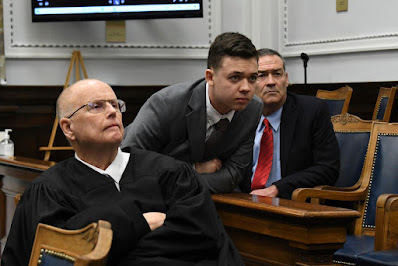
FOR THE BOY ON TRIAL

by David Southward


From left, Judge Bruce Schroeder, Kyle Rittenhouse and defense attorney Mark Richards watch a video Nov. 12 during Rittenhouse’s homicide trial in Kenosha, Wis. (Mark Hertzberg/Pool/AP via The Washington Post)


I don’t wish death
or solitary confinement
or even the hell
of half a life wasted
behind bars. No:
I want him to be stricken
with disgust—at the blood
he’s spilled, at the horror
of his rash heroics. I want God
to part the clouds of his mind
and set afire
its nest of fear and folly.
I want the clearing smoke
to open his eyes
to true manhood: the facing down
of an enemy hiding
within—the answering
of a people’s need
for sobriety, not messiah.
I want him to rise
above the buzzfed grapevines,
the twitter of rumor
and rumble of propagandas
and remember history:
to become his republic’s
most disarming
spokesman. I want him
to march and preach
civility—to be Prince Hal
to a nation of Hotspurs,
to become (in the unpredictable
flowerings of time)
our next King
of change.
 
 
David Southward teaches in the Honors College at the University of Wisconsin-Milwaukee. He is the author of Apocrypha (Wipf & Stock 2018) and Bachelor’s Buttons (Kelsay Books 2020)

Tuesday, March 20, 2018

THE BLOOD HAS STAINED OUR STREETS SOMETHING BAD

by DeWitt Clinton


Something is out there, and we’re all just a bit
Terrified of what’s going to happen next, but
What in the heck can we do about something
That we can’t even see when it’s coming about
To slash and twist us about so turning us into
Just about everything we’ve never ever wanted
To be, or even not be, and it’s just awful the way
Some of us know that it’s pretty hard to stop
What we don’t want, or grab at what we do
By crying out loud, or even whispering, but
Some suggest we find all our sleeping masks
And look around in the kitchen for kitchen knives
And run outside in the dark which is darker
Than we’ve ever known, but now we’re slashing
And stabbing and hoping one of those we
Think we’re gutting will be what’s started us
All into the panic we’re in, even on such a
Cold night in the smack dab middle of March
And we don’t want to make too much of it
But we do go out in the morning to see if any
Can find any blood splatters, anything that
Might let us know we’ve once again shaken
The cry baby who keeps us all up late at night,
Twittering and tweeting scaring the whatever
Out of us, but now we can rest a bit until the
Next blowhard makes a mess of something
Out there, which is really here, where we are.


Poems of DeWitt Clinton have appeared recently in Santa Fe Literary Review, Ekphrastic Review, Diaphanous Press, Meta/Phor(e)Play, and The Arabesques Review.  A new book collection of poems On a Lake by a Moon: Fishing with the Chinese Masters will be published in 2018 by Is A Rose Press, (Jerusalem) and a second book collection At the End of the War will be published by Kelsay Books (Hemet, Calif.) in the fall of 2018. He lives in Shorewood, Wisconsin.