Guidelines


Submission Guidelines: Send 1-3 unpublished poems in the body of an email (NO ATTACHMENTS) to nvneditor[at]gmail.com. No simultaneous submissions. Use "Verse News Submission" as the subject line. Send a brief bio. No payment. Authors retain all rights after 1st-time appearance here. Scroll down the right sidebar for the fine print.
Showing posts with label radio. Show all posts

Saturday, May 09, 2026

MIGRACIONES

by David Chorlton

on World Migratory Bird Day


Music in flight from the border tonight

and it’s pulling miles

of starlight behind it. Darkness

tuned to grosbeaks, orioles, homesick songs

and the Black-necked stilts

who come down at the golf course pond.

There’s an echo

to the ads between corridos

and the high romance that ends

in a flourish no matter

who stays and who leaves. The trogons

cross to occupy a canyon lined

with pine-oak where sycamores sing

to the daylight. Gray hawks

in the cottonwoods, tanagers where

the edge of woodland

overlooks a wide

and open valley dark priests occupied before

they named the land for

saints, and Black hawks looking down on it

from an indifferent sky.

Doves take back their city

for the summer in tune

with the natural order

of hunger and survival. 103.5, La Tricolor,

playing until morning and then

in the yard, russet crest and

greyly greened, the unmistakable

Trepador cola verde.


David Chorlton lives in Phoenix, Arizona. He writes, paints, and keeps track of which birds show up locally. Originally from Europe, he has learned that not all truth and beauty is to be found in museums and cathedrals (much as he enjoyed seeing them) but in wildlife.

Friday, April 03, 2026

HARRY HINES BLVD, DALLAS, TX, 0647 AM

by Kay White Drew

Taillights stream by like corpuscles thru blood vessels, branches
off the aortic arch (there’s a mnemonic for that I’ve forgotten),
blurred and softened by the translucent window shade.
Traffic lights turn from green to brief yellow to long red,
downtown skyline hulking in predawn distance, the stark ovoid 
tower of the Renaissance Hotel lording it over the rest.
A mile down the road, my brother sleeps in an isolation room,
his embattled bone marrow doing what it can to recover
from the chemical onslaught it’s been subjected to
in the name of healing, even as the drivers of these cars
whizzing by my 3rd floor hotel window go about their business—
driving to work, worrying about their bills and their kids
and their ailing parents, listening to some false prophet
on the radio telling them it’s all the fault of the immigrants
and the trans people rather than the demented tyrant in the White House.
How many miles from here to the nearest of the concentration camps
(and how many are there in this state?) where the people detained
would give anything to be driving to work, worrying
about an overdue mortgage payment or a wayward teenage son.
These hulking urban clusters, the fruit of oil/blood money,
can’t help but draw my contempt, even my hatred…
Yes, I hate you, Dallas, not just because my brother’s dying here,
but because our country is, too.
 

Kay White Drew is a retired physician whose poems appear in various anthologies and internet outlets including The Intima, GargoyleSecond Coming, and New Verse News. She’s also published short stories and several essays, one of which was nominated for a Pushcart Prize, and a memoir, Stress Test, about medical school in the 1970s. She lives in Rockville, MD with her husband. Reading and spending time in nature keep her sane(ish) in these difficult times.

Sunday, March 30, 2025

PERIOD PAINS

by Adele Evershed


On the radio, they talk about having a temper, as if it’s a wild creature, something you house in your chest—either caged or rampant. But the bigger conversation is about the trouble with boys, fueled by the latest viral offering on Netflix: Adolescence, which touches on the toxic brew of manhood and violence against women. I’ve watched the show, and unlike most sausage-stuffing series, it offers no explanations—no cathartic “I guessed that all along” or shocking dénouements. You’re left with more questions than answers. It’s simply a story about someone’s son who does something bad, and in the margins, there are glimpses of misogyny, of mob thinking, illustrated with kidney beans and dynamite emojislook them up, especially if you have teenagers.

But then a man rings in and talks about how “what it means to be a woman” has changed over time, how this has been embraced and encouraged, and unbidden, the Beyoncé song Run the World starts a beat in my chest that tames my beast. Then he adds that “what it means to be a new man” has been ignored, but when asked how to combat that, he’s stumped. Finally, he says, “We need to talk about it.” And there’s the rub—because in my experience, men like to run the world, but find it hard to talk about things they consider “female vices” like accountability, coping strategies, and keeping their temper.

blood moon…
I ask my husband to buy
some tampons
 

Adele Evershed is a Welsh writer who swapped the valleys for the American East Coast. You can find some of her poetry and prose in Grey Sparrow Journal, The New Verse News, Gyroscope, Modern Haiku, Frogpond, Janus Lit, and upcoming in Poetry Wales. Adele has two poetry collections, Turbulence in Small Spaces (Finishing Line Press) and The Brink of Silence (Bottlecap Press). Her third collection In the Belly of the Wail is upcoming with Querencia Press. 

Tuesday, April 16, 2024

WAR SONGS AND OTHER LAMENTS

by Adele Evershed


In the quiet of a collective breath-holding / Ladies Night / accidentally played on the radio / so an Israeli spokesman / delivered words / about exacting a price from Iran / to the throb of a disco beat 

I listened to the ballistic bass / and retorting trumpets / cut with words of war / as if this was a movie / the music an ironic middle finger / to the inevitability / of the end of the world / and it seemed like another sign / in a week of medieval omen 

After / the BBC made no mention of their mistake / Johnnie Walker just played the song / so we could all ignore / our electric slide / toward a bigger conflict / since Kool & The Gang / insisted everything would be alright 

And if it really was 'ladies night,' that might be true / if women were in charge / drones would be used / to make sure daughters got home safely / and sons would be iron-domed / so they didn't lay down precious lives / because they belonged to one tribe / or another

Instead all we can do is watch the sky unnaturally darken and try to remember how to breathe


Adele Evershed is a Welsh writer who now lives in America. Her poems and flash fictions have appeared in Grey Sparrow Journal, Anti Heroin Chic, Gyroscope, Janus Lit, and many other places. Adele has been nominated for the Best of the Net and the Pushcart Prize for poetry and short fiction. She has published two poetry chapbooks, Turbulence in Small Places (Finishing Line Press) and The Brink of Silence (Bottlecap Press). Adele has published a novella-in-flash, Wannabe (Alien Buddha Press), and a short story collection Suffer/Rage (Dark Myth Publisher).

Monday, July 25, 2022

I DREAMED LAST NIGHT

by Gordon Gilbert


I dreamed last night of seasons of unrest that lie ahead:

Saddled on nightmare steeds with fiery nostrils,
eyes of cold blue light and blood pouring down their heaving flanks,
apocalyptic horsemen rode over our lands,
setting farms and fields ablaze and poisoning the wells;
pestilence, drought and famine followed in their wake.

Monstrous firestorms swept across tinder-dry forests,
consuming all, obliterating every living thing  in their path;
whirlwinds that followed gathered up the dust and ash
and blotted out the sun.

Insufferable desert heat by day, 
unbearable desert cold by night.

All of our tomorrows, 
only the broken promises
of those who too long led us in denial.

All of our future days, 
each and every one in turn,
fading away into a long parade 
of sad and sorry yesterdays.

This morning I awoke to the radio:

The meteorologist was saying 
it’s unseasonably warm for this time of year,
and the temperature is rising.


Long-time NYC west villager Gordon Gilbert has found solace and inspiration during the pandemic in walks along the Hudson River, photographing and writing about the wildlife, flora, and river traffic as the seasons change. It gives him hope in these terrible times, but he knows that is not enough. Change only comes when we act to make it so.

Saturday, July 23, 2022

HEAT WAVE

by W. Luther Jett


Muffled staccato—
summer voices
too distant to be
understood—I try
not to stress the
circuitry mid-day—
douse the lights,
draw the shades.
A song from fifty
years ago plays on
my radio of memory
at 103 on the dial.


W. Luther Jett is a native of Montgomery County, Maryland and a retired special educator. His poetry has been published in numerous journals as well as several anthologies. He is the author of five poetry chapbooks: Not Quite: Poems Written in Search of My Father (Finishing Line Press, 2015), Our Situation (Prolific Press, 2018), Everyone Disappears (Finishing Line Press, 2020), Little Wars (Kelsay Books, 2021), and Watchman, What of the Night? (CW Books, 2022).

Thursday, July 30, 2020

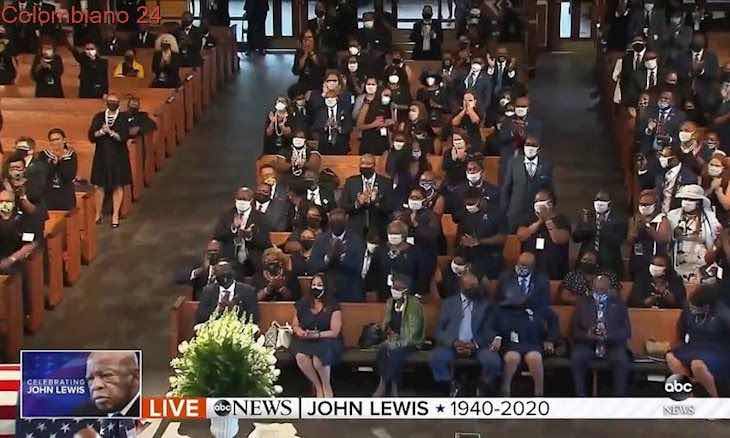
LISTENING TO JOHN LEWIS’S FUNERAL

by Penelope Scambly Schott


Yes, the singing, the speakers,
relatives, co-workers, mayor,
yes, three former presidents
(though not the racist-in-office),
their memories, tributes, praise,
but today it was the audience
in the Ebenezer Baptist Church,
that place sanctified by history,
how we, listening on the radio
to the speeches and applause,
could also hear people breathe
and hold their breaths, call out,
respond, agree, speak it aloud.
Say it, brother. Say it, sister. Amen.


Penelope Scambly Schott is a past recipient of the Oregon Book Award for Poetry. Recent books are House of the Cardamom Seed  and November Quilt.  Forthcoming is On Dufur Hill, a sequence of poems about a small (pop. 623) wheat-growing town in central Oregon.

Tuesday, July 21, 2020

POWER OUTAGE

by Laura Rodley


No Covid here, just sleeping dog, sleeping cat,
no Covid here, doorknobs wiped off, laundry dry,
no Covid here, breeze courting sparrows and wrens,

no Covid here, the leaves of the maples turn it away,
no Covid here, the mice at the gates chew it away,
no Covid here, sparrows, rose breasted grosbeaks peck at its crumbs,

no Covid here, tomato plants flowering, lettuce plumping,
no Covid here, sleeping dog, sleeping cat, popsicles,
no Covid here, last night power outage, lightning bugs for lamps,

no Covid here, the chipmunks carry it away in fat cheeks,
no Covid here, porcupines shake their quills at it,
no Covid here, table umbrella up, providing shade,

no Covid here, alcohol preps in front hallway,
no Covid here, doorknobs wiped off, floors vacuumed,
no Covid here, front line Jim took navy shower, conserving water,

no Covid here, clothes off, decontaminated,
no Covid here, hands washed, twenty seconds, length of a long sigh,
no Covid here, watermelons holding onto their flowers,

no Covid here, only the clock ticked, told time, trembled,
no Covid here, candles on the table, matches, no flushing toilets,
no Covid here, lightning bugs gathered on screens, blinking,

no Covid here, neighbors wear no masks walking,
no Covid here, they say they had it, but could not get tested,
no Covid here, they say they can’t get the antibody test either,

no Covid here, antibody test hard to get, they work at home,
no Covid here, no internet, no wireless lightning bugs beating,
no Covid here, the fox carries away all corpses.

No Covid here, garter snakes keep guard in the garden,
no Covid here, maple tree leaves wave it along its way,
no Covid here, the grounds area guarded by field mice,

no Covid here, grass covered with spent dandelions, comfrey,
no Covid here, pathway into forest deep and long, but it ends.
No Covid here, sonic boom of jets propel it away,

no Covid here, rock and roll radio, oldies station,
no Covid here, new grass won’t allow it, nor the chipmunks.


Laura Rodley is a Pushcart Prize Winner. Her most recent books are Turn Left at Normal (Big Table Publishing) and Counter Point (Prolific Press).

Friday, May 08, 2020

QUARANTINE AUBADE

by Juditha Dowd


"Lifeline" by Pascal Campion


The trucker is hauling food. We often hear him down on
the river road around this hour, hitting his Jake brakes,
slowing his rig on the curves. The sound bounces up and out,
finds us here on College Hill—wide-awake at four o’clock,
trying to return to sleep. He pauses at the highway ramp,
crosses the river, picks up speed. Soon he’ll unload at a market,
where workers rush to stock the shelves, where items spurned
for years are in demand: dry beans, yeast and prunes.
And here in the dark I’m my grandmother’s little girl again,
helping to squeeze red dye into bags of oleomargarine, waiting
to eat the biscuits she’ll take from her small white oven
while she listens to the radio, hopes there may be a letter today
from my uncle in the Army. Always the waiting. For the
the morning paper, twice-daily mail. Always we want news.
Bless our neighbor leaving now for what must be essential work.
Beams from his headlights circle the room. Birds are beginning
to stir, recalling those childhood mornings when I rose ahead of
my family, roused by their chorus, lifted into the dawn on wings.
After breakfast I’ll weed radishes we planted on a day that seems
like years go. Despite a killing frost, they’ve sprouted leaves.
Light is on the way. See how the air is whitening? That there’s
food … and those who must be fed. No certainties but these today.


Juditha Dowd’s latest book is Audubon’s Sparrow, a verse biography in the voice of Lucy Bakewell Audubon, out this month from Rose Metal Press. She has contributed work to many journals and anthologies, including Poet Lore, Poetry Daily, Spillway, Ekphrasis, Rock & Sling, and Florida Review.

Thursday, April 30, 2020

LULL

by Rick Mullin


Another month of stay-at-home-or-die.
The choice is getting tougher day by day!
A toss-up in the waning April sky
as gun enthusiasts come out to play
a game with cable news. Misspelling hate
as usual. Extolling T***p and Pence,
co-opting clumsy slogans from the left
about the right to choose. Try making sense
of their disdain for science. The bereft-
of-access taking on the Nanny State?
We’d buy it if the even-less-endowed
were not in body bags at Lost and Found.
We switch to radio. It’s not as loud
and, next up, we’ll have something from The Sound
of Music—Stick around for “Bach at 8”…


Rick Mullin's newest poetry collection is Lullaby and Wheel.

Friday, February 09, 2018

ON HEARING LOSS

by Melissa Bentley


A poster in Kasur, Pakistan, includes a picture of Zainab and the message: "Protest. Protest. Protest. Daughter Zainab, we are ashamed. But if not now, then never. Zainab, in light of your martyrdom, we will seek accountability for all similar events in the past. We will not rest without that." Photo by Diaa Hadid/NPR, February 1, 2018


From the comfort of my heated driver’s seat,

I listened to a Pakistani Mother pray
for God to hear her plea
   for the safety of

        her
    daughter
                   her
                  child,

whom the reporter had just told me
was found on a trash heap near her home -
raped, murdered, thrown away,
before the age of 6.
That child will not sit up on that heap of shit,
slide down, and take the short walk home today.
She will not show up at her Mother's door
now, tomorrow, or
               
                    ever.

I’m watching the sun rise
on my drive,
in pink and mellow skies,
listening to a Mother’s cries.

You tell me,
does God hear a
Mother’s prayer?


Melissa Bentley lives in North Carolina. She enjoys a variety of creative activities in addition to her day job.

Sunday, September 24, 2017

SUNDAY MORNING IN ST. LOUIS

by George Salamon


Police arrested at least 22 people in a protest at the St. Louis Galleria on Saturday, September 23 amid the continuing reaction to the acquittal Sept. 15 of a white police officer in the shooting death of Jason Stockley.  —Photo tweeted by Derk Brown


Water on the stove is boiling,
I slice a loaf of bread.
Restless, I press the power button
On my small kitchen radio.

"North Korean crisis heats up,
Washes whiter than ever,
Military option is on the table,
Big tech stocks are on the rise."

I don't pound the radio to smithereens,
Its voice of terror soothes me,
Its familiarity calms me,
Confirming most of us are still alive.

In St. Louis, protesters are marching and shouting again. Then those not arrested go home.


George Salamon lives in St. Louis, MO.

Saturday, November 19, 2016

FOR THE PLEASURES OF SERIOUSNESS

by David Chorlton


But I think there's an appetite for seriousness. Seriousness is voluptuous, and very few people have allowed themselves the luxury of it. Seriousness is not Calvinistic, it's not a renunciation, it's the very opposite of that. Seriousness is the deepest pleasure we have. But now I see people allowing their lives to diminish, to become shallow, so they can't enjoy the deep wells of experience. Maybe it's always been this way, when the heart tends to shut down. If only the heart shut down and there were no repercussions, it would be O.K., but when the heart shuts down, the whole system goes into a kind of despair that is intolerable." —Leonard Cohen to Anjelica Huston in Interview, November 1992


Strange, how a voice
can stay beside a person
for forty years without
its owner ever
stepping forward to be
introduced. On a cold night
in Vienna the vinyl
sang “Suzanne” for company
in a small apartment
with no view except
onto a lonely courtyard
starlight could not reach.
“It’s four in the morning . . . “
and always was
even on the radio
AM show. “Howdy”
said the host in his best
Austrian-English before
pronouncing Le-on-ard Co-hen
to introduce a song
that matched the weather.
Years later, in an Arizona
mining town
entering retirement
a poet set the needle down
and “One by one the guests arrived”
across the desert hills.
Deeper now
and deepening, the timbre
ripened with experience
passing through years
stained by war until it
could “run no more
with that lawless crowd
while killers in high places
say their prayers out loud.”
Everybody knows
what he referred to
while few could say it
with such elegant simplicity.
Out walking, when
a song came uninvited
to mind, it told me “We are ugly
but we have the music.”
It could plead
for “the light in the land of plenty
to shine on the truth someday.”
Whiskey warm
and cured in decades
of cigarette smoke
the voice endured
with a smile depression
can’t erase. In my Secret Life
I smile too, but in recognition
more than humor.
A man in his mid-seventies
ran skipping onto stage
to perform the soundtrack
for many of our lives. He was
still reading our collective minds
while opening his own.
He left the stage
the time I saw him
after three hours with a thousand
people, addressing us
one by one.


David Chorlton first heard Leonard Cohen songs on Austrian radio when he lived in Vienna. Since moving to Phoenix in 1978 he has kept up with new releases in between excursions to enjoy Arizona's landscape and wildlife. His Selected Poems was published by FutureCycle Press in 2014.

Monday, January 25, 2016

THE DAY THE POLKAS CRIED

by Laura Rodley


For thirty-seven years
Billy Belina drove in early morning light
or total dark to spin the polkas
on WMUA on Saturday,
not for the love of money
because he wasn’t paid
but for the love of the polkas.
Joined by Mitch Moskal and friends,
Polka Celebration ended
this morning with little warning,
cut by the powers that be
from UMass University.
Petitions are being signed
and voices raised but polkas
have been out-phased,
though folks listen on line
and twenty seven hundred
have signed from Japan
to Australia, to Chicago, polka land.
So many musicians, so many bands,
fifteen thousand shows
spurring polka music on,
but as of 11:45, that’s all gone.      


Laura Rodley’s New Verse News poem “Resurrection” appears in The Pushcart Prlze XXXVII: Best of the Small Presses (2013 edition). She was nominated twice before for the Prize as well as for Best of the Net. Her chapbook Rappelling Blue Light, a Mass Book Award nominee,  won honorable mention for the New England Poetry Society Jean Pedrick Award. Her second chapbook Your Left Front Wheel is Coming Loose was also nominated for a Mass Book Award and a L.L.Winship/Penn New England Award. Both were published by Finishing Line Press.  Co-curator of the Collected Poets Series, she teaches creative writing and works as contributing writer and photographer for the Daily Hampshire Gazette.  She edited As You Write It, A Franklin County Anthology, Volume I and Volume II.

Saturday, May 24, 2014

MEMORIAL DAY WEEKEND: ISLA VISTA, 2014

by Marjorie Maddox


Aftermath. Photo by Irfan Khan / Los Angeles Times. “Seen through a bullet hole, IV Deli Mart owner Michael Hassan cleans up his store near UC Santa Barbara. A gunman fatally shot someone there.”
     “Authorities on Saturday afternoon removed three bodies from the apartment of the suspect in Friday night's shooting rampage that left seven people dead in Isla Vista, near UC Santa Barbara.” --LA Times, May 24, 2014


On this weekend for honoring the dead,
more dead, the radio blasting updates
between ballads, Beach Boys, the “Battle
Hymn of the Republic.”

Friday night post-graduation
in a college town not unlike ours,
sorrow drenched in war songs and the same
bloody questions we’ve mourned before,
each grief mounting beyond what we feared
possible, and possible again,
the way the radio keeps blaring
Sousa, worse-case-scenarios drumming still
worse long after we’ve tried
to turn the knob, silence the sound waves,
to finally and forever
disconnect the throbbing beat
between each patriotic wave
of the half-mast flag.


Director of Creative Writing and professor of English at Lock Haven University, Marjorie Maddox’s book,  Local News from Someplace Else (Wipf & Stock 2013), focuses on living in an unsafe world. In addition, she has a new ebook, Perpendicular As I ( Kindle version, Nook version, Kobo version).

Friday, November 01, 2013

75 YEARS LATER

by Mark Danowsky


I put on my headphones
in preparation to head out
with the dog, tuned in
to public radio, but paused
hearing,

Our army wiped out . . .
artillery, air force,
everything wiped out. This
may be the last broadcast.
We'll stay here to the end . . .  


And I might have paused longer
had I tuned in when he said,

Police and army reserves are unable
to control the mad flight. By morning
the fugitives will have swelled
Philadelphia, Camden, and Trenton,
it is estimated, to twice
their normal population. At this time
martial law prevails throughout
New Jersey and eastern Pennsylvania.


But the old-timey recording quality
was a dead giveaway. And had it been
Audie Cornish or Robert Siegel
instead of Orson Welles
I would have re-bolted the front door
then run to the newsfeed.


Mark Danowsky’s poetry has recently appeared in Mobius: The Journal of Social Change, Red River Review, Right Hand Pointing, Snow Monkey and The Best of Every Day Poets Anthology Two.  He resides in Northwest Philadelphia and works for a private detective agency.