Guidelines


Submission Guidelines: Send 1-3 unpublished poems in the body of an email (NO ATTACHMENTS) to nvneditor[at]gmail.com. No simultaneous submissions. Use "Verse News Submission" as the subject line. Send a brief bio. No payment. Authors retain all rights after 1st-time appearance here. Scroll down the right sidebar for the fine print.
Showing posts with label teachers. Show all posts

Thursday, January 01, 2026

WE CAN MAKE IT SO

by Gordon Gilbert

in support of Zohran Mamdani


We say, 


“Nothing changes but we make it so!”   


“But change wreaks havoc on our world!” 


say those who would lecture us

on what they say we all should know.


It must be said that these "teachers" are older,

more well-off, and very much invested

in this world that they love so,

while we are young and still have little…


So we would say to them, 


“That’s a good thing! 

We have little to lose!" 


We can be bolder than those older,

and there is so much to be gained! 


And this much we know: 


Nothing changes but we make it so!   


Gordon Gilbert is a NYC west village writer who takes walks along the Hudson River to find some relief in nature from the almost daily unrelenting bad news. But he finds reason to hope for a better 2026 with the new mayor, Zohran Mamdani.

Thursday, September 05, 2024

JUST ANOTHER DAY AT SCHOOL

by Peter Witt


At least four people were killed and multiple people injured after a shooting Wednesday at a Barrow County high school, near Atlanta, the Georgia Bureau of Investigation announced, adding that a suspect was in custody. Photo: Women embrace following the shooting. (Elijah Nouvelage/Reuters)—The Washington Post, September 4, 2024


A fourteen year old killed two innocent children Wednesday,
along with two teachers, somebody's sons or daughters,
partners or parents, people who will be saddened,
no devasted, as the police call asking
a relative to come to the morgue, the death house,
to identify the body of a child or an adult who rose this morning,
dressed, said goodbye to their loved ones, forever,
and headed out the door to school, where they waited 
for a 14 year old with access to a gun to shoot them, 
dead, dead, dead. dead.

And the best we'll be able to do is thoughts and prayers,
as the gun lobby mounts another round of efforts
to suppress any reasonable action, as talking heads
are paraded across the TV screen with the same tired
rhetoric, while anti-reform legislators collect 1000s
of dollars to stand pat, do nothing 
again, and again, and again, and again.

Soon there will be funerals, with tearful parents,
loved ones, a community of people holding candles,
perhaps a politician speaking truth about killing machines 
in the hands of children, young people hugging each other, 
while hallways and classrooms are cleaned,
students and community members are offered counseling, 
so in a short period of time school can resume,
funds can be raised for a permanent memorial,
and the issue can disappear from the news
until the next young person gains access to a gun,
access to a school and puts out the light
again and again and again and again
in another group of young people
and dedicated teachers’ eyes.


Peter Witt is a Texas poet who is repulsed by the argument that people kill people not guns...it's obviously both...he has published his poetry in a wide-variety of outlets.  When he's not writing he's out birding and reinforcing his understanding of the human connection to the natural world. He and his wife also travel extensively, having just returned from Iceland/Greenland, where the witnessed first hand the impacts of climate change.

Saturday, July 29, 2023

KNOW THE VICTIM; KNOW THE SHOOTER

by Laura Lindeman


I know the victim!
knew…
Time in suspension 
For his extravagant antics:
Bouncing down the halls,
Bouncing words at teachers,
Bouncing a few punches 
off the faces of his peers.
But his smile races through a room 
Like lightning!
Dreads dancing on his head with the energy of a
Superbowl halftime show…
He was mischief and enthusiasm and zest!

But living in danger
His speed and agility 
Weaving through the violence
Not enough to protect him from the turbulence
Of generations of white oppression’s
Black destruction.

Armed by his family
False security in his sagging waistband.
At sixteen—just smart enough 
To make irrational risk 
Look adventurous.

Maybe this is why there used to be curfews?
Reasoning of the prefrontal cortex not fully formed 
For another half dozen years;
Which he won’t experience.

His unique weapon—fancy firearm
Not a secret.
Proudly waved 
Like a flag…
Or a dare.

During the next news cycle
I realize
I also know the shooter.
He took the dare;
Captured the flag.
Wanted the weapon of his friend.

Like two-year-olds in a sandbox
Tussling over a Tonka Truck.
What did they say?
“Mine.”
“Mine!”
“Give it!”
Bang…

Silence.

I know the shooter.
Smart, articulate
First year in middle school
Studying with headphones—Beats he called them.
Asking deep questions
Seeking complex answers
Quoting Tupac and Jay-Z

But survival on his block
Translates school as
“White people shit”.
Only slick, stark self-preservation
Was rewarded there.
The Seventh Sense
Of street survival.
Cutting classes,
Cursing teachers,
Curtailing disrespect from peers
At all costs.

Take what you want!
Command the room
      the block
      the bitches
      the boys.

So when he wants his bro’s gun,
He takes the weapon;
Takes the shot;
Takes the life.
Takes the arrest,
The parole violation.
Takes his OG’s soul
Her head in her hands in the court room.
Takes residence in a cell
No bail.
Taking traded for youth, freedom and “potential”

Barely a teenager
Playing adult games 
And losing.
Losing high school,
And chess club.
Losing a driver’s license and 
The right to vote.
Losing his siblings and 
His chance to age.
If tried and convicted as an adult
He’ll be incarcerated 45 to life.
Either way, life will be the sentence.
For the rest of his years, days, hours and moments
He will be dogged by the memory and 
Haunted by the choices 
He didn’t make:
To walk away,
To let go of the gun,
To put friendship over face-saving
And laugh at his own pretension

Stuck at fourteen forever.
Trauma imprints
Even if denied by bluster
He can’t out-run
out-shout
out-shoot
or fake out
His own fledgling soul.

I knew the victim;
I know the shooter.
Again.


Laura Lindeman is a new poet who has just decided to submit some poetry for publication with the help of a friend. This poem is a political poem focusing on gun violence, and as you will read, is based on her knowing, as a teacher, two teenagers before they became shooter and victim in a real-life tragedy. The poem speculates based on material revealed in news reports, but the poet has no first-hand knowledge of the crime itself.

Monday, July 24, 2023

AN OPEN LETTER EXPLAINING ELEMENTS OF OUR NEW, IMPROVED, AND DECIDEDLY UNWOKE CURRICULUM

by Dick Westheimer


Dear Parent,
 
We believe in children. We believe 
in padded playgrounds and unscuffed knees 
and helmets and a bubble wrapped curriculum 
lined with velvet and free from troubled ideas.
 
We believe our teachers should teach
like painting and planting for their personal benefit,
that residents of Auschwitz knew the trick of how 
to lose weight and look so fit, that members 
of the Five Tribes, removed for their own good, 
 
We believe those seeking refuge (whose boats 
overturn) might learn to swim, that those 
with black-lung get to sit in front of their TVs
in their BarcaLoungers with their very own 
government issued oxygen tanks, that Catholic 
boys get personal tutoring in anatomy from 
respected men in their white collared shirts, 
that trafficked girls get to travel the world 
and meet new friends.
 
We believe children should learn nothing
about those pre-teens head-bent in sweatshops
sewing their shoes, or two-year-olds toddling 
in electronics junk yards recycling their PCs
or tweens armed and taught to harm their kin. 
 
We do this for you, dear parent 
because, we are committed to protect 
you from Judgement Day when 
Johnny or Susie asks what 
you could have done and why, 
dear parent, you didn’t. 


Dick Westheimer lives in rural southwest Ohio. He is a Rattle Poetry Prize finalist. His poems have recently appeared in Whale Road Review, Innisfree Journal, Gyroscope Review, Banyan Review, Rattle, Ritual Well, One Art, and Cutthroat. His chapbook A Sword in Both Hands: Poems Responding to Russia’s War on Ukraine is published by SheilaNaGig.

Wednesday, June 01, 2022

ANNIE

by Judith Terzi


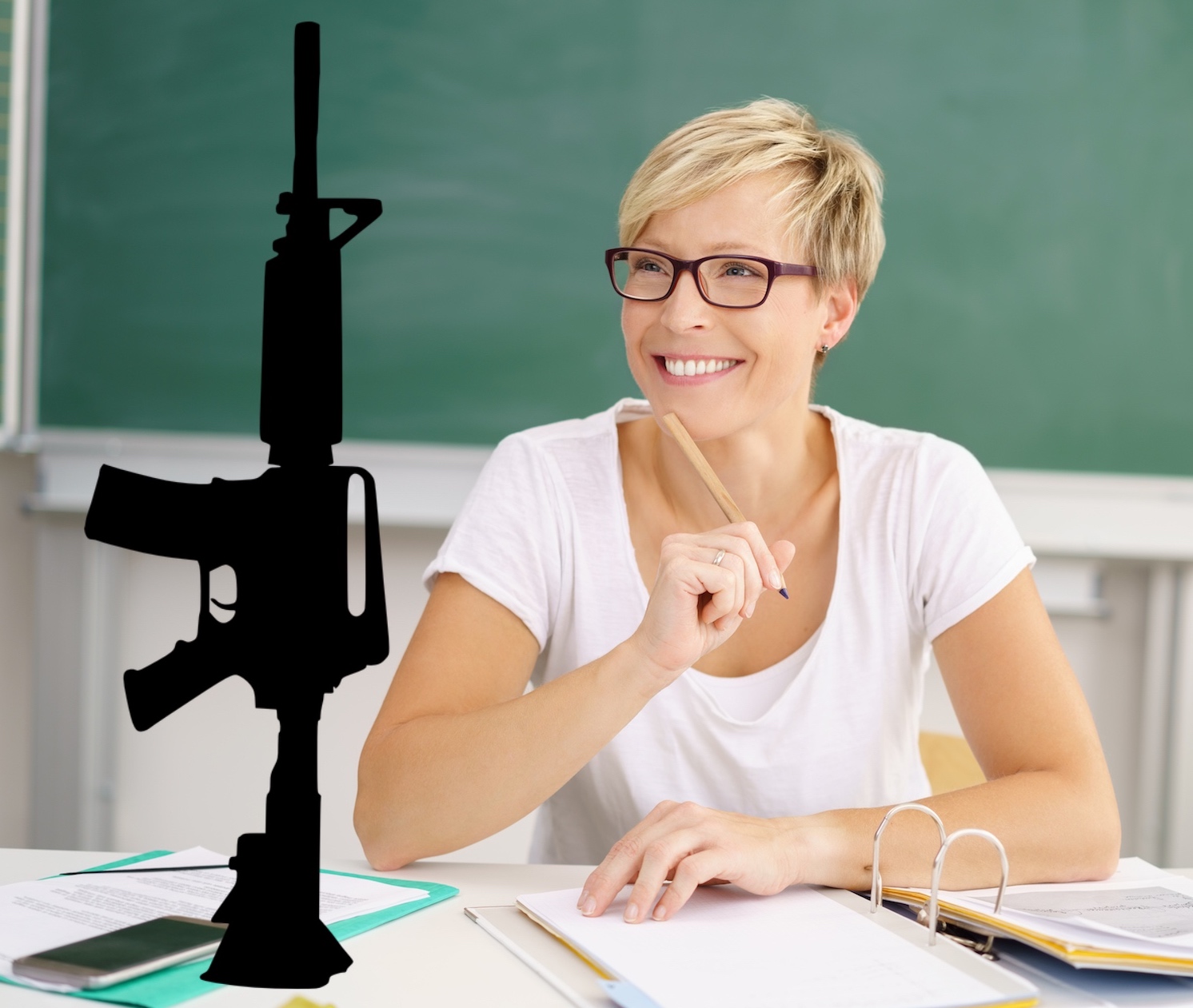
Arm me, I'm a teacher. Give me the best
that you've got. A pistol won't cut it. With 30 kids
in a class, a couple of shots too few. I'll need
an AR-15 to prevent the next slaughter. And give me
time above all. I'll need time off to learn what I'm not
trained to do. And give me a double to plan all my
classes, correct all the math, the history, the English,
the science, geography. The reading. And give me
another one to attend all the conferences, the meetings.
The kids will get why their teacher's not there.
They heard those big men on TV declare
that teachers are the absolute key to keeping them safe.
Oh give me the guts to learn how to kill.
Make me a sharpshooter, an Annie, if you will.


Author of Museum of Rearranged Objects (Kelsay), as well as of five chapbooks, Judith Terzi's poetry appears in a wide array of journals and anthologies. Her poem "Ode to Malala Yousafzai" was read on an episode of BBC/Radio 3's Words and Music. A new chapbook, Now, Somehow, will appear later this year. She taught French for many years in Pasadena, California, as well as English at California State University, Los Angeles, and in Algiers, Algeria.

Tuesday, May 31, 2022

MY DAUGHTER, A HISTORY AND HOLOCAUST EDUCATOR, SAYS IT’S IMPORTANT WE BEAR WITNESS; WE BOTH KNOW IT’S NOT ENOUGH

by Laurie Rosen


Two days after their daughter, Alexandria “Lexi” Aniyah Rubio, was shot and killed in Uvalde, Texas, Kimberly Rubio and her husband are urging elected officials to pass restrictive gun laws to help prevent future tragedies. “We live in this really small town in this red state, and everyone keeps telling us, you know, that it’s not the time to be political, but it is—it is,” Ms. Rubio said, her voice breaking through tears. “Don’t let this happen to anybody else.” Their family was contacted by Gov. Greg Abbott’s office on Wednesday, she said, and asked if they would be willing to meet with the governor. Ms. Rubio and her husband declined. —The New York Times, May  26, 2022. Photo: People visit a memorial for the victims of the mass shooting at Robb Elementary School on May 28, 2022 in Uvalde, Texas, United States. Anadolu Agency/Anadolu Agency via Getty Images via CHRON


He lays still, pretends to be dead. 
He frantically calls his mom from his classroom,
she hides under a desk, covers herself with her dying friend’s blood,
she whispers on the phone to 911, send police,
he hears a bullet crack his friend’s nose.  
She hears a cop shout to her, yells help, gives away 
her hiding spot, then promptly succumbs to gunshot. 

A husband dies broken-hearted two days after his wife perishes 
by gunfire—four children, left parentless.  
A mother’s son never returns home.
A father’s daughter, a cousin, a nephew, never return home. 

This is not a war zone/This is a war zone/We live in a war zone.
Our children grow up in a war zone, are taught to escape killers, guns
and madmen/Our children learn they won’t escape madmen with guns, 
that bullets meant for war pierce metal doors, tear off locks. 
Bullets ravage the faces and bodies of teachers and best friends, forever haunt 
survivors' dreams––nightmares of pooling blood and mangled flesh.

Our children promise to stay still and quiet/If only they stayed still enough, quiet enough. 

I did good Mommy, I stayed still, I stayed quiet.  


A lifelong New Englander, Laurie Rosen’s poetry has appeared in The Muddy River Poetry Review, Oddball Magazine, Zig-Zag Lit Mag, Peregrine, The New Verse News, Gyroscope Review, and elsewhere.

Friday, May 20, 2022

I AM THINKING ABOUT AMERICA TODAY

by Cecil Morris


A counselor attends to a grieving woman outside Geneva Presbyterian Church in Laguna Woods, Calif., site of a "politically-motivated hate incident" shooting which left a prominent doctor dead and another five people injured, on May 15. (Leonard Ortiz/MediaNews Group/Orange County Register/Getty Images) Photo illustrating “A weekend of violence punctuates generations of hate.” —The Washington Post, May 18, 2022


I am thinking that more people need more guns, many, many more guns in the hands of many more people, even young people, people too young to be trusted with books or ideas or facts or contraception or health care. If everyone has guns—both long and short and semi-automatic, bump-stopped and rapid-fire, with magazines large and small—then those bad guys with bad aims will be outnumbered and outgunned and no amount of metal-clad body armor will protect them. How else can we be prepared for the communists invading from Russia or Mexico or Cuba or Venezuela? How else stop the socialists spilling out from Blue States, flooding out from urban centers to America the Beautiful home of brave and unalienable rights. I am thinking Kid Rock or Ted Nugent or Lauren Opal Boebert or MTG needs to follow Dolly’s baby-book give-away example: a gun for every real American at birth and a new bullet for every month. I am thinking of growing libraries of arms borne and bared, of personal catalogs of destruction carefully curated and cleaned and oiled and mounted with laser-targeting sights so red dot marks the spot and shows us the way to heaven. I am thinking about teachers with guns and the indoctrination of students. I am thinking about ghost guns haunting America with our forefathers. I am thinking about women’s shelters handing out guns and incorporating target practice in their services, about Guns for Graduation, about CPS with guns and black plastic trash bags, about beaming girls at quinceañeras armed to the nines, about pistols in pews and a line of shopping carts with bullet-proof fairing and guns, about fortune cookie fortunes with guns in bed.


Cecil Morris taught high school English for 37 years. In his retirement, he has turned his attention to writing what he once taught students to understand and (maybe) enjoy. He has poems appearing in Cobalt Review, English Journal, Evening Street Review, Hiram Review, Hole in the Head Review, Midwest Quarterly, Poem, Talking River Review, and other literary magazines.

Wednesday, December 15, 2021

THE MOST POWERFUL NATION

by Imogen Arate


South Dakota teachers scramble for dollar bills in ‘demeaning’ game. Company behind the competition apologises after footage showing teachers stuffing notes into clothing to fund classrooms goes viral —The Guardian, December 13, 2021


The right to forego education is ours

the privilege to flaunt ignorance

Ogling teachers battling for dollars

we buy their dignity white-knuckling

desperately craving flexible seats


Luxuriating under quilts of greenbacks

stitching our bellyful laughs Oh look 

at that guy who's cramming his hat with

the pocket change we've let loose to

buy goodwill (tax credits) We pat our-

selves for our Xmas good deeds x’ed

out for the extreme sport of debasing 

grown adults to their hands and knees


What chumps would do for dedication

amirite

Am I right

Are We Right


Imogen Arate is an award-winning Asian-American poet and writer and the Executive Producer and Host of Poets and Muses (https://poetsandmuses.com), a weekly poetry podcast that won second place at National Federation of Press Women's 2020 Communications Contest. She has written in four languages and published in two. Her works were most recently published on The New Verse News and in Consilience and Rigorous. You can find her @PoetsandMuses on Twitter and Instagram.

Sunday, June 13, 2021

SESTINA FOR THIS SCHOOL YEAR

by Jen Gupta


Cartoon by Mark Knight, Kids News, May 28, 2020.


Everything was in twos this year, 
split into a before and after: 
two versions of each kid, one virtual 
forehead, pale ceiling, one real— 
three dimensional and so loud, silence 
something they saved for their homes.

At first, school had no home
lived on a bed or kitchen table, a year 
where every one was a muted silence,
a vacant square and it wasn’t until after
the panic, that we all became real,
more than a nuisance, virtually

everything changed when we were virtual,
each student tucked into a different home
life, some warm and orderly some real 
terrible, some a black and blue year
hidden under a black square and after 
it ended, they stayed silent.

Even us teachers were silent,
working nights to make virtual
every paper worksheet, after 
all, we had nothing at home,
just head down waiting for the year
to end, wishing for children more real

and then, finally, they were real,
the shattering of silence 
like September at the end of the year,
voices piercing through the virtual
nightmare, everyone happy to leave home,
to feel smiles under their masks, after

so long apart, we were sensitive. After
it ended, we couldn’t believe we had really
seen the insides of each other’s homes,
killed time in so much silence,
only known each other as virtual
in this gritty imitation of a year.

After the silence of this virtual year, 
we found home in each real moment, 
in the noise of three dimensional bliss.


Jen Gupta (she/her) is a middle school English teacher, writer, avid hiker, and horse lover. She lives in Somerville, Massachusetts with her husband and their seven houseplants. Her work has been published in Anti-Heroin Chic and is forthcoming at Sledgehammer. 

Thursday, September 03, 2020

CONTEMPLATE THIS FOR A MOMENT

by Marc Swan


Mario Guti/Getty Images via Los Angeles Magazine


Through my window I watch the older woman
across the street hold her mask
as one of the teen bathing beauties
returns from the dock. She dons her mask

and asks of the crowd—
the mid-August high tide locals
who gather each afternoon for a swim,
a paddle board or kayak ride,

a mixed bag, mostly kids,
young adults, no masks
or social distancing—
immunity of the community expected.

I try to imagine what this older woman thinks,
taking medication,
immune system compromised,
just wanting a short walk to a safe place.

I think of school reopening,
many starting in outdoor tents,
seated on folding chairs

or in some cases hay bales. Masks
for the middle and high school kids,
teachers trying to educate in person
as government leaders, some parents expect—

inspire the children, give them a social outlet,
a safe place to go
while parents toil in the work space,
play tennis at the club,
go for long walks along the shore.

If the wind picks up or rain falls
in a torrential burst     what then?

And when the virus strikes hard and deep
where will the students be?


Marc Swan’s latest collection all it would take was published in May 2020 by tall-lighthouse. Poems forthcoming in Gargoyle, The Stony Thursday Book, Nerve Cowboy, among others. He lives in coastal Maine with his wife Dd, an artist and yoga teacher.

Monday, August 03, 2020

FAREWELL MS. B

by Jen Schneider


Morning greetings spill through speakers, one per room - affixed to paint chipped ceilings – Good day, All - beside a single ceiling fan - in each of our building’s fifty-three rooms. Stocked with metal chairs on rusted legs, boxes of No. 2s, and books – many Requirements, more Favorites. Ferdinand and Potter. Mice and Men and Huckleberry Finn. Rosa, Ruby Bridges, and Malala, too. Most passed down for generations of classes before. Don’t consume. Critique, Ms. B. said, as she’d stock our stacks with book swap finds. Ms. B. fought hard – her 4 feet 11 inches - alerting officials – in formations six yards wide and six feet tall - at evening school board meetings – monthly. For years. Fifteen and counting. Until the counting stopped. Teach us to fight for what’s right – through the written word, library research, and careful fact-finding. 

I want to be a Teacher. And a Writer. And a Reader, Ms. B. Uncover injustice. Just like you.

Chuckling over inside jokes of hidden closets and earlier versions of ourselves from classes prior. Missing room No. 54. Did you see…? Misplaced backpacks, clear by compliance – it’s regulation. Did you hear…? Uninhabited chairs that squeak. Each room, a relic from the 1920s. Ms. B.’s magic made each home to no less than thirty-four warm bodies of all shapes and shades. 

Principal – Ms. B. - shares updates on weather – cloudy with a chance of rain – isn’t it always the case? – and schedules – extended time for third period – stomachs flutter, mandated tests, extra review – Algebra, U.S. History – with Ms. B.’s extra readings, so that we learn the truth – cells away, pencils out - no options for pass-permitted bathroom breaks – I’d rather not say why.

Always closing with words – the reason I - We – all eighteen hundred plus of us, united by zip code and respect for Ms. B. – show each day and on time.

No matter what, Remember, you are loved. Ms. B.

Static. Click. Now done. Silence. A single chair squeaks. Rubber-soled shoes shuffle. Someone coughs. With nothing more to say, we do as Ms. B. would. With space between us, we write.
Adjust elastic around ears. Reset cloth masks. Watch silent tears drop. Pick up broken No. 2s. 

We love you, too, Ms. B.

Rip sheets of lined paper from spiral notebook. Crumple, tight. Place in right front pocket. Wash.
For fifteen years and counting, kids like me would know the voice of kindness. Syllables streamed through pie-shaped speakers – tone of warm blueberry cobbler and savory chicken soup. In servings and portions perfect for all. Never too hot. Never too cold. Always just right.

Always Ms. B. 

Until now. Last week’s Board meeting was Ms. B’s final chapter. She set down her glasses, capped her blue inked pen, and returned her key. Want only to Unlock Lives and Unleash Learning, she spoke clearly. Lose No One, she continued. No One. Through tears. Confidently. With Conviction. Just like she taught us. Want only to pile on Love. 

Cannot police young bodies. Cannot risk more lives. 

Microphone off. Static. Then Silence. 

Good night, Ms. B. Good night, all.


Jen Schneider is an educator, attorney, and writer. She lives, writes, and works in small spaces throughout Philadelphia. Her work appears in The Popular Culture Studies Journal, unstamatic, Zingara Poetry Review, Streetlight Magazine, Chaleur Magazine, LSE Review of Books, and other literary and scholarly journals.

Thursday, February 06, 2020

WORDS, GRAMMAR, EVERYTHING

by Jen Schneider


CARTOON:  David Fitzsimmons, The Arizona Star, 2017


If for some reason you haven’t been clear about what President Trump thinks about traditional public schools, consider what he said about them in his State of the Union address Tuesday night. There was this: “For too long, countless American children have been trapped in failing government schools.” What’s a “government school” to Trump? A public school in a traditional public school district. —The Washington Post, February 5, 2020


Some speak of failing
government schools. The cement-block
halls and crowded rooms I call home.
Rooms lined with pet turtles, donated books,
and color-blocked rugs. Often too hot.
Sometimes too cold. Usually just right.
Some speak of failing
government schools. Staffed
by hard-working folks—with tenures
of ten, fifteen, and twenty years and passions
for literature, mathematics, Us—I call family.
Some speak of failing
government schools. The 7 AM through 4 PM
world where I find breakfast, lunch,
and meaning. And where I learned the power
of Words. Of Grammar. Of Punctuation.
Of love. Mrs. P. Ms. T. Mr. B.
I miss them—All.
Some speak of failing
government schools. I, rather, speak
of schools that have been failed.
Mr. B taught me well. We have not failed.
We have been failed. Where failing is a verb,
not an adjective. With funding
denied, teachers declared
no longer hired, and students
deemed unworthy
of care. Of Love. Some speak
of failing government schools.
All I see, from the windows
of the school I Love,
is a failing government.


Jen Schneider is an educator, attorney, and writer. She lives, writes, and works in small spaces throughout Philadelphia. Her work appears in The Popular Culture Studies Journal, unstamatic, Zingara Poetry Review, Streetlight Magazine, Chaleur Magazine, LSE Review of Books, and other literary and scholarly journals.

Saturday, June 02, 2018

THE CHILDREN MAKE THEIR PRAYER RUGS

by Tricia Knoll


Make new the angel’s carpet.
—Nezami Ganjavi, twelfth-century Iranian poet


Their lesson aimed more at special space
than Islam. Rough sketches to begin –
where an arrow might point to more than home
or maybe home: an old oak with withered ways,
a swing or jungle gym, grandfather’s path
toward twilight. For Marcus the soccer field,
boot to ball. One drew lines of fields of maize.
Another lupine. Lines they erased of bullets
flying, having learned the word trajectory,
painted over with the flame-gold of stars.

Then to measure fabric cut for a lay-down,
a tribute to their sizes. Refuge trimmed to fit.
Help with sewing on a fun of fringe.
Though they could not spell reverence,
a girl with braids cut and pasted spaniel eyes.
The boy who lisped drew his mother’s cello.
Lilacs appeared here and there as the blue vase
in the classroom broadcast May.
Timothy made a map of where his bicycle
could and could not go.

The template suggested a centered door,
open to what lies inside.
Lily drew her heart caught in a rib cage.
Aneshia, the stone library at story time.
John, his father gone to war.
Alejandro, his mother on the other side.

Low, slow background tunes of flutes
and piano. Soft the teacher made the mood
for work, then lowered shades for rest
in a world which all knew well
floated no magic carpets.


Author’s Note: Recently I heard a Unitarian Universalist spiritual education teacher say that kids in her classes were going to make their own prayer rugs in celebration of Ramadan. That sparked my imagination: what would it be like to make your own prayer rug in the days of so many school shootings and the separation of young children from their parents due to immigration injustices. 


Tricia Knoll is a Vermont poet. Her most recent collection is How I Learned To Be White—poetry that explores the roots of white privilege in education, ancestry, childhood and culture. 

Monday, March 12, 2018

TEACHER MINERS OF WEST VIRGINIA

by Alejandro Escudé


The victorious strike by teachers in West Virginia did not only result in a long overdue pay raise. With the exuberance of a nine-day teach-in, the teachers and their supporters have taught the nation a compelling lesson on the historical role of a true resistance. Taking to the streets, picketing on the sidewalks, and charging into the Capitol itself, the strike turned the public commons into a counter space for “we the people.” One by one, the roughly 20,000 teachers in West Virginia essentially forced lawmakers – and the nation – to stop our daily routine and address the growing education crisis on the terms of those most devoted to ensuring the best outcomes for our children: our teachers. —The Guardian, March 10, 2018


The teachers are digging for coal;
They pour out of the mines, dark-drenched,
Unimpressed by the earth’s time tables,
The maps colored outside the lines.
They are heading home from the mines.

The teachers have received the cables
That mark their pay; their fists are clenched
Even grading papers, their precious ore
A losing industry. As the work clock chimes
Apocalypse, for health they pay the fines.

The teachers breathe fumes of a Stygian shoal
As they sail on—confused, wrecked and bled,
Their career an entanglement of labels.
Of their day’s take nothing survives.
They’re servants to the ironies and declines.

Like prophets, they cluster countless Babels,
Their clothes contain the prints of our kindred.
Yet, where gratitude should be, there’s a hole.
A relentless grind, their minds like stripped mines,
For expenses overdue, for quarrying lives.


Alejandro Escudé published his first full-length collection of poems My Earthbound Eye in September 2013. He holds a master’s degree in creative writing from UC Davis and teaches high school English. Originally from Argentina, Alejandro lives in Los Angeles with his wife and two children.

Sunday, May 29, 2016

BEFORE MEMORIAL DAY

by James Penha


Large group of school children, with their teacher, standing in a town street, circa 1850s. Daguerreotype by an unknown photographer. Original in the Daguerreotypes Collection of the Library of Congress.


Which of these boys
in the back rows shucked
his suit for another uniform, packed
a Remington revolver 1858,
a Colt 1860,
or a Beaumont-Adams,
aimed a Pattern Enfield 1853 rifled musket,
a Springfield 1861,
or an M1841 Mississippi Rifle,
held high a Model 1832 foot Artillery Sword,
a Cutlass, or a Bowie knife,
before he was cranked
and grounded by a Gatling
or by J.D. Mill’s Coffee Mill Gun?

And how
many?

Which of their teachers?

Who among the girls cried
for the dead? Who
among the littler
boys?

Who craved
more?


Monday, April 11, 2016

MS. D AND THE FINAL THREE

by Lee Patton


She’s alone as usual at the far table in the teachers’ lunch room--
I stall, holding my tray, wondering if today will be the day
I join Ms. D, but Cheryl Sitkow groans at the rain-snow mix
through the staff room window, hoping to lure me into her tale.
“Reminds me of this time last year, Spring break, when we took
our kids to Poland.  Mist and fog and chilly rain every day.
We could barely tell the cathedrals of Krakow from the barracks
at Auschwitz, honestly.  All a gray blur. The kids were so bored.
My sisters kept asking if we could abandon the tour
and catch a  southbound train to the Riviera beaches.”

“What you get, Sitkow, trying to have an educational vacation,”
says Gary Schmidt, brown-bagging it with the other guys from PE.
“Geez, you’re such a history nerd.”  Gary turns to suffer
over his brackets, ratcheting down his hopes for the Final Four.
“If Kentucky doesn’t do any better next time, I’m personally flying
over there to kick their bluegrass asses.  That goes double
for my brother, who’s got double the money on the semi-finals.”

Fawn Lopez, the new Spanish teacher, joins Cheryl, despondent
at the window.  “My grandma says all this moisture means one thing.
Lawns to mow. Weeds to pluck.  Mud.  Can we put a stop to spring?”

Que lastima, I mutter, moving past. I bring my lunch tray to Ms. D’s
vicinity.  She smiles her slow, sad smile, nodding toward a chair.
 “I know why you avoid us, Ms. D,” I say, “all we do is kvetch.”

“It’s not so bad,” she says. “We’re all just stressed, blowing steam.
What about you?  Do you have grand plans for Spring Break?”

“Family stuff,” I sigh. “My cousins and I are driving my godmother
to Palm Springs to escape the rain.  Not real exciting, I’m afraid.”

“Sounds nice,” says Ms. D.  “Maybe you and your cousins can party
while she’s asleep.  And the desert sun is going to be heavenly.”
I warm up, dreaming about the margaritas we plan to blend
the minute we get there.  Then I ask her what she’d be up to.
“I’ll just stay close by my folks, as usual.”  I ask why, stunned
when she opens up to me at last.  She didn’t really have any one
besides her parents. No siblings, no cousins, no aunts, no uncles.
No grandparents.  “Just we three.”  Her folks, she says, were still babies
when they were hatched in separate camps, the only survivors
hung on each family tree. “A relief program brought them
to the States.  All they had were each other, and then me.”  

I remember all the times I’d seen Ms. D staring out, days
like this, to these chilly drizzles that follow blitzkrieg blizzards,
when March cedes to April’s peace, days the earth seems to yearn
for a treaty. She barely touches the Tuna Surprise on her cafeteria tray.
Granting her abashed smiles and polite hellos to us, drifted
to the farthest corner, Ms. D always abides the nearby noise,
this endless griping about all of our gifts.


Lee Patton, a Denverite, writes fiction, poetry, drama and commentary.   Quarterlies that have published his work include Best New Writing 2012, The Threepenny Review, The Massachusetts Review, The California Quarterly,  Poetry Quarterly, Ellipsis, Hawaii-Pacific Review, Adirondack Review and Memoir Journal. His third novel, My Aim Is True, was launched in 2015 from Dreamspinner Press.