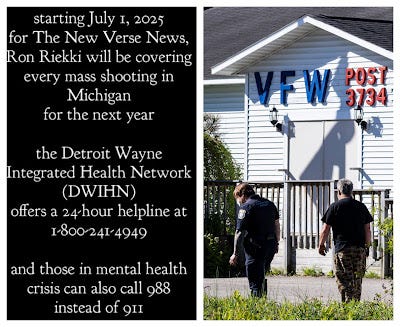
VFW, 5200 block of Airline
Road, Muskegon, MI, May 9, 2026
“‘They’re shooting at the
VFW!’ 911 calls detail chaotic scene at after-prom party.” —MLive, May 27, 2026
by
Ron Riekki

“If I can reach at least one,
then I’m doing my part.”
—Ebony Davis (Gemini DaPoet)
“They
that have the power to hurt”
—William Shakespeare, sonnet
XCIV
i: Prescription
We need to cure this
goddamn gun disease.
ii: Script
It’s the day after Memorial Day. I’m so rural
the GPS seems confused, isn’t even sure what its three letters stand for. I finally find
the mass shooting site—sad, hid, and all x’ed; it’s an old
building that reminds me of a bar in my hometown
when I was a boy, a bar my Grandpa buried himself inside, weekly;
it’s a VFW, has an axe-colored roof/awn, and its bin that’s a
Boy Scout of America Troop 1023 U.S. Flag
Retirement Box. Across the street, a bed of
thick green, a feel like Eve and Adam, of no one
at all in this world, just a bug, a bee, a fly. Not a dog, not a cow,
not a doe, not an elk, not a car
all day but mine. Instead, as far as I can see, an eon of elm, fir, oak, ash. Views I remember from my youth doing XC (cross-country). It’s May. The cry of sky, this place cut
by violence, the 911 call, an after-prom party,
police arriving just after midnight, on Mothers’ Day. 4 shot, 2 hit by the car, found by a cop lying in the street, “unresponsive” per police scanner, “multiple people down,” “patient in the road,” “30 to 40 shots” fired per audio, a 17-year-old girl “run over,” now in rehabilitation and “can’t walk” per FOX 17, and—fat chaos like grawlix—
a college football player named “Piggee” hit, now on crutches, “severed tendons” per WOODTV news, hit by the vehicle, tried to hop to the side to get away, but hit mid-air.
The calls of “GSW,” “GSW.” Gunshot wounds. “All vehicles” called. Four shots. E.R.
IV fluid resuscitation, x-ray, keep the patient warm. Direct pressure. The only way to stop the bleeding.
Just like politics. How you have to put on direct pressure.
Sometimes, maybe often, too often, it feels we don’t even try to improve this world.
Crush injuries. A vacuum effect at the point of entry, where debris
like bacteria, clothing, anything can enter the body, along with the bullet.
Bullets. On parade.
Then the bullet ricocheting around inside the body, off bones, or,
if high-powered,
through bones,
if not, going in any direction, hitting lung, bone, vein, pons, nose, foot, guts. Skin. Hair.
And exit wounds larger than the entrance, spurting blood, arteries
that can spurt a foot-and-a-half, blood gushing in rhythm with the heartbeat,
children’s heartbeat, here, teens’ heartbeats,
there, at the prom after-party.
Red.
Kid.
Blood on dresses, on walls, on hands, on the floor, on the parking lot.
This mix of arterial bright red, venous dark red, capillary darker red.
Children’s blood. We’re talking about children’s goddamn rushing blood.
I remember a paramedic telling me that when you see blood on the ground,
you’re seeing oxygen. A pool of oxygen. Hemoglobin transports oxygen.
Blood transports oxygen. That’s oxygen all over the dress, wall, hand, floor, lot.
A lot. They transport the children to the hospital. Teens. Tens. Hundreds. Thousands.
More than 17,000 children are shot in the U.S. every year. Every year. Every. 000!
This is America, guns
—Childish Gambino.
go, go away
I stand there. At the VFW.
In the sky, the dot of sun like a fire-
arm pointed at my eye. I think
of the 1,000 people shot in Michigan in the last year
and where they were shot—in the hip, the ear,
the jaw, arm, toe.
R.I.P. posts. Mom and
Dad sob, not a dry eye.
To die.
Thinking I need to eat, get something to drink. Gin.
You know, I remember this loop I got into when I was
trying to learn the Hamlet to-be-or-not-to-be speech when I was
young:
To be, or not to be, that is the question:
Whether 'tis nobler in the mind to suffer
The slings and arrows of outrageous fortune,
Or to take arms against a sea of troubles
And by opposing end them. To die—to sleep,
No more; and by a sleep to say we end
The heart-ache and the thousand natural shocks
That flesh is heir to: 'tis a consummation
Devoutly to be wish'd. To die, to sleep
No more; and by a sleep to say we end
The heart-ache and the thousand natural shocks
That flesh is heir to: 'tis a consummation
Devoutly to be wish'd. To die, to sleep
No more; and by a sleep to say we end
And it is a loop—violence. And I didn’t
have the text, wondered what I was doing
wrong, or if those words did, in fact, keep
going for infinity. Imagine the actor on-
stage, trapped in that soliloquy, for hours,
for years, forever, talking about suicide
ideation. To be or not to be or to be or not to be or to be or not to be or to be or . . .
All of this because of the four-letter word: guns.
There’s no one here to talk to. Too rural.
Even the wind is absent. I stare at the VFW.
When I go into buildings for the first time,
I honestly look for first-aid kit, the AED,
I once asked a stewardess where the AEDs were on the plane
and she treated me like a terrorist, asked why I’d want to know.
I couldn’t get the EMT out of my system. She told me they’re
located both front and back, but, still, the whole time she acted
like I was Isis. People are suspicious. I went to a series of offices
at U of M to talk about the ten sexual assaults that happen
per month on campus, and the lack of mental health care
for students. It was the same treatment, like I was vile,
as if the goal is no ally. I keep asking why there’s so much
gun violence, and the solutions, everywhere I’ve gone, all of
these mass shootings in the last eleven months in Michigan
in order: in Flint, in Detroit, in Saginaw, in Kalamazoo,
in Grand Blanc, in Highland Park, in Saginaw again, in
Muskegon, in Flint again, in Detroit again, and in Detroit
again, in Jackson, in Grand Rapids, now in Muskegon again,
innocent children, innocent women, innocent men, talking
with me intensely in stores, in tents, in the streets, in early-night
dusk. But what stands out is walking, then talking in Detroit,
taking my time talking to a group of black men where when
I asked about the root of the problem stunned me by saying
it’s childhood sexual trauma. I couldn’t even believe
the honesty. I kept that conversation going after leaving. Searched.
Researched. Found that one of three men have experienced sexual violence.
Why was this never mentioned once in my life before?
And worse, I talked to guy after guy after guy who couldn’t
get into therapy. Especially veterans. The wait list. They’d
call and it would be wait list. They’d try the V.A.: wait list.
They’ll call out in town: wait list. How long would the wait
list be? “We don’t know.” I tried myself. I called, literally,
more than thirty phone numbers listed online. Easily more.
The answer: wait list. Or “we don’t work with vets.” And
one therapist who said that veterans are “too dangerous,”
that she has no problem “calling the police” on them, if she
“has to.” I asked what she meant. She said that they can get out
of line. Except she doesn’t work with them. ? I asked if she does.
No, she said, but she’d work with the “level one veterans.”
I asked what that was. She said level two and level three
veterans have too much trauma, so she only works with
level one vets. The ones who are asymptomatic.
She’s really good, apparently, at working with
asymptomatic patients. If you have absolutely no
mental health problems, she’s a phenomenal therapist.
Others pushed telehealth on me. The majority did.
The therapists want to do therapy in their slippers.
The problem: telehealth is shit for complex PTSD.
It’s wonderful for minimal trauma, or no trauma,
but someone with childhood sexual trauma or
military sexual trauma or any sexual trauma
isn’t going to feel the most comfortable talking
on a computer, which can easily be hacked.
A friend of mine told me he can hack into any
email. “Any.” I asked how. He said, “It’s easy.”
Easy. Ease. When I started to get into the thirties
for the calls, therapist office after therapist office
telling me that they had no availability, I realized
how brutal it is to get mental health care, and
that’s even when you have the money. How
impossible it is to get in. But how incredibly
easy it is to get cannabis in this town, to get
alcohol, all the people I talked to in Muskegon,
Flint, Detroit, telling me how simple it is to get
a gun, but how BRUTAL it is to get mental health
care. The people on the other end of the phone
would actually laugh when I asked if they had
any availability. One therapist told me she could
get me in, but I had to agree that she could video-
tape record all of my sessions. Again, wonderful
if you have no trauma, if you want therapy due
to getting a D on your last report card, but if you
wanted to talk about the insane trauma that’s
so frequent in this world, especially trauma
that is hard to talk about at all, let alone with
a camera pointed at your face . . . When I refused,
therapist told me, “The camera on my laptop
won’t kill you.” I felt this rage of adrenaline
through my body at how little she could under-
stand. I started to tell her that computers can
be part of the trauma, told her that there are
things like cyberbullying and online human
trafficking and veterans who were forced to do
drone strikes, that computers in the military
can kill, that it’s—but she talked over me,
told me it was her rule, that it’s an absolute.
Of course, it’s a rule she’s making up. Of
course, she doesn’t have to videotape us.
Of course not. She hung up. I think of the 22
veterans per day that kill themselves, hang
themselves, shoot themselves. And then I thought
of the veterans who shoot others. I wonder how
many of them were denied care. I wonder how
many times they tried. I wonder if people laughed
at them when they called and were told about
the wait list. The wait list is just a wait list.
The wait list doesn’t factor in the level of trauma
of the person. The wait list doesn’t look for
the factors of having parents with substance abuse
or your own history of substance abuse or if
you are a survivor of abuse or anything about
abuse. It’s just a wait list. They told me I could
always get emergency crisis help, that you can go
to the hospital, check yourself in. They didn’t mention
what others have mentioned to me, which is that
the E.R. puts you on hold in an empty treatment bay,
a bay meant to drown you in waiting. I did this once.
The wait was like ten hours before the EMTs ever came.
Then, once they came, they tied me to the gurney.
Did they need to? No. Was I compliant? Yes.
I was depressed. I wanted help. Tied to the gurney,
there was nothing I could do on the ride to the psych ward
with the EMTs on the way making fun of me, complaining
about me, saying to me that the “suicidal” “waste” their “time,”
giving me a sick nickname I won’t repeat here, but one where
I wish my hands had been free, the total lack of ethics on their part,
the wish to wash my hands of that memory that got worse: when I arrived
to the ward where they gave me a bed, lying down on mattress in the dark
to find that it was covered in piss. Piss on my face, chest,
arms, legs. I could smell it, felt it, got up, turned the light on
fast, saw it, went to the front desk worker and told him
and he didn’t believe me, went to the bed, realized it was true,
told me he’d give me another bed. I said I needed to shower.
He said I couldn’t. It was after hours. Said I could in the morning.
I was covered in someone’s piss. I begged him. He said
there were rules, that he didn’t make the rules. I’d just been
mocked for the entire ride there, and I remember that smell
all over my face, my body, standing in a hallway, begging
this man to let me shower, begging him, pleading. Please.
I’d went to them for help.
No, I told the woman on the phone, no, I’d rather die
than go back there. I worry there is an underestimation
of the violence done to men. I remember talking with
some women, fellow writers, at a sports bar after workshop
and the conversation got to violence against women, so I thought
I’d shut up, lean back, listen, and when I removed myself,
observed, I realize this passionate conversation, their disgust
at violence directed at women, but, leaning back, I saw
all of these TV sets on the walls, dozens, all over the bar,
and on the screen, these two men, two boxers, just beating
the hell out of each other, blood, blood, and the bar exploding
into applause at this, and the absence of recognition of this,
as it was sport, fun, ignored, or, no, not ignored, but explored,
applauded, worshiped. I wonder, sometimes, if the way
we reduce violence against women is to reduce violence
against men. The link. I know I’m not allowed to say that.
But I don’t care. Meaning I care deeply. I think it’s helpful
to say it. If a woman ever says she was abused, believe her.
A hundred percent. But the system is set up where men
can’t bring it up. Men have told me of finally opening up,
talking about their sexual abuse in therapy and the therapist
silent, listening, the man bawling, getting the story out,
and as soon as he’s done, being asked, “Did you do that
to anyone?” Where men can only be seen as abusers.
Never as victims (even when they are). I’ve heard stories
of men bringing up sexual trauma and the therapist ignoring it
or him hinting at it and the therapist missing the hint.
Or of calling the RAINN hotline (the Rape, Abuse, &
Incest National Network) and being hung up on, being
told it’s not for men, being told they should call a different
number (then given that number to only find out it doesn’t
exist or there’s no answer). T. Charles Brantley on
the Men Need Love Too podcast with Kat Anna
talks about how “3/4 of all suicides are men, and I think
sexual abuse is the reason.” I worry that abused men
who can’t get mental health care turn to drugs, alcohol,
cannabis, porn, gambling, turn to trauma repetition where
they don’t heal, can’t heal. Instead they drown. Where
the incarceration system is thirsty for their bodies.
The estimate is that one million men have been sexually
abused in the prison system in the last decade.
And that’s the system where we send people with trauma.
To create more trauma. And the estimate is that one million
men have been sexually abused in the military in the last
decade. There’s more than 100,000 veterans in prison.
I’m worried we’ve created a silent system of sexual violence
against men and that silent system, because of its silence,
is the catalyst, the center for violence against women.
When I worked with survivors of torture, I found that
there are four global torture systems: police brutality,
incarceration, gangs, and the military. Those are the four
systems that practice torture globally. And more than 150
countries practice torture. The wealthier countries, in
particular. Police, prison, gangs, wars—that’s the torture
system. And more than 90% of police brutality happens
to men. More than 90% of those incarcerated are men.
More than 90% of gang members are men. More than 90%
of veterans are men. And I never hear about sexual violence
against men. It’s silenced in the way that torture silences.
It’s silenced in the way that death silences. Therapy
offices need to start having more accountability.
I know therapists who can’t get referrals, who can’t
survive financially, the therapy offices understaffed,
under-paying, and under-trained for trauma, author Mic
Hunter in Abused Boys stating that 95% of therapists
say they do not have enough training in sexual trauma,
and for male clients, it can be no training. At all. But, yet,
we have astounding ease of access to porn, to drugs, to alcohol,
to guns. #$%&!
iii: Postscript: they can’t kill words
To repeat: We need to cure this goddamn gun disease.
I’m not holding back, because I have nothing to lose.
I have no kids, no significant other. I have this body.
I have a voice. Like Alex Honnold, my amygdala gone
from being in two branches of the U.S. military,
from working on ambulances, working in the prison
system. It’s impossible to get a creative writing gig.
I’d rather give my life to writing, rather than quit.
I challenge the poets out there: go to the events in
your city and cover them like journalists. Don’t hide.
Write. But don’t just observe the news; get deep inside
the news. Write from that perspective. Force your way in.
I respect poets. I respect you. Now, Jesus Christ,
get deep into this madness and give us your voice.
Ron Riekki co-edited Undocumented: Great Lakes Poets Laureate on Social Justice.