Guidelines


Submission Guidelines: Send 1-3 unpublished poems in the body of an email (NO ATTACHMENTS) to nvneditor[at]gmail.com. No simultaneous submissions. Use "Verse News Submission" as the subject line. Send a brief bio. No payment. Authors retain all rights after 1st-time appearance here. Scroll down the right sidebar for the fine print.

Wednesday, January 14, 2015

HOW WE IMAGINED WE BLED OUR SUPPLICATIONS

by Ranjani Murali


Ink, Blood, and Tears, an OtherWords cartoon by Khalil Bendib


As if water dripping into
            the steel sink, bleaching

our brushes white, scoring the floors
            of our glass-doored office /

as if the vein of our favorite fountain
            pens (the ones that dug into

our index fingers while we caricatured
            old art teachers with balding

heads) had been spliced, spurting forth
            ink-splotched faces, the aphorisms

we drew in bubbles, their blood-vowels /
            as if bullets we drove into the walls

of easels, blithely / as if specks of flesh
            carving out their wounds, sinew

torn in watercolor, shards of glass painted
            in felt-tips / as if the tilt of our

mouths in these scenes, the seconds we
            almost smiled between smearing

steeple-minaret-altar as if wings / as if
            hierologists of tomorrows,

revealing our schisms, our compositions
            in grays and whitespace/ as

if ours, a name stenciled on drywall, on
            acid-free paper, beneath our

benedictions, beneath the as if / as if
            beneath the /  if  /


Ranjani Murali received her MFA in poetry from George Mason University. Her poetry, nonfiction and translations have appeared in Pratilipi, Phoebe, elimae, Kartika Review and elsewhere. She was the recipient of the 2014 Srinivas Rayaprol Prize and has received fellowships from the Fine Arts Work Center and the Vermont Studio Center.

Tuesday, January 13, 2015

NOTE TO THE SELF-RIGHTEOUS ONES

by LaWanda Walters


                              After James Merrill’s “Casual Wear”

We can see through your disguises.
It is nothing new to use the name of goodness
like it’s your accessory from Kate Spade.
These days you are young.  You follow a fad.

It is nothing new to use some name for goodness
as you end or maim someone’s being here.
So many of you are young.  This killing is a fad.
You chew and smack Muhammad’s name like a cud.

You end or maim someone who exists
while yelling some word that meant rain, forgiveness.
In your mouth that name's pink bubble gum,
is sugar, spit, preservative and dye.

You do not refer to kindness or rain.
What you mean is you are cool and in style,
blowing bubbles made of sugar and spit, blowing brains out.
There are others like you--other mobs and crowds--

who would hate my poem as much as you do.
You fit right in with those Americans
mouthing names like “Jesus” and “Christmas”
while they vote against those who can’t afford Kate Spade.


LaWanda Walters has had poems in Antioch Review, Georgia Review, Shenandoah, Ploughshares, Southern Poetry Review, Cincinnati Review, North American Review, Laurel Review, The New Verse News, Sou'wester, and other periodicals.  She lives in Cincinnati.

Monday, January 12, 2015

BEWARE HEIRS PRESUMPTUOUS

by Gil Hoy


The Supreme Court might be about to blow a hole in Obamacare large enough to fit nearly 10 million people, a new analysis shows. The high court is scheduled to hear arguments this March in a lawsuit claiming President Barack Obama's administration does not have the legal authority to give tax credit subsidies to millions of people who have insurance under the Affordable Care Act. The argument is over a small bit of wording in the law, which says subsidies can go to people buying insurance on state-run marketplaces, but not to people buying on federally run ones. Since the federal government operates the exchanges in two-thirds of the states, a ruling for the plaintiffs would gut the Affordable Care Act. --Jeffrey Young, Huff Post Politics, January 9, 2015


Beware heirs presumptuous
of Greeks, holding gavels, wearing
flowing black robes, potent
mutant seed of Solon, democracy
turned on its head,  sitting beneath
Corinthian marble columns
despising POTUS--Obamacare--
servants of the tyrant,
bearing gifts for Plutus.

There, I’ve said my piece.


Gil Hoy is a regular contributor to The New Verse News.  He is a Boston trial lawyer and studied poetry at Boston University, majoring in philosophy. Gil started writing his own poetry and fiction in February of last year.  Since then, his poems and fiction have been published in multiple journals, most recently in The Potomac, The Zodiac Review, Harbinger Asylum and Earl of Plaid Literary Journal.

Sunday, January 11, 2015

PARIS 1974, 2015

by Martha Deed


What has the sun said to you, my child ‒
that the world is a dangerous place
and this is a day to stay in bed?

But, No. It said
Do you see the shine of morning dew
on the cobblestone streets
and the spires of Notre Dame
kissing the clouds

The cafes bursting with coffee
and croissants in the hands of kids
on their way to school
on their way to work?

This is a day
the sun said
to take a good walk
along the quay

This is a day to look for a book
to visit the market of live birds
to hear them call
to admire their feathers
shining in the sun

the light flashing on them like sparklers
not like bullets at the newspaper
not like flash grenades
at the grocery store

This I tell you:
Because you heeded the sun,
you will live another day
your survival as accidental
as those held hostage
as those who died
at your grocery store
you did not visit
because you were taking 
a walk in the sun 


In this poem, Martha Deed has woven the close call she had in Paris in 1974 or 1975 when Millie was a baby.  They usually went to the news stand for the Sunday paper at 10:30 AM.  Regular as clockwork.  But that day, Martha simply thought to take a walk to a farther away news stand instead.  Carlos, the Jackal, had planted a bomb at her usual place, and it exploded, killing people, as Martha pushed Millie in her stroller down the Blvd Saint-Germaine.

NOT OBLIGED

by Michelle Marie


with hell to pay
   there was a rallying bray
i am charlie of hebdo !
   precious defiant minstrel show !

spirit grew robust
   wings light pen impaled
rose with a gust
   on which liberté sailed

but grief is a moment
   in that series to say
of violence that went
   the other ruthless way: 

algérie, irak, syrie

a flood of violence
   silting the hills with righteous license

imagination of power
   who fits in a world always ours more
lives drawn'n ink sour
   by martyrs right to offend, therefore

not obliged am i
   to repeat the offender's cry


Michelle Marie has written for Infita7 and Bluestockings Magazine.

INK

by Alejandro Escudé


Cyprien @MonsieurDream


I draw 
a cartoon of a god.

The god encircled 
by wolves.

The wolves 
with the faces of politicians.

I am a politician
sitting at my desk.

I hold my gonads 
tight under it,

here comes the myrrh, 
here comes
the frankincense. 

Where to draw the line?

I keep it simple 
and I fry. I make 
it complicated 
and I am incarcerated. 

Where to draw the line?

I said what I said. 
I’d say it atop 
the Eiffel Tower, too. 

I’d scream it  
from within 
the Bridge of Sighs.

Orphan. 
Poor. 
Alone. 
God-crazy. 

Where to draw, 
what to draw,
how to draw it 

fairly, plainly, lovingly.

The blood in my body 
was not ink.


Alejandro Escudé published his first full-length collection of poems, My Earthbound Eye, in September 2013. He holds a master’s degree in creative writing from UC Davis and teaches high school English. Originally from Argentina, Alejandro lives in Los Angeles with his wife and two children.

Saturday, January 10, 2015

ZERO IN THE CEMETERY

by Carolyn Gregory 


Nocturnal Sunrise by Alison Strange-Green


The angels at Pere Lachaise Cemetery
weep this morning,
tears glued frozen to classic features,
wings unable to fly.

They are mourning the dead journalists
who were too saucy with cartoons,
lambasting the prophet
when thousands die under drones
in trenched caverns in Syria.

One man's religion is not
another man's feast to roast and ride
when children and women drop
at weddings and in small cells.

The angels light the graves
of Oscar Wilde and the French Resistance,
stones shining above snow

and then they retreat
to melancholy for this season of violence,
wings bent down with grief.


Carolyn Gregory's poems and essays on music have been published in American Poetry Review, Main Street Rag, Bellowing Ark, Seattle Review, and Stylus. She was featured in For Lovers and Other Losses. She was nominated for a Pushcart Prize for poetry in 2011 and is a past recipient of a Massachusetts Cultural Council award. Her book, Open Letters, was published by Windmill Editions in 2009 and her next, Facing the Music, in 2012. She has been working on a series about the history of guns in America for several years now.

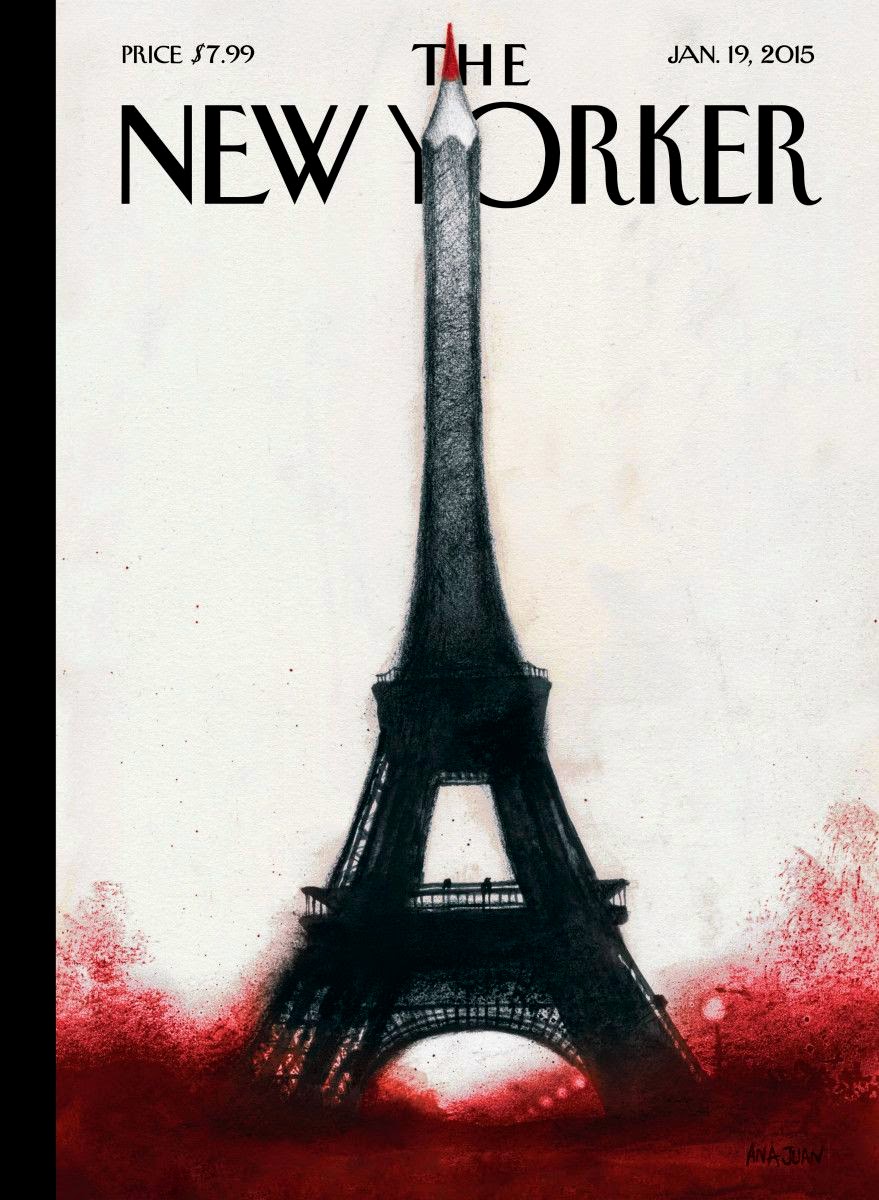
IS PARIS BLEEDING?

by Bill Costley


A million parisiens stand
facing the Tour Eiffel
shutting down quickly
on a massive film noir,

minus tourists,
minus frivolity.
What's amusant about
Charlie Hebdo now ?

Rien. (Nothing) Rien.
Millions of its
next edition will absorb
its dry editorial sang.

Paris is media-sanglant
The world, sympathique.


Bill Costley, among the earliest regular contributors to The New Verse News, served on the Steering Committee of the San Francisco Bay area chapter of the National Writers Union. He lives in Santa Clara, CA.

Friday, January 09, 2015

MARCHONS!

by George Held


   To the indelible spirit of “La Marseillaise”                                                          


Though assassins dealt a death blow                                                                        
To cartoonists at Charlie Hebdo,
Now the free world joins to say “Non!”
To terrorists who trade in woe:
“Vive la satire!” “À bas” the foes
Of liberty, equality, fraternity,
Those magnificent words English
And French and their multicultural
Societies share and now renew
Their commitment to.


George Held, a regular contributor to The New Verse News, has a new book out from Poets Wear Prada, Culling: New & Selected Nature Poems.

CREDO

by Rasma Haidri


“At least 12 were killed in an attack at the French satirical magazine Charlie Hebdo. Four cartoonists are among the dead, including editor and cartoonist Stephane ‘Charb’ Charbonnier, seen here defiantly holding one of the magazine’s covers. The magazine was fire-bombed in 2011 for publishing a cartoon of Muhammad and is know for its provocative satire. The Guardian has live updates here of developing events.” --Ann Telnaes, editorial cartoonist for The Washington Post, 7 January 2015.


I believe in One Art
Father of Cartoon
Begotten of the Pen Almighty
Maker of heaven and earth
I believe in Drawings
Visible and Invisible
Born not made
Being of one Substance
The Ink, the Pen and the Lead
I believe that Art,
Giver of Life, Begotten of man
Came and dwelt among us
Suffered and was buried
So the multitudes would rise
Take up Arms of Pens,
Draw Cartoons a Thousandfold
In world without end.


Rasma Haidri grew up in Tennessee and now lives in the Norwegian arctic where she is a newspaper columnist, textbook writer and teacher. Her poems and essays have been widely published and are forthcoming in Songs for a Passbook Torch, an anthology of poems about Nelson Mandela and Veils, Halos and Shackles, an anthology about violence towards women.

Thursday, January 08, 2015

EMERGENCY ROOM, NYC

by Terese Coe


Sitting on a cot in the walkway of the ER for hours
to get up and walk the circle of disease and decay,
he is struck by the bleeding case, the festering case,
the dying woman no one tends but her daughter.
After four hours the intimidation team of interns
marches in to insist on an overnight stay. You’ll
have a bed within two hours. Another three hours on,
no bed. He cases the joint for exits. Uniformed officers
stand at every exit except one, which is locked,
and prove their seriousness when he
approaches them. Having signed himself in, he is
no longer free to quit the place. He climbs into his
clothing again, saying he’s cold, ambles to the empty
interior hall and waits. Five minutes later a nurse
enters the hall, fails to notice him in the dead
end on the other side, swipes her card on
the pad for the unguarded door and, like a
miracle, passes through the magic portal with her tray
of meds. It remains open just long enough for him to follow
her through unseen. He finds himself in the main hall
of the hospital, suddenly unconstrained across meandering
public areas and out the front door. Intact. At home,
Arlene calls to say she went to visit him in the ER
and they were looking for him: I asked them how you
could have disappeared and a nurse said “He’s not a
psychiatric patient, so we can’t force him to stay.”
He says, “If I’d been there any longer, I would have been
a psychiatric patient.” That night the swelling subsides
when he takes a shower. No one calls from the ER
to ask questions--yet.


Terese Coe's poems and translations have appeared in Threepenny Review, Poetry, New American Writing, Ploughshares, Alaska Quarterly Review, The Cincinnati Review, The Huffington Post, Poetry Review, TLS, Agenda, New Walk Magazine, Warwick Review, The Stinging Fly, and many other publications, including anthologies. One of her poems was chosen for the 2012 London Olympics Rain of Poems and heli-dropped across London, and her latest collection of poems will be out in February 2015.

Wednesday, January 07, 2015

RAISING THE MINIMUM WAGE

by Skaidrite Stelzer


Image source: Windsor Star


The old man smokes on the bus bench
at the Cherry Street Mission in Toledo, Ohio,
hunched over in permanent posture
while the radio blares out against him--
hate speech still allowed against anyone
who can’t make a living. 
The minimum wage shrunken over the years.
“See a coin and pick it up.” 
And the smacking of lips by observers
because he must drink.
Begging is outlawed now in most places,
though I see it discreetly hidden behind signs.
“Will work for food.”
I give her a dollar.
In the East Village, years ago,
a homeless man slept each night in the back
of our pick-up truck.
Others ran to clean our windshields
with dirty rags.
Vying for coins, jostling against each other:
the ballet of poverty.
“All that day you’ll have good luck.”
The majority rules,
making the rich even richer,
giving them more and more
as we hide the poor.
There are still neglected alleys.
Some freeze each winter but we don’t
see their names in the newspapers.
“See a coin and let it lay.”
A minimal wage for a minimal day
cannot buy a home or a room.
I see him scrounging the gutters for cigarette butts,
and when I look at him he gestures and yells.
“Out of his mind,” I have told myself.
Yet he earns his morning coffee.
He cleans the sidewalk of the Sufficient Grounds
coffee shop on Central Street.
No job, no money, but here’s his warm reward.
“What are you looking at?”
or a greeting; it varies.
Then he freezes one winter
like the rest.
Because he was somebody’s son,
there is a small obituary in The Blade.
“You’ll have bad luck all that day.”
The radio blares its message.
The rich need more money.
They must have more money.
One day they are bound to share.
“See a coin and pick it up.”
The frozen sidewalk has no eyes.


Skaidrite Stelzer is a poet and teacher living in Toledo Ohio.  A post-WWII refugee, she grew up in Michigan as a displaced person. Her poems have appeared in many journals, including the Georgetown Review, Eclipse, The Fourth River and The Baltimore Review. She teaches a variety of writing and literature courses at The University of Toledo.

Tuesday, January 06, 2015

r > g

by Tim Kahl


French economist Thomas Piketty has spurned the Legion of Honour, the country’s highest distinction, on the grounds that the government should not decide who is honourable. Piketty, author of the bestselling Capital in the Twenty-First Century, which has become compulsory reading for world leaders, added: “They’d be better off concentrating on boosting growth in France and Europe.” --The Guardian, January 1, 2015

after Thomas Piketty


In the space between profit and economic rent
the wood of the forest grows to have a price placed
on it. Who is to pay for the license to gather it?
The owner comes to realize his land is earning more
than he is. He lines up a string of assets to
satisfy conditions for maintaining the wealth effect.

The rate of return on capital (r) is bigger in
the room than any of the tables and chairs,
the knives and forks, the working doors on cabinets.
Everyone sits down to eat and secretly they
are served by the incorrigible invisible hand
that has been replaced by the hand that grabs
and is giving the middle class the middle finger.

What is wealth doing now? No one seems to know.
It travels into safe crevices that are not
upset by light. It goes by the name of anonymous
and hypnosis. It is surreptitious and tries its best to
reinvest where its privilege won't be revealed.
If someone understands how to apply a tax to it, 
in just a moment it will melt again into the dark.

The amount of economic growth (g) measured
between the polar caps will always lag behind
the impact of a good amount of capital 
whose managerial class will rise to the apex
of steadfast vigilance. They shepherd funds
across the borders to come to peaceful rest 
in their blessed state of inheritance.

Work hard, play by the rules, and you get a stake
in the outcome. But that notion is so passé.
The holders of debt have foreclosed on the government.
Run for the hills and take your children with you.
Build a bunker. Get a gun. Are there any ideas that 
can prevail in this cynical age, in this grim era of discipline?


Tim Kahl is the author of Possessing Yourself (CW Books, 2009) and The Century of Travel (CW Books, 2012). His work has been published in Prairie Schooner, Mad Hatters' Review, Indiana Review, Metazen, Ninth Letter, Sein und Werden, Notre Dame Review, The Really System, Konundrum Engine Literary Magazine, The Journal, The Volta, Parthenon West Review, Caliban and many other journals in the U.S. He appears as Victor Schnickelfritz at the poetry and poetics blog The Great American Pinup and the poetry video blog Linebreak Studios. He is also editor of Bald Trickster Press and Clade Song. He is the vice president and events coordinator of The Sacramento Poetry Center. He also has a public installation in Sacramento {In Scarcity We Bare The Teeth}. He currently houses his father's literary estate—one volume: Robert Gerstmann's book of photos of Chile, 1932.

Monday, January 05, 2015

FLASHES

by Jo-Ann Reid


We trade causes like children playing at double-dutch; tagged in and out like committee positions trading lip-service leaving the sheen of caring. Which cops are on the take? Why aren’t the good ones shouting to the rafters? Which are massaging bullets erect in flimsy pockets and digging for press conference notes? Anticipate the groove of pen strokes feigning apologies; the inflation of yellow tape and chalk the same shade that black boy used to trace; committing his own name to cursive.

Armored with gold coins some toss their blinding hair, glimmer in branded outfits from thousand-dollar plate dinner guests gorged on handshakes and conjured commitment.

Dialed-in causes that will do nothing but pluck our peacock feathers. Hooked on our own coins; the best parts of ourselves devoured; and still--our tongues click with unrest.

Are we any different?


Jo-Ann Reid is an Associate Professor of English at Dean College in Franklin, MA.  The youngest daughter of established Haitian immigrants, her work explores cross-cultural boundaries, gender, restriction and issues of social injustice. Ms. Reid won a poetry contest judged by Harryette Mullen while earning her MFA at The Pennsylvania State University.