Guidelines


Submission Guidelines: Send 1-3 unpublished poems in the body of an email (NO ATTACHMENTS) to nvneditor[at]gmail.com. No simultaneous submissions. Use "Verse News Submission" as the subject line. Send a brief bio. No payment. Authors retain all rights after 1st-time appearance here. Scroll down the right sidebar for the fine print.
Showing posts with label art. Show all posts

Saturday, April 05, 2025

DO NOT

by Devon Balwit


Cartoon by Custodio.


Do not
 
check the box saying I agree when you haven’t
read the terms, nor put an I believe sign in the front
yard while the yardless are being hauled out the back,
nor assume threat ugly rather than urbane and slick,
nor think one must sloganize to fight (for a lone wag
can be sufficiently ironical to shake the dog),
wor forget the power of art to move unfettered
by a common style, nor worry you must do it better
even to begin, nor avert from sure embarrassment—
for nothing embarrasses more than the human predicament—
our minds in compostable bodies, seeking the light
in the brief blip between birth and night.
Do not obey evil in advance, die
before you’re dead, or—worst of all—refuse to try.


Devon Balwit walks in all weather and edits for Asimov Press, Asterisk Magazine, and Works in Progress.

Sunday, April 21, 2024

FAITH RINGGOLD WITH MY DAUGHTER, AGE 9

by Alice Sims-Gunzenhauser


in memoriam: Faith RinggoldOctober 8, 1930 - April 13, 2024


Part I, #4: Sunflowers Quilting Bee at Arles by Faith Ringgold

We sit among the adult
audience, you with your pigtail
I with my arm around you. 
Her new French Collection, placing
African American figures in 
white European bastions of art
within her glorious quilts
disconcerting one or two
of the art historians present.
 
When it is time for questions
she calls on you first of all
from among the many raised hands.
You ask why she decided 
to be an artist. 
Faith Ringgold, world famous,
hears the importance of this to you
locks onto your gaze
and says, 

Because when I make art,
then I'm free.


Alice Sims-Gunzenhauser is a visual artist and poet who lives in New Jersey. Her art has been included in regional and national exhibits. Her poetry has been published in the Kelsey Review

Sunday, September 10, 2023

UNNATURAL TIMES

by Renee Williams


KFF


After the pandemic, it’s natural to come out of hiding

to share wine with friends at a photography opening


to hug and greet one another after years of trepidation

to see faces and smiles and to hear that delicious laughter of life


to be reminded that this is the stuff that makes all the toil worth it

to gather, to enjoy art together, to see depictions of our 600-year-old oak


that has lived through the Spanish Influenza and so much more during its time on this earth

and is still standing, as our photos show, from spring to summer and covered in snow.


Later the sniffles start, sore throats appear, and the slow headaches emerge.

It cannot be. It cannot be. Allergies, yes, sinuses, of course, but no, not that, not again.


The test shows the faintest line of positivity… and all doubt disappears. 

Another person from the group becomes ill, and another, and another. 


Once more we find ourselves communicating via text, email, or Facebook Messenger

sharing our lives in the most unnatural way possible once more. 


Renee Williams is a retired English professor, who has written for Of Rust and Glass, Alien Buddha Press, and Fevers of the Mind.

Friday, June 10, 2022

PAULA REGO DIED TODAY

by stella graham-landau


The artist Paula Rego, who died [on June 8] aged 87, once said that she liked “to work on the edge”, and her many series of paintings and drawings, about the subjugation of women, abortion and the marriage market, cut across social perceptions of the role of women, and disrupted the male view of women and their sexuality. —The Guardian, June 8, 2022. Above: Abortion protest. Triptych, 1997-98, which helped change public opinion in Portugal. Photograph: Paula Rego, courtesy Marlborough International Fine Art via The Guardian.


a moment ago she was here
now all that is left are 
her dirty pieces of broken pastels
and a body of work
that leaves viewers disturbed

i am distressed that she is gone
no one is left to explain what she meant
painting women who look like men
and a man posed naked and emaciated
like a rotten pear in a still life

what would she paint next
what repellant image to make her point

she is no longer
still life or any life
only a collection
of discomforting images
and her signature
a reminder

life is stark


stella graham-landau is a writer and artist living in richmond, va. she has recently been published in Bare: An Unzipped Anthology.

Wednesday, January 05, 2022

OH, MALCONTENT CHANGING CLIMATE

by Earl J. Wilcox


All the great ones say something about it.
Poets speak of climate because it’s nearby
While they write or sleep or laugh, weep.
Snow, rain, sunshine, hail—even blustery
Tornadoes may flourish in dramatic lines.
In thrall of climate change—like poems—
our weather evolves not just by seasons
but by an hour or day, from lovely, cum
placid, toward splendid feverish havoc.
Myopic romantic writers—like climate
Naysayers-- still focus on sunshine
And blue skies, cloudless balmy days,
Like times we cherish in spring or summer.
It seems fair and realistic to believe
our climate hunches, predictions, history,
great climate-driven works of art and literature
will forever evolve as human cycles change
perhaps subdue even poets, the last and most
Changeless chroniclers of life on this planet
Await nature’s next course, whither we go.


Earl Wilcox awaits nature's next course in South Carolina. 

Wednesday, November 03, 2021

THE BIRD IN A BUSH

by Mike Mesterton-Gibbons


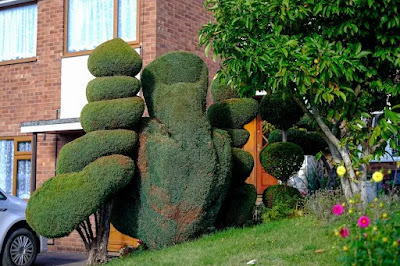
A gardener who trimmed a 10ft hedge into a hand flipping the middle finger has been warned he faces police action if he doesn’t chop it down. —The Independent (UK), October 19, 2021


Throughout the lore of English countryside,
Home topiary's an art that has been prized—
Except by one whose eyes were mortified
By what a green-thumbed gardener devised
In Warwickshire: a middle-finger shrub
Raised 10 feet high to flip the bird, in jest,
Directly opposite a village pub
In Warton. For two decades, it impressed.
Now someone wants to kill the goose that laid
A golden egg—more tourists at the inn—
By chopping down the shrub. So calls were made
Upon the gardener. But he won't bin
Street art he's groomed for decades as a joke—
His bush still flips the bird at prudish folk!


Mike Mesterton-Gibbons is a Professor Emeritus at Florida State University. His acrostic sonnets have appeared in Autumn Sky Poetry Daily, Better Than Starbucks, the Creativity Webzine, Current Conservation, the Daily Mail, the Ekphrastic Review, Grand Little Things, Light, Lighten Up Online, The New Verse News, Oddball Magazine, Rat’s Ass Review, The Satirist, The Washington Post, and WestWard Quarterly.

Tuesday, January 26, 2021

CONSUMER CULTURE

by Mary Clurman


EL ANATSUI is a Ghanaian sculptor who has spent much of his achievement packed career living and working in Nigeria. El Anatsui currently runs a very robust studio in Nsukka, Enugu, Nigeria, where some of the most beautiful and touching works of art in the world today are created. He is one of the most highly acclaimed artists in African History and foremost contemporary artists in the world. El Anatsui uses resources typically discarded such as liquor bottle caps and cassava graters to create sculpture that defies categorisation. His use of these materials reflects his interest in reuse, transformation, and an intrinsic desire to connect to his continent while transcending the limitations of place. His work can interrogate the history of colonialism and draw connections between consumption, waste, and the environment, but at the core is his unique formal language that distinguishes his practice. Above: El Anatsui’s “New World Map,” aluminum bottle caps and copper wire, 2009–2010.


El Anatsui’s elegant creations— 
assembled bottle caps
glorious detritus from
a million billion bottles
reimagined as a map
in fabric 
Christo-like
but shiny 
weight enough 
to smother Mother Earth.

Let us all now drink to El
his wit and grace and hype.
He’s seen a value we have not
Until we learn to do without
he weaves with what we’ve got.


After two years in Art History at Bryn Mawr College, Mary Clurman transferred to Cooper Union Art School. Now a retired Montessori teacher, she lives in Princeton, NJ, summers in Barnard, VT. A jack-of-all media—woodworking, cooking, gardening, local issues—she is finally focused on poetry.

Thursday, January 21, 2021

BREATHLESS

 by George Salamon


"Joe Biden must usher in a new era," —The Hill, January 20, 2021

"Not the least of the torments which plague our existence is the constant pressure of time, which never lets us so much as draw breath but pursues us all like a taskmaster with a whip." —Arthur Schopenhauer, On the Suffering of the World.


We can stop and draw our breath,
like we did as children, playing,
the flotsam of years is not gone,
the losses of just one year took
on such proportions that the days
grew dark, the stories in the papers
were too much to bear, we grew
hardened, now we can return to
the world of the visible, the world
of the reliable, return to hear the
rustle of the human and the animal,
see the reliable green of forests and
wilderness, touch the solid walls of
houses that did not crumble and be
touched by pictures of painters that
are art until we are ready for the  
journey inward to recover the light 
of logic we lost in a long and dark tunnel.


George Salamon not sure we are on the threshold of a "new era" yet, or are ready for it, but he hopes we will get there. In the meantime, he expects he'll keep contributing to The Asses of Parnassus, One Sentence Poems, Dissident Voice and The New Verse News from St.Louis.

Tuesday, August 11, 2020

WHAT STILL BELONGS TO US

by Sean J Mahoney


“Tangled Roots,” a painting by Wayne Doyle.


Offer the dark and far side of the house as stilled
prey to light and wind. Sky filled with weather
balloons, a story of openings and the dishrag
calamities of coming wars fought not between
soldiers but callous ideologies. My neighbors
crossing waters caught aflame, sown with
stench of powder, predatory hint of pheromone.
Those boat holds packed with coffins of kin.
Fragments of lovers. Loads of hurt, spray-painted
time, viral loss of speech coming fast, loose.

Clothed people with weathered skin, sitting and
waiting for apples and a humanity of eyebrows.
Decent beings most, stripped for their good deeds,
their mutual bonds and returns, for grid coordinates
of physical love and further acid rain bombs.
As though a brush stroke across the sky could
cure the vicissitudes of storms, of the prickly
aftermath where many headed in the days and
years that followed. Brush and slow stroke.
Spiritual tech and the uncaged graphic stations

of the body. This they say is art. Street magic.
Lord of hands digging trenches through rubble
and dirty clothing of unfamiliar beings. Postcards
of a land in better times; tourists, culture, and
radiant sunshine. Blue house on a block of narrow
mildewed homes. Bloated curbs and skinny
streetlamps illume familiar strain: a colored side
and the other side, a have side and a have next
to nothing side. Storm drains usher ill promises
and leprous iguanas to a cold sea amid tangles
of tree roots promulgated by water and by state.


Sean J Mahoney has had work published at Poets Reading the News, The Good Men Project, Nine Mile Literary Magazine, Antithesis Journal, Catamaran Literary Reader, and Wordgathering among others. He lives in Southern California with Dianne, her mother, 3 dogs, and 4 renters. There is a large garden and two trees with big, bitter oranges that look more lemon-like. Sean co-edited the 2nd and 3rd volumes of the MS benefit anthology series Something On Our Minds and he helps to run the Disability Literature Consortium booth at the annual AWP bookfair… lit by crips.

Monday, July 13, 2020

THE PANDEMONIUM AT FREEDOMLAND

by Rick Mullin


Please Scream Inside Your Heart,’ Japanese
Amusement Park Tells Thrill-Seekers                          

National Public Radio, July 9, 2020


We’d ask you, please, to scream inside your heart.
Consider others and the outcomes of your actions.
Secure yourself. The ride’s about to start.

The mechanism of this rocket cart
will get thrown off by any loud distractions.
We’d ask you, please, to scream inside your heart.

In Freedomland, survival is the art
of navigating obstacles and factions.
Secure yourself. The ride’s about to start.

The dark comes fast. It’s difficult to chart
the course of cannon shots and counteractions.
We’d ask you, please, to scream inside your heart.

It’s quiet now. I feel we’ve grown apart
composing our corrections and retractions.
Secure yourself. The ride’s about to start.

Democracy, the Slide of Bonaparte…
forget those rusty Freedomland attractions.
We’d ask you, please, to scream inside your heart.
Secure yourself. The ride’s about to start.


Rick Mullin's newest poetry collection is Lullaby and Wheel.

Sunday, April 26, 2020

CORONAVISION

by Judith Terzi


There they are—intimate backgrounds
for the news these COVID-19 days.
It's as if we were voyeurs into the lives
of those we watch & listen to. There they

are, right in their own living spaces. Fireplace
here, lampshade there. Bookshelves filled
with oeuvres that surely don't include any
of my poetry books. I see titles like I Am

That or Night Draws Near. I see games
like Yahtzee & Big Boggle. A stuffed lion
waits on one shelf. On another, a clay
hippopotamus. Dull brown pillows thrown

on a chair in a home for effect in one
interview. Or maybe it's an Airbnb rented
in haste for isolation. Probably so. The lamps
seem pretty Motel 6-like. Madame Nancy

stands in front of an abstract art piece. I love
the pastels, & her eye makeup this evening
is subtler than at her last interview. Different
lighting, perhaps. I've heard that a naked

man in a shower was accidentally on camera
thanks to a mirror not removed in time.
Someone has wedding photos hanging
in perfect alignment. She looks happier

in the black & white glossies. A former
Intelligence maven has six books on a table––
three lying down, three upright, but
upside down. Another hasty setup no doubt.

And a different maven has two copies
of Leon Panetta on a little table along with
Six Days of War. Grim, detailed reading,
for sure. Oprah has such a cool living room.

I love her comfy sofa, her unlit fireplace.
There is a low-fired turquoise pitcher
on someone else's shelf. Pottery—still no
poetry that I can spot. The avocado walls

of yet another background are rich,
as is the cranberry wall of the former
Ebola tsar. Gee, I'm dying to see the rest
of Madame Nancy's house. Aren't you?


Author of Museum of Rearranged Objects (Kelsay), as well as of five chapbooks, including Casbah and If You Spot Your Brother Floating By (Kattywompus), Judith Terzi's poems have received Pushcart and Best of the Web and Net nominations and have been read on Radio 3 of the BBC. She holds an M.A. in French Literature and taught high school French for many years as well as English and French at California State University, Los Angeles, and in Algiers, Algeria.

Sunday, January 26, 2020

THE AMERICAN DREAM

by Alan Catlin


Born in Wichita, Kansas, fine art photographer Tom Kiefer was raised primarily in the Seattle area and worked in Los Angeles as a graphic designer. Kiefer moved to Ajo, Arizona in December 2001 to fully develop and concentrate his efforts in studying and photographing the urban and rural landscape and the cultural infrastructure. In 2015 Kiefer was included in LensCulture's top 50 emerging photographers and Photolucida's top 50 Critical Mass. His ongoing work “El Sueño Americano” (the American Dream) has been featured in news publications nationally and internationally. 

“Don’t let no one take your hope or dreams away.”
            —Tom Kiefer, photographer, assembler


Dispossessed items
at the Border made into
Art:

Duct tape re-enforced water
bottles used as canteens

One worn Mickey Mouse sweater
child sized 2017

One baby shoe 2018

A montage of hair brushes
and combs fitted into a near-
perfect square pattern 2017

A tangle of shoelaces, blue
like a nest of vipers,
conqueror worms 2017

50 potentially lethal,
non-essential toothbrushes,
in patriotic colors: red, white and blue
assembled as USA USA USA 2019


Alan Catlin has published dozens of chapbooks and full-length books, most recently the chapbook Three Farmers on the Way to a Dance (Presa Press), a series of ekphrastic poems responding to the work of German photographer August Sander who did portraits of Germans before, during, and after both World Wars.

Saturday, August 03, 2019

SEESAWS AT THE BORDER WALL

by Sister Lou Ella Hickman


Two architects in the San Francisco Bay area are responsible for the installation over the weekend of the three seesaws that briefly graced a small stretch of the nearly-2,000-mile swath of land where the United States abuts Mexico. . . . Virginia San Fratello,  a professor at San Jose State University who designed the project with fellow architect Ronald Rael, said that the pair had made a conscious choice to combat the heavily charged politics of the border with a simple emotion: the joy of a child’s playground. . . . The seesaws were up for about 30 minutes on Sunday, San Fratello said, on a small stretch of border fence in the Anapra neighborhood of Sunland Park, N.M., about 20 minutes northwest of El Paso. The Washington Post, July 30, 2019


let there be pink
for play
and playground recess
where children are most themselves
let there be pink
people   look
at what make us great
again   look
imagination’s grace
to see grace
even here


Sister Lou Ella Hickman is a former teacher and librarian. She is a certified spiritual director as well as a poet and writer.  Her poems have appeared in numerous magazines such as America, First Things, Emmanuel, Third Wednesday, and TheNewVerse.News as well as in the anthologies The Night’s Magician: Poems about the Moon edited by Philip Kolin and Sue Brannnan Walker, Down to the Dark River edited by Philip Kolin, Secrets edited by Sue Brannan Walker, and After Shocks: The Poetry of Recover for Life-Shattering Events edited by Tom Lombardo. She was nominated for the Pushcart Prize in 2017. Her first book of poetry entitled she: robed and wordless was published by Press 53 in 2015.

Friday, September 07, 2018

IN THIS SEASON

by Anne Myles


On the boulevard, strange markings have appeared:
white dots in the corner of some sidewalk segments.
The mystery intrudes on us, unsettling.
A neighbor stands looking but she doesn’t know either.
Later, a letter from the city informs us
they show each section that’s heaved up, sunken,
cracked, uneven; we must replace them or the city will.

The segments lie in earthen beds
that breathe and toss across the seasons.
Why can’t they just remain, I wonder,
bearing their own flawed histories?
The dying ashes were cut down in December;
now in July we hear the roar of stump-grinders.
Beside the bare dirt circles left behind,
saplings of different species stand between their guys
like shy children in an unfamiliar class.

On TV I watch the skycam pan
over the mountains and lavish fields of France,
roads winding, dazed with so much past,
while the peloton grinds upwards. A rider falls back,
grimacing; the announcer cries out, oh, he’s cracked!

Outside, my neighbor Roger walks by slowly with his dog;
I’ve been watching them for years.
Now both will die soon, only one of them from age.
He relates his sentence calmly.
Whenever he appears, I can’t stop wondering
what he sees in the evening sky now, in the trees.
An artist, he has painted the fields of Iowa
and over them a plot of faint ruled lines,
as if seeing left a trace on what is seen.

This is a time of seeing, isn’t it.
This is a season of waiting for what comes.
The plot laid bare at last, and then what happens?
As the child asks her mother reading a story.
And this is not simply a thing that happened once.
This is a thing that is still happening
and will continue to happen.
This is an incredible, unprecedented moment—
that’s what I read in the news today.

The crickets have begun to sing at dusk,
reminding me of every summer I have lived—
that smell in the breeze as the leaves lift—
and everything that won’t happen any more.
I want it back if only to look at and remember.
I want my country back. I want to step
on every sidewalk crack and tilt as if
there were no question, as if it all were just what is.


Author's Note: The italicized lines in the penultimate stanza are from the opinion piece "Trump, Treasonous Traitor" by Charles M. Blow, New York Times, July 15, 2018.


Originally from New York, Anne Myles is associate professor of English at the University of Northern Iowa. A specialist in early American literature, she has recently rediscovered her poetic voice, one effect of the present troubles she is thankful for. Her poems have appeared or are forthcoming in Ghost City Review, Ink and Nebula, Friends Journal, Lavender Review, and Thimble.

Tuesday, May 29, 2018

MIKE PARR UNDER MACQUARIE STREET

by Martha Landman


The artist Mike Parr will be buried underneath a road for three days as part of a new performance work at this year’s Dark Mofo festival in Hobart. Parr will be buried below the bitumen in the central lane of Macquarie Street, which passes through the Hobart city centre, in a container measuring 4.5 metres by 1.7 metres by 2.2 metres, and the road will be resealed once the container is in place for traffic to continue as normal over the site. The work, entitled Underneath the Bitumen the Artist, is intended to be a comment on the violence of Australia’s colonial history. It will begin at 9pm on Thursday 14 June when the container is buried, and close at 9pm on Sunday 17 June, when Parr will make his exit. “When Mike Parr asks to be buried under the streets of Hobart, it’s hard to say no,” the Dark Mofo creative director, Leigh Carmichael, said in a statement.“Underneath the Bitumen the Artist acknowledges two deeply linked events in Tasmania’s history. The eventual transportation of 75,000 British and Irish convicts in the first half of the 19th century, and the subsequent, nearly total destruction of Tasmania’s Aboriginal population.” —The Guardian, May 25, 2018 Photo: Dotted white lines mark the spot where the hole for artist Mike Parr will be dug. —msn news, May 26, 2018


Let me be your experiment
I have nothing left to do
take me in your solemn arm
drown me in bloodshot eyes

Eat my fingers, my toes
I’m barefoot, supple as an apple
sip me through a bloody mary

thirty years’ fasting
unleashes a wishbone,
rainbows! Devour them!

Bury my madness in your rib cage
Paint me underground, taste the danger
                               beneath the surface

paint brushes, sketchpads, grinders explode —
a fire stoked in total silence
your walls breathe me


Mike Parr being painted in his own blood for his 2016 performance art piece Jackson Pollock the Female. Photograph: NGA via The Guardian, August 17, 2016.


Martha Landman lives in Adelaide, Australia.  Her work has appeared in various online journals and other anthologies.

Sunday, July 24, 2016

PHOTOREALISM:
CHUCK CLOSE IN LONG BEACH

by Rick Mullin


Chuck Close, Self-Portrait II, 2011 Oil on canvas, 36 x 30 inches. Saved to Pinterest from Blum & Poe.


He bristles at the notion that his work
might be described in terms of photographs.
This is an affectation or a quirk—
“Seurat renouncing dots!” one critic laughs,
intrigued by the technique and color chart;
the way that paintings done before a crisis
that would leave him paralyzed foretold
what was to come (commanding epic prices);
at how the magic leaves some critics cold.

But the master doesn’t know quite where to start
this afternoon, concerned with where he’ll end.
“I think the portrait’s dead again,” he tells
a writer from The New York Times who’ll spend
a year examining the parallels
between the late self portraits and a term of art.


Rick Mullin's new poetry collection is Stignatz & the User of Vicenza.

Thursday, April 28, 2016

THE 18-KARAT GOLD

by Howard Winn


An image created by the artist Maurizio Cattelan of his solid-gold toilet. It is to be installed in a bathroom in the Guggenheim Museum in May. Credit Maurizio Cattelan via The New York Times, April 19, 2016.


The 18-karat gold
potty at the art museum,
entitled America in irony,
throne for one in an exclusive
rest room reserved for a
sit down shit on that
cool gold seat while out-
side the line in the gallery
waits and twitches in need
not merely to piss or defecate
but to view this elaborate
priceless commode as a
comment on the pop
art that is kitsch beyond
value summing up what
life and art has become
in the postmodern world
where ostentation and
vulgarity have triumphed.


Howard Winn's work has been published in Dalhousie Review, The Long Story, Galway Review, Descant.  Antigonish Review, Southern Humanities Review, Chaffin Review, Main Street Rag, Evansville Review, Haight Ashbury Literary Journal, 3288 Review, Straylight Literary Magazine, and Blueline. He has a novel coming out soon from Propertius Press. His B.A. is from Vassar College. his M.A. from the Stanford University Creative Writing Program. His doctoral work was done at NYU. He is Professor of English at SUNY-Duchess.

Thursday, May 28, 2015

YOUR HANDS WILL BE PREGNANT IN THE AFTERLIFE

by Luisa A. Igloria


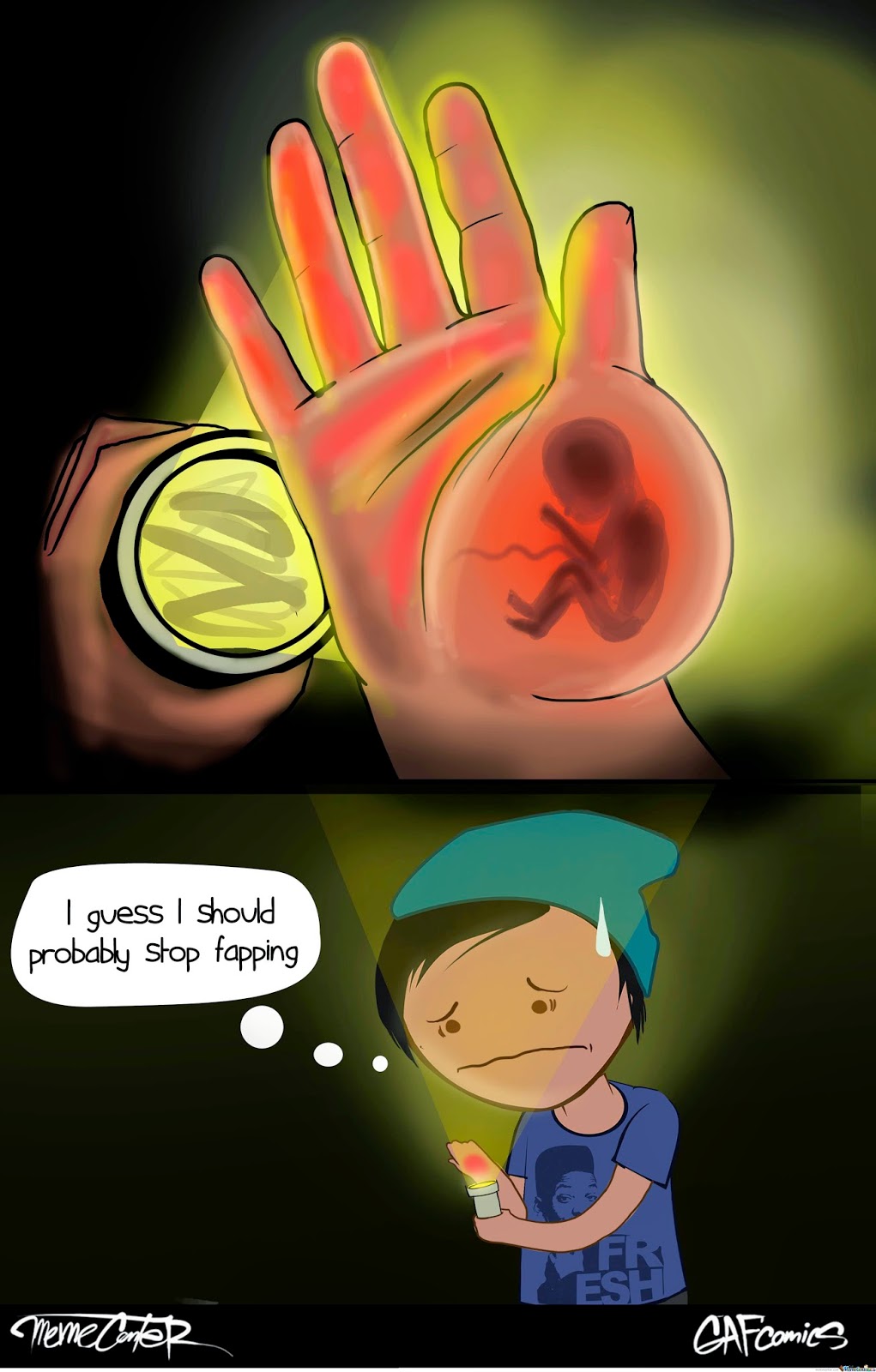
After claiming that a man would meet his masturbating hand “pregnant in the afterlife” and “asking for its rights,” a Muslim televangelist has set Turkish social media aflame. Self-styled televangelist Mücahid Cihad Han . . . claimed that Islam strictly prohibits masturbation as a “haram” (forbidden) act. “Moreover, one hadith states that those who have sexual intercourse with their hands will find their hands pregnant in the afterlife, complaining against them to God over its rights,” he said, referring to what he claimed to be a saying of Prophet Muhammad. . . . “Istimna,” the Arabic term for masturbation that Han also referred to, is a controversial issue in Islam, as there have been varying opinions on its permissibility throughout history. The Quran has no clear reference to masturbation and the authenticity of many hadiths is questionable. —Hurriyet Daily News (Turkey), May 25, 2015. Image source: MemeCenter


Your hands will be pregnant in the afterlife,
warns the televangelist to men who masturbate,
which makes me put my coffee cup down in alarm and stare hard

at my own hands. What about women? What happens to women's hands?
I mean, not necessarily from masturbating, but from all the things
our hands ​so frequently and ​lovingly do? I know a carver who couldn't stop

touching​ ​any surface of wood he happened across: flotsam on the beach,
the rails​ ​along a ship's boarding ramp on which his fingers could have lingered
for hours if not for the porter's brusque Come on, hurry it up will ya?​ 

I know a weaver who'll smooth and finger each tensile fiber on ​her loom,​ ​
each shuttle's pass setting off ​hundreds of indistinct vibrations that give
​the resulting garment its patterns of flushed color and shade.

If indeed hands could get pregnant in this or in ​the afterlife,
would that provide relief for women who have up to now borne
the brunt of each sexual​ ​aftermath, ​9 months housing a growing body

until it's really time​ ​to ​count out the rent? Think of ​the ​revisions
we'd have to make​ ​in the histories of our science and art, ​including
fashion---​ ​buttoned elbow-length gloves back in style, the idiom peek-

a-boo once more in circulation; artists commissioned to paint
fig leaves like giant Band-Aids over the hands of both Adam and Eve​,
in a garden cordoned off with signs saying Absolutely do not touch.


Luisa A. Igloria’s most recent publication credits include Ode to the Heart Smaller than a Pencil Eraser (Utah State University Press, 2014) and Night Willow (Phoenicia Publishing, 2014).

Friday, May 22, 2015

AND SO IT GOES

by Rosemerry Wahtola Trommer 


Dating back 40,000 years to the Denisovan species of early humans, new pictures show beauty and craftsmanship of prehistoric jewellery. It is intricately made with polished green stone and is thought to have adorned a very important woman or child on only special occasions. Yet this is no modern-day fashion accessory and is instead believed to be the oldest stone bracelet in the world, dating to as long ago as 40,000 years. Unearthed in the Altai region of Siberia in 2008, after detailed analysis Russian experts now accept its remarkable age as correct.  New pictures show this ancient piece of jewellery in its full glory with scientists concluding it was made by our prehistoric human ancestors, the Denisovans, and shows them to have been far more advanced than ever realised. 'The bracelet is stunning - in bright sunlight it reflects the sun rays, at night by the fire it casts a deep shade of green,' said Anatoly Derevyanko, Director of the Institute of Archaeology and Ethnography in Novosibirsk, part of the Siberian Branch of the Russian Academy of Sciences. —Anna Liesowska, The Siberian Times, May 7, 2015. Photo: Vera Salnitskaya


Thirty thousand years before the Stone Age,
someone made a bracelet of chlorite.
In the sun, the same sun that we know,
the bracelet glittered and reflected the rays.
In the night, just as dark and steep
as our night, the bracelet cast a deep shade
of green. Green, even then, was the color
of growth and new life. And the bracelet,
say the scientists, would have been worn
as protection from evil spirits. Not much has changed,
really, though the Denisovan people are long,
long gone from the caves in Siberia, gone
from the planet forever. But I think of how they,
like the homo sapiens, were moved
to make beauty. How they, too, perhaps stood
outside on a clear spring night
and felt the wind, the bright slap of the stars,
the possibility that art might save us.


Rosemerry Wahtola Trommer lives in Southwest Colorado. Her poems have appeared in O Magazine, on A Prairie Home Companion, in back alleys and on river rocks. One-word mantra: Adjust. 

Sunday, April 26, 2015

BEADED BOUNTY

by Catherine Wald


“Much of the beadwork featured in many pieces — from Ka’igwu moccasins to a Ute tobacco bag — used tiny glass seed beads from Venice, Italy, acquired through trade with Europeans.” —Seattle Times review (February 20, 2015) of “Indigenous Beauty”  at the Seattle Museum of Art.


Fingertips clasping confetti colors, I grasp
                  glass beads of Venice to recount ravens,
                                    superimpose suns and hawks. In shades of
                                                      Roman frescoes, my fables spin out:
                                                                        breathless as clouds, self-contained as cacti.

Plunder purchased from ghost-people, even in service
                  of beauty, of love, comes at a cost I can't fathom as I
                                    caress and pierce these tiny hulks, adorn
                                                      my childrens’ tunics with their shimmer.

As I bead, prairies are denuded, tents torched.
                  As I braid, Armageddons are prophesied and fulfilled.
                                    As I stitch, our love affair with earth is defiled by
                                                      notions of ownership; our sons succumb to
                                                                        microbes; our daughters birth monkeys;
                                                                                          our rivers run black, then dry.


Catherine Wald's books include poetry (Distant, burned-out stars, Finishing Line Press, 2011), nonfiction (The Resilient Writer: Stories of Rejection and Triumph From 23 Top Authors, Persea Books, 2005) and a translation from French of Valery Larbaud’s Childish Things (Sun & Moon Press). Her poems have been published in American Journal of Nursing, Buddhist Poetry Review, Chronogram, Exit 13, Friends Journal, Jewish Literary Journal, The New Poet, Society of Classical Poets, The 5-2 Crime Poetry Weekly and Westchester Review.