Guidelines


Submission Guidelines: Send 1-3 unpublished poems in the body of an email (NO ATTACHMENTS) to nvneditor[at]gmail.com. No simultaneous submissions. Use "Verse News Submission" as the subject line. Send a brief bio. No payment. Authors retain all rights after 1st-time appearance here. Scroll down the right sidebar for the fine print.
Showing posts with label photographs. Show all posts

Thursday, January 29, 2026

HOW MUCH CAN WE TAKE?

by Lynne Kemen


after viewing “Continuous Form” by Nishimura Yuko (Japan) 2020—washi paper


The paper is impossibly twisted, pleated

like skirts used to be. How is it possible

that this is paper? Nishimura Yuko's washi

folding into itself, holding a shape

it shouldn't hold.


On the wall behind, faces

also impossibly shaped, bearing witness,

watching.


Tensile strength. The word makes me think

of tension, how it translates to my own body

squirming to get comfortable, no longer able

to hold erect posture. Two total knee replacements.

Back pain. Neck pain. I'm so tired.


Pretti is our conscience. One of the helpers

who always shows up, who cares about others,

who refuses to look away. His phone

documenting what shouldn't be happening,

what we need to see.


I used to protest the Vietnam war. Kent State

terrified me—that girl kneeling, her mouth open,

screaming over the body. Some photographs

are that raw, that perfectly horrific.

Once I see them, they're in my DNA somehow,

in my body.


I can't stand for long periods now.

And I know I cannot look away.

So many do. They don't think it affects them—

until it does.


The sculpture before us, still whole.

Those circular faces, still watching.

We know fabric tears.

We just don't know when.


Lynne Kemen is the author of Shoes for Lucy (SCE Press, 2023) and More Than a Handful (Woodland Arts Editions, 2020). Her work has appeared in One Art, The Ekphrastic Review, MacQueen's Quinterly, and elsewhere. She received a 2024 Pushcart Prize nomination and serves as Editor/Interviewer for The Blue Mountain Review. She is currently working on two full-length poetry volumes. Lynne lives in rural Delaware County, New York.

Friday, April 18, 2025

ON CRUELTY: RILEY MOORE AT CECOT

by Jennifer Browne


What makes human hands unique? The human opposable thumb is longer, compared to finger length, than any other primate thumb. This long thumb and its ability to easily touch the other fingers allow humans to firmly grasp and manipulate objects of many different shapes. —American Museum of Natural History 


1. 

The hand can wield a weapon. The hand can soothe the lost, can smooth a tear-streaked cheek. The hand can navigate a loving body. The hand can pull an infant from a blood-smeared body. The hand can make a meal for a child, can feed a child. The hand can lead a person away from his home by the arm. The hand can pull a hood over a head. The hand can dig a grave in which to place a body. The hand can join in prayer. The hand can hold the grey-painted bar of a cell. The hand can close and lock the door of a grey-painted cell. There is so much to carry, to hold, to grasp. The hand can hold the reins and lead a clattering cart speeding into a ditch. The hand can hold a marker, can scrawl and sign a document. The hand can hold a tool. The hand can hold the tools that crack and crumble what felt sure. The hand can shape itself into a fist. The hand can shape itself into a fist and shake out its futility.


2. 

thumb (n.)—“shortest and thickest digit of the human hand, next the index finger and opposable to the others," Middle English thoume, from Old English þuma, from Proto-Germanic *thūman- (source also of Old Frisian thuma, Old Saxon, Old High German thumo, German Daumen, Dutch duim "thumb," Old Norse þumall "thumb of a glove"), etymologically "the stout or thick (finger)," from PIE *tum- "swell," from root *teue- "to swell" (source of tumortuber).


3. 

"Rep. Riley Moore posted photos of himself giving a thumbs up in front of imprisoned people at CECOT, an El Salvador prison notorious for human rights violations. The Trump administration has deported hundreds of immigrants without due process to CECOT, some by mistake. Moore also praised President Trump's handling of immigration in the post." —“Rep. Riley Moore Does Not Belong in Congress,” ACLU West Virginia


4. 

In its base state, the hand is empty.  


5. 

thumb (n.), ctd.—The figure of being under (someone's) thumb "controlled by that person's power or influence" is from late 14c.


6.

Look into the palm of any human hand, any primate hand, and see your own, see yourself. Interlace your fingers and feel the wealth of nerves that let you feel. Think of holding hands, holding faces, your beloved, the innocents within your care. Think of any of the harms you’ve wrought. The speed with which those harms happen, the carelessness.


7. 

We have stood at this door before, this terrifying new.


8.

"The photographs tell it all. In one, Private England, a cigarette dangling from her mouth, is giving a jaunty thumbs-up sign and pointing at the genitals of a young Iraqi, who is naked except for a sandbag over his head…In another, England stands arm in arm with Specialist Graner; both are grinning and giving the thumbs-up behind a cluster of perhaps seven naked Iraqis, knees bent, piled clumsily on top of each other in a pyramid." —Seymour M. Hersh, “Torture at Abu Ghraib,” The New Yorker, April 30, 2004


9.

Look into these photographs. Into whose ears do you want to speak some solace? Whose shoulders do you want to wrap with care? 


10. 

I cannot hold the want of wrath that rises from a place I have no name for in my body. 


11. 

thumb (n.), ctd.—Thumbs up (1887) and thumbs down (1906) were said to be from expressions of approval or the opposite in ancient amphitheaters, especially gladiator shows, where the gesture decided whether a defeated combatant was spared or slain. But the Roman gesture was merely one of hiding the thumb in the hand or extending it. Perhaps the modern gesture is from the usual coachmen's way of greeting while the hands are occupied with the reins.


12. 

There is something that I need to say, need to sing, need to scream into the ears of any who would listen, but the ones who would listen also want to scream. I have no words. There is something I need to say about power, about influence. There is something I need to say about how power swells. There is something I need to say about bloodsport, about the merciless. There is something I need to say about what can be manipulated even out of reach of a thumb, a finger, a hand. Look into these photographs. There are so many who are also raising thumbs, who are saying good, good, who are saying they are monsters. They are monsters. 


13. 

I have too many words. I have no words.


Author's noteMy grandmother was born in 1906 in Elkins, WV, a city in West Virginia's 2nd congressional district, currently represented by Riley Moore. 


Jennifer Browne falls in love easily with other people’s dogs. She is the author of American Crow (Beltway Editions, 2024) and the poetry chapbooks Before: After (Pure Sleeze Press, 2025), In a Period of Absence, a Lake (Origami Poems Project, 2025), whisper song (tiny wren publishing, 2023) and The Salt of the Geologic World (Bottlecap Press, 2023).

Saturday, March 16, 2024

THE PATTIE BOYD COLLECTION AT CHRISTIE’S

by Jacqueline Coleman-Fried


Dear Beatles fans,


You may picture me as a saucer-eyed flower 

child with golden hair and thigh-high skirts. 


I’m eighty now, a lot more covered, a lot more knowing—


yet I still don’t understand why George 

soured on me. In “Something,” the song 

he wrote for me, he said I don’t need no other 


lover, but that was a lie. You should know—

like picking bon bons from a gift box, he slept 

with any girl he fancied. Until he slept with Ringo’s 


wife in our mansion—

yes, I caught them in a bedroom.

Eric, my second husband, pursued me for years, 


wrote “Layla” for me. But he, too, couldn’t keep

his sex in his pants. And he drank. 

When he had a child 


with his Italian lover, while I was trying

to have a child with him, 

I had to go. Demolished.


My womb refused to flower for either spouse.


Reading their letters now, thinking

how they trashed my love, is it any wonder

I’m selling these reminders?


Old age is expensive. 

The doctor visits, the tests, the treatments—


Once I was a sylph with the palest skin and hair, 

too naive to demand more alimony 

from two multi-millionaires


who slayed the world with their guitars.


Jacqueline Coleman-Fried is a poet living in Tuckahoe, NY. Her work has appeared in The New Verse News, Consequence, The Orchards Poetry Journal, and Sparks of Calliope.

Friday, December 17, 2021

WINGS

by Tricia Knoll


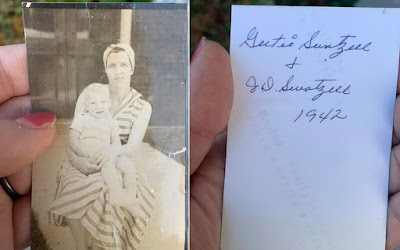
This photo combo shows Katie Posten holding the front and back of a photograph she found stuck to her car's windshield on Dec. 11 in New Albany, Ind. The photo is from a tornado-damaged home in Kentucky that landed almost 130 miles away in Indiana. The photograph was among dozens of personal items to turn up far from home in the aftermath of the tornadoes that sowed a path of destruction across six states. Photographs, by far, were the most common find. In major storms, they’re often carried the furthest, said John Knox, an associate professor of geography at the University of Georgia. “They’re like little wings when they go up into the air,” he said. (AP via The Washington Post, December 12, 2021)


I archive my family’s wings
    letters Union soldier William Lewis wrote home during the Civil War
    my grandmother’s photo holding my squirming mother
    my mother in her fancy hat leaning against my dad’s black Buick
    my mother rocking my newborn daughter
    my daughter holding her newborn
 I have no idea where they go next. 
 
I cannot forget    
    I found the photo of an altar boy wearing a halo
    and a white gown in a driveway in the Ninth Ward
    in New Orleans after Hurricane Katrina. 
I never knew whose angel he was. 
 
What hurricane wind tears apart
    flies, lives that shift from black and white
    to battered color. Wings beating birds 
    to refuge on a windshield,
    a mud puddle. Stuck in the twig
    of a naked sycamore. 
 
Angel memories try to find
    a way home. I believe
    the only thing my mother feared
    was the hurricanes in Florida. 
    I have no pictures of her fear.


Author's note: I am the archivist of most of the Civil War memorabilia of my great-grandfather William Lewis who served in an Indiana regiment. I never heard back from the historical societies in Indiana when I offered them the 65 letters he and his friends wrote to my great grandmother. Some of what he said is included in my book of poetry How I Learned to Be White.


Tricia Knoll lives in Vermont which catches the tail end of most weather systems that flow from west to east. Her poetry appears widely in journals, anthologies and five collections. Most recent is Checkered Mates, a chapbook out from Kelsay Books. Her next collection entitled Let's Hear It for the Horses—love song poems to horses—is on pre-sale discount from The Poetry Box publishing house through December 31 for its release on February 1. 

Sunday, December 20, 2020

PANDEMIC WOE

by Alejandro Escudé


I’ve learned there was a time they
wished they’d forbidden the media 
from photographing dead Vietnam 
soldiers. American flag-draped 
coffins were seen arriving on planes 
flown through Nixon-clouds. 
Macabre, isn’t it? Needing to see 
the bodies stacked like the skeletal 
victims in Auschwitz? Oh I take 
the nurse on Eyewitness News at her 
white-coated word, sitting in an office, 
backgrounded by books, Epidemiology 
prominent in the titles. But I want 
to see the Civil War leg-towers, 
and if there’s a law, then blurring 
would do, or a drone flown over 
the languid masses, doctors shuttling 
stretchers back and forth, a man’s leg 
askew for some reason, a woman 
crying, cradling a loved one’s 
inert head against her chest. 


Alejandro Escudé published his first full-length collection of poems My Earthbound Eye in September 2013. He holds a master’s degree in creative writing from UC Davis and teaches high school English. Originally from Argentina, Alejandro lives in Los Angeles with his wife and two children.

Sunday, January 26, 2020

THE AMERICAN DREAM

by Alan Catlin


Born in Wichita, Kansas, fine art photographer Tom Kiefer was raised primarily in the Seattle area and worked in Los Angeles as a graphic designer. Kiefer moved to Ajo, Arizona in December 2001 to fully develop and concentrate his efforts in studying and photographing the urban and rural landscape and the cultural infrastructure. In 2015 Kiefer was included in LensCulture's top 50 emerging photographers and Photolucida's top 50 Critical Mass. His ongoing work “El Sueño Americano” (the American Dream) has been featured in news publications nationally and internationally. 

“Don’t let no one take your hope or dreams away.”
            —Tom Kiefer, photographer, assembler


Dispossessed items
at the Border made into
Art:

Duct tape re-enforced water
bottles used as canteens

One worn Mickey Mouse sweater
child sized 2017

One baby shoe 2018

A montage of hair brushes
and combs fitted into a near-
perfect square pattern 2017

A tangle of shoelaces, blue
like a nest of vipers,
conqueror worms 2017

50 potentially lethal,
non-essential toothbrushes,
in patriotic colors: red, white and blue
assembled as USA USA USA 2019


Alan Catlin has published dozens of chapbooks and full-length books, most recently the chapbook Three Farmers on the Way to a Dance (Presa Press), a series of ekphrastic poems responding to the work of German photographer August Sander who did portraits of Germans before, during, and after both World Wars.

Monday, October 14, 2019

THE PHOTOS DON'T DO JUSTICE

by Tricia Knoll


QAMISHLI, Syria – "Eight-year-old Sara Yousif has become a symbol of the Turkish war on northeast Syria, which has caused the death of around 40 civilians, according to a war monitor." —The Independent (UK), October 13, 2019. "Sara lost her leg when Turkish shells rained down on her neighborhood of Qudurbag, eastern Qamishli on Thursday, killing her brother 11-year-old Mohammed and wounding her mother and brother Ahmad." —Rudaw (Kurdish media network), October 13, 2019.  Below, Sara's father Yousif Gharib speaks to reporters at the funeral for his son. Credit Rudaw for photos.


to the glory light on sober gold
of Vermont’s falling leaves

or for the places we’ve seen
Ansel Adam’s Yosemite

now smothered in wildfire smoke.
Those people we remember –

the Afghani girl’s blue eyes
the minister on the hotel balcony

the monk in flames or the man
with a flower facing a rolling tank

the father’s arm holding daughter
Valeria on the banks of the Rio Grande

and now Sara, age eight,  a Kurd, who lost
her leg to a fast-moving Turkish bomb

and her father sobbing over the body
of his dead son, not yet pointing his finger

to the betrayal of a man in Washington
whose soldiers she may have once trusted.

The photos do not do justice, let them
remind us justice could be done.


Tricia Knoll’s most recent poetry collection How I Learned To Be White (Antrim House) received the Gold Prize in the Poetry Book Category for Motivational Poetry in the Human Relations Indie Book Prize for 2018.

Wednesday, August 22, 2018

WIRE CUTTERS

by Bill Sullivan


"Cutting Barbed Wire" by Toyo Miyatake (circa 1944/1945).


Somehow Mr. Miyatake was able to smuggle in his lenses,
build a makeshift box camera out of what scraps were available
in the Manzanar Internment Camp. Confinement could not
constrain his ingenuity, his spirit, his need to document injustice.
So we have a black and white record of this shameful action
as well as photos of a resilient, proud people to absorb and remember.

               I am looking at his image of a raised arm, a hand
clutches a wire cutter, as if it were a lifeline, its blades open,
ready, eager, one senses, to sever a strand of razor sharp barbed wire.
In the top left-hand corner, we see the guard tower looming
over the scene. Yes, a given time and place. A dark piece
of our past, but it could have been taken at one of the Nazi
concentration camps, a Siberian gulag, any one of too many
political prisons. Clashing symbols; the desire to be free
and the drive to imprison.

               I am thinking of the suspicion, fear and greed
that led to the confinement of Japanese Americans decades ago
but also, the recent images of Central American children separated
from parents, crammed into cages, lying there on concrete
or thin pads, alone, sobbing, some silently, Brown children, vermin
to some, quarantined, held as hostages to convince their parents
to return to their countries and to deter other asylum seekers
from crossing the border. All that cruelty to assure the whiteness
of America prevails.

Has a photographer pressed his shutter, captured
the indifference and abuse in this house of horrors?
Has a filmmaker documented the bewilderment
and innocence of children, the anguish of parents?
So that after the wires are severed and they are free
and united, we and our children's children can see,
know shame and anger, reap love from the ashes
of our history.


Shoes and toys left at a port of entry to the U.S. in Tornillo, Texas. Photo by Brendan Smialowski/AFP/Getty Images accompanying “Toddlers fend for themselves in immigration court thanks to Trump,” an op-ed by Sen. Richard Durbin, Chicago Sun-Times, August 17, 2018. "The policy began in secret. The Trump administration denied such a policy existed. And when it finally acknowledged that migrant children were being separated from their parents at the border, chaos ensued. Only now is the full picture of what happened and why becoming clear." —The Daily podcast presents "Divided."


Bill Sullivan taught English and American studies at Keene State College, co-authored books on Twentieth century American poetry, co-produced two documentary films, and most recently published Loon Lore: In Poetry and Prose.

Sunday, March 22, 2015

FINDING BEAUTY IN SEWERS

by Catherine Wald


A new photography exhibition featuring images taken by Paris’ homeless and most vulnerable citizens was inaugurated by Deputy Mayors Bruno Julliard and Dominique Versini this week. The photos are on display on the railings surrounding Paris City Hall. This new initiative is the outcome of a partnership developed between 'Deuxième Marche', a nonprofit association offering assistance and educational opportunities to vulnerable individuals in France, and the start-up Wipplay, which organizes amateur photography competitions online. After a short training period, the twelve homeless individuals selected spent 4 weeks capturing Parisian life from their perspectives. Accompanied if they wished by students from Paris’ art schools, the photographers set out to depict their daily lives and to provide an insight into a side of Paris that most people never experience. The exhibition aims to raise public awareness of homelessness, and to demonstrate photography's potential as a means of reinsertion and rehabilitation. A selection of the photos taken are on display outside the City Hall until March 19th, and will also be available for purchase online on Deuxième Marche’s website. The profits from these sales will be shared equally between the association and the photographer concerned. The hundreds of photographs submitted depict scenes of solitude, insecurity, exclusion, and public indifference, as well as moments of beauty. —Mairie de Paris, February 20, 2015


In the tradition of our patron saint, Baudelaire, we are exhorted
to find harmony in mud, trash and indifference; given cameras
and point-and-click lessons; sent in search of photo ops.

We have no hesitation in rising to the challenge – we, the
flowers of poverty and displacement, society’s poisonous vapors,
perambulating poets that trail nasty refrains after us wherever we go.

Our longing for beauty, actually, is more poignant than yours.
We have learned to conjure it from sewers, air vents, public
toilets and fountains, billboards, and tunnels that only
sometimes have light at the end of them.

We are the visionaries -- not you soft, you sheltered ones.  It’s easy
to embrace loveliness when it wraps a silken shawl about your
shoulders, when it looks like your kin and feels like your birthright.

It’s supremely possible to celebrate ugliness when it’s a choice, not
an obligation, not a brooding and inescapable horizon.

Do you doubt us?

How do you think we’ve survived thus far on nothing
but fumes and cold pavement?  We are not metaphors,
we are the living dead, and we have learned over and
over again how to inject beauty into our thinning veins,
decomposing clothing, the cracked and bleeding
soles of our feet.

We have been artists all our lives.


Catherine Wald's books include poetry (Distant, burned-out stars, Finishing Line Press, 2011), nonfiction (The Resilient Writer: Stories of Rejection and Triumph From 23 Top Authors, Persea Books, 2005) and a translation from French of Valery Larbaud’s Childish Things (Sun & Moon Press). Her poems have been published in American Journal of Nursing, Buddhist Poetry Review, Chronogram, Exit 13, Friends Journal, Jewish Literary Journal, The New Poet, Society of Classical Poets, The 5-2 Crime Poetry Weekly and Westchester Review.