Guidelines


Submission Guidelines: Send 1-3 unpublished poems in the body of an email (NO ATTACHMENTS) to nvneditor[at]gmail.com. No simultaneous submissions. Use "Verse News Submission" as the subject line. Send a brief bio. No payment. Authors retain all rights after 1st-time appearance here. Scroll down the right sidebar for the fine print.
Showing posts with label French. Show all posts

Friday, January 24, 2025

CANADIAN DEATHS IN THE BOER WAR

Written after reading about the North Koreans who have been killed, wounded, or captured fighting in Ukraine for Russia

by Steve Hellyard Swartz


In Quebec City there's a monument to Canadian soldiers killed in action during the Boer War in South Africa from 1899 to 1902

Whenever I saw that little memorial I thought about what it must have been like to be a young French Canadian man conscripted into service,

You're on a boat with others trying to be brave

And it's not that hard, still on the boat, there are card games and smokes and the food is bad but you're young and it's an adventure

You don't love that most of your fellow soldiers aren't from Quebec and speak English but they seem okay and there are enough French-speakers so you pretty much know what's going on

And then you get there

Which is where exactly?

Where are we?

No one is exactly sure what they call the place where  you are

You get off the boat and the sign isn't what you recognize as French or English.

Someone tells you it's Dutch, or what the white people in this place speak, which comes from Dutch

You want to know how the hell the Dutch got involved in all this but no one has time to tell you

Red-faced men are barking in English for everybody to do something

You look around and do what everybody else is doing

The red-faced man and other red-faced men are pointing and screaming for you to March!

You march

Some of you are smiling and when you ask why you're told it's better than being on that fucking boat, at least this is something, at least we're doing what we're here to do

Which is what? And where are we? 

Nobody knows for sure but at least it's not nothing

You get on a train and it's warm

Windows are opened

Cigarettes are passed around, someone has a bottle but it's empty before you can get it

The train rolls on forever

You look out the window and it looks like a lot of nothing

Is this what they're fighting over? And who is this "they" anyway?

It's the fucking British, it's not the French, that much you know.

So who is it then - the British against the Dutch? Or what passes for Dutch out here? What passes for British?

You wonder if you pass for British? You think about how your parents and grandparents, your aunts and uncles, your sister and brother, would not be happy with you passing for British

So why are you here? You look at the other soldiers laughing, smoking, passing around another bottle.

You know that the bottle will be empty before it reaches you

This is bullshit you think

Why the fuck am I here?

Somebody offers you a cigarette and you take it

An English-speaker offers you the bottle with one swig left,

You take it, you smile, he lights your smoke.

You think about that as you lie on the field later that day

You think about his nice smile and how he flicked the match against his thumb

You'd die for a smoke right now, you'd die for a swig

You close your eyes and feel the African sun hot on your face,

You hear someone yelling but you don't know these words

You don't want to die like this, this is no way to die

So you open your eyes to see the one thing you understand

You open your eyes and stare at the sun.


Steve Hellyard Swartz's movie Never Leave Nevada opened at the Sundance Film Festival thirty-five years ago this week. He is an award-winning poet, filmmaker, movie critic, and the author of a new memoir The Last Jewish Mother Joke.

Monday, August 29, 2016

RELAXING INTO BLACKNESS

by Orel Protopopescu


 “He [Obama] was not always free to relax into his blackness, out of fear that it would frighten white America." —Michael Eric Dyson,  The New York Times, June 24, 2016

Although my winter skin is sallow,
a pale olive the world calls white,
my eyes and ears and pores
absorbed many shades of blackness
in New York in the sixties
in the middle of Long Island.

When I relax into my blackness,
I’m back in the music of the streets,
homes and churches of my childhood,
back with the old folks who called me baby
like they’d given birth to me,
their pupils widened in welcome,
back where doo wop groups sang
in the halls of Hempstead High
and we spilled out of choir to join them.

Where are you now, besides alive in me,
sweet-time brothers Andriamaharu,
who taught me to speak French,
a few words of Malgache,
and how to make a dance of laughter?

Fast and deep run the dark waters
that take me everywhere, bathed
in the fine and mellow vibrations
that forever slip like syrup
from the throat where Billie Holiday
birthed her blues, a fierce beauty,
a deep ease like a pair of taps
laying down paths I never want to leave,
sounds I never want to stop hearing,
like the voice of my then best friend,
abused for “talking like a white”
who said, in her Jamaican lilt,
“I don’t know what color a voice has.”

Oh, to relax again in the hammock
of our blackness, sharing secrets,
dividing the gold of the world between us.


Orel Protopopescu, children’s author, translator and poet, has been published by major houses (Simon&Schuster, FSG, Scholastic) and her book of translations, A Thousand Peaks, Poems from China (with Siyu Liu) was honored by the New York Public Library. Orel won the Oberon poetry prize in 2010. What Remains, a chapbook (2011) followed. Thelonious Mouse, her fourth picture book, won a Crystal Kite, 2012, from SCBWI.  A Word’s a Bird, her animated, bilingual (English/French) poetry book for iPad, was on SLJ’s list of ten best children’s apps, 2013. Her poetry has appeared in Spoon River Poetry Review, Light, Lighten Up Online, and other reviews and anthologies.

Wednesday, March 30, 2016

A VIEW FROM HOME

by David Chorlton


On March 24, the international tribunal in The Hague delivered the Radovan Karadzic verdict - more than 20 years after he was indicted and eight years after he was finally arrested. By this judgment, like most of those delivered by the International Criminal Tribunal for the former Yugoslavia (ICTY) judges, nationalistic ideologies were described as the reason behind the killings, tortures, forced detentions, mass rapes, ethnic cleansing and genocide. Unfortunately, people from the Balkans, but also in other parts of the world, did not grasp the message hidden behind the legal jargon. Over the years, international tribunals have never put enough effort to make their decisions clearer to average people; and this is often abused by politicians who interpret those decisions however they like. . . . After 23 years of work, the international tribunal in The Hague did not succeed in having a real impact on the people of the region. We did not hear loudly and clearly the judgment against nationalism, even though the judges did issue many. —Nidzara Ahmetasevic, Aljazeera, March 27, 2016. Photo:  A survivor of the 1995 massacre in Srebrenica prays by her husband’s grave at a memorial centre in Potocari, on 24 March 2016, the day the former Bosnian Serb leader Radovan Karadžić was found guilty of genocide. Photograph: Elvis Barukcic/AFP/Getty Images via The Guardian.


The scene today is tranquil
at the window where
a verdin flies between the roses
and the bougainvillea
unaware that glass is all
that keeps it safe from cats
alert to its every movement.
Outside, the afternoon’s
long shadows alternate
with glowing pavement
and winter’s dormant grass
begins to green. By the hour
news breaks in: the morning radio,
analysis at noon, and television
with its reruns of the panic
after Tuesday’s attack, translated
from French and Flemish now
and who knows which language
next. Interviewing experts
brings no more comfort
than the speeches made
by candidates campaigning.
The sparrows are chattering
in the bushes, and mockingbirds
pursue the last, late insects.
The battle for Mosul
won’t be over soon, Boko Haram
sends young girls out
to become stars for a moment
before being dead forever,
and every holiday in Europe
begins with armed guards
on patrol. Home is a good place
to be, watching lovebirds
in the sumac, listening to the news
that Radovan Karadžić
has been found guilty, guilty, guilty,
of killing on a scale
others only dream of, yet he still
finds a word for innocent
that applies to him alone.


David Chorlton is a transplanted European, who has lived in Phoenix since 1978. His poems have appeared in many publications on- and off-line, and reflect his affection for the natural world, as well as occasional bewilderment at aspects of human behavior. His most recent book, A Field Guide to Fire, was his contribution to the Fires of Change exhibition shown in Flagstaff and Tucson in Arizona.

Wednesday, August 19, 2015

WHAT THE NEWS BRINGS: TOO MUCH, NOT ENOUGH

by Shirley Brewer

I


The sea calls, deep with freedom
and risk. A sparkling summer day,
a fishing adventure off the Florida coast
in their 19-foot boat. Born on the water,
the two teens learned to walk in water.
Are they heading toward a destination,
maybe the Bahamas, paradise,
an escape from the mundane? Nature
sings in open air, until the squalls.
When the boat capsizes, they become
lost boys. The ocean no longer a home;
it swallows them whole. Despite
days of searching, the sea rules.
The boat turns up, far away from the place
where they set out. The boys are missing.
Too much. Too much water.


II


A family of three from France
plans for a whole year to visit
the Wild West. A five-week journey.
Week One goes well. Then, New Mexico,
White Sands National Monument. They arrive
at noon, 100+ in the August desert.
What prompts them to set out
on the longest trail—4.6 miles, no shade—
with only two small bottles of water?
In the dreamer’s mind, a vision of adventure
doesn’t come with a temperature.
Mother heads back to the truck, feeling unwell.
She drops and dies. Father falls, stops breathing—
his tongue swollen. Their 9-year-old son will live.
Sands blow and shift: cruel beauty, brutal sun.
Not enough. Not enough water.


Shirley J. Brewer (Baltimore, Maryland) is a poet, educator and workshop facilitator. In addition to TheNewVerse.News, her poems appear in Passager, Stone Canoe, Spillway, Little Patuxent Review, Gargoyle, The Comstock Review, and other journals. Her poetry chapbooks include A Little Breast Music, 2008, Passager Books, and After Words, 2013, Apprentice House/Loyola University. 

Friday, January 09, 2015

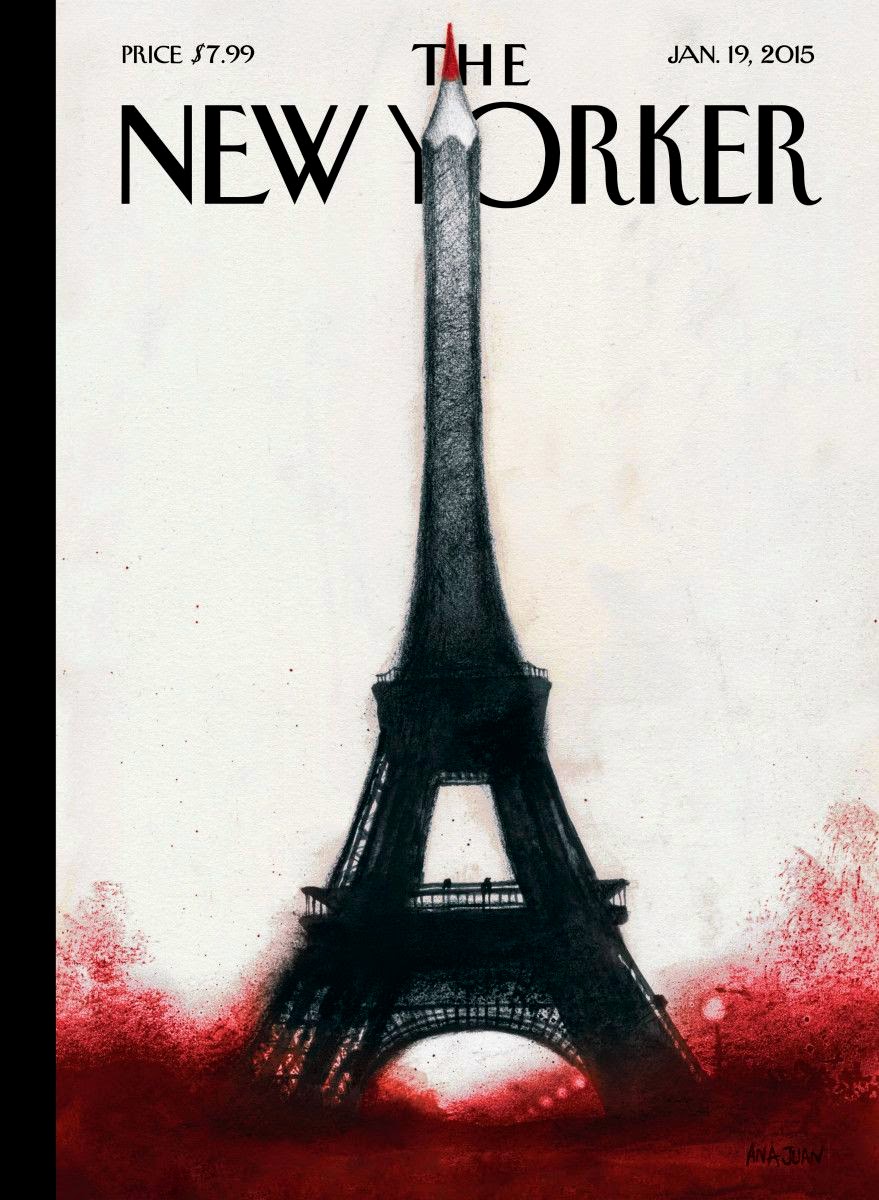
MARCHONS!

by George Held


   To the indelible spirit of “La Marseillaise”                                                          


Though assassins dealt a death blow                                                                        
To cartoonists at Charlie Hebdo,
Now the free world joins to say “Non!”
To terrorists who trade in woe:
“Vive la satire!” “À bas” the foes
Of liberty, equality, fraternity,
Those magnificent words English
And French and their multicultural
Societies share and now renew
Their commitment to.


George Held, a regular contributor to The New Verse News, has a new book out from Poets Wear Prada, Culling: New & Selected Nature Poems.

Thursday, September 12, 2013

JEAN-PAUL SARTRE INTERVIEWS BASHAR AL-ASSAD

by Judith Terzi


Jean-Paul:      La ligne rouge? Have you crossed the red line?

Bashar:            Qu'est-ce que c'est?

Jean-Paul:      Did your regime use chemical weapons?

Bashar:            Facebook is a loaded pistol. A powder keg.
                          We are Syrians, not tweets. The story does
                          not hold together. Let me tell you the truth:
                          Hell is social media.

Jean-Paul:       If you were a philosopher, what would you do?

Bashar:            I would stop dyeing my hair, for one. It looks
                          horrible on screen. I would strive to become
                          authentic. How do you say: authentique?
                          I would dance naked with French women.
                          Naked as a worm. French women kiss like rebels,
                          n'est-ce pas? Oh, pardon, I mean like...terrorists.
                          I would sing  Non, je ne regrette rien. Wonderful
                          song. Ha, ha, ha, ha, ha, ha, ha, ha, ha, ha...
                       
Jean-Paul:       Did your regime use chemical weapons?

Bashar:            When the rich go to war, women and children
                          die in the blink of an explosion in a tunnel. Red
                          line, red blood, red tulip, jungle red (my wife's
                          lipstick), Russian red, Rudolph red. You see,
                          Syria is a secular regime, Jean-Paul. Stockpiles
                          have no meaning if you are condemned to be free.
           
Jean-Paul:      Would you leave Syria if safe passage were offered?

Bashar:            Ah, Jean-Paul, the chips are not yet down. How do you
                          say: Les jeux ne sont pas faits?

Jean-Paul:      Oh, you have it wrong, cher Bashar. Les jeux sont faits.
                          So you read my play? What will happen if France
                          decides to strike? Or the U.S.?

Bashar:            I am no fortune teller, Jean-Paul. You can expect
                          the unexpected anywhere, anytime. Ha, ha, ha, ha...
                          Your peoples are no strangers to the accessories
                          of war. Engagement is an act, not a dot.com. Kind
                          regards from my wife. She wishes you would chill.
                                    

Recent poems by Judith Terzi have appeared or are forthcoming in: Malala: Poems for Malala Yousafzai (FutureCycle Press); Myrrh, Mothwing, Smoke: Erotic Poems (Tupelo Press); The Raintown Review; Times They Were A-Changing: Women Remember the 60s & 70s (She Writes Press); and elsewhere. Her fourth chapbook, Ghazal for a Chambermaid, is forthcoming from Finishing Line.