The New Verse News presents politically progressive poetry on current events and topical issues.
Guidelines
Submission Guidelines: Send 1-3 unpublished poems in the body of an email (NO ATTACHMENTS) to nvneditor[at]gmail.com. No simultaneous submissions. Use "Verse News Submission" as the subject line. Send a brief bio. No payment. Authors retain all rights after 1st-time appearance here. Scroll down the right sidebar for the fine print.
Kyle Hunter is a poet and managing editor of the 50. His poems have
appeared in Main Street Rag, DASH Literary Journal, So It Goes, Tipton
Poetry Journal, Rat's Ass Review, and elsewhere.
Johannesburg-born artist Adam Broomberg, 53, took photographs of olive trees to his mother just before she died in December last year. She had been an ardent supporter of the state of Israel and a firm Zionist. Like many people in South Africa’s Jewish community, her family were Holocaust survivors. Both her parents lost 90% of their family in that pogrom. Broomberg has been taking pictures of ancient olive trees in Palestine for the past 18 months — most of them were planted more than a thousand years ago. The oldest one, called the Al-Badawi tree, is over 4 500 years old. Every two years this tree still yields 800kg of olives. It is nearly 20m high and has a circumference of 25m. “There is the sweetest man who lives there; at night he sleeps underneath the Al-Badawi tree just to protect it,” Broomberg tells me on a Zoom call from Berlin, where he is now based. “I was meant to go on 23 October, to take seven of my students to Palestine to go and pick olives from the Al-Badawi tree, because it is olive-picking season.” But the Israeli war—many describe it as a genocide—on Gaza, about 75km away, has put a firm brake on that plan. “It’s heart-breaking not to be able to go there,” Broomberg says. He pauses and closes his eyes. Since 1967 more than 800 000 of these trees have been either uprooted or burnt to the ground by Israeli authorities or by illegal Jewish settlers under the supervision of the military. Between August 2020 and 2021, more than 9 300 olive trees were destroyed in the West Bank, according to The Art Newspaper. —Mail & Guardian (South Africa), October 21, 2023
Is there anything more innocent than olives, green and heavy on the branch, Is there anything more peaceful than those branches, Or more gentle than the wind chime of those leaves?
Isn’t it always the olive branch offered, between man and wife, Between nations, the olive branch carried off to the Moon, even, coded into statue and treaty, held out with pleading arms Noah, himself, relieved when the dove returns with that verdant sign in its beak. Mud receding, the return of life.
Deborah was going to pick olives this fall a special harvest program, there, by the Mediterranean Israelis gathering with Palestinians, Palestinians picking next to Israelis Round hard olives in their hands, not stones, not weapons. just olives An effort to extract some small oily, slippery drops of justice.
And then came the news, the shock of it, in that holy, but defiled place and the world gasped in horror and the olives flew off the trees bleeding, ripped, raped, burned and the trees fell to the ground and hope scattered and hid.
So many wrongs No matter from which hillside you gaze The soil festers with pain Hate fueled, fertilized, continued. Why can’t there just be olives?
Gabriella Brand’s work has appeared worldwide in over fifty literary magazines. Her latest U.S published poems and short stories can be found in Abandoned Mine, Syncopation, and Amaranth Journal. She is a Pushcart Prize nominee. Gabriella lives near New Haven, Connecticut, where she teaches foreign languages.
I am the person formerly known as _____ _____ - _____.
Now she is the bird left behind from the flock.
She is the figure weeping in the sand.
A witness, witnessed only by the sea.
I am not a war correspondent or a social media expert.
I am not a documentarian of suffering.
Don’t worry. I have nothing to teach you and nothing to say.
I’m just skipping words like stones along the water,
knowing they will bounce and then sink down.
The birds laugh at us.
Birds side eye sonic jets and helicopters.
Maybe they will tell the trees what’s going on — what they see and feel.
Last week I was a writer.
Today I am a barnacle on the belly of a whale.
I am moaning like an underwater animal.
When did time stop? When will it start back up?
Will it? Is this the new time,
the timeless time, lost in unknowing?
I am not a flag.
I am no longer really a woman, I just gave birth to life.
I am not a faith, just faithful.
Oh broken bones and heavy stones
How far will you tumble?
How far down will you fall?
Six days ago was the sabbath. We gathered
with 29 members of my family across four generations. Cousins with cousins.
Sisters with sisters. Brothers and children and grandparents.
Six days ago was a Friday.
Today is six days past a moment of miracles, six days past the bomb.
24 hours x 6 ago there was a night where we could all lay down and hope to sleep.
If I am going to sit with the page I have to say that I don’t want to say
I want this to not be true.
Before I speak, I want you to know that I am wrong.
Not because I know nothing but because everything is wrong.
Not everything but the big world of powers that evaporate worlds.
I don’t want to remind my mind and relive what has become a beginning.
I don’t want to state the facts because the facts are a mush of kindnesses and disasters.
I am the person formerly known as a self.
I melted into the Mediterranean, sonic booms above our heads.
My tears salt the water and make everything sting.
I want to tell you about the weeping.
The mother collapsing onto her belly like a conch shell whose life has departed.
She is the throw away, the detritus of those left behind.
Author’s note: I have been in three cities in Israel during this past week. I am from Los Angeles. My mother was born here in 1932 as a Jewish person under the British Mandate Palestine. I am a mother, a teacher, and a culture maker. I am deeply opposed to murder, torture, war, and intergenerational harm. War is the loss of lives and infrastructure and dreams and time. Torture and war are the worst uses of human energy and potential.
From January 2023 to August 2023, inclusive, the UNHCR records that 2,314 people have died or been declared missing at sea on Mediterranean migration routes; the IOM similarly recorded 2,324 deaths or disappearances over the same time. —Wikipedia
For these burials at sea
the dead are not sewn into sail cloth
No ceremony no one prays over them
Their boat converts to casket
submerges to a mass grave
their last refuge
Joanne Kennedy Frazer (Durham, NC) enjoys spending her silvering years writing poetry and publishing in numerous anthologies, journals, and ezines. She has written two chapbooks. Most recently, Seasonings (Kelsay Press).
Keep those within your sight. Your heart. Your head.
It’s good advice. On days when all I’ve read
puts basic human decency in doubt,
and all I’ve heard’s what hurtful people shout,
I focus on the helpful folks instead.
Or try to. Sometimes all that’s in the frame
is evidence that helpers never came.
Two long, light-gray balloons, like downturned lips,
say several states withheld their rescue ships.
No helpers in the picture. Not this time.
But you can help bear witness to this crime.
A shipwreck off the Libyan coast has reportedly claimed the lives of 130 people, despite SOS calls for help, the UN migration agency IOM said on Friday [April 23]. The tragedy was confirmed late on Thursday by the volunteer rescue vessel Ocean Viking, which found dozens of bodies floating in the water northeast of Tripoli. It had been in distress since Wednesday morning, the NGO said in a statement. IOM spokesperson, Safa Msehli, told journalists in Geneva that the victims had been on board a rubber dinghy for two days before it sank in the central Mediterranean. “For two days, the NGO alarm phone, which is responsible for sending distress calls to the relevant maritime rescue centres in the region, has been calling on States to uphold their responsibilities towards these people and send rescue vessels. Unfortunately, that has not happened.” More than 500 people have drowned on the so-called Central Mediterranean sea route this year according to IOM—almost three times as many the same period last year. —UN News, April 23, 2021
Julie Steiner is a pseudonym in San Diego. Besides The New Verse News, the venues in which her poetry has appeared include the Able Muse Review, Rattle, Light, and the Asses of Parnassus.
And the oceans, seas and rivers bled, then and now.
1
So many unshackled black bodies,
hauled topside, dragged to the rail like sacks
of trash, worthless cargo when breathless or ill.
Unshrouded, unblessed, tossed to the sharks.
Lost: your freedom, your fields, family, friends,
songs and dances, your chanted village score,
your matching parts. Separated and silenced
you descend to the unknown ocean floor.
2
Now a coyote says, “This far and no further;
A raft is there by the Rio Bravo.” Death threats,
and poverty marched the family north to the churning
spring waters, hoping to elude the border’s net.
“We will not be separated, will stay a family,”
Mid river, the rapids sank the raft, the dream.
Four will never know the opposite shore. Lost—
father, daughter child, and infant, swept downstream.
3
The Mediterranean Sea, the reddest of borders,
graveyard for countless non-Europeans fleeing torture
and war. First an embrace from the host, then rejection.
For a time, heroic rescues at sea, then cessation.
Thank the Turkish soldier who kindly retrieves
the lifeless body from Bodrum’s shore, who cradles
Aylan, in his arms, a three-year-old Syrian Kurd. Mother,
sister lost at sea; only the broken father left to grieve.
4
Who knows who first pressed the knife’s tip in, opened
the wound? But slave trader, captain and merchant pushed
it deeper. And despots, dealers, war lords, smugglers twisted
it more than a turn or two—then, hope and story severed.
If you don’t turn your head, you will see children confined,
crying out for their parents, drowning in a sea of abuse,
but also gaze at the perp’s or the collaborator’s eyes,
black and blank, a passageway to the dying soul’s cries.
5
The spirit, the sea—eternal and universal; every creature
a part of the tale. The sea, the womb; life’s origins.
Joined, at birth, our ties soon severed by Mammon’s legions.
Exiles and lords, cast apart, songless in a wounded sea.
Who in that sea will sing the first note of the song
that sparks the afflicted, that turns the cruel and greedy,
that invites every voice to join, that note by note stops
the bleeding, purifies the water, rewrites the wrongs?
Bill Sullivan taught English and American Studies at Keene State College. He co-authored two studies of twentieth century poetry, co-directed two documentaries. His poems have appeared in a number of print and online publications. His Loon Lore: In Poetry and Prose was published by Grove Street Books in 2015. He retired to Westerly, RI and turns to the ocean and gardens when times turn bleak.
At least 52 people died after a boat carrying around 180 refugees and migrants sank off the coast of Tunisia on Saturday. UNHCR, the UN Refugee Agency, is deeply saddened at this latest tragedy in the Mediterranean Sea and is concerned about the high number of people dying on the Central Mediterranean route with over 700 dead or missing so far in 2018. —UNHCR, June 5, 2018; Meanwhile, Italian Interior Minister Matteo Salvini (in photo) says he will stop migrants trying to reach Europe via Sicily. – EPA pic, June 4, 2018.
"Can I escape from fell Charybdis and ward Scylla off?" —Homer, Odyssey, Book 12, Lines 115, Odysseus to Circe
At Sfax, the news was horrible—five dozen dead—and more,
near to Kerkennah Island off of north Tunisia's shore.
Increasingly the human traffickers launch people from
Tunisia, now that Libya is tighter than a drum.
The boat was packed with migrants fleeing Africa to be
free from the lives they do not like for hope in Italy.
But, o, alas, the relatives of those who learned the worst,
their souls, like Dido's when Aeneas left her, are accursed.
But further off, up north, Salvini said at Sicily,
"We will no longer be the camp for Europe's refugees."
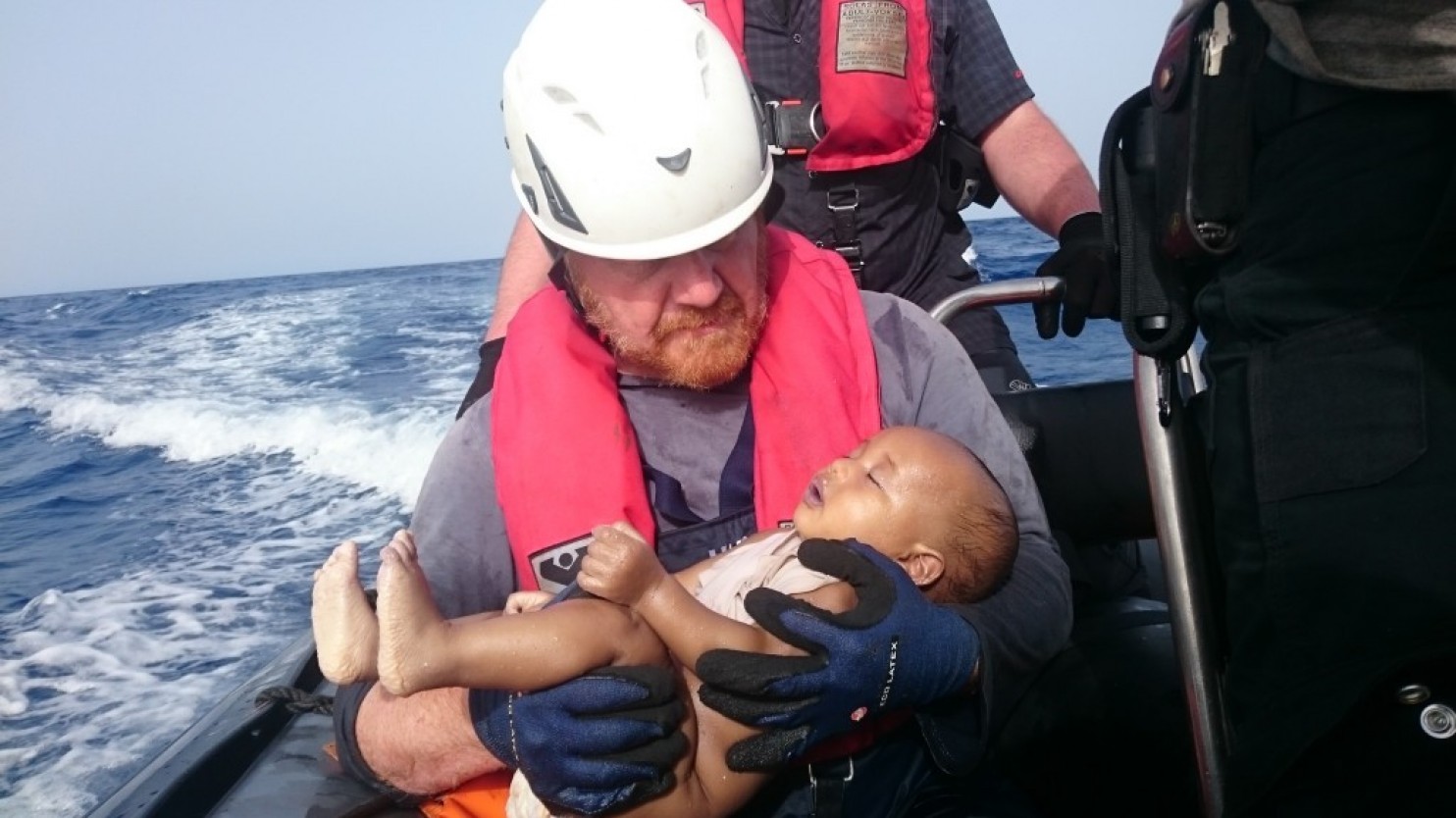
A German rescuer holds the corpse of a drowned baby off the Libyan coast May 27. Source: Christian Buettner/Eikon Nord GmbH Germany via Reuters and The Washington Post, May 31, 2016.
“Again! again! again!”
On our way to the Pacific
we snuggle in the back seat
with The Poky Little Puppy—
“Rice pudding,” our little traveler echoes,
“He likes it!”
At the beach, we splash through
currents, waves breaking warm
around her ankles
Bodies small as hers
wash up on other shores,
refuse of war
their families refused
safe passage
refuge
My son’s body
disappears
in green-white breakers
He resurfaces
and waves
A yellow shovel
shapes her first sandcastle
A man says he wants only
to bury his children
and sit by their graves
until he dies
Fresh from her evening bath,
her dark head emerging from a white-towel chrysalis
safe in her father’s arms
both of them laughing—
Beneath the Milky Way
the sea returns
again again again
Across the Atlantic
a 13-year old imitates
as best he can with a crossbow
that kills a teacher.
Anniversary of Columbine
in a Barcelona school.
Blossoms on the verge
of unlocking in Colorado:
blue violet about to spill
across the San Juans.
Across the Capitol lawn
a gyrocopter glides to a stop.
No odes aboard, only
political prose for campaign
finance reform. Oh mail me
a poem, Mr. Mailman,
make it the lyric of the month.
I know you're someone's hero,
an elegy clinging to a wing,
like migrants hanging
to la vita on a shoddy ship
across the Mediterranean.
They sold their organs to pay
pirates in coyotes' clothing.
And across the bench sits
Dzhokhar, gaze pasted
to the scribble of alphabet,
bowls of letters across a page. If onlys dangle between blue
lines like columbines hugging
the soil before the next rain.
Judith Terzi is a Southern California poet whose recent work has appeared or is forthcoming in journals and anthologies such as Off the Coast, Raintown Review, Unsplendid, and Wide Awake: The Poets of Los Angeles and Beyond (Beyond Baroque). If You Spot Your Brother Floating By is her latest chapbook from Kattywompus Press.
nothing is fixed
not the broken boat on the water
not the broken lives fleeing the forces of war
not the broken system that dehumanizes and deports
nothing stands
between those on board and
the breaking of the waves
not the luck that never holds out
not the promises that never pan out
not the border patrol that refuses to look out
for a ship lost at sea
in waters that never deceive:
only when your image is no longer reflected in the water do you begin to see yourself the way the world sees you
Michelle Marie has written for Infita7 and Bluestockings Magazine.