The New Verse News presents politically progressive poetry on current events and topical issues.
Guidelines
Submission Guidelines: Send 1-3 unpublished poems in the body of an email (NO ATTACHMENTS) to nvneditor[at]gmail.com. No simultaneous submissions. Use "Verse News Submission" as the subject line. Send a brief bio. No payment. Authors retain all rights after 1st-time appearance here. Scroll down the right sidebar for the fine print.
When distant bombs and bread denied leave no trace abroad except in heart and mind of reader and writer
where do we turn in our countries of refuge for the next impulse to compose? To whom shall we address
our song? And should we eat and love, or fast and be silent? For how long?
Indran Amirthanayagam writes a Substack. His publications include El bosque de deleites fratricidas ( RIL Editores), Seer (Hanging Loose Press),The Runner's Almanac (Spuyten Duyvil), Powèt Nan Pò A: Poet of the Port (Mad Hat), and Ten Thousand Steps Against the Tyrant (Broadstone Books). He is the translator of Kenia Cano’s Animal For The Eyes (Dialogos Books) and Origami: Selected Poems of Manuel Ulacia (Dialogos Books). He edits The Beltway Poetry Quarterly, hosts the Poetry Channel on YouTube, and publishes poetry books with Sara Cahill Marron at Beltway Editions.
From January 2023 to August 2023, inclusive, the UNHCR records that 2,314 people have died or been declared missing at sea on Mediterranean migration routes; the IOM similarly recorded 2,324 deaths or disappearances over the same time. —Wikipedia
For these burials at sea
the dead are not sewn into sail cloth
No ceremony no one prays over them
Their boat converts to casket
submerges to a mass grave
their last refuge
Joanne Kennedy Frazer (Durham, NC) enjoys spending her silvering years writing poetry and publishing in numerous anthologies, journals, and ezines. She has written two chapbooks. Most recently, Seasonings (Kelsay Press).
story line the same, but now removing it from San Leandro,
taking it to Mariupol, setting up production there for
the same play, with young Ukrainians in the roles of Belle,
The Beast, the talking Armoire and the flickering Lumiere,
all taking turns rehearsing for the opening night. The local
story tells of students whose dramatic arc
had lost two years, pandemic’s having moved them away
from stages and onto screens. The story from another world
shows readers columns, perhaps Corinthian, now holding air,
the theater they adorned now roofless, the drama playing out
a theme of death and rubble, shrapnel-scarred skeletons, smoke
the scrim. Who may have played these roles we do not know, those
killed as they sought refuge in a theater basement.
The layout
is the story: partitioned narratives reveal two worlds, one
where drama’s curtain rises to roles donned,
the other where the drama is demise,
where nothing’s left for anyone, for any of us,
to understand.
Barbara Simmons, a native Bostonian residing in California, a graduate of Wellesley College and The Writing Seminars from Johns Hopkins, is a retired teacher and counselor. She explores the communion of words as ways to remember and envision. Publications include Boston Accent, The NewVerse News, Soul-Lit, and Capsule Stories. Offertories: Exclamations and Disequilibriums is her first book of poetry due in Spring 2022.
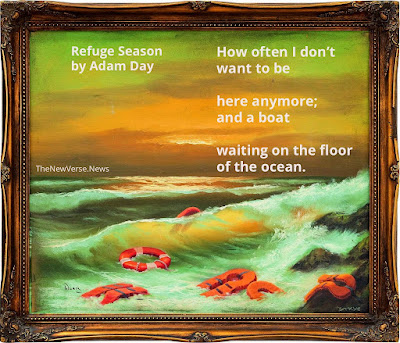
Art: Banksy, Mediterranean Sea View 2017, detail of a triptych. Photo courtesy of Sotheby's London via artnet news.
Adam Day is the the author of Left-Handed Wolf (LSU Press, 2020), and of Model of a City in Civil War (Sarabande Books), and the recipient of a Poetry Society of America Chapbook Fellowship for Badger, Apocrypha, and of a PEN Award. He is the editor of the forthcoming anthology, Divine Orphans of the Poetic Project, from 1913 Press, and his work has appeared in the APR, Boston Review, Denver Quarterly, Volt, Kenyon Review, Iowa Review, and elsewhere.
The sad leaked like ripe fruit from the core of our world
The men in blue pepper sprayed a nine year old girl
I don’t think the politicians, protected in suits, will save us
I don’t think these issues are something they’d care to discuss
We woke up to close the blinds against a wildfire world
The men in blue pepper sprayed a nine year old girl
I don’t believe life ends at Black or starts at conception
I don’t believe in law enforcement’s redemption
We live in the same country but different worlds
The men in blue pepper sprayed a nine year old girl
cops / defenders / bastards they’ll come for you too,
hit you hard in the streets if you step on their shoes
I sent a letter to the P.O. box of our homeless world
The men in blue pepper sprayed a nine year old girl
We’ve been taught rights are something we can negotiate
We’ve seen first hand our systems were contrived in hate
We stand outside and wave goodbye to a disappearing world
The men in blue pepper sprayed a nine year old girl
I wonder if there is a point where we’re past being saved
If this marks a civilization too utterly depraved
I want so bad to rescue this reckless, refuge world
I want so bad to cover the eyes of the nine year old girl
Open your own eyes and see where the real danger compiles
in our actions, in our violence, not in the fearful, backtalk of a child.
What if we gather and release this knotted up, wounded world
and teach the next generation to protect all nine year old girls?
Am I too hopeful or can we confront it, our long past of disparity?
Am I too hopeful or can we grow them, our seeds of peaceful solidarity?
Angelica Whitehorne is a New York artist who writes poems, pieces of fiction, and stanza-formatted rants about the world we’re living in. She’s not creative enough to write about some other world, so this one is all she’s got. She has published or forthcoming work in The Laurel Review, The Cardiff Review, North Dakota Quarterly, Mantis, Ruminate, and Hooligan Magazine among others.
a hand holds out a cookie of molasses and oats.
Square in the center of that little cake,
red licorice, or black, a peppermint.
Job well done. Time for rest
and health care, cool water,
baths, consideration
of overtime, a refuge
with a solid roof,
greens, a kind hand,
good neighbors,
legal papers,
retirement benefits
and a living wage.
Tricia Knoll has loved to be around horses all her life. One of those kind of poet-girls. This poem came to her after watching a spectacular jumping competition in Wilsonville, Oregon. Tricia’s new book of poetry Broadfork Farm compiles love songs to a small organic farm in Trout Lake, Washington—and includes one other poem about horses in the midst of those about dogs, chickens, pigs, goats, farmers, and orchards. @triciaknollwind
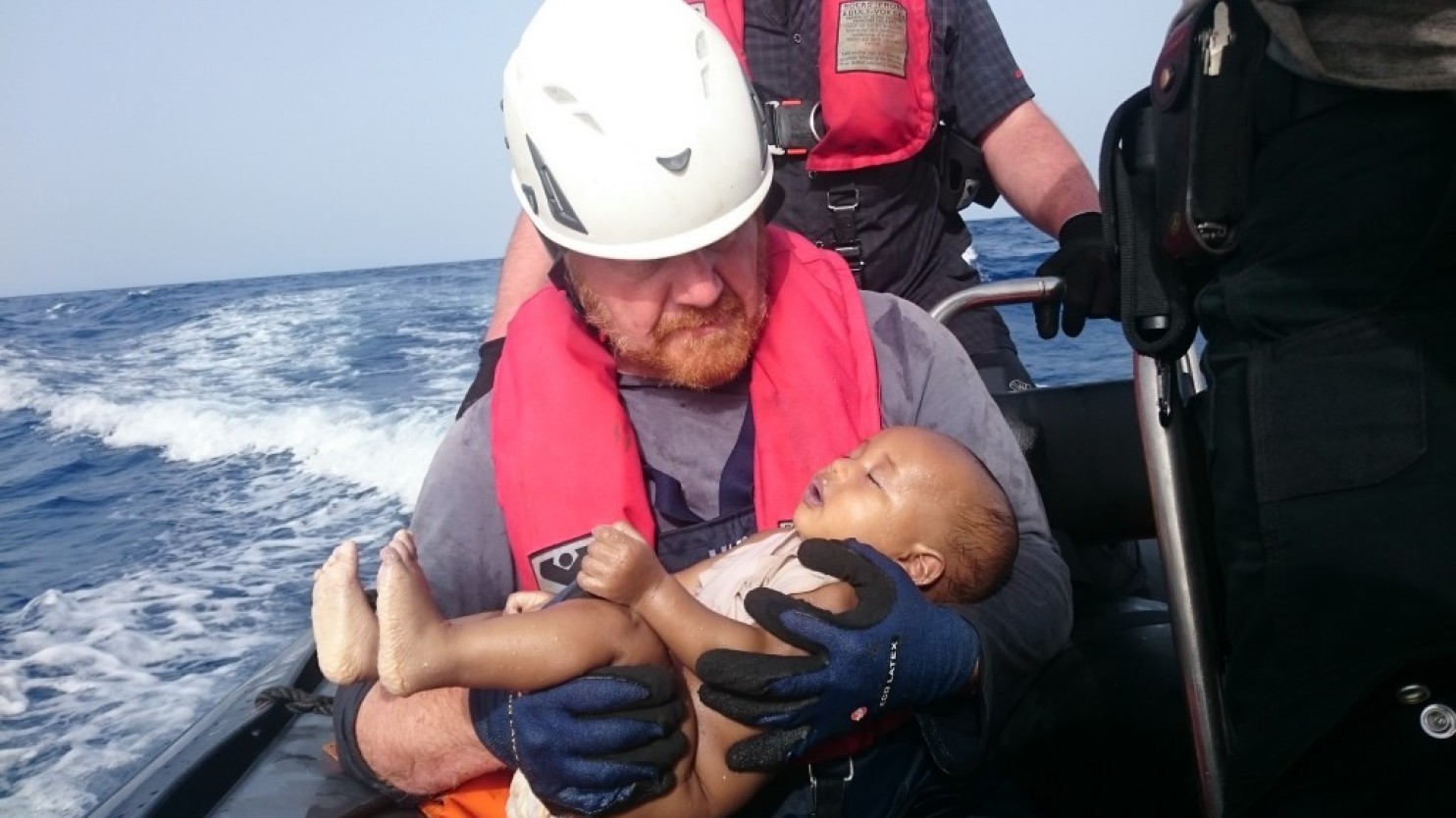
A German rescuer holds the corpse of a drowned baby off the Libyan coast May 27. Source: Christian Buettner/Eikon Nord GmbH Germany via Reuters and The Washington Post, May 31, 2016.
“Again! again! again!”
On our way to the Pacific
we snuggle in the back seat
with The Poky Little Puppy—
“Rice pudding,” our little traveler echoes,
“He likes it!”
At the beach, we splash through
currents, waves breaking warm
around her ankles
Bodies small as hers
wash up on other shores,
refuse of war
their families refused
safe passage
refuge
My son’s body
disappears
in green-white breakers
He resurfaces
and waves
A yellow shovel
shapes her first sandcastle
A man says he wants only
to bury his children
and sit by their graves
until he dies
Fresh from her evening bath,
her dark head emerging from a white-towel chrysalis
safe in her father’s arms
both of them laughing—
Beneath the Milky Way
the sea returns
again again again