Guidelines


Submission Guidelines: Send 1-3 unpublished poems in the body of an email (NO ATTACHMENTS) to nvneditor[at]gmail.com. No simultaneous submissions. Use "Verse News Submission" as the subject line. Send a brief bio. No payment. Authors retain all rights after 1st-time appearance here. Scroll down the right sidebar for the fine print.
Showing posts with label #BLM. Show all posts

Tuesday, May 31, 2022

ANTHEM FOR THE WOKE

by Geoffrey Philp


‘Stay Woke, Go Vote’ rally stirs spirited emotions, heartfelt pleas
 

Where are the protestors from the summer of plague
who saw Black lives threatened, and marched to free
us from fascists and were greeted by an army of fear
mongers united in their cause to make sure change
would never happen, and began a campaign of lies
among the afflicted to sate the elites' lust for power,
 
that revealed their resistance to Black power—
the rising numbers in the cities they see as a plague,
so every cable series or news story is filled with lies
about Black crime—dire warnings that if we're ever free,
no one will be free, for we will have changed
America for the worse, and everyone will live in fear?
 
It's what Public Enemy was rapping about in Fear
of a Black Planet, especially in "Fight the Power,"
so we'd start the process of believing in the change
that must happen at the top, or else we'll be plagued
by doubters who will delay our quest for freedom
from their lies. For they lie. They lie. They lie.
 
But what if we stopped believing their lies,
the denials and gaslighting that keep them in fear
of shadows they've invented—that won't set them free
until they've given up their need for control, for power,
at the cost of the planet's life—before we're plagued
by circumstances, we won't be able to change
 
once the irreversible effects of climate change,
which oil company CEOs have labeled as a lie,
melts ice caps and releases viruses to plague
future generations, who will live in perpetual fear
of the next hurricane, heatwaves that disrupt power
grids, melt electric cables—when fresh air won't be free?
 
The ancestors' promise lives in the struggle to be free.
Ancestors like Marcus and Malcolm, who tried to change
our minds about the hold of the empire's power
over our people who have been educated with lies
about our past while others, paralyzed with fear
stare into the future as if it were a plague.
 
Rise, once again, and free yourselves from the lies
that keep us cowering in the dark. Rise, change your fear
from a plague of doubt into a power that liberates.
 

Geoffrey Philp is the author of the novels Garvey's Ghost and Benjamin, my son, five books of poetry, two collections of short stories, and three children's books, including Marcus and the Amazons. His forthcoming books include a graphic novel for children, My Name is Marcus, and a collection of poems, Archipelagos, which borrows from Kamau Brathwaite's "Middle Passage" lecture, Aime Cesaire's "Discourse on Colonialism," Sylvia Wynter's "1492," and Amitav Ghosh's thesis in The Nutmeg's Curse to explore the relationship between Christianity, colonialism, and genocide in the Plantationocene. He is currently working on a collection of poems, Letter from Marcus Garvey.

Thursday, February 24, 2022

THE ARTIST

by Louise Wilford


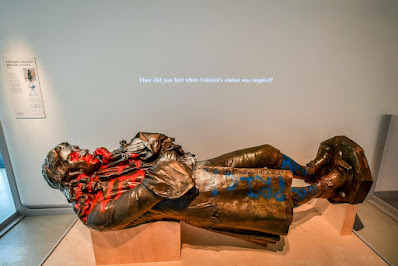
Covered in red and blue graffiti, the toppled statue of British politician Edward Colston, who enslaved tens of thousands of people, stood in the city of Bristol, UK for more than 100 years before it was pulled down by angry protesters during a wave of Black Lives Matter protests across the country last summer—after the death of George Floyd at the hands of Minneapolis police. Demonstrators used rope to tug the statue from its stone plinth and their bare hands to roll it through the streets and into the murky waters of a nearby harbor as onlookers cheered. Others chanted “Black Lives Matter,” in solidarity with those across the Atlantic dealing with issues of police brutality, systemic racism and complex histories. —The Washington Post, June 4, 2121


She painted Love on a garage roof,
in throbbing streaks of purple-red, the convolutions of a colon.
Sprayed Birth inside a canal bridge arch–metallic mist of bronze and copper,
cream and jungle green—its colours glowing loud as we moved
closer. Joy on a fire-damaged caravan, in orange streaks, fading
at their edge to silver fairy-dust against a woodland midnight.
 
Paintings drifted off around the tow –first drafts, discarded
—or maybe gifts, or threats. A wisp of air, she moved
about the streets, unseen save for the spores that trailed behind,
hand-prints on lamp-posts, splashes on a fence, office windows
and abandoned cars. Tragedy in a bus shelter, thick brown strokes
with an uneven brush; Bliss rolled up a shutter’s sides in jolting yellow
stripes; the turquoise-blue of Hope rubbed on the bricks of an abandoned
warehouse—and Innocence, black as a crow’s wing, sprawling, smug, along
a dry-stone wall.   
 
On the beech-tree avenue in the park, she painted the stretch of Life,
from gold to god, each stage a different tree. Her colours startled
like a kestrel’s swoop, on bollards, awnings, road signs, multi-storey
concrete car-parks. On a crossing, she painted the white stripes shocking
pink. She filled the holes of letters with tiny dots like grains inside an hour-glass;
 
scrawled a Nightmare on an underpass, a Daydream on a council refuse bin;
Ambition on the tall side of a Tesco van, Destruction on the shovel of a JCB.
Peace, soft as sand, perched on picnic tables. She spread her peacock tail
so the hues that churned inside her could escape, Tenderness like a swirl
of oil on a puddle, blood-red Anger, bile-green Envy, the pewter-grey
of Misery, and the sharp vermilion ache of Fear, vinegar shiny as a magpie
feather. Shades and shadows, grit and silk and dust and grease, stirred
and shifted, blended and erased.
 
Until one day, she drenched with the fishbone-white of Death,
a statue of a man whose alchemy created gold from blood and bone.
This man of stone had swaggered in that square for a hundred and fifty years.
Her colours now were spent. She hiccuped out a final few beige coughs,
a gentle sneeze that left a cloud of baby-pink dancing in the sun—and then,
with a flap of her wings, she left.
 

Louise Wilford lives in Yorkshire, UK. Her work has been widely published, most recently in Bandit, English Review, Goats’ Milk, Jaden, Makarelle, POTB, The Fieldstone Review, and Parakeet. In 2020, she won the Arts Quarterly Short Story Prize, the Merefest Poetry Prize, and was awarded a Masters in Creative Writing (Distinction). She is working on a children’s fantasy novel.

Thursday, February 17, 2022

BLACK MAN RUNNING

by L. Smith


"At the end of the day, the evidence in this case will prove that if Ahmaud Arbery had been White, he would have gone for a jog, checked out a cool house under construction, and been home in time for Sunday supper," Assistant US Attorney Barbara Bernstein told the jury [in an opening statement of the federal hate crimes trial of Arbery’s killers]. "Instead, he went out for a jog and ended up running for his life.” —CNN, February 14, 2022


“A White father and son in Mississippi were charged this week after they were accused of chasing and shooting at a Black FedEx driver in an incident that the driver’s attorney says was a “copycat crime” of the murder of Ahmaud Arbery. FedEx driver D’Monterrio Gibson said he was delivering packages on his route in Brookhaven, Miss., on Jan. 24 when two White men with whom he had not interacted chased him in a pickup truck for about seven minutes and fired at least five shots at the van he was driving.” —The Washington Post, February 12, 2022


Inhale, exhale. Red blood pumping.
He was a black man running.
Running for what? For leisure?
For health? For fun? For fit? In pursuit of dreams?
He was a Black man running, running until the gun, the threat, the them,
the father and the son—they both pointed that gun and
Black man running now running from that gun
from the threat
of the ones
in pursuit
of him.
 
Black man running, for what? For leisure?
For health? For fun? For fit? In pursuit of dreams?
(Nah, they don’t do that. Not the black man, huh?)
Black man running run from himself, from his shadow,
run from his responsibilities, from his family, from his integrity,
at least that’s the lie they try and try again to tell me. Black man running from
something that he did, that he ain’t supposed to do, ain’t supposed to have done, and
Black man running with something he stole, like their wealth, like their women’s innocence,
running with something he ain’t supposed to have like self-pride and self-confidence,
that’s what they wanna feed my conscience, but nah—
Black man running running b’cause he gots to run.
He gots to run to keep from crying, from screaming, from loosing.
He gots to run to keep from coming loose.
He gots to run to keep from the noose.
He gots to run to keep the noose loose.
 
(That uppity nigga there got the audacity to run with entitlement.)
 
Hell yeah, that black man running. He running from that gun.
Black man running always been running from the gun,
from the one with the perceived power, from the wretched one with the will to
kill his potential, stifle his legacy, ruin his reputation, claim his coins and his creations.
Black man running, he run from the pain, from the fear,
from the frustration, and he can feel all those running who
ran before him, running with him now, running inside of his chest—
making his heart beat harder and his lungs fill faster and legs run rapid.
Inhale, exhale. Red blood pumping.
 
Black man running been running a long time. Black man running is
tired of running—not of feeling tired, not the bottom of his feet feeling tired, not the soles aching,
but the bottom of his soul, tired and aching, from all those souls running inside his chest keeping his
blood pumping red.
He is so tired; he is soul-tired of blacks running.
Tired of being a black man running.
Tired of them chasing him while he’s chasing his dreams.
Tied of them chasing him while he’s slowing down.
Tired of them chasing him while he’s doing no thing. At all.
Inhale exhale, inhale exhale. Red blood pumping.
 
(This nigga here got the audacity to be running and funning.)
 
But what happened to black man running?
Black man running with his red blood pumping? Well,
they forced him to stop running. Inhale, inhale.
 
But what if black man running was running toward somethin’?
Well, black man running was forced to fight those in pursuit
of his portion, in pursuit of his promise. Inhale, inhale, inhale.
 
Black man running had to stop his run, to stop his fun, his fit, his leisure,
had to quit his pursuit of his kingdom, of his dreamdom
to fight those in pursuit of his freedom,
those in lust of his life, jealous of his journey, envious of his evolution,
not that one, but of the magnanimous way he was created
by the Creator, and how their pursuit to stifle him never seems to really win,
they—them other theys—literally shackled his ankles a time or twelve million,
amputated his manhood for sport cloaked as social order, for hate hooded as justice,
and black man—well, he just keeps running, keeps evolving,
so they—these theys—saw this black man running
and decided for him that he would run no more.
 
Inhale, inhale, inhale. Red blood pumping.
 
Black man running would have run on, would have won on, had he kept on running.
He would have been winning, had he kept on running, but they—the jealous, the fearful, the hateful—
they jolted his journey.
Inhale, inhale. inhale. Red blood pumping.
 
The father and the son—they both had that gun.
The wicked and the wretched—they both wrestled his run, and when it seems like
black man running wins with his wrestle, with his hustle, with his bustle, and
when it seems like black man running is making gains with his grind and with his grit, and
just when it seems like black man running might get the glory,
what they know
is that black man running
can’t win ‘gainst no gun.
(This nigga here ain’t gone outrun this gun.)
 
Inhale, inhale, inhale. Red blood pumping.
 
The gun wants no fun, no fit for the black man running.
                No gaining, no glory for the black man running.
                No playing, no pleasure for the black man running.
                No leisure, no living for the black man running.
(Black man running, you gets this gun.)
                The kingdom not coming for the black man running.
(Black man running, this gun got your gallows.)
                No dreaming, just drumming for the black man running.
 
Exhale. Red blood spilled.
 
He was a working black man running
running at work.
He was a running black man running
who went for a run.


L. Smith, a New Orleans native, is a writer, an English teacher, and a Johns Hopkins University graduate who has freelanced for local newspapers. She has an anthology of poems and prose set to publish spring 2022 that her mother and daughter created space for her to write. She also has begun the blog Writer Teacher for writers teaching writers.

Monday, February 07, 2022

FOR KAREN, MOTHER OF AMIR

by Jennifer Hernandez


An officer with the Minneapolis Police Department SWAT team shot and killed a 22-year-old man early Wednesday morning during the execution of a no-knock raid, reinvigorating debate around a law-enforcement tactic that many say is ripe for abuse. The victim, Amir Locke, who appeared to be asleep on the couch that morning, was not named on that warrant. In a matter of about three seconds, body camera footage shows the man—buried under a thick white blanket—stirring to the sound of the cops' entry with his hand on the barrel of a firearm. Officer Mark Hanneman then shoots him three times. Interim Minneapolis Police Chief Amelia Huffman initially said that Hanneman shot Locke because Locke pointed his gun "in the direction of officers." But the footage released by the government appeared to contradict that: Locke's gun was pointed to the side, and his hand was on the barrel of the weapon, not the trigger. He owned the gun legally and had a concealed carry permit, according to his family's legal representation. "My son was executed…and now his dreams have been destroyed," said Locke's mother, Karen Wells, at a press conference Friday. "They didn't even give him a chance," echoed attorney Ben Crump. —reason, February 4, 2022. Photo: USA  Today, February 5, 2022


My child is also a deep sleeper.
 
If he crashes on the couch
at the home of a friend
after a night at the club or
making music or playing COD,
his head covered by a blanket
so he doesn’t see or hear
the door open, the strangers
enter the room, the strangers
kick the couch to rouse him
in the pre-dawn darkness—
 
If he wakes in fear at strangers—
If he grabs a weapon for protection—
 
will my son be shot three times
in nine seconds? Will I be left
to wail over his young body?
Will I be forced to fight
for justice? Will I?


Editor's Recommended Reading: "The Burden of the Black Mother"
 
 
Jennifer Hernandez lives in Minnesota with her husband and three sons. She teaches immigrant youth and writes poetry, flash, and creative non-fiction. Publications include Radical Teacher, Rise Up Review, Writers Resist, and This Was 2020: Minnesotans Write About Pandemics and Social Justice in a Historic Year. Her poem "Taco Love" was also featured in Poetry in the Park in the Dark sponsored by the Saint Paul Almanac.

Friday, November 19, 2021

ONCE AGAIN REALITY

by Buff Whitman-Bradley


Source: Puzzle Warehouse


Once again reality
Has collided with fantasy.
Once again the truth
About America
Has crashed into 
Our pretty beliefs
About the basic goodness
Of our nation under God.
And once again 
All the old cliches
Will be hauled out—
“Sure, we’re not perfect,
We make mistakes sometimes,
But at the end of the day
We’re still lucky to be living
In the Land of the Free
The Home of the Brave
From Sea to Shining Sea
Amen.”
And little by little
Memory of the latest grotesque injustice
Will fade.
We will go to the movies,
Watch the Super Bowl,
Have dinner with friends,
Take our kids to the park,
And recede back into 
The collective dream
Of America the Good.
And we will be shocked 
All over again
The next time a cop murders a black kid,
The next time a governor
Poisons a whole city with contaminated water,
The next time a hospital 
Throws an indigent patient 
Out onto the street,
The next time
A vigilante gets away with murder.


Buff Whitman-Bradley’s poems have appeared in numerous print and online journals.  His most recent book is At the Driveway Guitar Sale: Poems on Aging, Memory, Mortality, from Main Street Rag Publishers.  He podcasts poems on aging at thirdactpoems.podbean.com and lives with his wife, Cynthia, in northern California.

DUNCAN AND BRADY

by Julian O. Long


after the Kyle Rittenhouse verdict
 

Speaking of ’lectric cars,
once at a Fort Worth stop sign
a lowrider lifted a fender
like a dog might lift his leg to piss
and flipped me the bird as he took off
laughing around the corner.
That was long ago, but he knew what
he meant—and he loved it.
 
As the uptight white boy I was
in those days, I may have deserved
his contempt. These days I’d like
to blow him a kiss on the wind he stirred,
as he spun out that souped-up Chevy.
Would it were so, amigo,
would it were so.
 
Staggerlee remembers Xmas
but King Brady, he lies dead
and the ghost of old St. Louie
flew past my naked bed
when the rage for George Floyd started
up and down my street,
and the high-tailed carriages
came and went all night
breaking in the windows
knocking down the door
startling me in bed on the second floor... 
 
Busy now, containing Russia,
smug in my alabaster pink
pragmatism, I rejoiced in my country’s
apparent arrested decline. Cop who murdered
Floyd will go to jail, I thought. We threw out
the bastards who stormed the Capitol, I said—
forgetting only too eagerly
Republicans’ settled intention
to lynch the rest of us, La Migra still
lording it up at the border, catching runaways
jury finding Rittenhouse ‘not guilty on all counts.’
 
Nothin’ for it but the blues?
James Baldwin’s Staggerlee let pent up anger, blues remade,
hiss out of him like rancid air from some hack’s
rubber tire.
 
Seem like King Brady never died,
Duncan shot him,
doctor found him dead
but he just raised his hammy fist, took that doctor by the throat
and growled, “Sumbitch, you know I cain’t be killed!”
 
We’ll not overcome this last lynch mob—they’re us;
we’ll watch polite and passive as the Good Old US steals
away down Dixie one last time; no matter clawhammer steels
 
ring out from edges of fields
to tell it again
how we’ve all of us been—
 
yeah, we’ve been on the job
too long... 


Julian O. Long is a previous contributor to The New Verse News. His poems and essays have appeared in The Sewanee Review, Pembroke Magazine, New Texas, New Mexico Magazine, and Horizon among others. His chapbook High Wire Man is number twenty-two in the Trilobite Poetry series published by the University of North Texas Libraries. A collection of his poems, Reading Evening Prayer in an Empty Church, appeared from Backroom Window Press in 2018. Other online publications have appeared or are forthcoming at The Piker Press, Better Than Starbucks, The Raw Art Review, and Litbreak Magazine.  Long has taught school at the University of North Texas, North Carolina State University, and Saint Louis University. He is now retired and lives in Saint Louis, Missouri.

Wednesday, October 20, 2021

THEY CALLED HIM A "F-ING N—"

by Rémy Dambron


Ahmaud Arbery's aunt, Theawanza Brooks, says, "Nobody has the decision to make as far as being the judge, jury and executioner." Her nephew was shot and killed in 2020. The trial is set to begin Monday in Brunswick, Ga. —NPR, October 18, 2021. Photo: NICOLE BUCHANAN FOR NPR


Once again, it falls 
on Georgians to guide the way

to be our nation’s conscience,
filtering out the noise, the hyperbole,

the lies.

Once again, it falls
on Georgians to decipher the truth

to act not on our prejudices or partisanships, but on our collective

humanness.

Once again, it falls
on Georgians to rise,

to stand as one and affirm 
that this man was not a thief,

was not burglar, was not a prowler, was not a criminal, was not a threat,

just a jogger.

Once again, it falls 
on Georgians to convince the courts

not to fear him for his skin,
not to judge him for their rage,

but to picture them standing over his bloodied body, shotgun still smoking

with the gall to call him that horrible word.

Once again it falls,
on Georgians to uphold the law,

to make right the wrongs 
of centuries of recklessness,

of supremacy.

To make good on the little remaining scraps of a social contract we used to

cherish.

Once again it falls,
on Georgians and a jury of their peers 

to demand that justice be done 
but never done,

screaming one more time
into the void of voids

enough is enough.


Rémy is a teacher and Portland-based activist whose work focuses on denouncing political corruption and advocating for social and environmental justice. With the help of his loving wife and chief editor, his poetry has appeared in What Rough Beast, Poets Reading the News, Writers Resist, Society of Classical Poets, and The New Verse News. 

Friday, May 21, 2021

A BRIEF GEOGRAPHY OF GOODBYES

by Mary K O'Melveny


"Red Composition" by Jackson Pollock


Everyone who knows grief as it settles onto chests,
humid as a jungle, thick as fog on a heath,
understands that goodbyes can be a gift. A brief
cushion to ease the long emptiness ahead.
 
As I write this, my friend’s husband is dying
in hospice care in New York. He surrendered
after waging a fierce battle with leukemia that,
for a merciful time, he seemed to be winning.
 
Each arc of loss beams wider than celestial skies
on clear summer nights. His young grandchildren
gather at a grassy hospital garden to say goodbye.
Siblings fly from far-flung homes to do the same.
 
My sister and I stood at our mother’s bedside
watching lights on monitors fade and fizzle out.
Without evidence of audibility, we still sang to her,
believing emigration is aided by a sound track.

In Gaza, bereaved households are less blessed.
A fine whine of rockets the only warning before
a family’s cardamom tea and künefe splatters
like a Pollock canvas across living room walls.
 
In Delhi, breaths come to a close after failed searches
for oxygen – it seems there is no price that can be paid
for air though grieving loved ones would mortgage
their own lung capacities if currencies allowed.
 
In North Carolina, police kill a man as he tries
to drive away from death. His story forms a pattern
recurrent as an Escher etching. Each morning’s only
question – will this day mark memory’s final day.
 
COVID focused attention toward microscopic gestures –
the tensile strength of touch, the graceful creases
of a laugh line, the thrill of whispered thank yous.
Such gifts may allow us to survive our diminishments.


Mary K O'Melveny is a recently retired labor rights attorney who lives in Washington DC and Woodstock NY.  Her work has appeared in various print and on-line journals. Her first poetry chapbook A Woman of a Certain Age is available from Finishing Line Press. Mary’s poetry collection Merging Star Hypotheses was published by Finishing Line Press in January, 2020.

Monday, May 10, 2021

VERDICT

by Donna Katzin


Demonstrators march towards Boston Police Headquarters to protest the police-perpetrated killing of 16-year-old Ma'Khia Bryant who was shot by Columbus Police on April 21, 2021. This march was initially organized to celebrate the life of George Floyd following the verdict of Derek Chauvin. Credit: ANIK RAHMAN / NURPHOTO via GETTY IMAGES via TRUTHOUT


There’s a reason why so many activists have insisted that the Derek Chauvin verdict — though it offers a measure of solace for George Floyd’s family — isn’t justice. Our current way of thinking about and doing justice does not and cannot meet the moment. If anything, the Chauvin verdict achingly demonstrates that justice as we know it is wanting. It’s time to imagine a new justice that does and can…  It’s about reckoning with and disrupting entire histories, legacies, and systems of racial terror and white supremacy that, like monsters who we think are dead but keep coming back, relentlessly replicate and reproduce themselves. —Fania E. Davis, Truthout, May 9, 2021


After a year of protests,
witnesses, testimonies, videos,
this time we see the scales balance --
a white perpetrator in blue found guilty
of squeezing the life out of a Black man.
 
For a moment the weight of planets
lifts from our backs, shoulders,
necks, and we can stand
a little straighter,
breathe again.
 
But still we hear
the ripping of the land
as more Black bodies fall, blood
oozing from crevasses
too wide to heal.
 
In the streets, the howl
of the original sin refuses to die,
roots like a relentless, toxic weed
in its shallow grave, waiting
to show its face again.


Donna Katzin is the founding executive director of Shared Interest, a fund that mobilizes the human and financial resources of low-income communities of color in South and Southern Africa.  A board member of Community Change in the U.S., and co-coordinator of Tipitapa Partners working in Nicaragua, she has written extensively about South Africa, community development and impact investing.  Published in journals and sites including The New Verse News and The Mom Egg, she is the author of With the Hands, a book of poems and photographs about post-apartheid South Africa’s process of giving birth to itself. 

Friday, April 30, 2021

TORNADO SIREN

by Julie L. Moore


Unmoored from its original empirical underpinnings, particularly with respect to African Americans...  ‘Blackness’ has become the symbolic assailant. 

—Jeannine Bell, Indiana University Maurer School of Law


Each Saturday at noon they practice the drill—

shrill shine in spring air like a child’s high-

pitch whine in a public sphere 

where everyone can hear—

so when the real storm

arrives, we’ll fly down 

basement steps or insulate

ourselves in inner rooms,

to save ourselves—

but what horn warned 

John Crawford III

                             that fiddling with a bb gun 

in the middle of a Walmart aisle 

while chatting on his cell

               would be his sirens’ song 

full of sound and fury signifying

assailant, that 9-1-1 wouldn’t 

bring aid but grave 

in a half-second flat? 

What bell rang 

for Breonna Taylor, 

who climbed into bed, reaching 

for her beloved, for a good night’s 

rest, not knowing it’d be eternal

& irredeemable?  

                                                          O, something wicked that way 

came, & keeps on coming: 

It knows no caution & hides 

in plain sight. Sly & slick,

it slithers through amber

waves of grain, through the rocks

of ages. Did you see it 

funneling all its strength 

as it chased 

Ahmaud Arbery 

on the road, 

nipping at his heels, 

mowing him down?

And after, 

did you see 

its twisted tail 

slide across his fallen 

flesh & hear

its overdue alarm 

roar like Chimera

used to snort, 

sense its 

white-

tipped tongue

wagging 

as it left?


Author's Note: The epigraph comes from Jeannine Bell’s article, “Dead Canaries in the Coal Mines: The Symbolic Assailant Revisited,” Georgia State University Law Review, vol. 34, no. 3, Spring 2018.


A Best of the Net and six-time Pushcart Prize nominee, Julie L. Moore is the author of four poetry collections, including, most recently, Full Worm Moon which won a 2018 Woodrow Hall Top Shelf Award and received honorable mention for the Conference on Christianity and Literature's 2018 Book of the Year Award. Her poetry has appeared in African American Review, Alaska Quarterly Review, Image, New Ohio Review, Poetry Daily, Prairie Schooner, The Southern Review, and Verse Daily. She is the Writing Center Director at Taylor University, where she is also the poetry editor for Relief Journal.

Tuesday, April 20, 2021

ODE TO CARIOL HORNE

by Julie L. Moore


November 2006, Buffalo—

Cariol channeled

Fannie Lou, meeting white rage

dressed in blue that throttled

Black breath with bear hug 

headlock,


& yanked the uniform’s

manly collar, traded blow

for blow, throwing

her fists in rhyme

to the mantra keeping

time: by any means 

necessary.


When IA cleared

Kwiatkowski,

not Officer Horne,

when he sued her

& won, when her

car became her home,

she sang I will 

overcome.

  And 15 years,

180 months,

65,700 days,

1,576,800 hours

later—

             after he

pled guilty in 2011

to civil rights

violations against

4 Black teens

whose heads

& torsos he shel-

lacked & shoved
into a cruiser, 

after he spent 4

months in jail—


after 12 year-olds

DeAunta Terrel

Farrow & Tamir

Rice bled out

with toys

    in hand,  

after Charleena

Chavon Lyles

& the baby

in her womb

were christened

with an ungodly

spray (she

thought police

devils & KKK),


after Terence Crutcher,

Philando Castile,

& Alton Sterling,

after matriarch

& Missionary Baptist

“Betty Boo” Jones

received

   an offering

of lead the day

after Christmas,

never to raise her voice

in the choir again—


after Sandra Bland,

after beloved Juniors,

Freddie Carlos Gray

& Michael Brown,

after John Crawford III,

after Eric Garner

could no longer savor

the flavor of American

air, after Miriam

Irish Carey’s wrong

turn

drew 26 bullets

from Capitol Police
(who didn’t hesitate

then), after Alesia Thomas

got kicked in her legs,

her abdomen, her groin—

barbarian at her L.A.

gate!—


after Aiyana Mo'Nay 

Stanley-Jones

caught a slug

in her seven year-old

skull, after Tarika Wilson

embraced her son

while a cop rendered 

a grotesque

       of Madonna & child,


after Botham Jean
& Breonna Taylor

learned a house

can become a noose,

after George Floyd

cried for his mother

with his last, agonizing

gasp,

after

Daunte Demetrius Wright—


finally, 

finally, 

finally,

this fierce

& beautiful Black

woman, with a law

now in her name,

heard the judge proclaim,

the time is always right

to do right.


A Best of the Net and six-time Pushcart Prize nominee, Julie L. Moore is the author of four poetry collections, including, most recently, Full Worm Moon which won a 2018 Woodrow Hall Top Shelf Award and received honorable mention for the Conference on Christianity and Literature's 2018 Book of the Year Award. Her poetry has appeared in African American Review, Alaska Quarterly Review, Image, New Ohio Review, Poetry Daily, Prairie Schooner, The Southern Review, and Verse Daily. She is the Writing Center Director at Taylor University, where she is also the poetry editor for Relief Journal.

Thursday, April 15, 2021

HE CALLED FOR HIS MAMA

by Laurie Rosen


When I gave birth to my son without the aid 
of narcotics or an epidural, pain searing, I called 
for my Mama. A grown woman, already a Mama 
and I called for mine. 

It wasn’t something I planned, the cry shot out 
my grimaced mouth, my husband sitting by my side, 
a nurse coaching me on. I shouted for my Mama 
because somewhere in my subconscious I believed 
no one else but my Mama could relieve me of my pain.  
Not even the man who loves me could do that. 

When I heard George Floyd called for his Mama,
(not his girlfriend or brother) I thought, Of course he did. 
Who else but a Mama might rescue a son from the grip
of a cop determined to strangle the life out of him?  

And when I learned Duante Wright called his Mama,
just before a cop shot him dead, I imagined him reaching
for his Mama. Who else but a Mama would lay their body 
across a son to shield him from the bullet 
they both knew was coming. 


Laurie Rosen is a lifelong New Englander. Her poems have appeared in The London Reader, Muddy River Poetry Review, Beach Reads (an anthology from Third Street Writers), Peregrine, Oddball Magazine, and other journals. 

Wednesday, April 14, 2021

FOR DAUNTE WRIGHT

by Rebecca Surmont


Video still from KARE 11 TV·via The New York Times, April 13, 2021.


Again. Again a gun.
When can we end what has begun?
Another day, another gun
goes off by “accident” but a gun
needs a hand ready on its silver gun-
metal finish to pour all its gun
fear into. so much fear we grab a gun
and run or hide, flip upside-down in gun-
smoke circling all those bodies. gun-
ned down bodies, dark as gun
powder and turned to ash. our gun
grey eyes stunned by gun
slinging guardians, a shogun
in blue who will protect me but not you. gun
dogs sniffing the streets and gun-
less dreamers snuffed to sleep at gun-
points undeterred in finding live targets. a gun-
fight never has a winner. i do not understand the gun-
ned down making hard history or gun
stock rising, the real people at the end of the gun-
play left to bow under a white curtain. Gun
again. Gone again. 
 

Rebecca Surmont is a poet from Minneapolis, MN, whose work has been in Silver Birch Press, The Southwest Journal, and the book Seasons by Trolley Car Press. 

Sunday, March 14, 2021

FROM THE CORE OF OUR WORLD

by Angelica Whitehorne


The sad leaked like ripe fruit from the core of our world

The men in blue pepper sprayed a nine year old girl 

I don’t think the politicians, protected in suits, will save us

I don’t think these issues are something they’d care to discuss


We woke up to close the blinds against a wildfire world

The men in blue pepper sprayed a nine year old girl 

I don’t believe life ends at Black or starts at conception

I don’t believe in law enforcement’s redemption 


We live in the same country but different worlds

The men in blue pepper sprayed a nine year old girl

cops / defenders / bastards they’ll come for you too,

hit you hard in the streets if you step on their shoes


I sent a letter to the P.O. box of our homeless world

The men in blue pepper sprayed a nine year old girl 

We’ve been taught rights are something we can negotiate  

We’ve seen first hand our systems were contrived in hate


We stand outside and wave goodbye to a disappearing world

The men in blue pepper sprayed a nine year old girl

I wonder if there is a point where we’re past being saved 

If this marks a civilization too utterly depraved


I want so bad to rescue this reckless, refuge world

I want so bad to cover the eyes of the nine year old girl 

Open your own eyes and see where the real danger compiles

in our actions, in our violence, not in the fearful, backtalk of a child. 


What if we gather and release this knotted up, wounded world

and teach the next generation to protect all nine year old girls?

Am I too hopeful or can we confront it, our long past of disparity?

Am I too hopeful or can we grow them, our seeds of peaceful solidarity?


Angelica Whitehorne is a New York artist who writes poems, pieces of fiction, and stanza-formatted rants about the world we’re living in. She’s not creative enough to write about some other world, so this one is all she’s got. She has published or forthcoming work in The Laurel Review, The Cardiff Review, North Dakota Quarterly, Mantis, Ruminate, and Hooligan Magazine among others.

Saturday, January 16, 2021

IN-SUH-REK-SHUHN

by Rémy Dambron


they said this man was just like them we said he doesn’t feel the same

they said he said that’s just fake news we said this is a dangerous game

they said he’s making us great again while we witnessed his power abuses

they diminished and deflected delivering his excuses

we called this pattern treacherous nefarious hateful nasty

they called him biblical 
patriotic bold and crafty

we said he’s promoting violence 
they said he doesn’t mean it

we showed them clips of footage 
they said we just don’t see it

we said hands up don’t shoot 
black lives matter me too

they said shut up and dribble 
all lives matter back the blue

we plead for justice 
but just us took a knee

so they beat us up with shields batons and false decrees

we said we have our rights 
they said well not today

we said these were our streets 
so they gassed us all away

we protested peacefully 
get your knees off our neck

they called us anarchists
then wrote themselves some checks

we turned out in record 
to win the election

they claimed there was fraud 
pledged their objections

we agreed to a recount 
they cried stop the steal

maskless they rallied 
refusing to heal

they threatened more violence despite our constitution

we said he’s propagating 
they called it lib delusion

then hundreds and hundreds 
with his flags and motifs

assailed the steps
of our nation’s top chiefs

we cried this is madness 
the building’s not secured

they said our take-back has begun and we will not be deterred

we said look at the police 
they’re like ushers in disguise

allowing them to enter 
with insurgency supplies

we saw gates open wide 
with a skirmish or two

then a lonely black cop
with just a stick and film crew

never drawing his firearm 
just clutching his baton

yelling and retreating
his leverage too far gone

they paraded their faces 
took selfies and stole files

besieged and disgraced
our nations state house defiled

they were released without consequence 
set free without question

acquitted of their felonies 
at forty fives direction

we watched in horror for hours
what we had known would come true

his fascist america 
executing their coup


Rémy Dambron is an English teacher, proud husband, and activist whose poetry focuses primarily on advocating for social justice and denouncing political corruption. His work has been featured on What Rough Beast, Writer’s Resist, Poets Reading the News, and The New Verse News.