Guidelines


Submission Guidelines: Send 1-3 unpublished poems in the body of an email (NO ATTACHMENTS) to nvneditor[at]gmail.com. No simultaneous submissions. Use "Verse News Submission" as the subject line. Send a brief bio. No payment. Authors retain all rights after 1st-time appearance here. Scroll down the right sidebar for the fine print.
Showing posts with label statue. Show all posts

Thursday, August 29, 2024

MARY ON THE CAMPAIGN TRAIL

by Suzanne Morris


The irrepressible
Mary Richards has

seized the cap she had
tossed in the air,

shined up her high brass
walking boots, and

temporarily stepped down
from her iconic pedestal

on Nicollet Mall at the
corner of 7th Avenue

in Minneapolis.

At the urging of
the Vice President and

the Governor, who
wholeheartedly agreed

nothing could be
Minnesota Nicer than to

have Mary on board
as a campaign adviser,

the 1970's TV character
who cheered women on

in the chase for their dreams

recognized at once
the meaningful encore

to her long-running
top-rated sitcom:

cheering on the first Black/
Asian American woman

in her quest for the
highest office in the land

right up to the
5th of November

when–God willing–
the VP and the Governor

will carry the day and
all the joy

into the White House
for the next four years.

Then, with parting advice
for the new President

to remember her example

Mary can climb up
on her pedestal again,

toss her cap
in the air, and

turn the world on
with her smile.


Suzanne Morris is a novelist with eight published works, and a poet.  Her poems have appeared in several anthologies, and in online poetry journals including The New Verse News, The Texas Poetry Assignment, and Stone Poetry Quarterly.  She resides in Cherokee County, Texas.

Sunday, August 20, 2023

MISSING

by Laura Rodley


Native and Himalayan Views souvenir shop along the Mohawk Trail in Charlemont removed the 20-foot-tall Native American statue in front of the Route 2 store. Photo Credit: Native and Himalayan Views Facebook via Daily Voice.


First I passed the feathers
of the headdress
over the lip of Greenfield Mountain,
a headdress on a flatbed,
then the rest of the body
of the twenty-foot
Native American statue
that stood in Charlemont
in front of the gift shop
since before I was born,
the shop changing hands
many times, 
and now it’s being trucked
to Vinita Oklahoma, so distinctive
it’s recognizable from the tip
of headdress lying flat,
his face carved with deep grooves,
resembling oak bark, no smile.
I miss it already,
though I haven’t seen
it in years.


Laura Rodley, Pushcart Prize winner, is a quintuple Pushcart Prize nominee and quintuple Best of Net nominee. Latest books: Turn Left at Normal by Big Table Publishing, Counter Point by Prolific Press, and As You Write It Lucky 7, a collection of 11 writers' work.

Monday, August 29, 2022

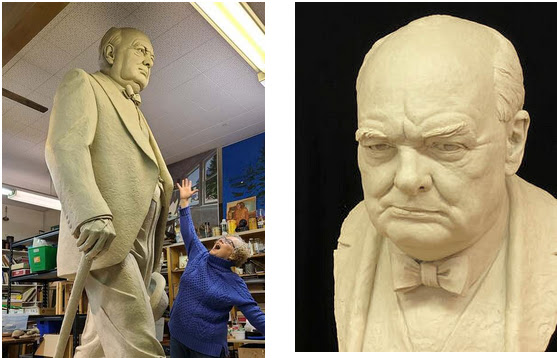
A NEW WINSTON CHURCHILL STATUE

by Tom Bauer


‘Self-indulgent’: Churchill statue plans stir public controversy, perplexity over motivation. Statue will be installed at Calgary’s McDougall Centre in 2023. —Livewire Calgary, August 27, 2022


Like deadly white mold, signs keep surfacing.
The skin of life develops pustules and blisters;
past echos of a fierce disease of dominance
resurfacing to blight the natural landscape.

Looking at faces I see hope and care.
I see landscapes of spontaneous growth
moving as one towards some shared outcome
each of us unconsciously wants to see.

Statues do not see, and will not see us through
their purpose, ownership of all we seem.
Their stone presence blocks our human landscape.

The greatest monument might come to be
feeling connected when we come together
and see the real enemy: the harms we cause.


Tom Bauer's an old coot who lives in Montreal and plays a lot of board games.

Friday, May 13, 2022

COLOSSAL LOSSES

by Timothy Kercher


The Soviet monument symbolising historic ties between ex-Soviet Ukraine and Russia being dismantled in Kyiv on April 26, 2022.


Today I read that Russian
casualties are colossal, Latin
for larger than life,
the Romans using the word
to describe the statue of Helios
in the harbor at Rhodes,
a term now used to describe
abounding death, the day before
a colossal eight meter-tall Soviet
-era statue of two men
representing Russia and Ukraine
holding a banner of friendship
was taken down, the heads
rolling right off in the middle 
of Kyiv, where, in the surrounding
towns, colossal losses
were suffered, larger than life
numbers of dead civilians
strewn in the streets, add 
to this the soldiers on
both sides, the mass 
casualties on the eastern 
front in the cities, apartments, 
theaters, schools, hospitals eclipsed 
by heavy artillery, the war's
collective losses larger
than a toppled statue depicting
friendship, larger still
than a statue of the sun god.


Timothy Kercher lives in southwestern Colorado with his family and teaches on the Navajo Nation. He has lived much of his adult life overseas, including time in Ukraine, Republic of Georgia, Bosnia, Mongolia and Mexico. His essays, poetry, and translations have appeared in many literary journals including Crazyhorse, Plume, Ruminate, Guernica, and Quiddity.

Thursday, February 24, 2022

THE ARTIST

by Louise Wilford


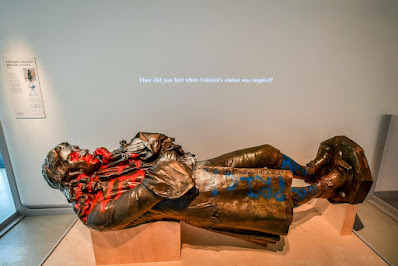
Covered in red and blue graffiti, the toppled statue of British politician Edward Colston, who enslaved tens of thousands of people, stood in the city of Bristol, UK for more than 100 years before it was pulled down by angry protesters during a wave of Black Lives Matter protests across the country last summer—after the death of George Floyd at the hands of Minneapolis police. Demonstrators used rope to tug the statue from its stone plinth and their bare hands to roll it through the streets and into the murky waters of a nearby harbor as onlookers cheered. Others chanted “Black Lives Matter,” in solidarity with those across the Atlantic dealing with issues of police brutality, systemic racism and complex histories. —The Washington Post, June 4, 2121


She painted Love on a garage roof,
in throbbing streaks of purple-red, the convolutions of a colon.
Sprayed Birth inside a canal bridge arch–metallic mist of bronze and copper,
cream and jungle green—its colours glowing loud as we moved
closer. Joy on a fire-damaged caravan, in orange streaks, fading
at their edge to silver fairy-dust against a woodland midnight.
 
Paintings drifted off around the tow –first drafts, discarded
—or maybe gifts, or threats. A wisp of air, she moved
about the streets, unseen save for the spores that trailed behind,
hand-prints on lamp-posts, splashes on a fence, office windows
and abandoned cars. Tragedy in a bus shelter, thick brown strokes
with an uneven brush; Bliss rolled up a shutter’s sides in jolting yellow
stripes; the turquoise-blue of Hope rubbed on the bricks of an abandoned
warehouse—and Innocence, black as a crow’s wing, sprawling, smug, along
a dry-stone wall.   
 
On the beech-tree avenue in the park, she painted the stretch of Life,
from gold to god, each stage a different tree. Her colours startled
like a kestrel’s swoop, on bollards, awnings, road signs, multi-storey
concrete car-parks. On a crossing, she painted the white stripes shocking
pink. She filled the holes of letters with tiny dots like grains inside an hour-glass;
 
scrawled a Nightmare on an underpass, a Daydream on a council refuse bin;
Ambition on the tall side of a Tesco van, Destruction on the shovel of a JCB.
Peace, soft as sand, perched on picnic tables. She spread her peacock tail
so the hues that churned inside her could escape, Tenderness like a swirl
of oil on a puddle, blood-red Anger, bile-green Envy, the pewter-grey
of Misery, and the sharp vermilion ache of Fear, vinegar shiny as a magpie
feather. Shades and shadows, grit and silk and dust and grease, stirred
and shifted, blended and erased.
 
Until one day, she drenched with the fishbone-white of Death,
a statue of a man whose alchemy created gold from blood and bone.
This man of stone had swaggered in that square for a hundred and fifty years.
Her colours now were spent. She hiccuped out a final few beige coughs,
a gentle sneeze that left a cloud of baby-pink dancing in the sun—and then,
with a flap of her wings, she left.
 

Louise Wilford lives in Yorkshire, UK. Her work has been widely published, most recently in Bandit, English Review, Goats’ Milk, Jaden, Makarelle, POTB, The Fieldstone Review, and Parakeet. In 2020, she won the Arts Quarterly Short Story Prize, the Merefest Poetry Prize, and was awarded a Masters in Creative Writing (Distinction). She is working on a children’s fantasy novel.

Sunday, August 16, 2020

BILLY GRAHAM PREPARES TO ENTER STATUARY HALL

by Alan Walowitz


The U.S. Capitol’s Statuary Hall, where two iconic figures from every state hold court, will soon have a new resident: A clay likeness of the late Reverend Billy Graham, the popular televangelist who brought the word of Jesus Christ to the masses through a series of high-profile “crusades,” evangelistic campaigns that saw massive rallies across the United States. For Jews and groups concerned with the separation of church and state, the prospect is a problematic one. Last week, a North Carolina legislative committee approved a scale model of the 10-foot, 10-inch Graham statue, which would be placed at the Capitol sometime next year pending the approval of a congressional committee. If that approval comes through, Graham’s effigy will replace a statue of Charles Brantley Aycock, a North Carolina governor and white supremacist…  Graham, who died in 2018 at the age of 99, was beloved by many and is certainly an improvement over Aycock, who helped engineer the overthrow of a largely Black government in Wilmington, N.C. But the preacher is controversial on several fronts. His record with regard to civil rights was mixed, as he accepted segregation at some of his crusades and critiqued the tactics of marches and sit-ins to end Jim Crow laws. Like many Evangelicals, he also believed homosexuality to be a sin, calling it a “sinister form of perversion.” And while he had a reputation for building interfaith bridges, a major rift with his relationship with the Jewish community emerged in 1994, when Nixon Chief of Staff H.R. Haldeman’s White House diaries became public. Haldeman wrote that Nixon and Graham, alone in the Oval Office after a prayer breakfast in February of 1972, discussed Jewish control of the media. Graham denied having this conversation, but in 2002, the tape was released by the National Archives.In the recording, Graham agreed with Nixon that liberal Jews had too much influence, saying, “This stranglehold has got to be broken or the country’s going down the drain.” Graham further accused Jews of “putting out the pornographic stuff” in the culture and contended that, while he was friendly with Jews who “swarm around me and are friendly to me because they know that I’m friendly with Israel,” those Jews “don’t know how I really feel about what they are doing to this country. And I have no power, no way to handle them, but I would stand up if under proper circumstances.” Graham apologized after the tape became public, telling a group of Jewish leaders he was on his “hands and knees” to make up for the harm of his remarks. —The Forward, August 10, 2020. Photo: An earlier statue of Graham was removed in 2016 from its location in downtown Nashville destined be relocated to a Christian Conference Center near Asheville, North Carolina. —WTVF, Nashville.


"I've read the last page of the Bible; it's all going to turn out all right." —Billy Graham


Far as I’m concerned, the Reverend Graham
may take his place in Statuary Hall. Must’ve been tall,
10 foot 10, the story implies, good reason alone—
but we were at least that high as we made our way
to the stage at Shea that time, to be saved behind
the pitcher's mound. The Jesus-part never stuck, as God
surely knew, which might be why Billy told his presidential pal
he’d have better luck without the Jews controlling all.
And sometimes he didn’t like those Black folks coming
round to those Deep South crusades.  How else
was he to get those crackers to accept
Christ—for Christ’s sake—and be forgiven in his name?
“God will curse all who add or take away,” it says right near the end.
The God I want would love, accept—and, Bill, even sometimes amend.


Alan Walowitz has been published various places on the web and off.  His work was nominated for a Pushcart Prize in 2017 and 2018 and he is a Contributing Editor at Verse-Virtual, an Online Community Journal of Poetry.  His chapbook Exactly Like Love is available from Osedax Press, and his full-length book The Story of the Milkman and Other Poems is available from Truth Serum Press. 

Thursday, August 24, 2017

LET'S HEAR IT FOR THE HORSES

by Tricia Knoll


Horse Statue by jellobuster at DeviantArt


One million dead in the Civil War,
if you count the mules.
Which I do.

I say, blowtorch the rebel statue
men off their mounts and keep
the horses striding on their pedestals.

They were not traitors
to their country, showed no sign
of caring who they carried,

black or white, male or
female. Their integrity
is without question.

They did the work
they were asked to do
without a nod at glory.


Tricia Knoll is an Oregon poet with a deep fondness for horses. I can see these statues with newly installed saddles replacing the old white men, perhaps ladders for children to climb up on. 

Friday, September 23, 2016

SUNDAYS IN THE PARK WITH DONALD

by George Salamon


"Yet it took Mr. Trump five years of dodging, winking and joking to surrender to reality, finally, on Friday, after a remarkable campaign of relentless deception that tried to undermine the legitimacy of the nation’s first black president." —Michael Barbaro, The New York Times, September 16, 2016

Important men should be honored,
But they should not be believed.
So wrote a poet from Germany.
To give Trump his due, says this
Nattering nabob of doggerel,
Build him a statue in the park,
A place for pigeons to poop and
Shrine to his character.
Create hell of a hullabaloo
For talking airheads on TV.

Some of our presidents have been crooks,
Others just moral zeroes.
But now we really need heroes.
To ride up Capitol Hill.
Guess we'll have to make do
With Hillary and Bill.


George Salamon has turned from coverage of the campaign to reruns of M*A*S*H, but does not advise that you too do this at home. He lives in St. Louis, MO, often a blue pocket in a red state.