Guidelines


Submission Guidelines: Send 1-3 unpublished poems in the body of an email (NO ATTACHMENTS) to nvneditor[at]gmail.com. No simultaneous submissions. Use "Verse News Submission" as the subject line. Send a brief bio. No payment. Authors retain all rights after 1st-time appearance here. Scroll down the right sidebar for the fine print.
Showing posts with label heroes. Show all posts

Friday, March 06, 2026

EMPERATORI PARS VE GHARB (THE PERSIAN EMPIRE AND THE WEST)

by J. P. Linstroth
 

To Our Armed Forces 


Combat between a Persian (left) and a Greek (right), depicted on a cup at the National Archaeological Museum of Athens. Credit: Wikipedia


I.

A vision of armies of men in thousands kicking up dust in white puffs in ordered unison files

                        Marching forward, beating rounded shields of Athenian owls and Spartan Lambda letters

            Their burnished Corinthian helmets, their fierce eyes peering through almond bronze slits

Aeneous and glinting bronze in the sun, horsehair plumes of varying colours, waving from zephyrs

                        Metallic and muscular cuirasses shining aurulent and golden in harsh sunlight


Emperatori Pars under Darius the Great and his son, Xerxes, the existential threat to Greek isles

Legends, the Athenian General Miltiades at Marathon, King Lionidas at Thermopylae Pass, with no betters

            In ancient times from the West, even with acrimony among Hellenes, and all their splits

Moving as one at the Battles of Marathon and Thermopylae and Salamis, against Persian aggressors

With bronze swords drawn, a chiliad of pointing dorata, gleaming helmets behind shields tensed to fight


            Cleverness of the Greeks tricking Persians in battle even with their formations across many miles

Outnumbering the Hellenes in the thousands and the weightiness of death in all its bellicose fetters

            If it were not for these brave men, then what of Western civilization, and all its benefits

To win the day, again and again, and many times at great loss, the sacrifice of war, and all its tethers

            For empire, for glory, for homeland, even with Pars Bozorg (Persian Empire), the Greeks never bowed to their might


II.

            And more than two thousand and five hundred years forward a war against old Persia continues

Having become part of Islam and Shia from the martyrdom of Husayn Ibn Ali and following the Imams

Reaching back to the death of Mohammed and at one time British and following the Shah

With all its oil riches and arcane monarchy and then the Iranian Revolution and American hostages in ’79

            And the rise of Ayatollah Khomeini and advent of an oppressive Iranian theocracy


And so our past repeats, again and again, from ancient times til now regardless of disparate epochal venues

Every time and place, men in continual discord, even against the House of David, and revenge of Absalom

            How soon we forget after unity against Great Persia, Athenians and Spartans brawled in awe

Of brother against brother, Greek to Greek, the Peloponnesian War, how civil wars intertwine

            From Alexander the Great, and Napoleon, of voids to the destruction of Republics and Democracy


Can you not see we are the same brethren, those of the reds, whites, and blues

            The same from Washington, the same from Gettysburg, but now directives from Jerusalem

Across Zagros and Alborz ranges and deserts, against Islamic Revolutionary Guard Corps, and their Allah

            To contend with ourselves, and not think Poland 1939, but reverse time, and save our demokratia


III.

            For all our technologies and our missiles and our Artificial Intelligence and aircraft carriers

War is no less terrible and spontaneous circumstances no less unforeseen and death death death

            Young men struggle for generals’ musings far removed and clash in arms on land, sea, and air

Often far from homelands, for fellow brothers, for fellow countrymen, for the flag under God

            And Persia once more erased, once more conquered by armies as powerful as Hellenic hordes


Lest we forget ourselves in conquest and lose our values and our Republic, lest we remove such barriers

            For ours a Constitutional Republic and much celebrated, lest we drink from the waters of Lethe

Lest we forget red poppy fields of the Somme, or white crosses of Normandy, and markers en plein air

            As our Arlington and Tomb of the Unknown, so many Medals of Honour, so many left abroad

Lest we forget how the Iranians ignored our pleas to avert a day of war by dismissing all our accords


But remember this one and all, we are Americans, our nation is still true, our jets as raptors and harriers

Ripping azure skies, missiles through azuline heavens, across Strait of Hormuz, against Iranian shibboleth

From Mullahs and their enforcement of Islamic law, at the expense of the Iranian populace and its despair

            May ours be a road to freedom, away from Shiite clerics, a regime heavily flawed

By waging war in the name of God, supporting Hamas, Hezbollah, and Houthis, their demise by swords


IV.

            And while the thousands marched and thousands more gunned down for their freedom

Lest we forget ours in these uncertain times and living with mendacity and profiteering

            At the expense of our dignity of our community of our brotherhood of our common sense

Lest we forget our Independence from tyranny, lest we forget our lacking representation

            And we remember Locke and Montesquieu and Rousseau and our Enlightenment


Now some two-hundred and fifty years, from independence to civil war, now extremam corruptiem

            Of our leaders to whom we entrust with our lives, but who seem immune from sneering

And directing us toward wars and away from personal investigations and forgetting our tariffed expense

May we uphold the pillars of our democratic oaths by not scapegoating the newest from migration

While understanding hyper-capitalism undermining our social welfare from Neo-Gilded Age Entitlement


To our brave soldiers, brave men and women, who fight for our Republic, not as vassals for a fiefdom

Lest forgetting Spartan might won over Athenian intellect, and protect ourselves with judicial hearings

            If necessary and to use our laws and our cameras and checking imbalances in our defence

So, to the breach against armies and foes, now the Iranians, we ask to pray for victims in supplication

            Likewise remembering who we are and our history, and not the spoiled life of a political miscreant


To America, to America, forever the brave and the bold

            Across the seas from now and remembering times of old

                        May we remember our fallen heroes always, their fearlessness not to be cajoled


To America, to America, the beautiful and the bold

            May we always protect our sea shining shores, may your glories always be extolled


                        To America, to America

                                    Now and forever as many have before foretold

                                                About the land of our brave and our bold


J. P. Linstroth has a PhD (D.Phil.) in Social and Cultural Anthropology from the University of Oxford, UK with several awards for his research concentrating on the Spanish-Basques, Brazilian urban Amerindians, and Cuban, Haitian, and Guatemalan-Mayan immigrants in South Florida. He is an Adjunct Professor at Palm Beach State College (PBSC) and the author of several books: Marching Against Gender Practice: Political Imaginings in the Basqueland (2015, Bloomsbury Books); The Forgotten Shore (Poetic Matrix Press, 2017); Epochal Reckonings (Proverse Publishers HK, 2020, Winner of Proverse Prize 2019); Politics and Racism Beyond Nations: A Multidisciplinary Approach to Crises (2022, Palgrave Macmillan); and Swimming in Blue Shadows: A Collection of Short Stories and Poems (2022, Proverse Publishing, Proverse Supplemental Prize). He was awarded a J. William Fulbright Foreign Scholar Grant (2008-2009) to study urban Amerindians in Manaus, Brazil and he received a Presidential Lifetime Achievement Award for his accomplishments toward peace, conflict resolution, and social justice. 

Wednesday, February 19, 2025

SWAMP THING

by Mark Hendrickson


Kermit the Frog grew up in a swamp  
before he moved to Manhattan  
where all the rats still skate on butter. 
He tried to warn us that rainbows are only illusions,  
back before his voice changed,  
back when swamps seemed quirky and cute. 
 
Speaking of swamps, a story came out today  
about the 2010 discovery by Felisa Wolfe-Simon  
of a low form of life that lives in the muck  
and somehow thrives on toxic arsenic; 
she has now discovered other seemingly mindless creatures  
that appear to thrive on sheer magnetism alone. 
 
I live in the blue center dot  
of a tidal pool made of salt and Windex  
surrounded by organisms that live  
on all that is poisonous, microbes that live  
by breaking down all structure,  
that thrive on decomposition.  
 
People cheer as every potentate since Saint Reagan  
swears to finally drain the swamp; yet instead  
we see it is the swamp that drains us. 
We are mangroves surrounding ourselves with mangroves,  
all standing up to our knees in it, 
mired in marsh and methane. 
 
We all know swamps smell like corrupted flesh,  
yet our nostrils are so saturated we can’t tell anymore. 
Complacency is a swamp we think is stagnant 
even as it spreads to engulf us, and Canada, and Greenland. 
We have become swamp things: reluctant heroes twisted by the world, 
trying to save what we can; a show too implausible to endure for long. 


Mark Hendrickson (he/him/his) is a gay poet and writer in the Des Moines area. His work has appeared or is forthcoming in Variant Lit, Vestal Review, The New Verse News, Spellbinder, and others. Mark worked for many years as a Mental Health Technician in a locked psychiatric unit. He has advanced degrees in marriage & family therapy, health information management, and music. Follow him @MarkHPoetry.

Monday, February 17, 2025

TRUTH, JUSTICE, AND BRAIN ROT

by Bonnie Proudfoot


AI-generated graphic by Shutterstock for The New Verse News.


Don’t tell me you spent all your allowance 

on comic books, or you used to stay up until 

daybreak, your knees shaping a tent under 

the covers, a weak flashlight, Superman, 

Supergirl, Batman, Spidey and the mutants, 

the whole gang rotting your brain, your eyes too. 

Did you stash your valor between the mattress 

and box spring, your rotting brain leaping tall buildings 

at a single bound, ready to keep evil at bay, fighting 

for, oh, truth, justice, and the American way.


Did you heft yourself out of bed on time 

for first period, or did your rotten brain let you 

snooze, then snooze some more? Did it make you 

listen to rock ‘n roll, sing "Sympathy for the Devil" 

as you walked to school? Did it know what 

"Satisfaction" really meant? And so what if 

your brain did rot? Blotchy, dark, and spongy, 

a not-so-fresh potato, or cottage cheese 

in the back of the fridge with curds of green mold 

lacing through? Would it rot all at once? Or 

one day no rot, one day riddled, one day a lot? 


So here you are, it’s minutes before midnight, 

kryptonite closing in, fascists tunnelling 

into Fort Knox, your knees a tent under 

the saggy covers, nothing left to lose. You’re 

scrolling through headlines at a single bound, 

seeking truth and seeking justice, index finger 

on your phone tapping with the dexterity 

of the Incredible Hulk threading a needle, 

the fate of the free world to defend,

secretly shouting Shazam, pushing send.


Bonnie Proudfoot's fiction, poetry, reviews, and essays have appeared in journals and anthologies. Her writing has been nominated for Best of the Net and the Pushcart. Her novel Goshen Road (OU Swallow Press) was the WCONA Book of the Year and long-listed for the PEN/ Hemingway. Household Gods a poetry chapbook, was published in 2022 (Sheila-Na-Gig Editions). A full-length poetry collection, Incomer, is forthcoming on Shadelandhouse Modern Press. Bonnie resides in Athens, Ohio.

Thursday, May 26, 2022

COLORING BOOK WITH SECRET SUPERHEROES

by Bonnie Proudfoot


This is a coloring book without lines.
This is a coloring book where Jane
wears any clothing she feels like
wearing and so does Dick, and both
of them won’t carry a gun. In this book
guns aren’t invented. Still, this book
is full of action figures, girl ones and boy ones
Wonder Woman and Captain Marvel
and Doctor Strange and Harley Quinn, ones
who move in light, and ones who delight
in mayhem. All the superheroes use their powers
to keep sharp things out of babies’ reach,
even though they shine. There’s a secret superhero
you can find her if you look, and it is you, 
this is a book that claps for you, who can
almost roll over, who has never worn
a shoe, who can eat her bare feet,
who marched at six months of age,
well, sort of marched, for women’s choice.
This is a coloring book that says it’s ok,
use all the colors, be who you are, it hopes
you see the light that shines through your light
gray eyes, a book that looks like a mirror of love,
that smells like your breath that is a mirror
of milk, that marvels at the impressionist
masterpiece that is your diaper after eating
peas and beets, and that is only something
a nana would say, yes yes, this book
has another secret superhero, NanaMan,
who has the power to stop a gun from firing
at a supermarket or a school or a church
or synagogue, Nanaman is the conscience
of the world, or some kind of weird spirit,
don’t ask me how she/he works. The book knows
that babies are born into light, they come
here with all the colors that they need, and
when the pages of the book are clasped shut
it prays that the world does not start
taking those colors away too soon. 


Bonnie Proudfoot has had fiction and poetry published in the Gettysburg Review, Kestrel, Sheila-Na-Gig, Pine Mountain Sand and Gravel, SoFloPoJo, and other journals. Her first novel Goshen Road was published by Swallow Press in January of 2020, and was  long-listed for the 2021 PEN/ Hemingway award for debut fiction. Her debut book of poems Household Gods (Sheila-Na-Gig Press) will be published in the summer of 2022.

Sunday, May 08, 2022

FAR FROM THE WAR

by Charles Hughes


Cover of the May 6, 1944 issue of The New Yorker.


Far from the war, days bloom—
Some gorgeously—as in
A sickroom hopes can rise,
Though death must surely come.
Spring’s lust can’t be a sin,
We think, and hide our eyes
 
From war. Not from the war—
Its miseries we see well:
Heroes we meet we cheer,
Barbarians we deplore, 
Shocked by the sights of this hell,
Glad it’s not happening here.
 
Poppies bloomed long ago
In Flanders Fields, but now
The flowers all have gone;
Now few ask where or know
The words to disavow
War’s always dawning sun.


Charles Hughes has published two books of poems, The Evening Sky (2020) and Cave Art (2014), both from Wiseblood Books. He worked for over thirty years as a lawyer and now works at writing poems.

Friday, March 18, 2022

ON ANOTHER AVERAGE EVENING

by Ethan McGuire


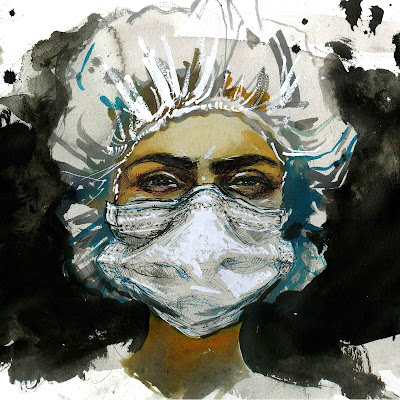
Top: Art by Molly Crabapple, special to ProPublica, April 24, 2020. Bottom: Graphic from National Nurses United.


She lies sprawled across a battered couch,
green scrubs still covering her body,
a cheap wine glass dangling from outstretched fingers.
He swings through the splintering apartment door,
blue, button-up uniform unbuttoned,
stained undershirt beneath it. “I’m home.”
“I had an awful day at work,” she sighs
as she picks up a bottle of Woodbridge merlot.
Pouring a glass, her eyes search the hall for him.
“Yeah?” he grunts, opening the fridge.
“Been having trouble with the charge nurse again,
and my plantar fasciitis is back.”
“Oh, no,” he says, pausing in the hallway.
“Administration, man, they’re coming down on us!
‘Course they won’t lower censuses for a damn thing... 
Maybe just another freaking pizza party... 
They’ll call us heroes but won’t give us a chance.”
“That sucks,” he says, as he limps through the hall
and as he sinks into the couch beside her.
“I hate being a floor nurse, hate it like hell.
I’ve gotta do something else.”
“I’m sorry.”
 
They sit still
in the cold and the quite then.
They only stare absently into
a noiseless, motionless TV, until
their hands touch. A certain love connects them.
She scoots over closer to his body,
and he slides his soiled, calloused hands under hers.


Ethan McGuire works by day as a healthcare information technology professional and by night as a writer, whose poetry, fiction, and essays have appeared in Better than Starbucks, The Dark Sire, Emerald Coast Review, and The Poetry Pea, among others. Ethan McGuire grew up in the Missouri Ozarks, but he, his wife who also works in healthcare as a nurse, and their new daughter currently live in the Florida Panhandle near the Gulf of Mexico. Twitter: @AHeavyMetalPen

Tuesday, March 08, 2022

WE ARE UKRAINIANS TOO

by Jonel Abellanosa


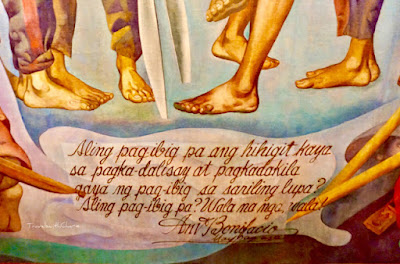
"What love is greater than the wholesome and heroic love of your own country? What other love? Nothing else." In this detail from a painting by Carlos "Botong" Francisco are the words of Andres Bonifacio, one of the founders of Kataas-taasan, Kagalang-galangan Katipunan ng Anak ng Bayan (KKK or Katipunan), a secret society organized in 1892 to gain independence from Spain through a revolution. Source: travels withcharie


Our ancestors knew subjugation forced
into throats where no words break, silence
sharp as bayonet, glass shards shimmered.
The noose gripping the tongue, expressions
of words deprived of sounds, fall and thud
turning choked air into death’s white light.
 
The garrote spells our history’s strangulation
in the hands of war criminals. Our heroes
and martyrs tell us we, with our rich lands
and seas, have to keep vigil how the heroic
unfolds where sunflowers are eternal as their
land. Our flag has their yellow and blue,
 
our dreams vast as their barley and wheat fields.
Ukrainians show, by their love for freedom,
they are Filipinos, too, their rights and reasons
to be free seven thousand as our islands.
They are our countrymen. Across our archipelago
bordered by disputed waters, we are also Ukrainians.    


Jonel Abellanosa lives in Cebu City, The Philippines. His works have been nominated for the Pushcart Prize, Dwarf Stars and Best of the Net Awards. His poetry and fiction have appeared in hundreds of magazines and anthologies, including The New Verse News, The Cape Rock, Muddy River Poetry Review, Chiron Review, Invisible City, The Lyric, The McNeese Review, and The Anglican Theological Review. His poetry collections include Songs from My Mind’s Tree and Multiverse (Clare Songbirds Publishing House, New York), 50 Acrostic Poems, (Cyberwit, India), In the Donald’s Time (Poetic Justice Books and Art, Florida), and Pan’s Saxophone (Weasel Press, Texas). He is a nature lover, with three companion dogs—Yves, Donna and their lovechild Daisy.

Sunday, March 06, 2022

THE GHOST OF THE OLD COUNTRY

by Kathryn A. Broderick


My grandmother is from the Old Country
A land of winding cities, valorous heroes, and ancient towers
Across the green-glass seas.
 
She whispers words that flow like water
As she sparks to life stories in that distant place
—But lowly and in secret, shamed by her foreign tongue.
 
Yet her secrets drip into the new life she’s crafted here
Coloring the edges of suburbia in Anywhere, USA
A resilient stain that assimilation cannot wash away.
 
The dust of butter-rich tea cakes
Cling to her withered fingers
As she weaves tales of her faraway home.
 
She tells me of the wild Baba Yaga
A witch that lives in a hut atop a mighty bird’s leg
And the ways to escape her enchantment.
 
She often weaves together the push-pull of escape and return
Haunted by the melancholia of self-imposed exile
As she tries to accept her unwilling divorce from the Old Country.
 
In her garden, soniashnyk bow their golden heads toward the sun
She calls the flowers her little kings with many-petalled crowns
She rests in their shadows as she paints pictures of her lost home.
 
My grandmother died before I knew the Old Country meant Ukraine.
She told me tales of its beauty. I never knew of its death.
She fled from its capital as a child.
 
Her father did not survive the journey
—at least, not as the same man.
Ghosts lingered in his heart.
 
The famine turned into skeletons those that remained.
Their bones returning to the embrace of earth in unmarked graves.
“Have another tea cake,” she’d say. “You look hungry.”
 
What was it like to be Slavic and living in America during the Cold War?
Living under the hostile glare of suspicious eyes branding you an enemy?
Surviving against your will as your family withered away?
 
I sit in the shadow of her sunflowers
Listening to news of Russia’s unprovoked attack
And I feel her fingerprints upon the pulse of the Old Country.
 
The heroic threads and tragedy lining each of her secret stories
Now shout at me from modern headlines.
We dwell in dark times—but in the darkness heroes rise
At least, as my grandmother said, they do in the Old Country.


Kathryn A. Broderick’s work has appeared in First Line and Mirror Dance. Her second novel Gorgon Crown will be released in June 2022.

Thursday, September 10, 2020

LOSERS AND SUCKERS

by Nan Ottenritter


My Dad 
Date of enlistment:                                         21 May 40
Education:                                                     grammar 8, high school 2, college 0
Military occupation specialty:                       Surgical Technician 86
Battles and campaigns:                                 Normandy, Northern France, Rhineland, Central Europe
Demobilized at the
convenience of the Government RR 1-1:       July 28, 1945
Mustering out pay:                                         $300

For five years, two months, and eight days my Dad served
our country, proudly defeated fascism.

He is my hero, our hero, our American hero.
I wouldn’t trade him for all the fathers in the world.

Nor will I let anyone call him a loser or a sucker. 
Call him that, call me that too for I 

carry his beliefs, his pride, and his trauma.
I was enlisted as an American on the day of my birth,

I am a warrior up until this day, and I will never
muster out, have Donald’s government demobilize me,

stop campaigning for voting rights, justice, equality, 
health care: the battlegrounds of our time.

I will soldier on. Our current enemy will be defeated.


Author's Note: The first half of this is a found poem with language taken from my father’s discharge papers. Battles are unique to time and place, yet have commonalities. I will fight on, not only because it is right, but as an homage to my father and all service men and women.


Nan Ottenritter is a poet and musician who lives in Richmond, VA.

Sunday, May 31, 2020

MISSION

by Wendy Hoffman


Credit: Doug Mills/The New York Times, May 29, 2020.


The moon lifts its holy head like a sanctified queen.
Humans should not be there or leave bent over, backwards, reverent.
But competitive men are curious which they believe gives them the right.
This country, which turned away victims but
invited defeated Nazi scientists,
rips the untouchable veil from the bottom up
and ejects transparent astronauts,
stooges, sacrificed heroes.
A large striped boot print tattoos crevasses, crevices,
craters.


When I was four playing outside, a neighborhood boy twice my age or more
wanted to see me down there. He pointed his skinny finger. I squeezed my thighs
together but already trained never to say no, I watched my cotton undies fall to
my turned in ankles. The curious boy who rode his bicycle through hilly blocks
pretended to be a scientist. He inspected and had a good look.


They have a good photographic look while jobless people
on earth look up and remain hungry.
I watch rockets on TV,
hide my reddened face from our irreverence.


Wendy Hoffman had amnesia for most of her life. When she regained memory late in life, she wrote books about what she had forgotten. Karnac Books, London, published two of her memoirs in 2014 and 2015, as well as her first book of poetry in 2016. She co-authored a book of essays in 2018 for Routledge. Her third memoir is forthcoming from Aeon Books. Hoffman has a MFA and lives on the Olympic Peninsula with her little dog.

Monday, March 30, 2020

THE PROMISE OF HANDIWORK

by Jen Schneider


A single tear drops and pools on uneven hardwood planks.
Startled white mice scamper. Droppings where gravel
and cement once filled buckling wood crevices cushion
wool socked soles. A burgundy chest, adorned with two
brown leather straps and a single metal lock, rests
in the far-right corner. Blanketed in warm layers of dust
and tattered cloth, the family heirloom boasts of guarded memories.

Blurred photos, sweat-stained frocks, penned letters—
Normal times and ordinary folk

To its right, a cardboard box, coated in a film of powder
and particles unknown, houses a machine long silenced
yet now pulsing with hope. Its thick black electrical cord,
wrapped in a tight coil, springs loose as lungs near
and far struggle to contract, then release.

Ready. Set. Go. Breathe.

Soon settled at the square kitchen table, pots
of needles, spools of speckled thread—shocks
of light lavender, crimson red, pistachio green -
and piles of fabric—gingham, plaid, tartan—
emerge with potential born anew.

Unordinary times. Normal folk seek purpose.

Coffee brews, then turns cold. Time presses
on as dry, chafed hands, fingers arched
from years of fieldwork, pull threads, needles,
and long discarded garments from bedroom
chests and kitchen drawers. Bodies work
with an urgency—a race against no ordinary clock—
long stifled and now eager to breathe.

Hours later, the machine continues to whirl
as needles pulse and earlier anxious feet pump
in a calming pattern—One, Two, Three, Breathe.
One, Two, Three, Breathe—generating new life
in old shifts to aid the beat of chests worn down
by a silent beast that silences the beat of a nation.

Moments of silence turn lengthy. Prayers for a world on pause.

Scattered thoughts focus on spools of twisted and spun
threads that bind with supple cloth. Patterned sketches
of protective gear for front line heroes convert
to tangible realities.

Ordinary days in extraordinary times.

In unity we find strength. And hope blooms anew.


Jen Schneider is an educator, attorney, and writer. She lives, writes, and works in small spaces throughout Philadelphia. Recent work appears in The Popular Culture Studies Journal, Bat City Review, Zingara Poetry Review, Streetlight Magazine, Chaleur Magazine, LSE Review of Books, and other literary and scholarly journals.

Friday, February 07, 2020

THE SMEDLEY D. BUTLER BRIGADE

by Art Goodtimes


Smedley Darlington Butler by Robert Shetterly / Americans Who Tell the Truth


John Bolton
Mitt Romney

McRedeye has to say
that it’s unexpected truth-tellers
of a completely different
stripe

that make my day

in FDR’s day

America’s not perfect
by a long white shot
but it has its heroes


Art Goodtimes of the Talking Gourds Poetry Program in Telluride has a new book out from Lithic Press in Fruita, Colorado: Dancing on Edge: the McRedeye Poems (2019).

Friday, May 17, 2019

REPRIEVE

by Emily Jo Scalzo


months will bleed by
when gunshots don’t echo
down school hallways
in classrooms or lecture halls
a reprieve from hero-teenagers
called to sacrifice themselves
jump on the grenade
clot the flow of bullets
to buy seconds
for their classmates

red rivulets dammed
not due to prevention
or common sense
but because summer
darkens these venues
empty of fear for now
the halls lie waiting
for fall and more
blood shed


Emily Jo Scalzo holds an MFA in fiction from California State University-Fresno and is currently an assistant teaching professor teaching research and creative writing at Ball State University in Muncie, Indiana. Her work has appeared in various magazines including Midwestern Gothic, Mobius: The Journal of Social Change, Blue Collar Review, and others. Her first chapbook, The Politics of Division, was published in 2017 and awarded honorable mention in the Eric Hoffer Book Awards in 2018.

Saturday, May 11, 2019

A MOTHER READS OF YET ANOTHER HERO

by Devon Balwit


Kendrick Castillo was killed while trying to stop one of the assailants during a shooting at his school in Highlands Ranch, Colo., on Tuesday. Photo credit: Rachel Short, via Associated Press via The New York Times, May 9, 2019


To run towards the man with the gun is not
what we mothers want our sons to want,

dead hero sons harder to bear than living ones,
and there being so many shooters, so many guns,

and though it makes us cry to read of the goodness
embodied in such sacrifice, we imagine the badness

of every day thereafter—the silent, strangely clean
house, and all the milestones unseen—

graduation, grandbabies, holidays—the eulogy
in the Times a poor substitute for the ordinary prodigy

of our boys. Our hearts burst at these still children
laying down their lives—we’d rather all stood up again.


Devon Balwit's most recent collection is titled A Brief Way to Identify a Body (Ursus Americanus Press). Her individual poems can be found in here as well as in Jet Fuel, The Worcester Review, The Cincinnati Review, Tampa Review, Apt (long-form issue), Tule Review, Grist, and Rattle among others.

Friday, February 23, 2018

HELL IS PUNGENT WITH GUNS

(My Neighbor Calls Gun Owners ‘Beelzeguns,’ 
Says They Call Themselves ‘Gun Nuts’ 
Because Otherwise They Don’t Have Any Balls)

Graphic from Jon Stewart's The Daily Show.


by Ron Riekki


There have been two killed and twenty injured
by gun violence in the U.S. since Parkland.*
The melting pot is melting because of climate
change and the heat of being ambushed by
a blizzard of shrapnel. I taught a course on gun
violence and near the halfway point a student’s

girlfriend was shot and killed on campus. Life
used to stand until a Loaded Gun carried me
away to my graveyard shift where I don’t teach
anymore, sunk into the valley of security,
unarmed security, where I’m paid to stay awake
and at night, in the mountains of dark I remember

a kid telling me during that class that he used to take
his gun and shoot it at the lake at his parents’ camp,
December, Alabama, trying to make the bullets
skip. I asked him if he thought he might have
killed someone by mistake doing that and he told
me, Nah, no one was around for miles. There’ve

been more than two killed, more than twenty injured
now since.* Since. In Detroit, I remember a moment
on the street where someone commented on
another person’s visible bullet-hole scar.  He
lifted up his shirt to reveal more and then a bunch
of those nearby started sharing their bullet holes,

pant legs rolled up, shirts off, the drinking
of wounds. In Virginia, I delivered a Feast Pizza
to a trailer where the guy sat on his historical sofa
holding an old shotgun pointed at my college chest.
I asked what the hell he was doing and he said,
I just wanted to see your reaction. His girl-

friend told him to put the gun down,
but he didn’t. When I got back to the Dominos,
one of the other drivers asked, Did he do it to you?
He likes to do that to everyone who delivers there.
A cop told me about a kid who got shot in the eye
and the bullet ricocheted and came out the other eye.

During EMT class, the instructor asked if any
of us had been shot and one of the students
raised his hand; he’d shot himself by mistake,
cleaning his gun. The instructor told us a story
of how he got shot by a kid when he was doing CPR
on a rival gang member that they didn’t want saved.

By a kid, I mean a child. By a child, I mean that we
are drowning in the shallow end. After school shootings,
gun sales go up. I mean, throw up. As in puke. “It’s too
soon to talk about gun control.”  Hell, it’s too late.
Graffiti by my apartment says, What You Rape
Is What You Sewer with an AR-15 policed underneath,

plastered to the wall, pulverized to the wall in onyx
paint. Two times in my life, when talking about gun
control, I’ve had a person reach over and pull a gun out
of nowhere. Anti-magic. One was under a couch.
Another in a purse. As if guns were cigarettes.
As if guns were TV channels. As if the guy who lived

across from me in Chicago wasn’t shot and killed
in his apartment. My favorite superheroes never
use a gun. That’s for villains. Batarangs and bat-darts—
sure, but I always prefer those who simply outsmart, whose
sheer intelligence comes out. The opposite of those
who cure guns with guns, who stop choking by choking

more. The king of choking. We elected the king
of choking. Chos—a Persian word for fart.  The NRA chos-
king. A rump . . . Real hunters use bow-and-arrow. They bow
before the flesh and honor the animal by using every
body part, not sitting next to an elephant, leaning
against its belly with the gun in his crotch. Cowards.


*Accurate as of February 21, 2018. The numbers have enlarged since then.


Ron Riekki wrote U.P.: a novel (Great Michigan Read nominated) and edited The Way North: Collected Upper Peninsula New Works (2014 Michigan Notable Book), Here: Women Writing on Michigan's Upper Peninsula (2016 Independent Publisher Book Award), and And Here: 100 Years of Upper Peninsula Writing, 1917-2017 (Michigan State University Press, 2017).

Tuesday, December 26, 2017

A CHRISTMAS SONNET

by Cally Conan-Davies


Aleksander Reed "Alek" Skarlatos is an American actor and Oregon Army National Guardsman specialist who, along with fellow Americans Spencer Stone and Anthony Sadler, a Briton and two Frenchmen, stopped a gunman on a Paris-bound train travelling from Amsterdam via Brussels in August 2015. He has been awarded the United States Army Soldier's Medal from U.S. President Barack Obama, and has received France's highest decoration, the Legion of Honour, from French president François Hollande as well as the medal of Arras, France. Skarlatos competed on season 21 of ABC's Dancing with the Stars with pro dancer Lindsay Arnold (pictured), and finished in third place.


I won't let the good men go unsung
Good men throw their bodies on the lives
of their mothers and their children and their wives
and the unknown. Good men don't die alone

Each day this year, my soul has been punched and stunned
by bullet-men ripping through the dance we do
by bully-men raping girls or threatening to
by barging-men pushing first through the doors of power

while good men act as if nothing mattered more
than to restore the faded elf to the christmas tree
to greet you every morning with toast and tea
to be the hand pressed in the hole the bullet tore

I refuse to let the good men go unsung
They are not many. They are one and one and one . . .


Cally Conan-Davies is a writer who expresses here her complex feelings of rage and powerful gratitude.