Guidelines


Submission Guidelines: Send 1-3 unpublished poems in the body of an email (NO ATTACHMENTS) to nvneditor[at]gmail.com. No simultaneous submissions. Use "Verse News Submission" as the subject line. Send a brief bio. No payment. Authors retain all rights after 1st-time appearance here. Scroll down the right sidebar for the fine print.
Showing posts with label Passover. Show all posts

Monday, April 20, 2026

OUT OF THE SHADOWS

by Jiang Pu


I want to bring you a heady symphony of roses, 

lavender and golden poppies as April unfolds

into giant butterfly wings in my yard, but 

I can’t sing; this morning my throat is choked 

like the Strait of Hormuz. 


I’m self-schooled in the art of drop-cover-shelter

from the bombing news, but o you wise one, 

teach me: how do I turn off this glaring pain

of my brothers and sisters constantly bombing

each other? And how do I forgive


the twin lakes of my eyes for shedding

useless tears—so useless they can’t even feed 

into desert desalination plants spared

by thirsty missiles? My tears sting more 


than the bitter horseradish a friend brings 

on a Passover. She teaches me to dip it 

into a nut paste, which is sweet, which, 

she says, tastes like 


hope. Maybe it’s time for a few Medjool Dates

grown from the cradle-land that I’ve visited

so many times in spirit but never once 

in body, so that I keep its soil and water

inside me to nourish a prayer for peace, so that


when I open my door to the unstoppable

spring outside, I can welcome Rumi’s sun

and other honored guests to visit

me today besides pain. 


Jiang Pu, Ph.D., is a first-generation Chinese American author and Ed leader. Her recent poems have appeared in California Quarterly, The Tiger Moth Review (Singapore), and Panorama (U.K.) among others and in several poetry anthologies.

Wednesday, April 16, 2025

THE PASSOVER STORY: A MIDRASH

by Joel Savishinsky


It seems that long ago, 
there was a strong streak 
of antisemitism in Egypt. 
Something about domestic servitude. 
Lots of salty sweat; 
construction jobs performed 
by undocumented people. 
A labor leader arose—the usual kind 
of suspect: Jewish, bearded, 
an immigrant, messianic inclinations 
—and he called a strike. There were 
threats of retribution. There 
were counter-threats, something 
about nasty stuff, plagues. 
 
Death threats, sacrificial animals, 
an angel making overhead 
surveillance flights—
possible early versions of 
Jewish space lasers—
lambs' blood smeared on doorways, 
a kind of warning, a kind of sign 
to leave us alone. Then there was 
an expulsion order. Many waters to cross...
that kind of thing. The people crossed over. 
It was not the Hudson. The promised land 
was not, contrary to rumors, New Jersey. 
 
Apparently, some of the descendants of 
the people who got across the water are 
now persecuting another people 
—also Semites, as it turns out—who live where 
the former slaves’ ancestors used to live. 
It is a sad cycle. 
 
Those who have a sense of history and 
its tragic ironies now raise their wine glasses 
and say, with tears in their eyes, Oy vey. 
We should know better. 
We could do a lot better than this.
 

Author's note: Midrash: an ancient commentary on part of the Hebrew scriptures, attached to the Biblical text. 
 

Joel Savishinsky is a retired professor of anthropology and gerontology, and the author of the collection Our Aching Bones, Our Breaking Hearts: Poems on Aging. A Pushcart and Best of the Net nominee, his work has appeared in The New York Times, Passager, and Willawaw. His book Breaking the Watch: The Meanings of Retirement in America, won the Gerontological Society of America’s annual book award. He has been leading family Passover Seders for many years. 

Saturday, April 12, 2025

ARE WE THERE YET?

Ode to Passover

by Anita S Pulier


Painting by Frans Pourpos the Elder (c. 1565–1580) depicting God showing Moses the Promised Land. Source: Wikipedia.


Celebrate forty years of wandering.
Forty years of searching.

Read Haggadah to the children,
give thanks,

sing praises
for the tribe surviving.

Focus on the ancients,
not the news.

Ignore ICE, as it issues
this warning: if officers

view you as Other,
hear a foreign accent,

take notice of tatoos,
you will be wrangled

like cattle into pens
and, paperless or not, deported.

To where? Weep, explain
you have lived here

since you were two,
this is your home.

Your wife, your children,
your aged mother

may never see you again.
Glory be to what?

Listen! Angry screams nurtured
by hatred, drown out the cries

of kids in Florida, or Texas, or next door.
How many more will be force fed this poison

in the name of a merciless God
punishing the sin of survival?

and Gaza
and Gaza

Tonight, we Jews co-opt words;
suffering, pain, freedom.

I imagine the day that
anyone’s God

will deliver enlightenment,
angels will sing,

heavenly light will shine
on the cruel irony of the self-righteous,

the day each of us will be revealed
as the supplicant,

each of us the Other.
The day our ancient journey,

our Passover celebration,
will not fall so woefully short

of the promised land.


Anita S Pulier's newest  books are Paradise Reexamined and Leaving Brooklyn  (Kelsay Books). ). Anita’s poems have appeared in many journals and her work is included in nine print anthologies. Anita has been a featured poet on The Writer's Almanac and Cultural Daily.

Tuesday, April 30, 2024

WORLD CENTRAL KITCHEN

by Pamela Wax


The ants 
are marching 
single 
file, their annual 
exodus across 
faux-granite 
counters, up 
and down door
jambs, through 
the sea of scraps 
in my stainless
steel sink. I’ve 
been told to kill 
them, a stew 
of sugar and boric 
acid. A sweet, 
merciful death.
But I can’t. 
Not this year.
Especially not
this year. May all
who are hungry 
come. Eat.


Pamela Wax is the author of Walking the Labyrinth(Main Street Rag, 2022) and Starter Mothers (Finishing Line Press, 2023). Her poems have received a Best of the Net nomination and awards from Crosswinds, Paterson Literary Review, Poets’ Billow, Oberon, and the Robinson Jeffers Tor House. Other publications include Barrow Street, Tupelo Quarterly, The Massachusetts Review, Chautauqua, The MacGuffin, Nimrod, Solstice, Mudfish, Connecticut River Review, Valparaiso Poetry Review, and Slippery Elm. An ordained rabbi, Pam offers spirituality and poetry workshops online and around the country. She lives in the Northern Berkshires of Massachusetts.

Friday, March 22, 2024

OH, ISRAEL

by Bonnie Proudfoot
Next Year in Jerusalem is said at the end of the Passover Seder. It is an ancient tradition that was first recorded by Isaac Tyrnau in the 15th century. Above art by Caren Garfen.


Oh, Israel, if my love is a suitcase, when I get to your house

I won't unpack, even though my mother and her mother,

my uncles and cousins are buried in pine boxes beneath

a star of David and our Rabbi wept for victims of the Holocaust,


cried for a homeland for the children of Zion. Yes, I used to feel

my chest swell open when I heard Hatikvah, yes, you've suffered,

people taken in sleep, in song, as they walked out of their homes.

I know you are perched on a precipice of strife. I too have felt


like a stranger in a strange land, my family holding our faith close

to shield us from hate or harm. Here, in the safety of my small

life, I see signs on the highway, a deer rearing up, a warning one

may careen across the road, but that isn't how it happens, not


right beside a road sign. When terror charged, you weren't

ready. I see stolen homes, stolen land. I see that hate calls out 

in darkness for more hate. Gazan families starve, pick through 

ashes to find bodies to bury while you shatter hospitals, shelters. 


I mean blood will stick to you, Israel. You shatter us too, we 

who were raised with a dream, who held you in the light each

Friday night. Two peoples, breath of one breath, voices raised to 

the same God. The more faith you steal, the less you'll keep.


Bonnie Proudfoot was raised in Queens, NY, and currently resides in Athens, Ohio. Her poetry has appeared previously in The New Verse News and many other fine journals and anthologies. Bonnie's first book of poems Household Gods was published by Sheila-Na-Gig editions, and her first novel Goshen Road was published by Swallow Press. It was named the WCONA Book of the Year and long-listed for the PEN/Hemingway Award.

Thursday, April 06, 2023

PASSOVER 2023

by Eric Greene


The Israelites were told that if they painted their doorposts with lamb's blood, their first-born child would not be killed by the angel.


The Angel of Death 
is running amok
 
and no amount 
of lamb’s blood
 
smeared 
on the schoolroom doors 
will keep him away
 
Columbine, Red Lake, Virginia Tech
 
No cup of sweet wine
will dull the suffering
 
Sandy Hook, Marjory Stoneman Douglas, Santa Fe
 
No bitter herb
will burn 
like a mother's pain
 
Oxford, Robb Elementary, Michigan State
 
In bondage 
once again
 
with no exodus 
in sight
 
we wait 
for the next child 
to be taken
 
The Covenant School… 
 
 
Eric Greene is a longtime member of The Southeast Michigan Poetry Workshop Group. His poems have appeared in The New Verse News and other online publications.

Friday, April 15, 2022

ARE WE THERE YET?

Passover 2022
by Anita S. Pulier


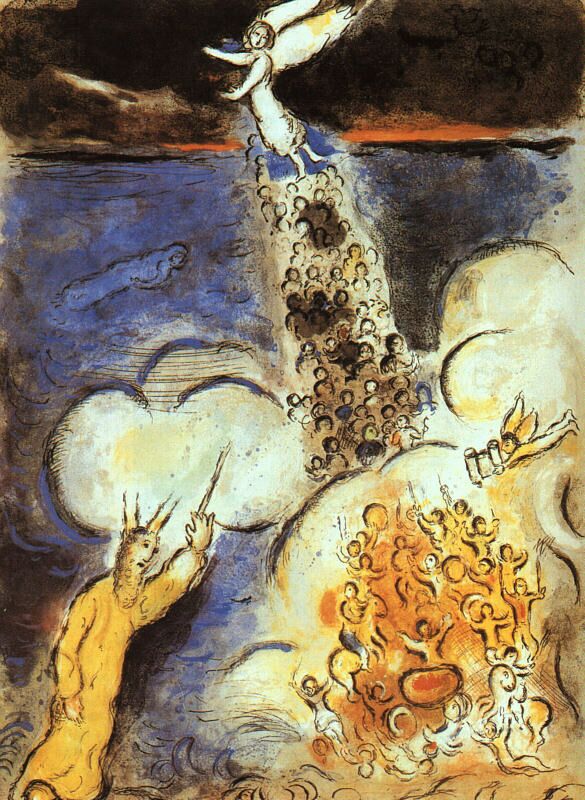
Marc Chagall's "Passover Haggadah"


Celebrate forty years of wandering.
40 years of searching.

Read Haggadah to the children,
give thanks,

sing praises
for the tribe surviving.

Focus on the ancients,
not the news.

Ignore ICE, as it issues
this warning: if officers

view you as Other,
hear a foreign accent,

take notice of shabby clothes,
you will be wrangled

like cattle into pens
and, paperless or not, deported.

To where? Weep, explain
you have lived here

since you were two,
this is your home.

Your wife, your children,
your aged mother

may never see you again.
Glory be to what?

Listen! Angry screams nurtured
by hatred, drown out the cries

of kids in Florida, or Texas, or next door.
How many more will be force fed this poison

in the name of a merciless God
punishing the sin of survival?

Tonight, we Jews co-opt words;
suffering, pain, freedom.

I imagine the day that
anyone’s God

will deliver enlightenment,
angels will sing,

heavenly light will shine
on the cruel irony of the self-righteous,

the day each of us will be revealed
as the supplicant,

each of us the Other.
The day our ancient journey,

our Passover celebration,
will not fall so woefully short

of the promised land.


Anita S. Pulier’s chapbooks Perfect Diet, The Lovely Mundane, and Sounds of Morning and her books The Butcher's Diamond and Toast were published by Finishing Line Press. Anita’s poems have appeared in many journals and her work is included in nine print anthologies. Anita has been a featured poet on The Writer's Almanac.

Sunday, March 28, 2021

SERMON FOR SPRING HOLIDAYS

by Catherine Gonick


Source: Image from NewVoices.org via Haggadot.com. Adapted from Dinah Winnick.


In a just and regenerative world
cooperation and honor
a given
 
no one would be made a slave
but we are all traffickers
 
                  Gloria
and violence would be only
the absence of good
but we’re all mass shooters
 
                  In excelsis
our souls
are returned to us pure
aach morning
 
                  Deo
and we repollute them
 
beggared
imaginations can’t be trusted
with much freedom
children must be taught to share
although adults
can’t do it
 
in the nineteen hundreds
sperm whales learned
to swim upwind
of sailing ships’ harpoons
but now can’t escape our noise
 
alone on rising
stolen seas
our Jonah spat out
floats on plastic
 
in our hopeful house
chametz is hunted
a beast sacrificed
another Passover feast prepared
 
we pray       tikkun olam
for whomever shall inherit     our Earth
                                   
 
Catherine Gonick’s poetry has appeared in literary magazines including Notre Dame Review, Beltway Poetry Quarterly, Halfway Down the Stairs, and Silver Birch Press, and in anthologies including in plein air, Grabbed, and Dead of Winter. She works in a company that seeks to slow the rate of global warming through projects that repair and restore the climate.

Wednesday, April 15, 2020

PASSOVER IN PLAGUE-TIME

by Betsy Mars


“The acre of grass is a sleeping swarm of locusts,
and in the house beside it,
tears too are mistaken” for a dark sea,
into which we dip our egg
hoping it will ignite in fertility,
that it will part, a million times—
or whatever is needed—

dividing into heart, lung, legs,
the brain and whatever refrain
we choose to utter
on this, one of the holy days,
to mark our division, and our coming together
a tribe in the end, passed over,
we find our bitter herbs
our unleavened bread

our toilet paper and paper towels shared:
the treasures of this day,
when we marked our doors,
hid inside and hoped to God
he’d pass us by.


Betsy Mars is a poet, educator, photographer, and occasional publisher. Her Kingly Street Press published its first anthology, Unsheathed: 24 Contemporary Poets Take Up the Knife, in October 2019. Her work has recently appeared in Verse-Virtual, The Blue Nib, The Ekphrastic Review, and Silver Birch Press. The daughter of a professor and a social worker, she has had a lifelong interest in issues pertaining to social justice.

Monday, May 06, 2019

THE MEETING OF LITTLE VALLEYS

(the meaning of Poway)

by Alejandro Escudé


Kumeyaay-Diegueño-Salinan-Chumash-Kashaya-Esselen-Kiliwa-Paipai. Tipai-Ipai (`T p -`E¯ p ) is the common name since the 1950s of two linguistically related groups formerly known as Kamia (Kumeyaay) and Diegueño. Both terms mean “People”. “Diegueño” comes from the Spanish mission San Diego. Photo via Pinterest.


Where the Diegueño people
roamed, before the state was state, stream
of stars, black-billed magpie,

Blue Sky

sycamore, willow, cottonwood, oh scent of sage scrub forever!

woodland roadrunners, coyotes, and bats
we take our welcomed people in our hands
for Passover
those Jewish, Christian, Buddhist, Muslim, all indigenous
living between the fallen limbs

among the wild roses, quail, and amphibians,

we walk with you arm in arm, through paths of chaparral and poison oak
as the bobcats look up at the moon,

glassy-eyed, weighed down by worldly cares,

there we sing, Dayenu—to the eternal family running along the red highway,
brothers and sisters

we will not let you fall to the captors who shall perish in their ancient pursuit,
as we

hold firm to the aromatic shrub of our blessèd word

to our common little meeting of valleys,

our people,
our Poway,

our truth.


Alejandro Escudé published his first full-length collection of poems My Earthbound Eye in September 2013. He holds a master’s degree in creative writing from UC Davis and teaches high school English. Originally from Argentina, Alejandro lives in Los Angeles with his wife and two children.

Wednesday, April 12, 2017

THE HORA FOR THE FIRST PASSOVER UNDER PRESIDENT T***P

by Zev Shanken


It's a chilly afternoon for Tel Aviv,
but we swim like we used to
and shiver and laugh,

because we’re not that old,
though I’m fat and bald,
but as soon as I visit you, you—

No!  You don’t turn me young and thin and hairy again.

Instead, you teach me the Hebrew
for loving a land
even when bad guys win,

for you've shown me the movements
for dancing on sand
with partners whom you pray to change.


Zev Shanken lived in Israel in the mid-1960s before, during and after the 1967 Six Day War.  His poems “Twilight of the Greatest Generation” and “High Noon” appeared in earlier issues of TheNewVerse.News.  Last year, Full Court Press released his selected poems Memory Tricks. 

Thursday, July 28, 2016

AGAINST PURITY

by Judy Kronenfeld


My father slipped out of Nazi Germany 
in history’s hidden pocket, but the sister
and her family he never talked about stepped 
over the crack between everyday
and juggernaut (deportiert 1942, verschollen
in Auschwitz, or für tot erklart
in the same hell). 

Briefly paused in Recife
on the way to Ascension Island,
courtesy of the U.S. Army, 1944, my father took in
the faces in gradations of brown,
and said, according to family legend:
“We should all intermarry
until we blend.” As if, to fuse 
the blacks and whites, the us
and them tense in his newly beloved
America would move us towards
a gene-pool Esperanto, one flavor, nothing
sticking out, nothing to hoist
a flag, or cross or crescent on.
Even a star. 
        
He dipped his pinky
in the Passover wine to spill the ten drops 
for the plagues God visited on the Egyptians,
and with his post-retirement
congregation, bowed to praise
the Creator “who has set us apart.”
But never held himself
apart or wished a plague
on anyone. In his decline, when congregants
visited the dementia wing, he could still mumble
the Hebrew prayers he’d learned by rote
as a kid, though almost everything 
in his life—including Paula, Mendel, 
Hermann and Charlotte—
was by then verschollen.

But someone is always saying

We’ve fallen from our ancient  purity—
take back our country!
        
Someone like Anders Breivik, self-trained in pure
ruthlessness, whose bomb and bullets 
shattered the charm enclosing open Norway. 
I remember  all of Oslo—like a village—
celebrating light in the dark 
of the autumnal equinox, 
gathering for the River Walk, 
the mud-slick banks of the Akerselva glowing
with candles and torches, spangles flickering
off the silver foil the school kids used 
to decorate the trees, all families—adopted African
or Asian children, Muslim mothers
in their sculpted head-scarves—
safe as houses.

And someone else, afraid to disagree,
will wave a torn and faded
flag, so long suppressed,
and holler yes!         
        
Like the proud father who bows
to God when his wife-and-kids-abandoning son 
fighting for Islamic State in Syria
is killed, who celebrates that son’s
martyr’s wedding (though the mother says
‘it’s a funeral for me’) in a great tent 
draped with black. 
        
It makes me want 
all things maculate, muddied
mottled, pocked, all things
tainted,     
stained,
blotchy, motley,
mongrel, splotched,
hybrid, scrambled,
half-caste —

If that’s what it takes
to defy Ein Volk, Ein Reich
Ein Führer,
the wished-for
Caliphate, Judea and Samaria,
Trump’s Muslim- and Latino-
free America.         


Judy Kronenfeld’s most recent books of poetry are Shimmer (WordTech Editions, 2012) and the second edition of Light Lowering in Diminished Sevenths (Antrim House, 2012), winner of the 2007 Litchfield Review Poetry Book Prize. Her fourth full collection, Bird Flying through the Banquet, will be published by FutureCycle Press in the spring of 2017. Her poems have appeared widely in  print and online journals including American Poetry Journal, Calyx, Cider Press Review, Cimarron Review, Connotation Press, DMQ Review, Hiram Poetry Review, Innisfree Poetry Journal, Louisville Review, Natural Bridge, The Pedestal, Portland Review, Sequestrum, Spoon River Poetry Review, Stirring, and Valparaiso Review, and in more than twenty anthologies. She is Lecturer Emerita, Dept. of Creative Writing, University of California, Riverside, and Associate Editor of the online journal, Poemeleon.