Guidelines


Submission Guidelines: Send 1-3 unpublished poems in the body of an email (NO ATTACHMENTS) to nvneditor[at]gmail.com. No simultaneous submissions. Use "Verse News Submission" as the subject line. Send a brief bio. No payment. Authors retain all rights after 1st-time appearance here. Scroll down the right sidebar for the fine print.
Showing posts with label letters. Show all posts

Saturday, March 07, 2026

CLAMPDOWN AT DILLEY DETENTION CENTER

by Ellen Romano


Children detained at the immigrant family detention center in Dilley, Texas, speaking with ProPublica reporter Mica Rosenberg over video call. Clockwise from top left: Diana Crespo, Luka Mora, Juan Nicolas Mo, Alexander Perez, Amalia Arrieta, Mayra Delgado. Mica Rosenberg/ProPublica. Click here to donate to ProPublica.


Imagine the children’s drawings, 

a family of three, standing in a cage, 

a family of five, standing in a cage, their faces blank,

a family of seven lying down in a cage, labelled

with the words, me quiero ir,  I want to go home. 


Imagine the children’s letters,

We are kidnapped, help.

There’s an agent here, he’s watching us.

I can’t see Willi, accompanied by a picture of a pet cat.


On the day the art supplies are confiscated,

crayons, pencils, drawing paper,

the letters and pictures are seized as well,

portraits of friends, the tracing of a child’s hand,

tears and a frowning face in the palm,

even a five year-old’s picture of a peaked roof house,

lit from one corner by an inextinguishable sun.


One mother saves a handful of shredded pages,

all that is left of her daughter’s drawings. In a place

that is never warm enough, another mother hides

the drawings of as many children as she can

in the sleeves of her puffy jacket, carries them

everywhere. 


Imagine a government that tries to steal 

a child’s ability to imagine, imagine a five-year old

wearing a detention uniform, a replacement 

for the blue, bunny-eared jacket taken from him,

the conejo that shared his name,


imagine a child’s voice too dangerous to be heard,

though no louder than the sound

a crayon makes on a scrap of paper.


Author’s note: All descriptions of children's letters and art work were taken from various news articles except for the description of a five-year old's picture of a house, which as an elementary school educator I feel is quite typical.


Ellen Romano, she/her, is an educator, mother, grandmother, widow, and beekeeper living with her dog, Doc, in Hayward, California. She is the winner of Third Wednesday’s 2023 Poetry Prize, and won second place in Naugatuck River Review’s 2023 Narrative Poetry Contest. Other work has appeared in Lascaux Review, The Deadlands, december magazine, and other publications. 

Sunday, April 06, 2025

THE NEW DHARMA BUMS

by Bradley McIlwain 


When I could not sing
Drunk on disillusionment
And pain 

Shiva drank the poison
From my throat 
To free my spirit 

From city lights
That burned too bright 
My past cremated in ashes and bottle caps

Too much bar puja
Midweek between pints 
And poetry 

Searching for Kerouac’s
Drunken Dharma Bums
Looking for enlightenment 

In the Desolation Peaks
And the road is a ghost 
Holding out my thumb 

Like old Dean Moriarty 
The highway line a rehab
Of breakthroughs and breakdowns.

Enlightenment 
A bridge that burns 
At both ends 

And the only way out
Is in;
The only way to the universe… within

Hopping freight trains 
In early morning fog
The lakes and forests 

Of America 
On fire with desire 
Boxcar wine and scrawl 

Of poet pirates 
Prophesying on 
The great railway lines 

Swallowing the landscape 
Like a serpent 
Of what might have been…

Vasuki
Coiled in the winds 
Of immortality 

Carries me to the desert 
Of mirage and reality 
Of starlight and self doubt 

A new Mahabharata
Through doorways 
Of non Euclidean dreams

Where the chaos 
Of freedom is born 
In the dust of factory floors;

Discarded verses 
Rediscovered in dust 
Swept up and drank 

From voices with dry tongues 
As a tonic for the cause.
The well spring of hope 

Lies just beyond the sun,
My rucksack as heavy 
As the heart of the mountain’s back.


Bradley McIlwain works as a Teacher-Librarian, where he strives to provide meaningful and inclusive spaces for knowledge exchange and advocacy. He believes that poems and poets can be agents for social change. Bradley’s latest book Dear Emily was published by Roasted Poet Press last year.

Monday, December 23, 2024

LETTERS TO LUIGI

by Andrew Romanelli


Luigi Mangione, suspect in the killing of UnitedHealthcare CEO Brian Thompson, departs after a hearing at Blair County Courthouse on December 19 in Hollidaysburg, Pennsylvania. Mangione has received dozens of letters and emails as well as monetary support while in prison, a report by the New York Post has revealed. Photo: Gene J. Puskar-Pool/Getty Images via Newsweek, December 21,2024


are about what you’d expect Jesus to receive

if he had mail privileges 

at Mount Zion, near Holy Sepulcher or Calvary.


I work for a company that prints letters, 

photos, and books for inmates that people 

upload and purchase for us to send.

I fold the letters, put the photos in envelopes,

noticing the names of inmates, the patterns

of image, of word, what gets sent and said.


Every letter to Luigi begins with an endorsement of full support.

Some just want to connect, say where they’re from

what they do for a living. They include a phone number,

a few photos of them hiking, walking a dog at sunrise,

a post gym ab showoff shirt lift, a night out on the town.


Most letters contain stories about illness.

How they lost their child, father, brother, mother,

wife, sister, best friend, high school crush, how

they have lost themselves to denials

of treatment plans, medication, surgeries.

There are pictures and pictures of X-rays,

pedicle screws for spine fusion and support,

scars on backs, calves, bellies, breasts, pictures

of phantom limbs gone to the time waiting for an approval.


The letters often close with:

“For the first moment since my diagnosis I feel

like you understand what I’m going through.”

Or “I’d do anything to be healthy again, 

thank you for giving me hope that things will be different.”


These are people who:

Have stopped writing and calling their leaders.

Understand that statistics have no effect in making a point.

That murder is wrong but wonder what do you call

the death of millions in the name of profit?


Last week I was processing mail for Puff Daddy.


Now its Luigi, a man-made avatar,

expressing the ignored collective suffering of the people.


Jesus was a guy in jail on charges of terrorism.


These are days in which we are able

to reach more people than any other time before.


Yet look what we are doing:

To be seen.

To be heard.

To be validated.


We have been taught the alternatives.

Yet our fracture, 

bound by violence,

gets the attention.


Can you begrudge the people for cheering? 


Andrew Romanelli was born and raised in Las Vegas. His first poetry book Rotgut was published by Zeitgeist Press. You can find him @downcharleston and at andrewromanelli.com .

Thursday, November 21, 2024

AN AUTHOR’S LAMENT

by Lynn Hess


My wisest friends are letters

with whom I have conferred.

I often like to join them in

small clusters known as words.

And frequently we congregate

to party or to rage

in sentences or paragraphs 

assembling on a page.


My dearest friends are letters.

They help transcribe my mind.

It doesn’t matter what I write,

they never are inclined

to call my writing “hazardous

to youth” or “outright lies”  

like novels once revered that now

so many stigmatize.


Like a precious vintage watch

worn by someone of wealth 

who knows it needs attentive care

   —it can’t mark time itself—

my words need winding in your mind

for you to understand 

their timeliness and that of all 

the books entitled Banned!


Lynn Hess is a retired middle-school teacher who, for thirty years, simultaneously conducted weekly poetry-writing workshops for students in grades K through 8. Her poetry has appeared in literary journals, including The Spoon River Quarterly, Aeolian-Harp, Discretionary Love, The Monterey Poetry Review, The Red Eft Review, The MockingOwl Roost, and others. Where Tigers Roar in Silence, a book of her poetry for children, was published by Lime Rock Press. Although Lynn writes mostly in free verse, she also cherishes the musicality of poems composed with rhyme and meter. As an educator, Lynn is especially saddened to see so many of the thought-provoking novels that evoked class discussion removed from library shelves.

Sunday, October 27, 2024

READING, WRITING, ARITHMETIC

by Ron Drummond


Sign up at Vote Forward


“The library is open.”

– RuPaul Charles


“Turn the page,” my candidate says,

and we are even more delighted 

with this ambassador of sanity 

than five-year-olds at story time.


I turn the page of a roll of voters

registered to the same party as me

and continue personalizing notes and

envelopes to possible “for” votes,


my handwriting in each letter

paired with a QR code spelling 

how, where and when to cast

their vote. I band stacks of stuffed,


stamped envelopes – this batch

of over three hundred going to

a state where all zips begin with

two, the numeral that allows for 


my finest work: a slight, lovely curve 

that swoops to a taut, crisp horizontal.

At some point, I will put on some music,

but for now, I am flying solo.


I picture the recipient’s odd experience 

of holding a hand-addressed envelope to be

like Sondheim’s Joanne pausing her song

to ask, “Does anyone still wear a hat?”


I relive the tedium of my factory job

working with extruded plastic, and those

night-shift endings at Denny’s “marrying”

the ketchups” – wedding the contents


of the bottles so that none are partly full, 

leaving each with the sediment of ancient 

condiment at their bottoms – when all 

I want is dawn, and to go home to bed.


Within reach of where I stamp and seal

is a cigar box of campaign buttons, mostly 

from lost crusades. I’m not a snob about them.  

I don’t take pride in backing failed runs. 


Most of the buttons promote anti-war pols,

and half are red, white and blue discs 

with the much-later-to-be-assassinated 

Allard Lowenstein’s name on them. 


But when this current election is over 

and I add a shiny new navy-blue one 

to my collection, I envision this old 

El Cid Corona Minors box – it once held


25 seven-inch (54 ring-gauge) cigars 

with open feet & capped heads – being 

transformed. It will no longer be a flat, 

hinged urn. It will no longer be a grief box.


“Turn the page,” my candidate repeats,

using a gesture even the non-literate

can understand.


Ron Drummond is the author of Why I Kick At Night (Portlandia). A founding editor of Barrow Street, his poetry and translations have appeared in over forty journals, as well as in anthologies and textbooks. He has received fellowships from Ragdale, VCCA, Blue Mountain Center, and the Macondo Foundation. He lives in NYC with his husband Terry Cook.

Tuesday, April 25, 2023

THE COST OF MAGIC

by Brian O'Sullivan


Union leaders say the traditionally high status of teachers in Ireland is under threat due to a combination of issues such as pay, workload, limited promotional posts and the growing complexity of the job. So, is teaching still an attractive profession? We asked delegates at teachers’ unions annual gatherings. —“Is Teaching Still an Attractive Profession?” The Irish Times, April 11, 2023


Orla Ryng told The Irish Times that “that magic
of being in the classroom is still there.” That magic

turns a student’s face from the cell phone’s dim light
to the brightness of a peer and an idea. That magic

turns some paper mache into a volcano,  and it
turns jumbled numbers into that kind of magic

spell mathematicians call a formula, and it even turns
the mangled words of social media into that magic

that I—and you, I bet?—value just about the most:
Words that leap and love and shout that magic,

which is to say poetry, will never die. And it’s with words
and letters that teachers are rewarded—like that magic

“N.T.” that got dangled off the ends of National Teachers’ names
in Ireland. My dad, being Irish, seemed to believe in that magic;

he asked, as I trudged through grad school, when I’d
be getting “the letters after [my] name,” that magic

“Ph.D.,” and I thought he was just teasing me, but later
I knew that even he, a practical guy, valued that magic

of letters. But letters don’t pay rent, and so Sean
Maher lives with his parents, still valuing that magic

That devalues him. Economists may
say that if you get good money and you also get that magic,

then you’ve been paid twice. ‘No one goes into teaching
expecting huge wages,” says Eoin Fenton; that magic

serves in place of huge wages, and asking for both money and magic
might be hubris. But would it, in the end, be all that tragic?


Brian O'Sullivan teaches literature and rhetoric in southern Maryland. He has had creative writing published in ONE ART, The Galway Review, The Ekphrastic Review, Verse Virtual, and Every Day Fiction.

Friday, December 17, 2021

WINGS

by Tricia Knoll


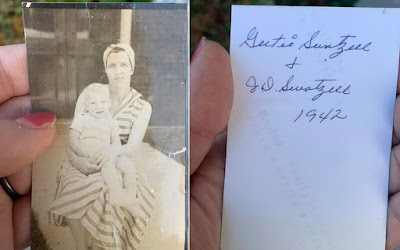
This photo combo shows Katie Posten holding the front and back of a photograph she found stuck to her car's windshield on Dec. 11 in New Albany, Ind. The photo is from a tornado-damaged home in Kentucky that landed almost 130 miles away in Indiana. The photograph was among dozens of personal items to turn up far from home in the aftermath of the tornadoes that sowed a path of destruction across six states. Photographs, by far, were the most common find. In major storms, they’re often carried the furthest, said John Knox, an associate professor of geography at the University of Georgia. “They’re like little wings when they go up into the air,” he said. (AP via The Washington Post, December 12, 2021)


I archive my family’s wings
    letters Union soldier William Lewis wrote home during the Civil War
    my grandmother’s photo holding my squirming mother
    my mother in her fancy hat leaning against my dad’s black Buick
    my mother rocking my newborn daughter
    my daughter holding her newborn
 I have no idea where they go next. 
 
I cannot forget    
    I found the photo of an altar boy wearing a halo
    and a white gown in a driveway in the Ninth Ward
    in New Orleans after Hurricane Katrina. 
I never knew whose angel he was. 
 
What hurricane wind tears apart
    flies, lives that shift from black and white
    to battered color. Wings beating birds 
    to refuge on a windshield,
    a mud puddle. Stuck in the twig
    of a naked sycamore. 
 
Angel memories try to find
    a way home. I believe
    the only thing my mother feared
    was the hurricanes in Florida. 
    I have no pictures of her fear.


Author's note: I am the archivist of most of the Civil War memorabilia of my great-grandfather William Lewis who served in an Indiana regiment. I never heard back from the historical societies in Indiana when I offered them the 65 letters he and his friends wrote to my great grandmother. Some of what he said is included in my book of poetry How I Learned to Be White.


Tricia Knoll lives in Vermont which catches the tail end of most weather systems that flow from west to east. Her poetry appears widely in journals, anthologies and five collections. Most recent is Checkered Mates, a chapbook out from Kelsay Books. Her next collection entitled Let's Hear It for the Horses—love song poems to horses—is on pre-sale discount from The Poetry Box publishing house through December 31 for its release on February 1. 

Thursday, September 23, 2021

POSTSCRIPT TO AN ACTIVIST'S LIFE

by David Chorlton


Unrest #1, a painting by Alyssa Liles-Amponsah


                nobody rich or famous…
                                Richard Shelton
 

The car in the driveway
has barely a pulse
and the windows don’t let in the light.
The palm trees no longer
aspire to the sky
and the garden hose hangs
on a hook.
Something’s eating the house from inside
say the neighbors,
no one answers the door when
they knock. The ceiling gave way
and a bucket of grief
stands under a hole where
time drips day
after day. The telephone’s hoarse
from repeating
I’m sorry I can’t speak now…,
the doorbell plays a dirge
and every minute makes
a tiny splash as it falls
into the unwashed dishes
in the kitchen sink.
 
He brought the border home with him,
unrolled it on the floor,
ran it through the kitchen to
the living room and cut
it into strips to hang instead of curtains
at the windows where a light
shone upon every nationality and exposed
the fault line between the rich
and poor. His trash bin
was filled with tailings from a mine
and every day he emptied it and
every next day it was full
again but he kept emptying. When the nails
fell out from where they held
the world together, he picked them up
to hammer back. Meetings.
Petitions. Meetings. Letters.
Meetings. Always somewhere to be,
to drive across town
on the sweating summer asphalt
with the windows down
to save money for gas.
 
Nobody knows for sure. It was
a mystery. The neighbors didn’t care much
for the man. He kept
largely to himself. Didn’t have a lot
to say. Kept going out, revving up
his car and coming back
then leaving again six
or eight times a day. The lady who lives across
from his house knows; she kept count.
Never really spoke
to him. And he spoke only
when spoken to. He was alone the last
few weeks. Come and go. Feed
the cats. People watched but didn’t know
what they were seeing. Didn’t
ask. Left him alone. And the weeds grew
like secrets in his yard
until one night the moon tipped
on its side, spilling
silver dust onto the moths around it
asking ancient questions
of the passionate light.


David Chorlton is a longtime resident of Phoenix, who continues writing, painting, and keeping track of the local bird life. His newest book is Unmapped Worlds, a collection of rehabilitated poems from his files of the past.

Wednesday, August 18, 2021

PILGRIMAGE TO EMILY DICKINSON'S HOUSE ON NINETY-TWO DEGREE SUMMER DAY

by Laura Rodley


What would Emily say? The driveway to her brother Edward’s home
is gated, the property surrounded with orange crisscrossed plastic
fencing, plastic not yet invented in her time, nor the cure for her kidney
ailments. Today her condition would have been aggravated by the chlorine
and other astringent agents the town uses to clean the water pumped
to the homes. She would have drunk water from an artesian well
in her Victorian home, writing poems at two a.m., loving someone
she could not have, not from the future, but from her own time period.
Was she ever pregnant as some suggest? Was she virginal as her white
dresses? Did she actually suffer from hypertension? Was she able
to see the future? Her poems crossed realms of time and space.
Would she have cut the crisscrossed orange fence, crushed it down,
or felt more secure to be enclosed, secure in her hermitage
peopled with family, cooks, and Irish workmen, six of whom carried
her casket to her grave in West Cemetery, where she walked in the evenings.
She was nourished by a garden that is no longer open to the public
due to Covid. A garden that fed her, kept her poetry
alive, already passed through the gates into other’s hands through letters.


Laura Rodley, Pushcart Prize winner, is a quintuple Pushcart Prize nominee and quintuple Best of Net nominee. Latest books: Turn Left at Normal by Big Table Publishing, Counter Point by Prolific Press, and As You Write It Lucky Lucky 7, a collection of 11 writers' work.

Saturday, October 03, 2020

AS THE ANGELS PASS

by Alejandro Escudé
The coronavirus builds a far-reaching ladder-like apparatus from core helical amino acids (green) in its spike protein that latch on to its host cell, leading to infection. A computer model is simulating these dynamics on Longhorn, the subsystem of the Frontera supercomputer at the Texas Advanced Computing Center (TACC). Credit: Numan Oezguen, Texas Children's Hospital and Baylor College of Medicine. —Phys.Org


I’ve been trying to write you, Covid-19.
The suddenness of the tree is more tree-like
after you and yesterday a woman told me
she preferred taking the elevator alone. 
I didn’t look her way when she said that, 
too tired to acknowledge the statement. 
The CDC says that the air is a ladder full 
of virus, but I already knew that, having 
climbed it like Jacob up to heaven and 
having seen the angels traveling up and 
down it wearing white satin masks, six feet 
apart from one another as they pass, the ladder
wide enough to allow for their wingspans.
I tried not to look at their eyes, furrowed
brows like their human counterparts, a bottle
of sanitizer at the base of the shaky steps.
I’ve been trying to write you, Covid-19.
Write you into the day after tomorrow
and write you into yesterday, when I found
myself in an auditorium with teacher
colleagues listening to the priest lead us 
through a mass as the rain fell and no one 
knew the sequestered work that lay ahead, 
how our hands would turn into hearts, 
sweaty, red, pulsing, our minds become 
oceans of solitude. I’ve been trying 
to write you, Covid-19. Letters afloat 
in the air like germs, words freshened 
by fear. If I write fast enough Covid-19, 
I figure maybe I can stay ahead of you 
as you swim the air, aloft, riding our 
anxious breaths, the teeth-life of humor, 
the tongue-bond of our historic griefs.
I’ve been trying to write you, Covid-19,
as you scrape clean our liminal spaces, 
wicked seed, atomic salt pillar, icepick.


Alejandro Escudé published his first full-length collection of poems My Earthbound Eye in September 2013. He holds a master’s degree in creative writing from UC Davis and teaches high school English. Originally from Argentina, Alejandro lives in Los Angeles with his wife and two children.

Thursday, September 18, 2014

LETTERS TO THE EDITOR

by Lawrence J. Krips


Your article from February ninth
said nothing of how our terrorist search
protects no one but brings internecine fear
and what is it we teach?
So your author says of all the foiled plots
homeland has been saved many a day
not mentioning we’ve lost our country;
the freedom to be free, the world in dismay.

                        ~

I read your editorial on peace
and wonder when our nation will love,
love some space, just one small piece,
love even ones we hate.
My suggestion for your readers
is to start with loving us,
then we will stop killing our leaders
and then cease killing every one else.

                        ~

All I can say
is bless the N.R.A.
Who else to defend our rights
against unconstitutional insights?
The best protection is to arm.
More automatics keeps us from harm.
The radicals steal our guns
by stealing our rights one by one.

                        ~

The drones,
the killings,
the Americans.
Robot dragons
spit their fire.
the haste of death.
Blood spattered dreams –
            whose?
have died.

                        ~

We need to keep drilling.
Capitalism runs upon it.
We need to keep on killing.
This control is our ace in the hole.
We need to have more money
to serve the people who deserve.
We need to have soldiers in the army
to protect our preserve.

                        ~

Your anorexic take on modern psychotherapy
left me less than informed or cheered.
The lucid truth is therapy
is as good as the therapist.
And despite your insecurities about process
those that remain in the land of effects
remain in a territory tending toward death
instead of here in the thick of the juice.

                                                                                                                                             
Lawrence J. Krips is a writer and an empowerment coach.  His poems have appeared in Rhode Island Writers Circle Anthology, Origami Poems Project and Tifferet.  In 2012 he was nominated for a Pushcart Prize in poetry.