Guidelines


Submission Guidelines: Send 1-3 unpublished poems in the body of an email (NO ATTACHMENTS) to nvneditor[at]gmail.com. No simultaneous submissions. Use "Verse News Submission" as the subject line. Send a brief bio. No payment. Authors retain all rights after 1st-time appearance here. Scroll down the right sidebar for the fine print.
Showing posts with label madness. Show all posts

Thursday, October 29, 2026

PEAT MOSS AND CLOVER

by Julie Steiner


Photo credit: Julie Steiner


Some smells are Portkeys: following your nose
will take you where you wouldn't choose. The past,
as patient as a paparazzo, lies
in wait in harmless objects, poised to spring.
One soap brand’s scent assaults you. (There’s no way
you’d share that silly symptom with a doctor.)

Your mother had a friend who was a doctor —
the sort of gent who won’t look down his nose
at those beneath him. Honored by the way
they’re treated, social climbers think they’ve passed
some test that’s caused their public stock to spring
up fifty points. (We tell ourselves such lies.)

Our own redemption makes us idolize
such reputable citizens as Doctor
Snow. We’re baptized in their sacred spring.
If kissing up to them should brown your nose,
you hold them blameless. Demigods are past
reproach. Shit happens, but some other way.

So when your kid complains about the way
he shows affection, know the trouble lies
in misinterpretation. No one’s passed
the slightest ugly hint about the doctor.
He hugs a lot—that, everybody knows—
but Honi soit qui mal y pense. Don’t spring

to damaging conclusions. Irish Spring
(a bar held in her mouth) should wash away
the filth she’s said. But soon the whole town knows
about your kid’s attention-getting lies.
She starts accusing classmates, not just Doctor
Snow. The social life you loved is past.

And now these drawings! When will she get past
this stage? You hope her sex craze doesn’t spring
from something in your gene pool. Playing doctor,
miming sex acts—this could be the way
your grandpas went so wrong. Salvation lies
in moving to a place where no one knows

your problem child. There, doctor up her past.
Ignore her noes. Keep buying Irish Spring.
Don't cave to tantrums. That way madness lies.


Author's Note: The following context for the sestina "Peat Moss and Clover"—named for the scent profile of Irish Spring deodorant soap—might cast light on two recent news stories: first, the attack ad featuring Ohio gubernatorial candidate Amy Acton's mother calling her a liar, and second, the Cornell Seven situation.

The second-person narrator changes from the child's perspective to the mother's over the course of the poem, to reflect the erasure I have felt whenever I've tried to get my mom to acknowledge that I did, indeed, experience sexual abuse from ages five to seven, and that she and my father punished me for trying to report it (as well as for my attempts to come to terms with it, through drawings and playacting). She still clings to her preferred narrative—namely, that I was a deeply sinful kid, but through firm parental discipline and fervent prayer, she and my father saved me from being a pervert like the many convicted sexual predators in her family tree.

It is unsurprising that both my own mom and Amy Acton's are so deeply invested in characterizing their daughters as liars. The alternative is admitting that they made a bad situation worse for their kids, and that they continue to wrong us by being in such obstinate denial decades later. If I can't expect my mother, with whom I am otherwise on good terms, to give up the self-exonerating idea that her young daughter's claims of sexual abuse were just attention-seeking lies, I certainly wouldn't expect Acton's estranged and unstable mom to be able do so.

I had thought that the sexual abuse I experienced from other kids was an outlier, because my elementary school situation seemed unique. Many of my classmates were years older than I was, because I was put into an "open education" class—my elementary school's dumping ground for special needs kids of mixed ages. Hans Asperger was still a decade away from publishing the news that some individuals with autism have average, or even high, intelligence, but can be overwhelmed by sensory input (such as buzzing fluorescent lights, or by an entire classroom's worth of kids radiating laundry detergent and shampoo perfumes). My school didn't know what to do with me. I had entered kindergarten as a strong reader and was excellent at math, but I disrupted any classroom I was put into with my near-daily tantrums and distracting "stimming" behaviors. So they put me where I would only disrupt the almost non-existent education of the throwaway kids—those referred to in the day's lingo as "mentally retarded." These kids also happened to represent the population that is at the highest risk for being targeted by sexual predators. Some of my classmates were probably experiencing sexual contact outside of school, and were trying to make sense of it by experimenting on younger kids, like me. (I regret to say that I, in turn, did the same thing myself, when given the opportunity.)

But perhaps my victimization by, and of, other children was less unique than I'd thought. In an Oct. 20 PBS NewsHour interview, an expert on child sexual abuse said: 

"Up to 70% of contact offenses in the U.S. are caused by other kids. People are surprised that a lot of it is at the hands of other kids, and it can be every bit as harmful as adult-perpetrated abuse. But kids often do it for different reasons and under different circumstances [than adult offenders]. [...] Being cognizant of the fact that your kids are capable of causing harm, and teaching them not only about giving consent, but also about receivingconsent—this topic is coming up more and more, especially in the moment with the Cornell Seven. A lot of people are looking at the parents' involvement, and thinking about 'How did they teach their kids?' [...] It's a really good example of how we should be teaching our sons and our daughters about both sides of the [consent] equation."

I highly recommend the full interview with authors Elizabeth Letourneau and Luke Malone about their book One in Five: Why Child Sexual Abuse Is Our Biggest Public Health Crisis, available for free viewing on the PBS NewsHour website. It is surprisingly hopeful.


Editor’s note: The New Verse News is honored to continue to host, in the wake of the news at Cornell, a series of courageous memoir poems.


Julie Steiner is a pseudonym in San Diego. For her other poems in repeating forms and/or on this topic—many of them first published in The New Verse News—see her Substack, Off-Piste on Mount Parnassus.


Wednesday, October 07, 2026

AUBADE BEFORE THE ELECTION

by Cheryl Martone


One crow swoops down from his solo perch,

beholds a lifeless body of another. His sudden

voice nudges indifferent dawn, grates the air.

Sky stretches and shifts, grows rich with color,

streaked with wings. This is no Van Gogh sky,

though. No wheatfields here. And yet, a sweep

of nature’s gestures,


                                 menace on the horizon,

a certain madness in the air, and now—in my

own backyard—a community moved by and

within a murder of its own. Crows pace, scan,

echo each other. Somehow, they must know

how mythologies persist about them: trickster,

thief. Something to dread. But when I look

below my own window,


                                        I don’t see anything

worse than small creatures born with intent

to survive. Everywhere, it seems, some kind

of danger, another funeral. Old lamentations,

new ones not yet imagined. Eventually, each

bird lifts away, leaves one soul behind. They,

and I, begin this day acknowledging another

passing, another unease


                                beyond Equinox. Soon,

All Souls Day. And days later, the millions

of votes cast. Dies cast. But now, it’s still

October, the shorter days, human silhouettes

moving within the windows of their lives –

within a daily exorbitance of


                                               whatever’s next.

Is it this ticking brightness? Some take it all in.

Some resist. Others look down and away. Sky

anchors in cobalt, erases this dawn reflection

of our autumn world riddled with fire.


Cheryl Martone lives in Rhode Island, where she works as a grant writer for a food rescue and hunger relief nonprofit. Her work has been published in Still Point Arts Quarterly, River Heron Review, Gyroscope Review, Drifting Sands Haibun, Yellow Arrow Journal, and Unlost, among other publications. 

Sunday, February 09, 2025

A TIDAL WAVE POEM

by Gil Hoy


in my dream, the strongman threw my pages 
of poems into a wastebasket and told me 
not to write another poem about democracy. 
no more poems about human rights 
and fundamental freedoms, free and fair 
elections, independent branches of government, 
freedom of expression and press, 
constitutional guarantees of civilian authority. 
no more poems about democratic principles 
that fashioned my poems, they, that turned chaos 
and madness into people power, would no longer 
have permission to enter my poems. so instead, 
I wrote a tidal wave poem about a tidal wave coming.
not an about-democracy or about-democratic principles 
type of poem, not a poem about diversity and inclusion, 
one man-one vote, international law, or equal justice 
under the law. no, this poem was about a tidal wave. 
a tidal wave so strong and so powerful, 
so potent and so heavy, it could destroy evil 
in its path. a tidal wave thousands of miles long 
propelled by the strength of the sun, 
the moon and the earth. a tidal wave so 
demanding so dominant that his eyes 
and his lungs looked drowned. 
a tidal wave that yelled
don't ever fuck with my country again. 
a tidal wave so powerful, so so heavy
and strong, that, yes, it deserves its own poem.


Gil Hoy is a Best of the Net nominated Tucson, Arizona poet and writer who is studying fiction and poetry at The Writers Studio in Tucson, Arizona and previously at Boston University. Hoy previously received a B.A. in Philosophy from Boston University, an M.A. in Government from Georgetown University, and a J.D. from the University of Virginia School of Law. Hoy is a semi-retired trial lawyer and a former four-term elected Brookline, MA Selectman. His poetry and fiction have previously appeared in Third Wednesday, Tipton Poetry Journal, Chiron Review, Mobius: The Journal of Social Change, The Penmen Review,  Last Stanza Poetry Journal, Bewildering Stories, Literally Stories, The New Verse News and elsewhere.

Sunday, February 02, 2025

WHAT I LEARNED ABOUT BEING KIND

by Robin Wright


AI-generated graphic by NightCafé for The New Verse News


For Mariann Edgar Budde
 
Rip off the band aid
of sarcasm, hurt, madness,
drop it in the trash,
bend down on your knees,
push that trash down deep.
Don’t use one hand,
drop both in and push,
push hard. Stand up
close your eyes, take a breath.
Now you’re ready
for those who haven’t
completed the steps, those
who will test you and flunk you.
Their grade book closed,
locked with their own
unkindness.


Robin Wright lives in Southern Indiana. Her work has appeared in One Art, As it Ought to Be, Subliminal Surgery, Lothlorien Poetry Journal, Loch Raven Review, Panoply, Rat’s Ass Review, The Beatnik Cowboy, Spank the Carp, The New Verse News, and others. She is a Pushcart Prize nominee and a Best New Poets 2024 nominee. Her first chapbook, Ready or Not, was published by Finishing Line Press in 2020.

Thursday, March 02, 2023

SUNSHINE TIMES

by Alethea Kontis


They outlawed history here
And science
Next comes gaslighting the spectrum
Color by color
Until rainbows and unicorns are seen only by us other-minded
They will deny the very stars
Ony by one
Leaving children to wish on bees and blades of grass
Wishing to be somewhere 
over there
I long since gave up on the day my prince will come
Living instead on tea made from the tears of backyard alligators
Brewed by the last star allowed
Served by ibis and egrets
In this wonderless land where most sense
Is divinest madness


New York Times bestselling author Alethea Kontis is a princess, storm chaser, and adventurer. She has authored over 20 books and 50 short stories. Alethea has received the Jane Yolen Mid-List Author Grant, the Scribe Award, the Garden State Teen Book Award, and is a two-time winner of the Gelett Burgess Children’s Book Award. Alethea also narrates stories for multiple award-winning online magazines and contributes book reviews to NPR. Born in Vermont, she currently resides on the Space Coast of Florida with her teddy bear, Charlie.

Sunday, March 06, 2022

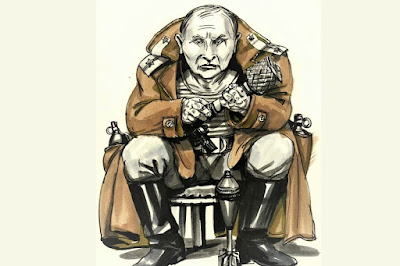
VLAD THE BAD

by Richard Schiffman


His most execrable excellency,
Czar Vlad the Bad, 
a pint-sized Napoleon wannabe in a Gucci suit
decreed ten thousand widows,
and so they were before the cock crowed twice, 
on the morning he deemed cancelled
in the city he called dust.
Just your standard issue human madness.
Of course, of course. A monomaniacal error.
A payback for fanciful slights.

The psycho-historians will have a field day
while the citizenry sleep in the subway,
or pack the next train out.
But how to get away from that feverish brain,
that heart of burning petrol?
There isn’t a bunker deep enough to hide in.
Bankers on six continents dole out the pain.
No SWIFT Code for the codeless.
Oligarchs go yachtless. The ruble is rubble.
Meanwhile, the nuclear finger twitches.
A shudder ripples down nine billion spines.

The spineless despot preens for the cameras,
shows off his cadaverous abs. 
It’s flesh and blood 
below the tailored shirt, for sure, for sure,
fresh meat for a million gurneys.
Dead man walking pale as a crematorium
holds court in a palace of white marble. 
One nation huddles in the basement.
Another weeps and hides its face.


Richard Schiffman is an environmental journalist, poet and author of two biographies. His poems have been published in The New Verse News, Alaska Quarterly, Rattle, The New Ohio Review, The Christian Science Monitor, The New York Times, Writer’s Almanac, This American Life in Poetry, Verse Daily, and other publications. His first poetry collection What the Dust Doesn't Know was published in 2017 by Salmon Poetry. 

Wednesday, May 27, 2020

ROMAN NUMERAL C

by J. D. Mackenzie


Novices learn in wax and clay
Freemen with mallets use stone

When the numbers grew so large
That the Emperor declared victory
Senators looked the other way

Mounds of bodies
Too many to count—
One hundred thousand?
How could this be?

Let the record show a single letter
At least for now, at this moment
Let the victors tell their story
Until we stop this madness
Someday


J. D. Mackenzie is holding up well, if by holding up well you mean writing poems every day and desperately trying to convert classes from traditional to online for an American community college in western Oregon. He and his family live in the foothills of the Coastal Range and are quickly relearning the art of growing their own arugula. 

Tuesday, May 05, 2020

QUARANTINED WITH THE DEAD

by Judy Kaber


Your boots sit
beside the door
as if you will

creep, turtle-mind    
full of muckage,
out to drink

from the stream.
Hope is nothing
but a skull now

& you at home
as much in roots
of foamflower

as anywhere.
Once we feasted
on pizza

together
drank sassafras tea
laughed at

ridiculous things
like death, like pockets
of earth that might

swallow us
that did swallow you
long before

I sequestered myself
in a quarantined world
long before

my poems fell
into books, into quiet
word-pools

long before
madness descended
uncalled


Judy Kaber is a retired elementary school teacher, having taught for 34 years. Her poems have appeared or are forthcoming in numerous journals, both print and online, including Atlanta Review, december, The Comstock Review, Tar River, and Spillway.

Friday, April 10, 2020

OPENING OF AN ORATION AGAINST T***P

by George Salamon


with apologies to Cicero

How long, T***p, will you abuse our patience?
How long will the farce of your presidency mock us?
To what length will your limitless gall go on?
How far down will your ignorance and deceit take us?
Your cruelty, greed and narcissism have undermined
The very foundations of the state itself.
Congress can decree that a president must
Resign, so that the state and its citizens shall
Suffer no more harm from your madness.
Where are the men and women with the
Courage to suppress the audacious effrontery.
Abuse, deception and contempt by you
And your band of bungling braggarts and fools?


George Salamon lives, writes and still reads Cicero in St. Louis, MO.

Tuesday, October 01, 2019

OUR AHAB

by Devon Balwit


Photo from William Thomas Online.


God help thee, old man, thy thoughts have created a creature in thee … a vulture feeds upon that heart for ever; that vulture the very creature he creates.


Daily, my stump percusses loss.
I punish the deck-timbers to-ing and fro-ing.
I hammer divots into pine. My underlings suspect
me mad but are too weak to topple me.
Somewhere a blanched and crenellated fin
froths the waters and flags my nemesis.
Bubble the very stench of hell
from my machinations, I will have him.
Not even my young wife slakes
this thirst. My gold doubloon
gaudies the mast. Whoever sings my foe
can pry it loose. I cannot sleep
for visions of ropes playing out
like spider silk, lance-men dangling
from his bulk. O to drain him and render him,
to spring a rib from his vaulted chest
and craft myself a new limb, an ivory needle
to tattoo the Earth with my passing over.
I count not the cost, so sweet my stupor.


Devon Balwit's most recent collection is titled A Brief Way to Identify a Body (Ursus Americanus Press). Her individual poems can be found in here as well as in Jet Fuel, The Worcester Review, The Cincinnati Review, Tampa Review, Apt (long-form issue), Tule Review, Grist, and Rattle among others.

Wednesday, November 02, 2016

TOO LATE, WE THOUGHT

by Lisa Vihos


July-August 2016 issue, The Atlantic


It was that autumn of hurrication
and blusterment, when kings fought
for their crowns, and beasticals awoke
to shake loose their brassy manes.
Geese flew every which way but south.

There was hatertude in the air
and a forbading sense of miserdom.
There was a feeling that something
had been lost; I’ll call it humankindlyness,
gone the way of the Mohican and the dodo.

It was a time when be equaled seems
and no one knew what the definition
of is was, or will be, or will have been.
It was a topsy-turvy time of extreme poshity
and abjectionable going-withoutedness.

The best minds of our generation
went missing in a moragmire
of interpetude and degenerance,
feigning some kind of wonderful;
some kind of altruistica merviosa.

It was a time when lachromosis set in
and a distinct hardening of arterial material.
We thought we had the answer. We thought
we could fix things with a bludgeon. We thought,
but it was not enough, and it came too late
to rectifiliate our dementia.


Lisa Vihos is a poet living near Lake Michigan in Sheboygan, Wisconsin. She is the Poetry and Arts Editor of Stoneboat Literary Journal and an organizer for 100 Thousand Poets for Change. She recently received a grant from her undergraduate alma mater, Vassar College, to design and build a children's reading garden in Malawi in 2017.

Monday, February 09, 2015

OUR LEADERS AREN'T LEARNING

by George Salamon


"With advice from  more than 200 policy experts, Hillary Rodham Clinton is trying to answer what has emerged as a central question of her early presidential campaign strategy: how to address the anger about income inequality without overly vilifying the wealthy."  The New York Times, February 8, 2015

In the twenty-first century we choose to be blind
To what Juvenal glimpsed in the first:
"Is it just simple madness to lose a hundred thousand,
And then refuse a shirt to a shivering slave?"
It was so in Rome then as it is in America today,
But the eyes of two-hundred policy experts are wide shut
To where the madness led then and is leading now:
"Most of mankind is now at sea! Wherever the hope
Of profit leads, a fleet will follow."
Madness, Juvenal understood, comes in different guises,
The ships following one sink as do those following another.
He knew what our leaders dismiss; but it takes no
Sherlock to know that in this case
two-hundred heads are not better than one.


George Salamon taught German at several colleges, served as staff reporter for the St. Louis Business Journal and Senior Editor of Defense Systems Review. He contributes regularly to the Gateway Journalism Review, Jewish Currents and The New Verse News from St. Louis, MO.

Sunday, September 28, 2014

THE ARTHUR MURRAY STUDIO IN MOSUL

by Christopher Woods


Has gone dark and quiet and sad,
But still the dancers come,
All ages, both sexes, sit in chairs,
In circles, or in lines facing each other,
No longer allowed the art of movement.
But imagination still breathes deeply
As they imagine dancing a polka,
Foxtrot, recall the smiles of partners
Taking each other’s hands, or holding
A lover close as a song ends.
No music here now, but who can forget
A glorious Strauss waltz, a sensual samba.
Still, they cannot, will not, surrender.
So in the ballroom gloom,
They silently, defiantly,
Hum Beethoven’s “Ode to Joy”
Over the din of madness
In the street outside.


Christopher Woods is a writer, teacher and photographer who lives in Texas.

Monday, May 26, 2014

CALIFORNIA SHOOTING: STATEMENT BY RICHARD MARTINEZ


Our son Christopher and six others
are dead.           Our family
has a message for every parent out there.            You
don’t think it will happen           to your child
until it does.

Chris was a really
great kid. Ask anyone
who knew him. His death           has left
our family           lost
and broken.

Why
did Chris die? Chris died
because of craven,
irresponsible politicians
and the NRA.

They talk about gun rights.
What about Chris’s right
to live? When
will this insanity stop? When
will enough people say,

‘Stop this madness, we don’t
have to live like this.'
Too many have died.
We should say to ourselves:
‘Not          one           more.'