The New Verse News presents politically progressive poetry on current events and topical issues.
Guidelines
Submission Guidelines: Send 1-3 unpublished poems in the body of an email (NO ATTACHMENTS) to nvneditor[at]gmail.com. No simultaneous submissions. Use "Verse News Submission" as the subject line. Send a brief bio. No payment. Authors retain all rights after 1st-time appearance here. Scroll down the right sidebar for the fine print.
From Nest to Deathbed, Jackie the Eagle Entranced California and Beyond. The bald eagle and her mate gained fame during the pandemic, as a livestream tracked their nesting attempts. She died while being treated for anemia. —The New York Times, August 10, 2026
mated for years
jackie is larger than shadow her compadre of the skies both hardwired to protect each egg each feathered chick perhaps they met in a playground of clouds an accidental encounter not paired by families imagining a coupling worthy of majesty they soar own the sky build aeries in the tops of giant trees relying on architectural instinct carried in their bones jackie an unpretentious name for a mother tasked to save her species eons of ancestral instructions to keep eagles aloft
build a nest mate lay eggs hatch fledge
repeat
stella graham-landau is a poet in richmond va. she has been published on the new verse news and other journals, websites, and anthologies. she loves the generous community of poets she has found online and welcomes conversations with other creators.
"[An] F-250 King Ranch model [truck] will be staying at a dealership in Kansas for a couple more days after a family of robins has taken up residence atop one of the truck’s 34-inch tires. Since the birds are protected by the Migratory Bird Treaty Act, the employees at Olathe Ford Lincoln and the vehicle customer must wait until the robin’s family of hatchlings grows old enough to leave the nest, and the dealership, behind." —Paul Kampe, Ford website, May 22, 2026. Photo by Olathe Ford Lincoln
Hush, little birdie, don’t be alarmed,
We are gonna keep all your chicks unharmed—
And even if they’re slow to fledge,
That is still no reason to feel on edge,
For though some migrants (human ones)
Have to leave their nests thanks to men with guns,
Robins are protected by our word.
Aren’t you glad you were born a bird?
Melissa Balmain edits Light, North America's longest-running journal of comic verse. Her poems and/or prose have appeared in Crab Orchard Review, Ecotone, The Hopkins Review, Literary Matters, McSweeney’s, The New Yorker, The New York Times, Nimrod, Poetry Daily, and Rattle. Her latest book of poetry is Satan Talks to His Therapist (Paul Dry Books).
Representative Eric Burlison, Republican of Missouri and a member of the Freedom Caucus, said it was “inappropriate” for Republicans to say that they “aren’t going to touch” Medicaid — a phrase that Mr. Trump has used — and then “leave all that fraud in the system.” He suggested that provider taxes, which states use to offset their portion of the cost of Medicaid, were a form of “fraud” that he would want to eliminate. —The New York Times, May 29, 2025. AI-generated graphic by Shutterstock for The New Verse News.
Protected by the roof of the porch, a robin has tucked her nest on top of the artificial spring wreath hung on the front door, with easy access to grass and flowers and oak tress— showing she knows something about location, location, location in picking real estate. But when the door swings open, she flies flustered from the nest, fussing nearby until the door closes. It’s like finding the foundation underneath the kids’ bedroom is cracked. Like attempting to eat cherry ice cream on a steamy afternoon in a cone that has a hole in the bottom, or trying to drink a cup of scalding coffee on a train when it lurches. It’s like believing your child is safe because she is American born, only to see her swept up by ICE and sent to Honduras. Mothers need to be flexible, but there are so many openings to peril, so many teeth in the mouth of despair. They might tie themselves in knots, but even the most agile can’t block it all.
Lynne Schilling has published poems in Quartet, The Alchemy Spoon, Rue Scribe, Braided Way Magazine and others. She won Honorable Mention in the 2024 Barbara Mandigo Kelly Peace Poetry Contest for her poem, “Prayers I Wish I’d Uttered When Forced to Pray Aloud in Fifth Grade.”
My feet are cold. My financial value is diminishing. I am baffled by the future, except for my demise, which is guaranteed by the history of birds like me. Birds who sing as if today is forever, as if all we need is enough seed, a few twigs for a nest, and the egg we share with its speckled shell, protected by Social Security, by Medicare, by whatever we gave ourselves yesterday when we planned for tomorrow, which is cracking today. I am memorizing country codes so I can use my phone to call for help. Hello Portugal, this is an American wren speaking, can I rent a birdhouse? I am a Boomer. I won’t sing for long.
Al Ortolani, a winner of the Rattle Chapbook Prize, has been featured in Garrison Keillor’s Writer’s Almanac, Ted Kooser’s American Life in Poetry, and George Bilgere’s Poetry Town. He was the recipient of the Bill Hickok Humor Award from I-70 Review. He’s a contributing editor to the Chiron Review.
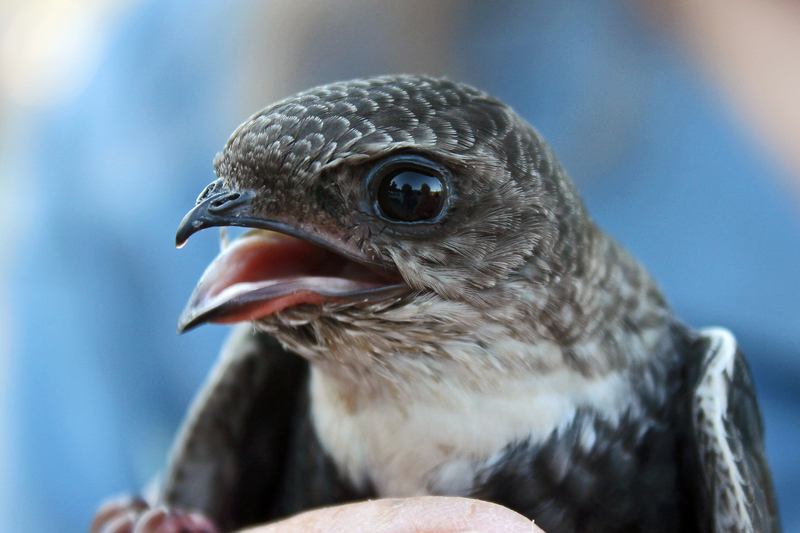
She’s black, she’s white— she’s a white-throated swift moving so quickly I barely see the male on her back as she barrels toward earth in a courtship spin— swerving at the point of impact, then hurtling upward again to become a speck in the sky. (Black and white, dark and light—) The nest— a cup of moss and twigs glued to the side of a sheer cliff with saliva. (I was once convinced that dark news was really light—) Fifty trips a day to care for chicks, feeding them balls of insects… instincts as true as their flight. Before dark times, I could tell black from white… I will again, when I can see through these reddened eyes… Will I/will we turn back in time to see the brilliant blue sky?
A lover of the outdoors, Beth Fox was a finalist in four New England poetry contests and is widely published in New England. She helped seniors publish their work in an anthology, Other Voices, Other Lives. Her chapbook Reaching for the Nightingale is available at Finishing Line Press. Beth lives in Wolfeboro, NH.
White grace floats the lake, rippling in icy torrents
of another Trump tirade.
A stopover in migration, a congregation
of reacquaintance-feeding-reuniting in purpose.
They paddle in silent choreography, know nothing
of deportations, hate-vengeance-greed.
Know to stay clear of marsh grass, where alligators
nest-hunt-eat more than needed.
Their long-bowed faces remember loss—how easy
to destroy a nest than to build one.
They glide into flight formation. Broad webbed feet
flapflapflap in domino percussion.
Snowy wings underscore the black of mourning.
They fly away.
Catherine Arra is a native of the Hudson Valley in upstate New York, where she lives with wildlife and changing seasons until winter, when she migrates to the Space Coast of Florida. Arra teaches part-time and facilitates local writing groups. She is the author of four full-length collections and four chapbooks. Recent work appears in Unleash Lit., Eclectica Magazine, LitBreak Magazine, Poem Alone, and The Ekphrastic Review.
The cardinals nesting in the barberry bush beneath my bedroom window work together as if they have fledged many chicks during their brief lives. The mother, dusty brown and patient, approaches her chicks through aerial feints. And by hopping from lower branches to the upper fork where the hatchlings await the spiders and crickets she delivers. The scarlet male darts and barrel rolls toward its forage with what I pretend is pride.
Soldiers were once children in such a hurry to fly. I was such a boy aiming toy bazookas and sniper rifles at Lincoln Log forts under siege. Now I celebrate the appetites of five hungry gullets, hoping the chicks survive the neighbor cat’s overnight prowls. If I can’t protect the spring’s latest brood, how can I save the children of Jerusalem and Rafah.
Michael Brockley is a retired school psychologist who lives in Muncie, Indiana. His poems have appeared in The Parliament Literary Journal, Stormwash: Environmental Poems, and Barstow and Grand. Poems are forthcoming in Of Rust and Glass, Ryder Magazine, Otherwise Elsewhere Literature and Arts Journal, and The Prose Poem.
Woman found living in Family Fare sign in Midland, Michigan for almost a year.
It had a roof and a door
space for a laptop and clothes
electric kettle, plant and more
in her improvised home
above the big box store.
warmed on chill Michigan nights
wrapped in rays of a red neon sign
while unseeing shoppers passed below
What thoughts crossed her mind
as she lay perched behind the sign;
Is it a crime to be homeless in America?
settlers came to this land
with only their hands
and some tools and their wits
making up the rules of wrong
and right as survival
is the primal law
not simply a need for shelter
led her to this penthouse nest.
living for a year like a stealthy mountaineer
scaling the crest of Family Fare.
a temporary home.
a summit of her own.
Lisa Seidenberg is a writer and filmmaker who makes documentaries and poetry films. She enjoys reading poems on the Rattlecast and other poetry performance venues.
“One hundred percent girls,” whispered the biologist, crawling next to the pregnant reptile. “This nest will be 100 percent girls.” As the earth gets hotter, turtle hatchlings worldwide are expected to skew dangerously female, scientists predict, making the animals an unwitting gauge for the warming climate. —The Washington Post, October 22, 2019. Photo: A marine biologist helps a newborn sea turtle reach the sea on Cape Verde’s Boa Vista island. Credit: Danielle Paquette via The Washington Post.
In the dark sea, a greater darkness
An absence of starlight, moving
Then on the wet sand, a stone
Stone into turtle, with gathering of breath
And the climb begins, pull and drag
Against all the weight of earth
Far up the beach, with pause for gasp
The turtle curves wings
Into mittened hands, and digs
For this warmth of nest, the ocean shed
This gush of eggs into the place prepared
Hidden among the grains of sand
Then the lurch, the thrash
The torn-up ground, last concealment
Before the run toward home
At the first break of wave
She lifts head, trailing earthly tears
Rests, breathes full, and flies free
So it has been, the mothers forever
Returning to their mothers’ beach
The fathers waiting in the fathers’ surf
But now, the warmth too warm
The nests send only girls into the sea
Until fathers can be found no more
For long barren years, turtles will swim
Far from the beckoning useless land
Bearing eggs for no generation, the last
Pepper Trail is a poet and naturalist based in Ashland, Oregon. His poetry has appeared in Rattle, Atlanta Review, Spillway, Kyoto Journal, Cascadia Review, and other publications, and has been nominated for Pushcart and Best of the Net awards. His collection Cascade-Siskiyou was a finalist for the 2016 Oregon Book Award in Poetry.
One hundred days the Queen hibernates,
burrowed deep in a cavern of bark.
Every day, a star blinks on, or off,
birth of another scientist, or murderer,
and someone loses his or her job.
Every day is someone's first
at something, waking up married, burying
the dog, eating dinner alone as a widow.
Every spring, the earth gets back to work.
Queen searches for a dry place, a loft or shed,
a wedge of light between truss and stud,
someplace warm and undisclosed,
close to the source: Wood she'll strip from lap
or fence, chew and mix with saliva.
She works fast, connects petiole to rafter.
Spins the nest about the center stalk, weaves
combs for drones whose eggs take five to eight
days to incubate. Then they get to work.
Everything they do is for the Queen.
She never returns to the same nest.
Scot Siegel, Oregon poet and city planner, is the author of five books of poetry, most recently The Constellation of Extinct Stars and Other Poems (2016) and Thousands Flee California Wildflowers (2012), both from Salmon Poetry of Ireland. His poetry is part of the permanent art installation along the Portland, Oregon Light Rail Transit ‘Orange Line.’
Space weather events that have been building over the last week continued to affect Earth early this morning (Aug. 28), increasing the possibility of amped up auroras around the planet's polar regions. A string of space weather occurrences this week has led to some beautiful aurora displays, such as the one seen in the picture above. But showers of powerful particles from the sun can also cause problems for power grids, satellites and astronauts, so government agencies are keeping a close eye on the activity. —Space.com, August 28, 2015. Photo: An image of the Aurora Borealis, taken by night sky photographer Dora Miller (also known as Aurora Dora) on Aug. 22, 2015, in Talkeetna, Alaska.
A friend warns of solar flares
and the end of electricity as we know it.
I repair to the window,
refuse to cut the leafless shringa
because here the hummingbird
likes to sit, huddled inside her wings
her only respite from flying
once out of the nest.
What have I to offer,
what bedtime story
to keep the world whole?
The hummingbird tarries,
though her heart beats rapidly,
she listens only to the stillness
attending to the wake-up
call of thirst.
Laura Rodley’s New Verse News poem “Resurrection” appears in The Pushcart Prlze XXXVII: Best of the Small Presses (2013 edition). She was nominated twice before for the Prize as well as for Best of the Net. Her chapbook Rappelling Blue Light, a Mass Book Award nominee, won honorable mention for the New England Poetry Society Jean Pedrick Award. Her second chapbook Your Left Front Wheel is Coming Loose was also nominated for a Mass Book Award and a L.L.Winship/Penn New England Award. Both were published by Finishing Line Press. Co-curator of the Collected Poets Series, she teaches creative writing and works as contributing writer and photographer for the Daily Hampshire Gazette. She edited As You Write It, A Franklin County Anthology, Volume I and Volume II.
“Everything is beautiful in my room, but only in my room, not in Gaza.” --Nidaa Badwan quoted by Jodi Rudoren in The New York Times February 28, 2015
Call me radical, you who uphold
hegemony of the hothead; call me
artist when I find beauty on the
inside, where it’s supposed to
have been stamped out; call
me traditionalist, locked away in
my own self-inflicted zenana.
Here, no one will beat me or throw
stones after me. Here, I can forget about
which missile coming from which side
may explode my face. Here, I have
rediscovered what safety feels like.
Look carefully: let me remind you, too.
This is the only way I know to honor
perfection of nests and eggs and those
fledglings straining at the windows who
will have to learn to fly inside their heads
like I have, like we all have, in this ageless
conga line of barefoot women on hot sands.
Here, when I am punched in the gut, it’s by sunlight
or soul; colors or ideas. Freedom, I call this freedom.
No need to send for a doctor. This is how I heal.
Some day I would like to fit the whole world into this room.
Catherine Wald'sbooks include poetry (Distant, burned-out stars, Finishing Line Press, 2011), nonfiction (The Resilient Writer: Stories of Rejection and Triumph From 23 Top Authors, Persea Books, 2005) and a translation from French of Valery Larbaud’s Childish Things (Sun & Moon Press). Her poems have been published in American Journal of Nursing, Buddhist Poetry Review, Chronogram, Exit 13, Friends Journal, Jewish Literary Journal, The New Poet, Society of ClassicalPoets, The 5-2 Crime Poetry Weekly and Westchester Review.