Guidelines


Submission Guidelines: Send 1-3 unpublished poems in the body of an email (NO ATTACHMENTS) to nvneditor[at]gmail.com. No simultaneous submissions. Use "Verse News Submission" as the subject line. Send a brief bio. No payment. Authors retain all rights after 1st-time appearance here. Scroll down the right sidebar for the fine print.
Showing posts with label thirst. Show all posts

Monday, October 19, 2026

PLOT FORTY-TWO

by Shirin Jabalameli 


Plot Forty-Two is located in Behesht-e Zahra Cemetery in Tehran, Iran. It is associated with those killed in the recent war involving Iran, the United States, and Israel.


In Plot Forty-Two,
the war is not yet over.
A bullet
is lodged in the throat of the earth,
and every season,
a fresh clover
pushes through its mouth.

On the stones
are names
cut short
by the blast;
names that, if called aloud,
might make someone
turn back
beyond the trench.

Here,
death smells of metal;
of a shirt
that never dried in the sun,
of gunpowder
that, months later,
still clings to the mothers’ hair.

The war
came this far
on mud-caked boots.
Even now,
its footprints
remain
on the sleeping stones.

In one of the graves,
a child lies buried.
In his last drawing,
there was a sky
and the very airplane
that had passed overhead.

And that soldier,
perhaps he is still running in his dreams,
from one trench to another,
his mouth full of earth,
a letter in his breast pocket
that never reached its destination.

No one knows
what he was thinking
in his final moments.

An empty magazine?
His brother’s hands?
The window he had meant to repair
before winter?

Perhaps
all he wanted
was a glass of water.

And this
is the most terrible thing about war:
that even on the brink
of disappearing,
a human being
can still feel thirsty.

Beside one of the stones,
a mother sits.
She does not weep.
She says nothing.
With her fingernail,
she brushes the dirt
from a name
that, each time,
sinks back into the earth.

As though she were still
brushing dust from his shoulders,
straightening his collar
for his return.

In Plot Forty-Two,
the wind blows,
and no one carries a gun.
Yet as I walk among the graves,
I lower my head,
as though I still had to cross
a stretch of ground
that might explode
at any moment.

Beyond the wall,
the city is busy buying bread.
Buses arrive.
Traffic lights turn green.
Someone quickens their pace
to avoid being late.

And here,
beneath the earth,
a young man remains
forever the age
at which he should have begun to live.

Sometimes,
this is what war is:
not the sound of an explosion,
but a rented room,
a broken radio,
a shirt hanging behind a door,
someone
who was supposed to come home
on Friday evening.

And now,
in Plot Forty-Two,
the roots of trees
thread through bones,
unaware
which side of the front line
they belong to.

I leave the cemetery.
I slip my hand into my pocket.
The key is cold,
and the cold
climbs to my wrist.

Suddenly,
I think of home:
a door closing,
the clatter of dishes in the kitchen,
someone in the next room
calling out,
“Are you home?”

And I think of all those who are gone,
all those
who will never again
be asked
that question.


Shirin Jabalameli is an Iranian poet, artist, and writer. Her poems have appeared in international journals including Braided Way Magazine (USA), The Lake (UK), The New Verse News (USA), and Poetry Super Highway(USA), where she was selected Poet of the Week. She has authored books including Crows Rarely Laugh, Apranik, 101 Moments, and 25 Fell from the Frame; her latest book titled Beneath the Skin of Tehran was recently published. She was nominated for the 2026 Pushcart Prize for her poem “The Lineage of Birds”. Her short story “The Red Thread” was selected among the Top 25 Works Worldwide for the Hannah Arendt Special Edition presented by the International Human Rights Art Movement in Manhattan, New York.

Tuesday, June 11, 2024

MY MOTHER IS SUING THE US GOVERNMENT FOR POISONING HER HUSBAND

by Bill Garvey


The government doubts his
cancer was caused by Camp Lejeune.
How do you know he was even there? they ask. 
We lived in New Bern North Carolina, 
she says, and every day Bill took the bus to Cherry Point 
or Camp Lejeune depending on his orders.
 
But even if he was at Camp Lejeune,
how do you know he drank the water?
It was hot, May to September 1952.
I'm sure he drank the water.
Were you with him at Lejeune?
Did you witness him drink the water?
 
Of course I wasn't with him. 
Of course I didn't witness... 
So for all you know he could have quenched
his thirst with an ice-cold Coca-Cola.
Or even a Ginger Ale. For all you know he was never 
exposed to the water at Camp Lejeune. 
 
I was madly in love with a Marine 
with crooked teeth and a cocky grin. 
Every day from May to September he came 
home to me seventy-two years ago,
clean and showered, so handsome 
in his crisp uniform, stepping from the bus 
 
into our tiny apartment, ready for me. 
Embracing me so close I forgot all about the heat. 
I'll always remember how good he smelled 
at the end of a long day, his hair still damp from 
your showers, not a whiff of Coca-Cola—
or even a Ginger Ale—on his lips.


Author's note: This is a true story. My mother is 93, still sharp, and she is suing the US government for my father's death from kidney and renal cancer in 1977, when the world was ignorant to Lejeune.


Bill Garvey's collection of poetry The basement on Biella was published in 2023 by DarkWinter Press. His poems have been published or are forthcoming in Rattle, One Art, San Antonio Review, Connecticut River Review, Cimarron Review, The New Verse News, The New Quarterly and others.

Thursday, December 21, 2023

MONSOON BLUES

by Geoffrey Philp


Venice is sinking. So are Rotterdam, Bangkok and New York. But no place compares to Jakarta, the fastest-sinking megacity on the planet. Over the past 25 years, the hardest-hit areas of Indonesia’s capital have subsided more than 16 feet. The city has until 2030 to figure out a solution, experts say, or it will be too late to hold back the Java Sea. —Bloomberg, December 6, 2023


Walking along Jalan Tebet Baru Timur where the East Tebet Sugar Plantation once sprawled across the delta on which modern Jakarta is built, cranes hover over a metropolis dotted with blue and black plastic water tanks. The air seems thicker, trapped between the glass and steel towers crisscrossing the city where water supplies wither under a blazing tropical sun, and the city's thirst drains the last drop from depleted reservoirs.
 
While sea levels rise
Jakarta waits for the rain
in the Ring of Fire.


Author’s Note: As coastal megacities like Jakarta sink under the combined weight of rapid development, rising seas, and unstable land subsidence, these converging forces spotlight the harsh realities of climate change threats facing our urban future.


Geoffrey Philp, a Silver Musgrave Medal recipient, is the author of Archipelagos, a book of poems about climate change which was long-listed for the Laurel Prize. Philp’s Twelve Poems and a Story for Christmas retells the nativity story, transporting readers back to that holy night in a fresh yet traditional way. His poem “A Prayer for My Children” is featured on The Poetry Rail—an homage to 12 writers who shaped Miami's culture. He  lives in Miami and is working on a children's book Marsha and the Mangroves.

Wednesday, November 08, 2023

DON’T FORGET

by Laura Rodley


The cause of mysterious mass deaths of African elephants has finally been unraveled — and scientists who authored a new report say that the outbreaks could be more likely to occur amid conditions created by the ongoing climate crisis. Thirty-five African elephants in northwestern Zimbabwe dropped dead under baffling circumstances between late August and November 2020. Eleven of the massive herd animals died within a 24-hour period… Earlier that same year, about 350 elephants in neighboring northern Botswana also had died suddenly over the course of three months… It turns out a bacterial infection killed the elephants, according to the research based on samples taken from 15 of the animals that died in Zimbabwe… The deaths took place as food and water resources dwindled during the dry season, forcing the elephants to travel increasing distances to look for water and to forage… The authors said that heat, drought and population density in that area were likely contributing factors to the outbreak. And the extreme conditions that scientists project will occur with more frequency as Earth warms could mean more elephant deaths in the future. —CNN, November 6, 2023


We don’t forget, we remember the waterholes
shown to us by the elders:
in Zimbabwe we trekked lumbering our feet
across the arid dry ground, leaves and
twigs, fruits already eaten
by those hungry before us.
It is a fever that starts first as thirst,
no relief from flapping our ears back,
waving dry dust across each others’ backs,
we remember the waterholes our elders
brought us to in times of thirst—
they’ve been here before, but never so long as this.
We don’t forget, we hold all the memories
of the beauty of the running water,
the coolness in the shade, how
you loved each other, all of you—
don’t forget—the rumble of our feet
transmitting messages to each other as
we roam further apart, the sound
of jeeps from rescuers from other years
bringing banana leaves, but this time,
the water holes we remembered
had dried up, you walked too far away
for our message to reach you—turn back.


Laura Rodley, Pushcart Prize winner, is a quintuple Pushcart Prize nominee and quintuple Best of Net nominee. Latest books: Turn Left at Normal by Big Table Publishing, Counter Point by Prolific Press, and As You Write It Lucky 7, a collection of 11 writers' work.

Thursday, May 19, 2022

JUST AS THE BIRDS, DISTRACTED

by Paula J. Lambert


Most nights this week, there will be more birds in the air above
this country than people in beds down below.” —Josh Sokol
 

Just as the birds, distracted by light
that splits the star they follow into sparks
and mirrors so they never see the towers
that reach out to kill them, just as the birds,
 
so entranced by needs they cannot explain
that they propel themselves steadfastly
forward through all the wildfires we set 
for them (if they recognize their own 

plummeting numbers when they emerge 
from the smoke, they don’t show it, 
they keep flying) just as the birds 
soar even through their own sleep as, 

one by one by one, they die of thirst 
or starvation or exhaustion, falling into fields 
and ditches and sidewalks, mountain peaks
and seldom-seen valleys, just as they 

keep going, season after season, year after 
year, eon after unfathomable eon, so we 
sleep through it all in our beds below, 
writhing maybe through tangles of sheets 

and the existential threat we’ve made
of our lives—we who’ve lived long enough 
to multiply every problem we inherited, 
who’ve ignored or angrily explained away 

the desperate patterns of our own migration—
but sleeping, blithely unwilling to do more
than worry while, awake, we grab our keys 
and cameras and binoculars and go,
 
to the marshes, waterways and wild places
still left, still untrampled, still—unbeknownst
to us—part of the twisted dreams and difficult
truths we rarely remember, come morning. 


Paula J. Lambert has authored several collections of poetry including The Ghost of Every Feathered Thing (FutureCycle 2022) and How to See the World (Bottom Dog 2020). Awarded PEN America's L'Engle-Rahman Prize for Mentorship, Lambert's poetry and prose has been supported by the Ohio Arts Council, the Greater Columbus Arts Council and the Virginia Center for Creative Arts. Her work has been nominated for several Pushcart and Best of the Net prizes.

Tuesday, July 06, 2021

FOSSIL FUGUE

by Dustin Michael


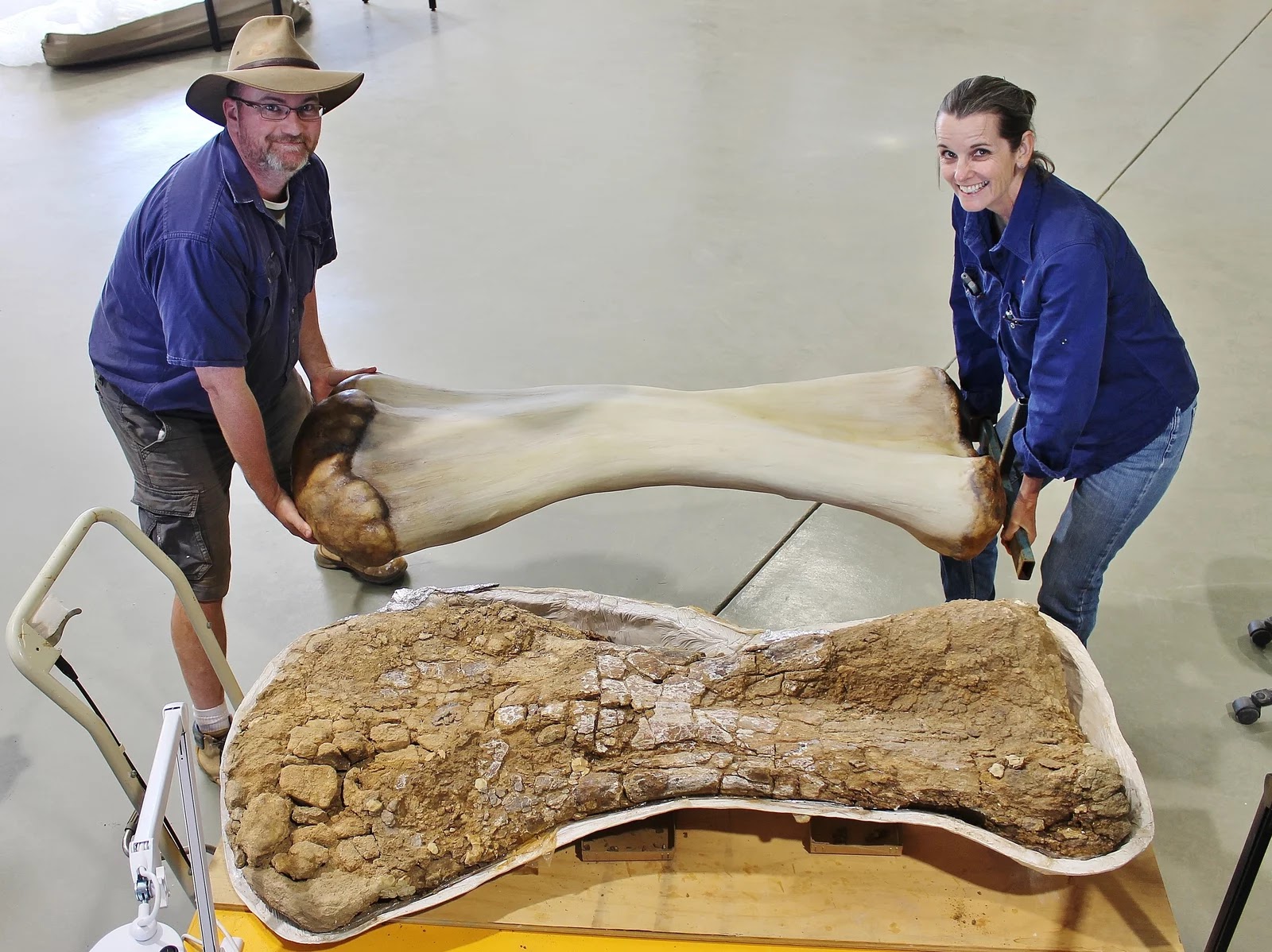
Researchers in Australia have confirmed the discovery of Australia's largest dinosaur species ever found. Australotitan cooperensis was about 80 to 100 feet long and 16 to 21 feet tall at its hip. It weighed somewhere between 25 and 81 tons. For comparison, the Tyrannosaurus rex was about 40 feet long and 12 feet tall. Photo: Scott Hocknull and Eromanga Natural History Museum Director Robyn Mackenzie hold a model of what the humerus of the dinosaur would have looked like next to the fossilized remains of the humerus. Credit: Eromanga Natural History Museum via NPR,June 8, 2021.


What is the price for a puppet show with 
fewer puppets but more stories? Always 
the same story endlessly staged, 
every age’s marionettes and the same 
tired tale, a shifting cast of shadows 
behind the age-old screen.

Study any desert, and behold 
that same sun blistering their backs,
baking their bodies and bones, the breadcrumbs 
of immigrants, their grim trail markers and that same
the docile plodding rhythm, a drumbeat of footsteps 
from the fossil record ringing through time. 

Here is another variation. 
They walked, shielding their young 
with their own bodies, their necks 
like cracked leather, craned high
toward new skies, the breath
of hunger, thirst, and danger fogging 
each footfall, their scaled feet disturbing 
the dust, scattering already ancient rocks, stale
wind whistling faint melody in the world’s eternal 
fugue.

The news reports these dinosaur bones came 
from creatures as big as basketball courts
whose Patagonian ancestors crossed connected 
continents and arrived in Australia. 
No boats to be turned back, no papers to be denied, 
no armed agents or bureaucratic barriers to halt them—
only land in stretches longer 
than even their tales and necks,
and vengeful heat, and hungry earth
whispering Not to worry, not to worry, 
even if they never find all of your bones
the story of your journey 
will always be retold. 


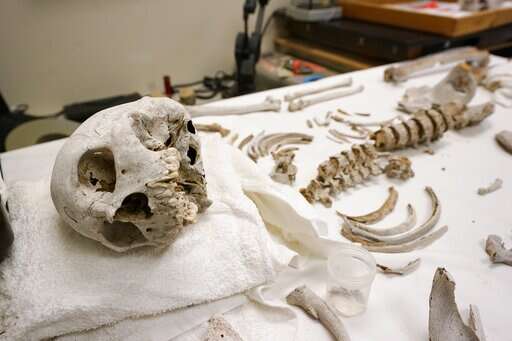
Faith-based groups are working to protect migrants and honor those who have died while attempting to cross the southern border from Mexico into the United States. Humane Borders is an organization that sets up water stations in the Arizona desert on routes used by migrants to cross the border. The group also works with Pima County chief medical examiner Dr. Gre Hess to document the discovery of bodies of those who died on the journey. According to the Associated Press, Hess's office received the remains of 79 border-crossers this year as of late May. In 2020, Humane Borders documented 227 deaths, the highest in a decade after a record hot and dry summer in Arizona. Activists fear this year will be even worse. —Newsweek, July 5, 2021. Photo: Unidentified bones found in the desert and suspected to be that of a migrant are assembled together for examination at the Pima County Medical Examiner's forensic labs in Tucson, Ariz. Credit: Ross D. Franklin/Associated Press via The Journal, July 5, 2021.


Dustin Michael lives in Georgia and teaches college writing and literature. His work has appeared in numerous literary journals and his favorite dinosaur is stegosaurus, not that anyone asked.

Saturday, February 02, 2019

THIRST

by Mary K O'Melveny


FOUR NO MORE DEATHS VOLUNTEERS FOUND GUILTY FOR PROVIDING LIFE-SAVING HUMANITARIAN AID ON “TRAIL OF DEATH” IN ARIZONA DESERT —No More Deaths, January 18, 2019


I.
What do most of us know of it?
Safe in our homes, cars, streets, sidewalks.
Plastic water bottles piled up,
filling the bellies of sperm whales.

We are half filled with liquids. Yet,
when water vanishes in an
eye blink, thirst is just death’s first sign.
A face reddens. A tongue swells. Limbs

cool, cramp. A brain aches. Eyes sink,
as if they might find liquids still
sloshing about under shrinking skin.
Deluge dreams become delusions.


II.
An Arizona desert turns crime scene.
Not because bodies of immigrants
lie scattered about, bone-thin hands
still clutching their rosaries,

but because someone has placed jugs
of water, cans of beans along
a ragged trail hoping to stave
off more gruesome deaths.

Four women may spend prison time
for desecration of a refuge.
Their water cans ran afoul of
the pristine nature of the place.

III.
Perhaps bodies gathering dust
along an arroyo where final
prayers for salvation once formed
do not amount to misdemeanors.

As dying travelers shed hats,
shirts, backpacks, photographs, sandals,
rangers scooped up remnants of lost
lives like so much tourist trash.

There is no one left to pay fines
for property abandonment
except earnest water bearers.
Our thirst for punishment wins out.


Mary K O'Melveny is a recently retired labor rights attorney who lives in Washington DC and Woodstock NY.  Her work has appeared in various print and on-line journals. Her first poetry chapbook A Woman of a Certain Age is available from Finishing Line Press.

Tuesday, June 20, 2017

MAY IT BE NOTED

by Buff Whitman-Bradley


PHOENIX — The Border Patrol raided a humanitarian aid group’s base camp in the Southern Arizona desert on Thursday and arrested four men who had crossed into the United States illegally, officials with Customs and Border Protection said. Volunteers with the group, No More Deaths, which gives water and first-aid care to migrants, said the men were from Mexico and were receiving emergency medical care at the camp, which had been raided by agents in the past. But this was the first time border agents had used a search warrant to gain entry, the group said in a statement, suggesting a change in strategy by the Border Patrol leadership in the region at a time when temperatures are soaring. Despite a history of tense relations with No More Deaths, the agency had previously abided by an informal, Obama-era agreement allowing migrants to seek medical help at the camp without fear of arrest. In an interview on Friday, the group’s founder, John Fife, characterized the raid as “clearly a strategy by the border agents to cripple and even make moot the lifesaving mission of a medical facility they had agreed to respect.” His fear, he said, is that word would get out among migrants seeking help that the No More Deaths camp is no longer safe, because of border agents’ attention on it. Several volunteer groups leave jugs of water and canned food for migrants and provide them with medical aid, but No More Deaths is one of the largest and the only one in Arizona with a permanent base in the desert. —The New York Times, June 16, 2017. Photo by No Mas Muertes.

to the humanitarian volunteers of No Mas Muertes


When the large histories are written
Of this place and time
May it be recorded in a footnote
In some tome
That our government recently sent
Its not-so-secret police
To destroy an encampment
Of people of good will
Offering water and medical help
To parched migrants
Completing a brutal desert crossing
In order to enter our country
Seeking a better life.
May it be noted
That those migrants were escaping
Bitter poverty
Political violence
Repressive regimes
Destruction of their lands
Supported by
The political and economic policies
Of our own country
Its corporations
Its clandestine agents.
May it be noted
That 30 armed officers
Of the not-so-secret police
Protected the security of our nation
Using 15 trucks, two all-terrain vehicles
And a helicopter
To arrest four migrants receiving medical care.
And may it be noted
That the humanitarian workers present
To assist the migrants
Had been providing such aid for many years
That even as our country
Spiraled deeper and deeper into a vortex
Of racism and xenophobia
There were those among us
Who still believed in providing water
For whoever was thirsty.


Volunteers with the aid group “No More Deaths” distributed water along desert migrant paths in 2013. Credit Josh Haner/The New York Times.


Buff Whitman-Bradley's poetry has appeared in many print and online journals, including Atlanta Review, Bryant Literary Review, Concho River Review, Crannog, december, Hawai'i Review, Pinyon, Rockhurst Review, Solstice, Third Wednesdayand others. He has published several collections of poems, most recently, To Get Our Bearings in this Wheeling World. His interviews with soldiers who refused to fight in Iraq and Afghanistan became the book About Face: Military Resisters Turn Against War. He lives in northern California with his wife Cynthia.

Sunday, September 06, 2015

MOCK ORANGE

by Laura Rodley


Space weather events that have been building over the last week continued to affect Earth early this morning (Aug. 28), increasing the possibility of amped up auroras around the planet's polar regions. A string of space weather occurrences this week has led to some beautiful aurora displays, such as the one seen in the picture above. But showers of powerful particles from the sun can also cause problems for power grids, satellites and astronauts, so government agencies are keeping a close eye on the activity. —Space.com, August 28, 2015. Photo: An image of the Aurora Borealis, taken by night sky photographer Dora Miller (also known as Aurora Dora) on Aug. 22, 2015, in Talkeetna, Alaska. 


A friend warns of solar flares
and the end of electricity as we know it.
I repair to the window,
refuse to cut the leafless shringa
because here the hummingbird
likes to sit, huddled inside her wings
her only respite from flying
once out of the nest.
What have I to offer,
what bedtime story
to keep the world whole?
The hummingbird tarries,
though her heart beats rapidly,
she listens only to the stillness
attending to the wake-up
call of thirst.


Laura Rodley’s New Verse News poem “Resurrection” appears in The Pushcart Prlze XXXVII: Best of the Small Presses (2013 edition). She was nominated twice before for the Prize as well as for Best of the Net. Her chapbook Rappelling Blue Light, a Mass Book Award nominee,  won honorable mention for the New England Poetry Society Jean Pedrick Award. Her second chapbook Your Left Front Wheel is Coming Loose was also nominated for a Mass Book Award and a L.L.Winship/Penn New England Award. Both were published by Finishing Line Press.  Co-curator of the Collected Poets Series, she teaches creative writing and works as contributing writer and photographer for the Daily Hampshire Gazette.  She edited As You Write It, A Franklin County Anthology, Volume I and Volume II.