Guidelines


Submission Guidelines: Send 1-3 unpublished poems in the body of an email (NO ATTACHMENTS) to nvneditor[at]gmail.com. No simultaneous submissions. Use "Verse News Submission" as the subject line. Send a brief bio. No payment. Authors retain all rights after 1st-time appearance here. Scroll down the right sidebar for the fine print.
Showing posts with label therapy. Show all posts

Monday, June 15, 2026

MASS SHOOTING #16

19300 block of Rensellor Street, Livonia, MI, 

June 10, 2026


by Ron Riekki


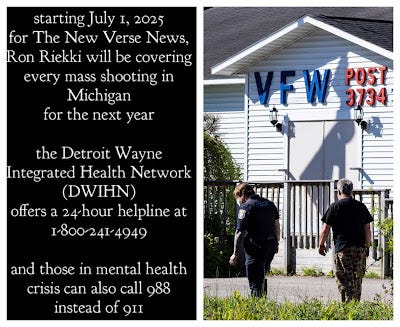
Ron Riekki has covered every mass shooting in Michigan since July 2025 for The New Verse News.


The Detroit Wayne Integrated Health Network offers a 24-hour helpline at 1-800-241-4949.


And those in a mental health crisis can call 988 instead of 911.


“With my ear to the door

of my cell.  And my want

like a comb in my hair.”

—Jane Huffman,

“Failed Sestina”


“I’m sure as heat,

as surety.

The bleed”

—Jane Huffman,

“Surety”


“Police say there is no ongoing threat to the public.”

Are you kidding me?  Michigan has had more than

100 mass shootings since 2020.  You don’t think it’s

an ongoing threat?!  I can’t imagine a more ongoing


threat to the public.  It’s another family annihilation.

Yes, another family annihilation.  Another.  Another

family.  Another family annihilated.  Anti-Christed,

hated, non-mothered, to not, knotted, no other Tues-


days, shooter unsteady.  When you search “Livonia”

on the Poetry Foundation website, it says “0 results.”

When you search “Livonia” on the Gun Violence

Archive website, you get 31 results since 2014—


31 shootings here since 2014.  Only one of them a mass

shooting.  I’m at the mass shooting.  The house, small.

The houses nearby, small.  A small man sits on a small

porch, a tiny porch, broken wooden rails, his skin also


broken so that I ask what’s wrong, bandages on both

arms, the look like previous bleeding, bruises, purpura,

petechiae.  The feel of peripeteia, bathos, pathos, cath-

arsis, anagnorisis, a chorus of country music cranked


in some a--holes truck parked mid-street, blocking traffic,

the guy getting out, going to the memorial in front of

the house, standing there, staring at it, has enough, goes

back to his truck and then squeals the tires loooong with


the truck in park, attention-seeking, angry, this hyper-mask,

this loudness, this performativity, and then he floors it,

truck swerving, almost hitting cars on the side of the road,

and he’s gone.  I talk to Doug, a neighbor two doors down


from the mass shooting.  So many of these guys who live

near the mass shootings I go to look like pirates—sea-salt

skin, Blackbeard-types with white beards, beer-belly skinny.

Doug tells me his last name and, swear to God, he actually


has the same last name as a famous pirate, a 1600s buccaneer.

He smokes, looking like a survivor, tells me that on Tuesday,

the day of the mass murders, he was in the backyard with

the family that was killed, helping them set up a pool.  I say,


“A pool.  And then it becomes a pool of blood.”  Doug says

in a voice that combines hip-hop’s Drake and outlaw pirate

Sir Francis Drake, “I should kick you in the shins.”  He’s not

joking.  He tells me of seeing the corpse of the mother killed


by the shooter, tells me the shooting happened at 5 p.m.-some-

thing, but the bodies weren’t taken out until 11:30 p.m.-ish.

Why would they leave the bodies there for that long?

Fingerprints, detectives, a cop telling him, “This is a crime


scene,” Doug staying on his property.  And the cop cars.

Cop car after cop car.  No place to park.  He points to a car

on the street, says, “That’s Sterling’s car.”  58-year-old.

The father.  Shot and killed by his son who shot his mother,


his brother, and his brother’s girlfriend.  Doug tells me that

they’re slowly towing their cars away.  I never thought of

the cars.  How the owners are all dead.  Something I’d never

even think of.  He tells me how long it took them to take


the bodies away, how long it’s taking them to tow the cars.

Doug wears an ALICE’S RESTAURANT WOODSIDE

CALIFORNIA T-shirt, black-and-white.  It’s a black-and-

white neighborhood.  The shooter, white.  Family, white.


All dead.  The killer looking dead in news video footage of

him in front of the judge who denied him bail.  A face that,

honestly, the first time I saw it, I thought of severe substance

abuse disorder.  A face that made me think of abuse, and of


disorder.  Doug pulls his shirt out like pro basketball players

do after scoring a critical basket, says, “Guthrie,” proud,

a song about cops, about crime, the longest song I’ve ever

heard.  Doug tells me of his wife calling him, telling him


she heard gunshots.  Doug telling her to hide in the bath-

tub if it continues.  The song has the lyrics of kill kill kill

kill.  Such strange lyrics.  Such a strange life.  Telling your

wife to hide in a bathtub if the gunshots continue.  Doug


tells me the mass shooter “didn’t talk much,” was “quiet,”

but “I’d joke with him every once in a while,” like yelling

at him to “buy me a Slurpee!”  Doug tells me the mother

planted flowers.  It’s the exact same talk as the last family


annihilation I went to, the neighbor in Grand Rapids telling

me about the woman’s love of gardening.  These mass

shooters are killing women who love to garden.  I can’t

imagine anything more peaceful, more grounded, paired


with such horror.  This life makes no sense, because of all

the death.  That pairing.  Doug says, it “seemed like a normal

day,” the day of the mass murders.  He tells me no bullets

came towards his home.  The killer used a semiautomatic


rifle, shoots five to thirty rounds with up to five bullets per

second.  You can kill five people in one second with a semi-

automatic rifle.  Who would own that?  Online, it says semi-

automatic rifles are for “hunting, sport shooting, self-defense,”


and, apparently, for mass shootings.  They forget to mention it.

I’m going to be honest: Fuck the NRA.  That’s my one

curse word I’ll allow.  The three-letter curse word: NRA.

The nonrandomness of these shootings, how repetitive


they are, automatic, unraveling daily, nonrational, enraging,

the pain they cause unratable.  Sunrays hit the house, punch

our skin.  Doug tells me he’s on blood-thinners, the reason

for his contusions, his arms covered in red, blue, purple,


green, yellow discolorations.  Semiautomatic rifles were

invented by a German, were used by the Nazis in WWII.

The killer’s last name is Pierce: to make a hole or opening

in.  Perforate.  Penetrate.  The penitentiary awaits.


I remember when I worked in the prison system, an inmate

in there who was doing back-to-back-to-back life sentences—

he would have to die, get resurrected, die again, resurrect,

and then die again, and then he could get out on his fourth


life.  I think of the 1.7 million men in prison in the U.S.

The prison system is hungry for angry men.  Its stomach

aches for angry men.  It’s “nearly impossible” for men

to get into therapy—the cost, the therapists who work


Monday through Friday from 9 a.m. to 5 p.m. and don’t

realize that’s when people work, that they can’t go to

therapy if you schedule your hours for when they work,

the therapists who “refuse to see men,” the stigma, markets


of anger, the MMA marketing, the UFC marketing, WWE,

the road-rage retaliation that’s stuffed into men’s brains, how

boring it is, how polluted.  Doug tells me the shooter killed

his brother in his bedroom, his brother’s girlfriend the same


bedroom, killed his parents in their backyard, Doug realizing

the mother was dead because she’d “been there for an hour

and a half,” lying there, motionless, when he saw her, the body

in the sun, the body “on the patio.”  Doug tells me “Tuesday


night, I prayed and cried and cried and prayed,” that he “did

not sleep well.”  He tells me it took “two days” for their “cat

to come out of the basement.”  The shooter even shot one

of the dogs in the leg.  Doug says, “I didn’t know he got


any guns in the house.”  I ask Doug if he has a gun.  “No,

my wife won’t let me.”  I ask him if his wife won’t let him

because so many guns, I find, are used to kill the partner.

It seems there’s nothing safer than ensuring there are no


guns at all in a home.  I talked to a therapist who told me

that gun ownership is a sign of mental health disorder,

another therapist who told me how often you find that

those with substance use disorders are gun owners, as if


they go hand-in-hand.  If I was married to someone, I think

the first thing I’d do is throw out any guns in the home,

because I’d prefer not to be shot.  But that’s just me.

I want to tell Doug that his wife is smart, brilliant.


I ask Doug what needs to happen to improve things.  He says,

“The yahoo in the White House, he doesn’t do anything

about gun control,” adds, “I don’t even like saying his name.”

Doug tells me he’d own a gun though, if it wasn’t for his wife.


Why?  “Protection.”  He says the problem is “alpha males,

macho males,” says the answer is if we “cut the trigger finger

off” of these mass shooters, takes his free hand and acts like

he’s holding a saw, his finger sticking out, pretending he’s


invisibly sawing off his finger, adds, “background checks”

would help.  I tell him the mass shooter had no criminal

background, no reported mental health issues.  At least

that’s what the news reports.  I see a neighbor pull up,


lives in the house right next to the mass shooting.  I go

over.  The guy reminds me of Ichabod Crane, how I

imagined him when I read the story.  He’s nervous,

visibly, very.  We talk.  He’s guarded.  A full family


was murdered feet from where we’re standing.  Even

his dog in the window looks scared.  I say this to him.

I asked if he talked to the shooter.  Yes.  I ask what

he was like.  He starts to tell me, then backtracks.


He’s jittery.  He tells me not to put that, tells me

to put he was “nice,” that the mass shooter was

always “nice.”  He repeats the word “nice.”  He

doesn’t want me to put what he was originally


going to say, except I don’t know what he was

going to originally say, just that now he wants me

to put that the killer was “nice,” and I have this

revelation—all these times I’ve seen the news


where neighbors, friends, family of the mass

murderer gets asked to describe the killer, they

always say something like that, that he was “nice”

and I realize now, for the first time, that it’s B.S.


He’s saying the killer was nice, because he’s nervous,

noticeably, almost exaggeratedly, a definite PTSD, eyes

darting, restless.  He doesn’t want me putting anything

down that might make the killer pissed off, a killer who,


I remind him, will most likely be doing life in prison

with no parole.  He tells me his name, but I tell him

I can use a nickname, but he says, no, I can use his

name, but I won’t, simply because of all sixteen mass


shootings I’ve gone to, I can tell he’s really honestly

fearing for his life from this guy who’ll probably be

incarcerated forever, but I understand.  It’s right next

to his home, his dog in the window, anxious for him


to go inside, his dog having heard the gunshots.  Can

dogs have PTSD?  Hell yes.  My parents owned a rescue

dog and that thing was more hypervigilant than an ex-

Marine.  I walk over to the memorial in front of the house.


I notice the neighbor watching me.  He mentioned that

he’s in therapy.  I think, Good.  I wish more men would

get into therapy.  I wish more men weren’t seduced by

the small-penis pseudo-cure of gun ownership.  I wish


more men were actually like Ichabod Crane and less

Headless Horseman—brainless, violent, ghoulish; I think

of the Hell that awaits the mass murderer, what happens

in prison, the sons in there, the poison of prison, the way


you pay and pay and pay and pay, an inmate one time

telling me that he taped books to his chest when he slept

at night, worried about being stabbed in his sleep, another

inmate telling me he didn’t go to the chapel because so


many men were raped in there, and I remember this row

of toilets, toilet after toilet after toilet that you’d see

through the glass, on the way with the walk to the chapel

and how all these men would be sitting, shitting, in full


sight, no privacy, and the chapel in back, a guard taking me,

and this intricate Jesus Christ depiction, incredible, detailed,

even expensive looking, carved, careful, Jesus with so much

blood on his wrists.  So much.  I kept staring at all the blood.


Ron Riekki co-edited Undocumented: Great Lakes Poets Laureate on Social Justice. 

Friday, June 05, 2026

MASS SHOOTING #14


VFW, 5200 block of Airline Road, Muskegon, MI, May 9, 2026 


“‘They’re shooting at the VFW!’ 911 calls detail chaotic scene at after-prom party.” —MLive, May 27, 2026


by Ron Riekki


“If I can reach at least one, then I’m doing my part.”

—Ebony Davis (Gemini DaPoet)


“They that have the power to hurt”

—William Shakespeare, sonnet XCIV


            i: Prescription

 
We need to cure this
goddamn gun disease.

 
            ii: Script
 
It’s the day after Memorial Day.  I’m so rural
the GPS seems confused, isn’t even sure what its three letters stand for.  I finally find
the mass shooting site—sad, hid, and all x’ed; it’s an old
building that reminds me of a bar in my hometown
 
when I was a boy, a bar my Grandpa buried himself inside, weekly;
it’s a VFW, has an axe-colored roof/awn, and its bin that’s a 
Boy Scout of America Troop 1023 U.S. Flag
Retirement Box
.  Across the street, a bed of
 
thick green, a feel like Eve and Adam, of no one
at all in this world, just a bug, a bee, a fly.  Not a dog, not a cow,
not a doe, not an elk, not a car
all day but mine.  Instead, as far as I can see, an eon of elm, fir, oak, ash.  Views I remember from my youth doing XC (cross-country).  It’s May.  The cry of sky, this place cut
 
by violence, the 911 call, an after-prom party,
police arriving just after midnight, on Mothers’ Day.  4 shot, 2 hit by the car, found by a cop lying in the street, “unresponsive” per police scanner, “multiple people down,” “patient in the road,” “30 to 40 shots” fired per audio, a 17-year-old girl “run over,” now in rehabilitation and “can’t walk” per FOX 17, and—fat chaos like grawlix—
a college football player named “Piggee” hit, now on crutches, “severed tendons” per WOODTV news, hit by the vehicle, tried to hop to the side to get away, but hit mid-air.
The calls of “GSW,” “GSW.”  Gunshot wounds.  “All vehicles” called.  Four shots.  E.R.
 
IV fluid resuscitation, x-ray, keep the patient warm.  Direct pressure.  The only way to stop the bleeding.
Just like politics.  How you have to put on direct pressure.
Sometimes, maybe often, too often, it feels we don’t even try to improve this world.
Crush injuries.  A vacuum effect at the point of entry, where debris
 
like bacteria, clothing, anything can enter the body, along with the bullet.
Bullets.  On parade.
Then the bullet ricocheting around inside the body, off bones, or,
if high-powered,
 
through bones,
if not, going in any direction, hitting lung, bone, vein, pons, nose, foot, guts.  Skin.  Hair.
And exit wounds larger than the entrance, spurting blood, arteries
that can spurt a foot-and-a-half, blood gushing in rhythm with the heartbeat,
 
children’s heartbeat, here, teens’ heartbeats,
there, at the prom after-party.
Red.
Kid.
 
Blood on dresses, on walls, on hands, on the floor, on the parking lot.
This mix of arterial bright red, venous dark red, capillary darker red.
Children’s blood.  We’re talking about children’s goddamn rushing blood.
I remember a paramedic telling me that when you see blood on the ground,
 
you’re seeing oxygen.  A pool of oxygen.  Hemoglobin transports oxygen.
Blood transports oxygen.  That’s oxygen all over the dress, wall, hand, floor, lot.
A lot.  They transport the children to the hospital.  Teens.  Tens.  Hundreds.  Thousands.
More than 17,000 children are shot in the U.S. every year.  Every year.  Every.  000!
 
This is America, guns
—Childish Gambino.
go, go away
I stand there.  At the VFW.
 
In the sky, the dot of sun like a fire-
arm pointed at my eye.  I think
of the 1,000 people shot in Michigan in the last year
and where they were shot—in the hip, the ear,
 
the jaw, arm, toe.
R.I.P. posts.  Mom and
Dad sob, not a dry eye.
To die.
 
Thinking I need to eat, get something to drink.  Gin.
You know, I remember this loop I got into when I was
trying to learn the Hamlet to-be-or-not-to-be speech when I was
young:
 
To be, or not to be, that is the question:
Whether 'tis nobler in the mind to suffer
The slings and arrows of outrageous fortune,
Or to take arms against a sea of troubles
And by opposing end them. To die—to sleep,
No more; and by a sleep to say we end
The heart-ache and the thousand natural shocks
That flesh is heir to: 'tis a consummation
Devoutly to be wish'd. To die, to sleep
No more; and by a sleep to say we end
The heart-ache and the thousand natural shocks
That flesh is heir to: 'tis a consummation
Devoutly to be wish'd. To die, to sleep
No more; and by a sleep to say we end

 
And it is a loop—violence.  And I didn’t
have the text, wondered what I was doing
wrong, or if those words did, in fact, keep
going for infinity.  Imagine the actor on-
 
stage, trapped in that soliloquy, for hours,
for years, forever, talking about suicide
ideation.  To be or not to be or to be or not to be or to be or not to be or to be or . . .
All of this because of the four-letter word: guns.
 
There’s no one here to talk to.  Too rural.
Even the wind is absent.  I stare at the VFW.
When I go into buildings for the first time,
I honestly look for first-aid kit, the AED,
 
I once asked a stewardess where the AEDs were on the plane
and she treated me like a terrorist, asked why I’d want to know.
I couldn’t get the EMT out of my system.  She told me they’re
located both front and back, but, still, the whole time she acted
 
like I was Isis.  People are suspicious.  I went to a series of offices
at U of M to talk about the ten sexual assaults that happen
per month on campus, and the lack of mental health care
for students.  It was the same treatment, like I was vile,
 
as if the goal is no ally.  I keep asking why there’s so much
gun violence, and the solutions, everywhere I’ve gone, all of
these mass shootings in the last eleven months in Michigan
in order: in Flint, in Detroit, in Saginaw, in Kalamazoo,
 
in Grand Blanc, in Highland Park, in Saginaw again, in
Muskegon, in Flint again, in Detroit again, and in Detroit
again, in Jackson, in Grand Rapids, now in Muskegon again,
innocent children, innocent women, innocent men, talking
 
with me intensely in stores, in tents, in the streets, in early-night
dusk.  But what stands out is walking, then talking in Detroit,
taking my time talking to a group of black men where when
I asked about the root of the problem stunned me by saying
 
it’s childhood sexual trauma.  I couldn’t even believe
the honesty.  I kept that conversation going after leaving.  Searched.
Researched.  Found that one of three men have experienced sexual violence.
Why was this never mentioned once in my life before?
 
And worse, I talked to guy after guy after guy who couldn’t
get into therapy.  Especially veterans.  The wait list.  They’d
call and it would be wait list.  They’d try the V.A.: wait list.
They’ll call out in town: wait list.  How long would the wait
 
list be?  “We don’t know.”  I tried myself.  I called, literally,
more than thirty phone numbers listed online.  Easily more.
The answer: wait list.  Or “we don’t work with vets.”  And
one therapist who said that veterans are “too dangerous,”
 
that she has no problem “calling the police” on them, if she
“has to.”  I asked what she meant.  She said that they can get out
of line.  Except she doesn’t work with them.  ?  I asked if she does.
No, she said, but she’d work with the “level one veterans.”
 
I asked what that was.  She said level two and level three
veterans have too much trauma, so she only works with
level one vets.  The ones who are asymptomatic.
She’s really good, apparently, at working with
 
asymptomatic patients.  If you have absolutely no
mental health problems, she’s a phenomenal therapist.
Others pushed telehealth on me.  The majority did.
The therapists want to do therapy in their slippers.
 
The problem: telehealth is shit for complex PTSD.
It’s wonderful for minimal trauma, or no trauma,
but someone with childhood sexual trauma or
military sexual trauma or any sexual trauma
 
isn’t going to feel the most comfortable talking
on a computer, which can easily be hacked.
A friend of mine told me he can hack into any
email.  “Any.”  I asked how.  He said, “It’s easy.”
 
Easy.  Ease.  When I started to get into the thirties
for the calls, therapist office after therapist office
telling me that they had no availability, I realized
how brutal it is to get mental health care, and
 
that’s even when you have the money.  How
impossible it is to get in.  But how incredibly
easy it is to get cannabis in this town, to get
alcohol, all the people I talked to in Muskegon,
 
Flint, Detroit, telling me how simple it is to get
a gun, but how BRUTAL it is to get mental health
care.  The people on the other end of the phone
would actually laugh when I asked if they had
 
any availability.  One therapist told me she could
get me in, but I had to agree that she could video-
tape record all of my sessions.  Again, wonderful
if you have no trauma, if you want therapy due
 
to getting a D on your last report card, but if you
wanted to talk about the insane trauma that’s
so frequent in this world, especially trauma
that is hard to talk about at all, let alone with
 
a camera pointed at your face . . . When I refused,
therapist told me, “The camera on my laptop
won’t kill you.”  I felt this rage of adrenaline
through my body at how little she could under-
 
stand.  I started to tell her that computers can
be part of the trauma, told her that there are
things like cyberbullying and online human
trafficking and veterans who were forced to do
 
drone strikes, that computers in the military
can kill, that it’s—but she talked over me,
told me it was her rule, that it’s an absolute.
Of course, it’s a rule she’s making up.  Of
 
course, she doesn’t have to videotape us.
Of course not.  She hung up.  I think of the 22
veterans per day that kill themselves, hang
themselves, shoot themselves.  And then I thought
 
of the veterans who shoot others.  I wonder how
many of them were denied care.  I wonder how
many times they tried.  I wonder if people laughed
at them when they called and were told about
 
the wait list.  The wait list is just a wait list.
The wait list doesn’t factor in the level of trauma
of the person.  The wait list doesn’t look for
the factors of having parents with substance abuse
 
or your own history of substance abuse or if
you are a survivor of abuse or anything about
abuse.  It’s just a wait list.  They told me I could
always get emergency crisis help, that you can go
 
to the hospital, check yourself in.  They didn’t mention
what others have mentioned to me, which is that
the E.R. puts you on hold in an empty treatment bay,
a bay meant to drown you in waiting.  I did this once.
 
The wait was like ten hours before the EMTs ever came.
Then, once they came, they tied me to the gurney.
Did they need to?  No.  Was I compliant?  Yes.
I was depressed.  I wanted help.  Tied to the gurney,
 
there was nothing I could do on the ride to the psych ward
with the EMTs on the way making fun of me, complaining
about me, saying to me that the “suicidal” “waste” their “time,”
giving me a sick nickname I won’t repeat here, but one where
 
I wish my hands had been free, the total lack of ethics on their part,
the wish to wash my hands of that memory that got worse: when I arrived
to the ward where they gave me a bed, lying down on mattress in the dark
to find that it was covered in piss.  Piss on my face, chest,
 
arms, legs.  I could smell it, felt it, got up, turned the light on
fast, saw it, went to the front desk worker and told him
and he didn’t believe me, went to the bed, realized it was true,
told me he’d give me another bed.  I said I needed to shower.
 
He said I couldn’t.  It was after hours.  Said I could in the morning.
I was covered in someone’s piss.  I begged him.  He said
there were rules, that he didn’t make the rules.  I’d just been
mocked for the entire ride there, and I remember that smell
 
all over my face, my body, standing in a hallway, begging
this man to let me shower, begging him, pleading.  Please.
I’d went to them for help.
No, I told the woman on the phone, no, I’d rather die
 
than go back there.  I worry there is an underestimation
of the violence done to men.  I remember talking with
some women, fellow writers, at a sports bar after workshop
and the conversation got to violence against women, so I thought
 
I’d shut up, lean back, listen, and when I removed myself,
observed, I realize this passionate conversation, their disgust
at violence directed at women, but, leaning back, I saw
all of these TV sets on the walls, dozens, all over the bar,
 
and on the screen, these two men, two boxers, just beating
the hell out of each other, blood, blood, and the bar exploding
into applause at this, and the absence of recognition of this,
as it was sport, fun, ignored, or, no, not ignored, but explored,
 
applauded, worshiped.  I wonder, sometimes, if the way
we reduce violence against women is to reduce violence
against men.  The link.  I know I’m not allowed to say that.
But I don’t care.  Meaning I care deeply.  I think it’s helpful
 
to say it.  If a woman ever says she was abused, believe her.
A hundred percent.  But the system is set up where men
can’t bring it up.  Men have told me of finally opening up,
talking about their sexual abuse in therapy and the therapist
 
silent, listening, the man bawling, getting the story out,
and as soon as he’s done, being asked, “Did you do that
to anyone?”  Where men can only be seen as abusers.
Never as victims (even when they are).  I’ve heard stories
 
of men bringing up sexual trauma and the therapist ignoring it
or him hinting at it and the therapist missing the hint.
Or of calling the RAINN hotline (the Rape, Abuse, &
Incest National Network) and being hung up on, being
 
told it’s not for men, being told they should call a different
number (then given that number to only find out it doesn’t
exist or there’s no answer).  T. Charles Brantley on
the Men Need Love Too podcast with Kat Anna
 
talks about how “3/4 of all suicides are men, and I think
sexual abuse is the reason.”  I worry that abused men
who can’t get mental health care turn to drugs, alcohol,
cannabis, porn, gambling, turn to trauma repetition where
 
they don’t heal, can’t heal.  Instead they drown.  Where
the incarceration system is thirsty for their bodies.
The estimate is that one million men have been sexually
abused in the prison system in the last decade.
 
And that’s the system where we send people with trauma.
To create more trauma.  And the estimate is that one million
men have been sexually abused in the military in the last
decade.  There’s more than 100,000 veterans in prison.
 
I’m worried we’ve created a silent system of sexual violence
against men and that silent system, because of its silence,
is the catalyst, the center for violence against women.
When I worked with survivors of torture, I found that
 
there are four global torture systems: police brutality,
incarceration, gangs, and the military.  Those are the four
systems that practice torture globally.  And more than 150
countries practice torture.  The wealthier countries, in
 
particular.  Police, prison, gangs, wars—that’s the torture
system.  And more than 90% of police brutality happens
to men.  More than 90% of those incarcerated are men.
More than 90% of gang members are men.  More than 90%
 
of veterans are men.  And I never hear about sexual violence
against men.  It’s silenced in the way that torture silences.
It’s silenced in the way that death silences.  Therapy
offices need to start having more accountability.
 
I know therapists who can’t get referrals, who can’t
survive financially, the therapy offices understaffed,
under-paying, and under-trained for trauma, author Mic
Hunter in Abused Boys stating that 95% of therapists
 
say they do not have enough training in sexual trauma,
and for male clients, it can be no training.  At all.  But, yet,
we have astounding ease of access to porn, to drugs, to alcohol,
to guns.                                                                       #$%&!
 
 
            iii: Postscript: they can’t kill words

 
To repeat: We need to cure this goddamn gun disease.
I’m not holding back, because I have nothing to lose.
I have no kids, no significant other.  I have this body.
I have a voice.  Like Alex Honnold, my amygdala gone
from being in two branches of the U.S. military,
from working on ambulances, working in the prison
system.  It’s impossible to get a creative writing gig.
I’d rather give my life to writing, rather than quit.
I challenge the poets out there: go to the events in
your city and cover them like journalists.  Don’t hide.
Write.  But don’t just observe the news; get deep inside
the news.  Write from that perspective.  Force your way in.
 I respect poets.  I respect you.  Now, Jesus Christ,
 get deep into this madness and give us your voice.
 
 
Ron Riekki co-edited Undocumented: Great Lakes Poets Laureate on Social Justice.