Guidelines


Submission Guidelines: Send 1-3 unpublished poems in the body of an email (NO ATTACHMENTS) to nvneditor[at]gmail.com. No simultaneous submissions. Use "Verse News Submission" as the subject line. Send a brief bio. No payment. Authors retain all rights after 1st-time appearance here. Scroll down the right sidebar for the fine print.
Showing posts with label ash. Show all posts

Wednesday, May 13, 2026

ABOUT LOVE

by Ryan Caidic
 
 
Nearly 200,000 people in 124 villages in the northeastern Philippines were affected and over 5,400 fled massive plumes of ash that billowed from Mayon volcano over the weekend due to the collapse of lava deposits from its slopes, officials said Monday. —AP, May 4, 2026

Mayon is the most active volcano in the Philippines, erupting over 52 times in the past 500 years... Its most destructive recorded eruption occurred on February 1, 1814. The volcano belched dark ash and eventually bombarded the town of Cagsawa [where] about 1,200 locals perished in what is considered to be the most lethal eruption in Mayon's history. —Wikipedia


We live in the time of ash and awe,

where the bell tower of a ruined

cathedral frames the perfect dome


its crater glow combusting in pallid

pyroclastic smoke, thousands have fled

its strombolian show


of affection, amid the terrible beauty

engulfing kilometers of sky and city

under siege of nature’s desire


to shape itself, they say that Mayon

was the womb that rose from the burial

tomb of lovers Magayon and Panganoron


passion in the form of fire turned crust

then magma, then igneous stone

then lava, then a quiet, then rage,


then warmth, then grief, then ash again—

layers that unravel histories, unpredictable

yet predictable all the same.


Those who were burned have forgotten

relocating closer to the pulse

where the fire of Ibalon resides.


That’s the theology of love.

To be close enough to feel the rumble

of a molten heart, to be in the shadow


of its ending, and to exist,

every time a little more consumed

by its divine ravishing of flame.  


Ryan Caidic is a Filipino poet and advertising creative living in Denmark. His poetry has appeared or is forthcoming in The Columbia Review, The Missouri Review, Southeast Review, Apricity, Poetry Wales, and elsewhere, and has been highly commended by the Bridport Prize and Munster Literature Center.  

Saturday, February 21, 2026

THE STRANDED CITY

by Iman Oshani
 
 
Tehran skyline at sunset, with the city's iconic Milad Tower rising in the distance, January 2026 —Iran International

 
The smell of gunpowder
lingers for a lifetime.
And in this land,
the snow migrated last year.
Car washes are shut down,
and cars won't move under the weight of ash.

Houses are drained of commotion.
The bedroom.
A large bed.
Sheets neatly made, but gathering dust.
The desk clock faces the wall.
And on the floor,
lies the only corpse: a fly.

The phone will not ring.
The TV is locked on the news.
And behind the window, there is no view...
except
a dog walking by,
sniffing the holes in the buildings.


Iman Oshani is an Iranian writer and poet based in Tehran. His work explores the surreal intersections of memory, objects, and the geography of crisis.

Tuesday, December 09, 2025

ICE

a Golden Shovel
after Adrienne Rich's  What Kind of Times Are These

by Nancy Sobanik


"We support our neighbors and we will stand with our neighbors," Leslie Carlson, a protester, said.


We are born suffused with stardust, not this
armload of crumbling charcoal. Hate isn’t
underground, it feeds on oxygen. A
tinderbox of words erupts like Russian
folk dancers. How quickly a poem
turns to men in black balaclavas. This
is our warning. Fire needs no wind, it is
fed by the pause. The wisp and spark not
stamped, and mouths bare their teeth. Somewhere
another will smother the burning, why else
would we let fire taste our own door?
But—
think of ash, think of diamonds. Grow them here.


A poet and Registered Nurse living in Maine, Nancy Sobanik (her/she) has recent work curated or forthcoming by The Orchards Poetry Journal, Mobius, Chiron Review, Jackdaw Review, Hole in The Head Review and others. A Best of The Net and Pushcart nominee, she is a three-time finalist awarded second and third place in the Maine Postmark Poetry Contest.  A manuscript screener for Alice James Books, her debut chapbook “The Unfolding”will be published by Finishing Line Press in 2026. Bluesky:
nancysobanik.bsky.social

Thursday, May 22, 2025

EMPTY SPACES

by Adam Bagdasarian


AI-generated graphic by Shutterstock for The New Verse News.


There is no pill or drink for this
No pill for the rubble of home
for the dust of flesh
the ash of bone

No drink for the season-less years—
for the trees, for the water
the sunlight one cannot feel
or the empty plate of the evening meal

Each new day comes D.O.A.
rewound, somehow and replayed
rewound and played
rewound, replayed


Adam Bagdasarian’s Forgotten Fire was a finalist for the 2000 National Book Award. In 2002,  First French Kiss and Other Traumas was a finalist for the ALA Top Ten Best Books for Young Adults.

Tuesday, January 28, 2025

HEALTH ALERT BULLETIN CONCERNING CAPITOL CLIMATE CHANGE

by Lynne Barnes


AI-generated graphic by NightCafé for The New Verse News.


Be advised:
 
Now is a time of high stress.
It’s in the air like smoke and ash.
You must mask while you’re out
and get inside as soon as you can.
 
Get inside circles of humans who see, know
who you are, circles of people who allow you
to share your emotions and thoughts.
 
Sharing inside circles of trust
can boost your immune system,
help neutralize the pollution
of this air we are breathing now,
 
air hazy with particulate matter of fear
that has come upon us suddenly
in this last half of
the month of January, 2025.
 
Take care.


Lynne Barnes is a retired psychiatric nurse and librarian who has lived in San Francisco since 1969. Her poetry memoir, Falling into Flowers (Blue Light Press, 2017) was a finalist for the 2018 Eric Hoffer Book Award.

Tuesday, January 21, 2025

RED FLAG

by Pepper Trail


This is the way now, the night helicopters orange-bellied from the flames, swallowing mouthfuls of ocean, dropping salt on the mansions, bungalows, trailers, the streets running wild with molten metal, airburst of exploding eucalyptus, every TV speaking wisely, hysterically of ember fall, windspeed, perimeters, acres, percents, containment, containment, containment, canyons, freeways, the survivors somehow calm, brave beside the ruins, char and ash, the scorched tricycle on its side, the bewildered chimneys of the cul-de-sacs, hell on earth you could say and not be wrong, the City of Angels twisting in the grasp of Santa Ana, beneath the red flags and this is the way now though maybe in your town it will be hurricane or tornado or flood or drought or heat unto death or maybe in some blessed places of sanctuary maybe only a tsunami of the desperate and displaced  but this is the everywhere now and we have made it so.


Pepper Trail is a poet and naturalist based in Ashland, Oregon. His poetry has appeared in Rattle, Atlanta Review, Spillway, Kyoto Journal, Cascadia Review, and other publications, and has been nominated for Pushcart and Best of the Net awards. His collection Cascade-Siskiyou was a finalist for the 2016 Oregon Book Award in Poetry.

Monday, January 13, 2025

THE UNNAMED FIRE

by Alejandro Escudé


Dozens of beachfront homes in Malibu were destroyed overnight in the Palisades Fire on Wednesday, Jan. 8, 2025 (Photo by David Crane, Los Angeles Daily News/SCNG)


The hills were there, lichen green, and I felt the small 

ferocious animals scurrying inside of it. The coyote ever-present, 

ready to pounce on the owners’ three Shih Tzu. Sometimes, we’d 

housesit, and I’d lounge on the front yard overlooking the Pacific Ocean. 

It was as if I could dip a toe in the sea from that cliff, the ruffled white curve

as it wound north toward Malibu, an emerald land too close to call distant.

Now that street has turned ash gray, only the outlines of the lots remain,

that same coast like the edge of a puddle of spilled black ink. I recognize

the people who were caught in their cars, cars that were later plowed

to make way for fire engines and ambulances. The wind spoke in vowels

the night before last across my humble balcony that faces those smoky hills.

The sudden clanks. Buffering curtains. The canyons siphoning destruction.

One could imagine the homes as graves. Ash-people holding on to one another.

In ancient times no machine could whisk them away to safety. A volcano

of wind, torrent of melted metal. What powers do the digital towers have?

What future awaits those of us who traverse this playground of film and filth

and indifference, negotiating the enchanted brutality of this hardened city? 

One can read the scroll of the flames; they speak a crackling language,

letters made of embers. It rages on, the unnamed fire, it wraps itself 

in the gales. A migration begins along an avenue of burning palm fronds.


Alejandro Escudé published his first full-length collection of poems My Earthbound Eye in September 2013. He holds a master’s degree in creative writing from UC Davis and teaches high school English. Originally from Argentina, Alejandro lives in Los Angeles with his wife and two children.


Friday, July 07, 2023

ONCE AGAIN, SMOKE

by JL Huffman


Once again, smoke from Canadian wildfires envelops many American cities —Medical Xpress, July 3, 2023


JL Huffman is a retired Trauma Surgeon/ICU doctor who has published three poetry books: Almanac: The Four Seasons (2020), Family Treasons (2021), and Voyage: Vista and Verse (2022). Her individual poems have appeared in The PharosThe Asahi Haikuist NetworkHaiku DialoguePoetry PeaCold Moon JournalThe Pan Haiku ReviewHaiku in ActionMeat for Tea: The Valley Review, and others. Twitter: @JoanHuffmanMD

Saturday, June 10, 2023

KINTSUGI

by Chris Reed


Kintsugi is the Japanese art or repairing broken pottery

with epoxy mixed with gold dust.

Cracks and repairs are not hidden but highlighted,

imperfections, part of an object’s life.


Sickly yellow lights the landscape,

like a room lit by an aging lampshade.

Great smoke plumes from Canadian forests,

blanket eastern farms, cities and shores,

swallow a line of green glittering trees

and a neighbor’s brown house

as if the fires are a mile,

and not a country away.


I taste ash on my tongue,

absorb smoke through sinuses,

and wonder about the birds, recently migrated

north across Lake Erie to nest,

On the deck, potted salmon-edged geraniums,

smaller blooms of pink and white,

and spikes of lavender, sit abjectly

in the aberrant light.


Rosemary and thyme rub against

each other in a blue pot with a gold seam.

My sister, the potter who shaped the planter,

repaired it in seven days,

mixing epoxy and resins with gold dust,

painting seams, fitting pieces together,

then aging the repaired pot in a large dark box. 

The trick, she said, is to know

that it is even more beautiful repaired.


Burnt ash in the air evokes memories

of not so distant atrocities and tragedies,

yet, seems a hairline fracture

in the ongoing dropping of our world.

Pillaging of nature, wars of aggression,

greed-driven power plays,

hate crimes and death-dealing viruses,

crack the thin ceramic of creation.

Lumpy veins of gold witness

our attempted repairs.


Is there room on this spiderweb

for another seam of gold. And how to start?

Epoxies of novenas and pilgrimages

don’t work anymore.

That god has picked up his play things. 

And even if we find the gold dust,

do we have a shoebox large enough?

And will we remember the trick?


Like others who live near or in the New York City area, Chris Reed was not only concerned about the extreme air quality conditions, but eerily reminded of the empty streets during the first year of Covid, and the indelible images of the air over New York after 9/11. Her poems have appeared in Blue Heron Review, US1 Worksheets, and The New Verse News.

Wednesday, March 01, 2023

A YEAR AFTER THE CARPENTER AND AN NPR JOURNALIST HUDDLE BESIDE A WOOD-BURNING FIRE IN LVIV

by Ellen Sazzman


Bohdan Kulik served in the Soviet military in the early 1980s in Moscow. He's done a bunch of odd jobs over the years since, he says, but in essence, he's a carpenter. He loves to make staircases. Photo by Ryan Kellman. —NPR, March 17, 2022


1

“My true love is building staircases,” the carpenter explains.  

“You must understand the difficulties of crafting a staircase.   

First the wood must be stained. Next...” The journalist 

interrupts, asks if the carpenter is worried about the war.    


The carpenter mans a checkpoint. Without a gun but with a crate 

of Molotov cocktails. His job: to stop cars, look for saboteurs.  

He pulls out his phone and shows videos of Russian destruction 

farther east in Kharkiv and Mariupol.  


The journalist asks again if the carpenter is worried.  

The carpenter chops kindling, feeds the stove, puts a kettle on.  

He offers coffee, says he’s 62, a pensioner. The carpenter repeats 

the importance of what goes into making a staircase:  


collecting accurate measurements, calculating the slope, installing 

risers, treads, handrails. The carpenter pulls out his phone once more, 

shares photos of staircases he has built. The journalist compliments

the staircases:  “They’re beautiful, but about the war?”    


2

After one year, a long nightmare, try to 

imagine the beauty of staircases, 

the smell of coffee, the warmth of a stove.  

Not the blood of suffering. Not the bombing.  

Not the decision to stay put  

despite what staircases are made for—  

scaling, leaving, fleeing 

through fumes and smoke, through 

a fine ash that still invades Lviv from the East 

and shrouds all things with the salt 

of a terrible weeping before a mute god.  

Pray there is dust enough

to re-make wild birds and beasts, 

to re-form woman and man, to re-plant.


Ellen Sazzman is a Pushcart-nominated poet whose work has been recently published in Peregrine, Delmarva Review, Another Chicago Magazine, PANK, Connecticut River Review, Ekphrastic Review, Sow’s Ear, Lilith, Moment, Common Ground, and CALYX, among others. Her collection The Shomer was selected as a finalist for the 2020 Blue Lynx Prize and a semifinalist for the 2020 Elixir Antivenom Award and the 2019 Codhill Press Poetry Award.

Wednesday, September 14, 2022

FIRE SEASON

by Laton Carter


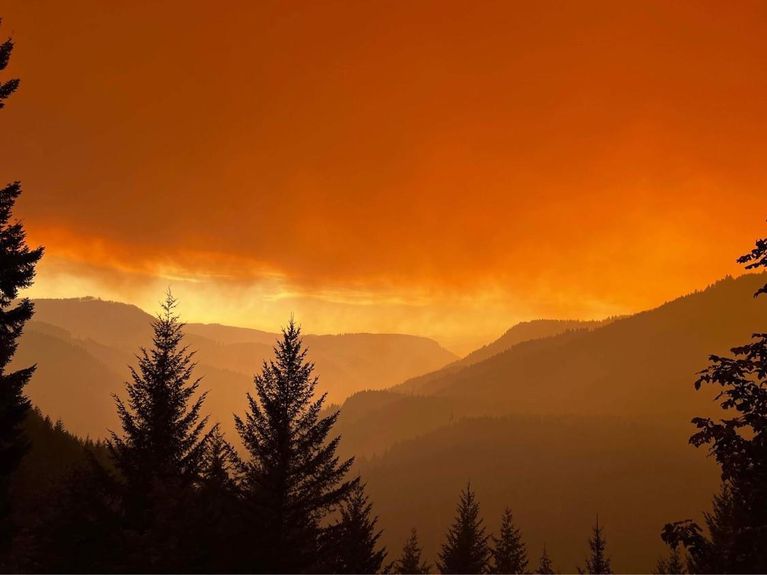
Smoke turns the morning light orange on Saturday in this photo taken near the Huckleberry Lookout, provided by the Cedar Creek Fire Incident Command. Credit: Cedar Creek Fire Incident Command via InciWeb and OPB, September 12, 2022


It is not that fire is snow. It is not even
that falling ash is snow. The sky
 
is stunned, swallowed
by a yellow glove whose palm
 
opens to haze and drifting filament. Burned
bodies, trees that pursed their mouths, that
 
refused to gasp or cry, handrails that melted, that
obeyed the persistence of time, they are
 
floating. (Floating only appears directionless.)
Summer is winter. Hold up your hand. In winter
 
no one answers. It is not that snow
is winter. Breathe in. Your lips, your throat,
 
your lungs. Prepare yourself.
Floating is not a weightless task.
 
Crucible,
blind pilot, un-
yielding conflagration.


Laton Carter's Leaving (University of Chicago Press) received the Oregon Book Award. His writing also appears in Indiana Review, Narrative, and Split Lip Magazine.

Wednesday, August 03, 2022

DROUGHT SONG OF THE ELEPHANTS

by Orel Protopopescu


We lumber along and sway  
closer to death, stirring dust
like the skirts of the women
eternally searching for water, 
jugs on their heads, 
their children like bundles
of sticks on their backs.
 
We are searching for water,
but keep finding death
in the soot of the grasses 
that once waved to us.
Who took the rain clouds, 
the green from the trees? 
We walk a parched path
where leaves crack and fall
 like birds from the sky.  
            
We remember the pools,
the pools where we played
before days dried in blood
left a burnt orange haze
of dust in our eyes. 
What drives us, who hunts us, 
what beast made of heat?
 
With the children like sticks
we keep drinking the dust.
We drink and they drink
until tongues turn to ash
and milky eyes close.
 
And now we’re forgetting
the clouds and the grasses,
the haze of the heat
with no name and no face.
We’re forgetting the children
who fell on this path 
where our tongues turn to ash
and our clouded eyes close.


Orel Protopopescu has written prize-winning works for children and adults. She won the Oberon poetry prize in 2010 and 2020. Her first biography Dancing Past the Light: The Life of Tanaquil Le Clercq (University Press of Florida, 2021) received a starred review in Library Journal. 

Monday, July 25, 2022

THE WEST IS BURNING

by Steve Deutsch


On the rise above 

Route 80, by a trickle

that was once 

a river


I watch a line

of traffic

a thousand miles long 

going nowhere.


The road has 

buckled and a semi

sits on its side

steam still boiling.


One by one

the cars and trucks

run out of gas—

dream irony


I suppose,


and people stand

beside their behemoths—

afraid at last.


The pine

and hemlock forest 

that lined the road

has turned


a sickly brown

and trees light up

like candlesticks

one by one.


Children fight

the fire

with blankets

and spit.


And the dust

and smoke 

and ash

make breathing


an occupation.

The west is burning

and few if any

will make it out.


I wake with a gasp—

heart escaping.

Smoke colors the moon

the west is burning.


Steve Deutsch has been widely published both on line and in print. Steve is a three time Pushcart Prize nominee. He is poetry editor for Centered Magazine. His poetry books: Perhaps You Can (2019), Persistence of Memory (2020),  and Going, Going, Gone (2021) were all published by Kelsay Press.