Guidelines


Submission Guidelines: Send 1-3 unpublished poems in the body of an email (NO ATTACHMENTS) to nvneditor[at]gmail.com. No simultaneous submissions. Use "Verse News Submission" as the subject line. Send a brief bio. No payment. Authors retain all rights after 1st-time appearance here. Scroll down the right sidebar for the fine print.
Showing posts with label crisis. Show all posts

Tuesday, June 17, 2025

ODE TO PROGRESS

by Tim Walker


Where are the mayflies of years past?
Or their descendants for that matter,
missed for many a May? But hey, at least
our windshield’s free of bug splatter.

Are night-blooming plants bereft of pollination
by moths confused by light pollution?
Praise be to LED lights, so productive,
we splurge on ever greater wattage!

And how does the little busy bee
keep up morale in its collapsing colony?
Being a social insect is overrated, vastly,
like being a seed-dispersing beasty.

The plants will learn to do without them.
We’re all tightening our belts. In the long run
we’ll concoct “honey” from sorghum
and petroleum byproducts, Amen.


Tim Walker read, for pleasure, the complete novels of Charles Dickens while earning a BA in Environmental Studies, and the complete novels of Anthony Trollope while earning a PhD in Geological Sciences, and has worked as a computer programmer, healthcare data analyst, used book seller, and pet sitter. He lives largely in his own head, while he corporeally resides in Santa Barbara with his son Dana and their cat Cassiopeia. His essays and poems most recently appeared in Harpy Hybrid Review, 3:AM, Fatal Flaw, Rock Salt Journal, and are forthcoming in Sneaker Wave Magazine and TYPO: The International Journal of Prototypes.

Sunday, March 17, 2024

AYITI, MA CHÈRIE

by Jerrice J. Baptiste


Le Nègre Marron


A long-simmering crisis over Haiti’s ability to govern itself, particularly after a series of natural disasters and an increasingly dire humanitarian emergency, has come to a head in the Caribbean nation, as its de facto president remains stranded in Puerto Rico and its people starve and live in fear of rampant violence. —NBC News, March 15, 2024


I long for sanctuaries of your forests.
Chirping bird—Hispaniolan Trogon.
Enduring name of long ago
La Perle des Antilles
Shimmering light.

I long for your full peasant skirts
flowing with countryside
breeze, where bare 
feet imprint
sand.

I long to be eating sizzling Fritaille 
griot, fried plantains, and pikliz 
of red & yellow hot bonnet 
peppers dancing 
in my belly.

I long for Krik-Krak from uncles. 
Stories told in backyards.
Laughter of familiar 
voices greeting
moonlight.

I long to bathe your infants 
in tranquil turquoise sea.
Dress your daughters
in white organza 
fabric.

I long for your Taino fathers
wearing red & indigo flags 
during carnival or Rara
dancing to Djembe 
rhythm.

I long for your Taino mothers 
Poto-Mitan, ivory backbone 
of our homes. Selling
clusters of quenepe
at street market.

I long for your white conch shell 
blown by bronze lips  
breaking chains.
Le Nègre 
Marron.


Jerrice J. Baptiste is an author of eight books and a poet in residence at the Prattsville Art Center & Residency in NY.  She is extensively published in journals and magazines such as Artemis Journal, The Yale Review, Mantis, Eco Theo Review, The Caribbean Writer, and many others. Jerrice has been nominated as Best of The Net by Blue Stem. She has been facilitating poetry workshops for eighteen years.

Sunday, November 27, 2022

FAR FROM HIM I WATCH A UKRAINIAN SURVIVOR ON THE NEWS

by Therése Halscheid


A man carries water bottles as he crosses a destroyed bridge in the frontline town of Bakhmut, in eastern Ukraine's Donetsk region, on Oct. 27, 2022, amid Russia's invasion of Ukraine. —VOA


He has stopped fearing the sirens, stopped running for shelter,
is now carrying a pail to a crater a Russian missile made.

The crater has filled with muddied water. 
You see him fetching a pail’s worth from the blown out earth.

See him lugging it along the road to Odessa, on the road to Odessa 
you see his back hunched, his legs barely hurrying. 

You do not see any other, only ruins and stacked tires
as well as anti-tank hedgehogs barricading the street.

I want to say to him: the wind knows your face.
It carries the look of others, it has knowledge, the wind does, 

and power enough to change his fate, want to share 
the wind is the bringer of things he cannot imagine 

it is the collector of thoughts and blows them
tirelessly about the world.

Want to say the air wears our collective consciousness
even if hardly anyone believes this can be. 

Whatever is given to the wind the wind willingly carries. 
I want to tell him: work with the wind. 

The softest touch is the finger of wind, feel its peace
at work, for it is our work, what we have been sending. 


Therése Halscheid's poetry and lyric essays have won awards and have been published in several magazines, among them The Gettysburg Review, Tampa Review, Sou’wester, South Loop. Her poetry collection Frozen Latitudes (Press 53) received an Eric Hoffer Book Award. Other collections include Uncommon Geography, Without Home, and a Pudding House Press Greatest Hits chapbook.

Tuesday, November 09, 2021

SPOTTED FROM SPACE

by Martin Elster


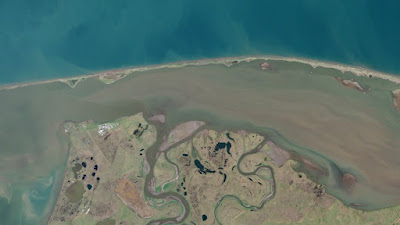
In recent satellite imagery captured by Planet, which operates the world's largest pack of Earth-observing satellites, large groups of walruses can be seen crowding Earth's coastlines, all the way from space. The image shows ambiguous, "distinctive red-brown" blobs decorating the Alaskan coastline. Previously, walruses would gather in groups of up to many thousands, called "haulouts," on Arctic sea ice far from the shore. But with sea ice melting at rapid speeds due to climate change, they have no choice but to gather on land. —Space.com, November 5, 2021


Thousands of walruses (called “haulouts”) gather
along Alaskan shores, spotted from space.
They’re resting ample bodies, but they’d rather
veg out on sea ice. Yet there’s not a trace
of frozen H2O. A satellite 
has taken photographs. How can they eat
or sleep now? Humans may create a fright.
Many will perish in their mad retreat,
tumbling en mass to the safety of the ocean.
Monitoring their populations might
show how, through climate change, they may persist.
Yet when at last they’re gone, will they be missed?
These mammals know this world is not all right.
These mammals know there is no magic potion.


Martin Elster, who never misses a beat, was for many years a percussionist with the Hartford Symphony Orchestra (now retired). He finds contentment in long woodland walks and writing poetry, often alluding to the creatures and plants he encounters. A full-length collection, Celestial Euphony, was published by Plum White Press in 2019.

Monday, August 09, 2021

GOODNIGHT EARTH

a cautionary tale, a cry from the heart,
by Buff Whitman-Bradley

after Goodnight Moon by Margaret Wise Brown


“Goodbye Earth” by Satovi at Deviant Art.


The fires, floods and extreme weather seen around the world in recent months are just a foretaste of what can be expected if global heating takes hold, scientists say, as the world’s leading authority on climate change prepares to warn of an imminent and dire risk to the global climate system. The Intergovernmental Panel on Climate Change (IPCC) will on Monday publish a landmark report, the most comprehensive assessment yet, less than three months before vital UN talks that will determine the future course of life on Earth. —The Guardian, August 8, 2021


Goodnight Earth
So blue and white
We’re sad to leave
Your days so bright
And starlit nights

Goodnight Earth
We cannot say
We did our best,
Now there’s no way
That we can stay

Goodnight raging forest fires
Goodnight rising seas
Goodnight melting glaciers
Goodnight honey bees
And so much more than these

Goodnight to the children
Who never breathed clean air
Who ate contaminated food
And didn’t have a prayer
Of a world that was fair

Goodnight to those who fought
For justice and equality
A return to wiser ways
Of diversity and sanity
And universal community

Goodnight friends and loved ones
Goodnight plants and beasts
Of our little planet 
That we caused to overheat
And otherwise mistreat

We won’t be coming back
We had our chance and blew it
Our story has a moral
But no one left to listen to it
(Or again to misconstrue it?)

So goodnight creek
Good night birds
Goodnight music
Goodnight words

Goodnight window
Goodnight door
Goodnight slippers
On the floor

Goodnight games
Goodnight toys
Goodnight girls
And goodnight boys

Goodnight chair
Goodnight spoon
Goodnight stars
And goodnight moon

Goodnight lark
And owl and thrush
Goodnight old lady
Whisphering Hush

Goodnight Earth


Buff Whitman-Bradley’s poetry has appeared in many print and online journals.  His new book is At the Driveway Guitar Sale from Main Street Rag Publishing.  He podcasts poems on again, memory, and mortality at thirdactpoems.podbean.com and lives with his wife, Cynthia, in northern California.

Wednesday, August 19, 2020

MARLON RETIRES

by Anita Cabrera


Photo source:  Photo credit: Lucas Jackson/Reuters via The New York Times.


In uniform-approved black shoes
feet now less nimble, snug inside
compression socks, he brings
checks and bills, report cards and
acceptance notices. Stuffs in flyers,
voter registration forms, packages
small enough to fit, before trudging
ahead heavied with our secrets (a

Card from prison, lien or loan). A
habit or skill not to sweat or to
complain through heatwave days or
winter rains? Varicose veins and
senile terrier nips endured with
tempered grace. Each pause at
box or slot, obedience to route and
oath. Gives us time to ask about
his family, catch him up on ours.
For years I called him

Merlin before learning Marlon is
his name, as in Brando. The
months his child lay quiet in a
coma, he kept a steady measured
pace, balanced the envelope of
grief and duty. Both our temples
greyer now, he’s ready to go
out of circulation, fly first-

Class, get whisked away, back to
where he can rest his legs, just
in time, before all of
our mail piles up
undelivered.


Anita Cabrera is a poet, essayist and fiction writer whose work has appeared in The Berkeley Poetry Review, Brain, Child Magazine, Colere, Acentos Review, The New Guard, and other journals. Her work has been nominated for a Pushcart Award, and adapted and performed by the Word for Word Theater Group. Ms. Cabrera lives and teaches in San Francisco, CA where she is active in dance and recovery communities.

Wednesday, May 27, 2020

THE MEN IN BLOOD RED POWER TIES

by Howie Good


I have seen them corrupt water and air, spew contagion when they speak, block the light from windows with their empty bulk. I have seen them gather armies of the deluded and the stupid, place the law in the keeping of shit-stained hands, turn away smirking from the motherless, the helpless, the lost. I have seen them obscenely rub up against dictators and corpses, reserve for themselves the best or the most, erase the last trace of truth with acid, chisels, and a blowtorch. I have seen them make a crisis of every loving gesture, a crime of every beautiful thought.


Howie Good is the author most recently of Stick Figure Opera: 99 100-word Prose Poems from Cajun Mutt Press. He co-edits the online journals Unbroken and UnLost.

Sunday, May 17, 2020

THE DREADFUL FIGURE

by James Penha


Cartoon by Jeff Darcy, cleveland.com


Among the reign
and blight
I see the figure 45
in orange
on a dread
crisis stuck
moving
tense
tweeted
to red caps
lying howls
and spiels rambling
through this gloomy nation.


James Penha edits TheNewVerse.News .

Thursday, April 30, 2020

PERSPECTIVE

by José A. Alcántara


The bud, newly broken,
does not care.

The virus, freely spreading,
does not care.

Each of them opens
into blossom,

trying to replicate,
as we do.

What is crisis to us,
is to them being.

The black spider
on the pale rock

hunts for blood.
That is what it does.


José A. Alcántara lives in Western Colorado. He has worked as a bookseller, mailman, commercial fisherman, baker, carpenter, studio photographer, door-to-door salesman, and math teacher. His poems have appeared in Poetry Daily, The Southern Review, Beloit Poetry Journal, Spillway, Rattle, and the anthologies, 99 Poems for the 99%, and America, We Call Your Name: Poems of Resistance and Resilience.

Thursday, January 09, 2020

IRAN CRISIS

Background art: Two Devils ...:  a lithograph by B. Williams, c. 1833


Elizabeth McMunn-Tetangco lives in California's Central Valley and co-edits One Sentence Poems. Her chapbooks, Various Lies, Lion Hunt, and Water Weight are available from Finishing Line Press, Plan B Press, and Right Hand Pointing, respectively.

Wednesday, June 20, 2018

THE LULLABIES FALL SILENT

by Janet Leahy


'Trump administration officials have been sending babies and other young children forcibly separated from their parents at the U.S.-Mexico border to at least three “tender age” shelters in South Texas, The Associated Press has learned. Lawyers and medical providers who have visited the Rio Grande Valley shelters described play rooms of crying preschool-age children in crisis.' —The Guardian, June 20, 2018


In the detention center
there are no lullabies for the eight-month-old infant,
for the two-year-old  girl, for the young boy
calling out for his Papa, his Mama,
for the child who has memorized
his auntie’s phone number, and pleads
to call her, so she can come and take him home.
No one sings behind the chain-link fence,   
no one reads “Good Night Moon,”
or hugs a child as darkness settles,
but in detention, darkness never settles,
lights stay on all night . . .
No one cradles a crying infant.
No one recites “Twinkle, Twinkle, Little Star”
still they wonder where . . . the lost parents are.
There are no groups singing rounds
of “Row, Row, Row Your Boat,”
children remember crossing the Rio Grande
in a boat too crowded, too cold, too wet.
No one intones “Are You Sleeping, Are You Sleeping”
because all one can hear is children weeping.
No one sings “Hush Little Baby,” yet little babies
do not hush, without a mother or father near.
All the while the king is in his counting house
counting out his money, the queen is in the parlour
eating bread and honey.
And the lullabies
fall silent.


Janet Leahy is a member of the Wisconsin Fellowship of Poets. Her ekphrastic poems have appeared in several art exhibits throughout the state. Her work has been published in the Wisconsin Poets’ Calendar, Midwest Prairie Review, in many anthologies, literary journals and online at My Daily Poem, TheNewVerse.News, and Blue Heron. She has published two collections of poetry. She enjoys working with a host of poets in the  Milwaukee-Waukesha area.

Saturday, March 31, 2018

SHIP OF FOOLS ON A CRUEL SEA

by George Salamon


It was later than I thought when I first believed you, / Now I cannot share your laughter, Ship of Fools, —"Ship of Fools," The Grateful Dead, Lyrics by Robert Hunter

April Fool's Eve, 2018


Self-made darkness
Drawing us down
In a vortex of
Psychic disturbances,
Confusion of values,
Flight from consciousness,
Devaluation of knowledge, and
Abandonment of reason.

Led by a rising economic elite
With disdain for morality,
Egocentrism at the core of character.
Its heart chained to management wisdom,
Lacking passion and compassion
To grasp the human condition,
Ill-suited to struggle with our crisis
Of equality, fraternity, and hope.


George Salamon, who lives in St. Louis, MO, arrived in the United States in 1948 when, as the song says, America's bottles were still "filled."

Sunday, July 24, 2016

PHOTOREALISM:
CHUCK CLOSE IN LONG BEACH

by Rick Mullin


Chuck Close, Self-Portrait II, 2011 Oil on canvas, 36 x 30 inches. Saved to Pinterest from Blum & Poe.


He bristles at the notion that his work
might be described in terms of photographs.
This is an affectation or a quirk—
“Seurat renouncing dots!” one critic laughs,
intrigued by the technique and color chart;
the way that paintings done before a crisis
that would leave him paralyzed foretold
what was to come (commanding epic prices);
at how the magic leaves some critics cold.

But the master doesn’t know quite where to start
this afternoon, concerned with where he’ll end.
“I think the portrait’s dead again,” he tells
a writer from The New York Times who’ll spend
a year examining the parallels
between the late self portraits and a term of art.


Rick Mullin's new poetry collection is Stignatz & the User of Vicenza.

Thursday, March 10, 2016

HIGHER EDUCATION HELD HOSTAGE

by Emily Jo Scalzo


Chicago State University students and supporters demonstrated in the Loop in early February. Photo source: RICH HEIN/SUN-TIMES via Chicago Reader, March 3, 2016. “Chicago State had said it would run out of money by the end of March as Illinois' public colleges and universities wait for state funding held up by the budget standoff. Chicago State has negotiated with the vendors it owes so that it can make payroll through the end of April. To stretch its finances, the predominantly black Chicago State has already issued notices of potential layoffs to its 900 employees and shortened the spring semester.”  —AP via Peoria Public Radio, March 3, 2016


The parking lot at Chicago State University
overflowed the night before the announcement
of nine hundred staff layoffs, a death knell—
the result of the budget impasse in Springfield.

Bernie Sanders chose this venue to hold a rally,
a state university now decimated by political gridlock,
its demographic comprised largely of minorities—
the latest victim in our sad culture war.

After eight months without state funding,
Spring Break was axed to finish the semester early,
to allow seniors to complete degrees, graduate—
all other students in limbo, the river run dry.

At twelve I haunted the halls of Chicago State University,
playing hooky from my small-town middle school,
attending my first poetry reading outside the president’s office—
surrounded by Ebonics and Spanish, African and Latin art.

There I was embraced in culture and pride in diversity,
political protests, creative endeavors, intellectual encouragement;
this environment, a refuge, determined my future—
soon those halls will be walked only by ghosts.


Emily Jo Scalzo holds an MFA in fiction from California State University-Fresno and is currently an assistant professor teaching research and creative writing at Ball State University in Muncie, Indiana. Her work has appeared in various magazines including Midwestern Gothic, Mobius: The Journal of Social Change, Blue Collar Review, Ms. Fit Magazine, Third Wednesday, Melancholy Hyperbole, and Leaves of Ink.

Thursday, June 25, 2015

THEIR FLEEING

by Robert Farmer


“Nearly 60 million people have been driven from their homes by war and persecution, an unprecedented global exodus that has burdened fragile countries with waves of newcomers and littered deserts and seas with the bodies of those who died trying to reach safety.” —New York Times, June 18, 2015


Their fleeing

is from these times
mired in apocalyptic struggle
spread through and by power
coated with ancient enmities and beliefs
brought up to slaughter and stagnation.

Safely sequestered, we trace the ways to today,
tracking back through old empires
and all manner of community
to rest in those imaginary ages
ruled by honored sages who left us

with stories of Tang poet-governors gathered
round wine and evening composition,
calm in the certainty of their world
and accepted sureness
of suffering and death.

Yet even they flaunted rants
on injustice of their times,
satire buried in language
which led them to exile
in far provinces.


Robert Farmer is a retired forester who lives in Cleveland and occasionally publishes poems in small journals.

Wednesday, March 26, 2014

GREATCOAT SHADOW

by Gary Bowers

Massive Nor’easter bigger than Hurricane Sandy expected to bring winds, snow, cold blast to Northeast for late March. Posted on March 25, 2014 by Anthony Watts on Watts Up With That?


We do warm.
Some soon day, when cataclysm is a daily thing,
The managers-by-crisis of our orbiting home
Might scatter squares of molecular-malleable metal
In a greatcoat for the Earth
Above the atmosphere.

We may cool.
Since weather is, in an interrelationship this size,
Irreducible to a set of equations,
There are bound to be consequences
No software simulation nor flight of fancy
May anticipate.

We may learn,
In the greatcoat shadow,
New transient joy
Of occluded sun and eclipted moon
Before the next
And final crisis.


Gary Bowers is a northern-Arizona poet whose specialties are acrostic, illustrated verse and the sonnet form. He is the author of Lives of the Eminent Poets of Greater Phoenix: Volume I. He lives happily with his collagist girlfriend Denise and their cat Cookie in Cottonwood, Arizona.

Saturday, November 23, 2013

LAST DAYS: A RANT

by George Held


Between November 9–11, 2013, a large iceberg finally separated from the calving front of Antarctica’s Pine Island Glacier. Scientists first detected a rift in the glacier in October 2011 during flights for NASA’s Operation IceBridge. By July 2013, infrared and radar images indicated that the crack had cut completely across the ice shelf to the southwestern edge. New images now show that Iceberg B-31 is finally moving away from the coast, with open water between the iceberg and the edge of Pine Island Glacier. --NASA


                          The watchword to my remarks [on halting global warming] is urgency.
                                                      –Bill McKibben, Brown Alumni Monthly


How few dare face the fatality we face:
Our electrified, motorized civilization
Pollutes the planet; mammoth enterprises
Fight for scarce resources, including water,
“The new oil.”

Will your grandchildren have a pure drop
To drink unless your children
Can afford to pay hundreds of dollars
Per gallon? Will the poor, driven mad
By thirst, revolt with Kalashnikovs,

IED’s, machetes to seize water supplies
for their families? All that storm water flooding
and drowning Kansas and the Philippines,
Bangladesh and the Jersey Shore
And not a drop to drink.

Scientists report time is short, even Al Gore’s
100 years sound far too optimistic,
Yet what are you doing right now to stem
Our reliance on fossil fuels and advance
Our shift to renewable, sun and wind, power?

Right now what are you doing to save Mother
Earth from the ravages of global warming,
to keep air breathable, water drinkable,
Life livable? Do it, right now, for the last days
Are near. Tomorrow is too late.


An occasional contributor to The New Verse News, George Held occasionally blogs at www.georgeheld.blogspot.com