Guidelines


Submission Guidelines: Send 1-3 unpublished poems in the body of an email (NO ATTACHMENTS) to nvneditor[at]gmail.com. No simultaneous submissions. Use "Verse News Submission" as the subject line. Send a brief bio. No payment. Authors retain all rights after 1st-time appearance here. Scroll down the right sidebar for the fine print.
Showing posts with label land. Show all posts

Monday, December 18, 2023

WINTER RUBBLE

by Susan Kay Anderson


New leaves strive
to take the place
of blossoms
even if they 
don't bear fruit
there are
so many flowers
hanging above
the cold ground down down
winter's tomb
tomorrow's rooftop.  
 
The foreign countrymen spray
into the pushing crowd
marking where the land       breaks       faces
cheeks        eyes        mouths
 
weeds needing killing.  Pulling.  Before sunset.
Rolling    razor wire  
someday we’ll be sitting
at a table remembering  how
saying why.


Susan Kay Anderson lives in southwestern Oregon’s Umpqua River Basin. Her long poem "Man’s West Once” was selected for Barrow Street Journal’s “4 X 2 Project” and is included in Mezzanine (2019). Anderson also published Virginia Brautigan Aste’s memoir Please Plant This Book Coast To Coast (2021).

Sunday, November 26, 2023

SIMCHAT TORAH WAR

by Elya Braden


“Bereshit” print from Nireh Or


The beginning is the promise of the end.

—Henry Ward Beecher


Every Fall we rock the house,

dance & sing & lift the scroll.

Roll back to B’reishit. In the beginning—

chaos cleaved into light & dark

a man a woman a garden a fall.


Roll back l’dor v’dor—generation

to generation. 

Roll back Deuteronomy’s gifts—

Ten Commandments, Moses peering

into the Promised Land.

Roll back Numbers’ sufferings—

rod, stone, bland manna,

a wilderness of complaint. 

Roll back Leviticus’ hundreds of tiny edicts

the cost of forgiveness—

denial & purification.

Roll back Exodus’ hungry waters,

locusts, frogs, endless night,

          lambs’ blood to guardian our sons.

Roll back to Genesis—father/mother/handmaid,

multiply two sons & divide 

by one patch of desert.


So, who’s to blame for blood feud? 

Isaac & Ishmael? Or their mothers—

Sarah & Hagar? Sarah’s laughter 

withering on her lips as her handmaid 

suckles Abraham’s eldest— 

a legacy of lack & opportunity.

Or blame God—God’s two-faced 

promise: I will make of your son 

a great nation. 


Well, one thing we know about land 

is God ain’t making any more.

Yet we multiply like frogs, spill

from lakes & puddles & faucets & mouths, 

our hunger rises like the papery wings 

of a thousand moths splitting their cocoons, 

stripping the trees of green.


So why not drone a war on this day 

we dance & sing, raise Torah scrolls 

above our heads to celebrate return? 

B’reishit bara Elohim,

“In the beginning, God created…”


Air raid sirens the only psalms now sung 

in this land of too many Gods.


Editor’s Note: Simchat Torah, a Jewish holiday that celebrates and marks the conclusion of the annual cycle of public Torah readings, began for Hebrew Year 5784 on Saturday, 7 October 2023 and ended on Sunday, 8 October 2023.


Elya Braden is a writer and mixed-media artist living in Ventura County, CA, and is an editor for Gyroscope Review. She is the author of the chapbooks, Open The Fist (2020) and The Sight of Invisible Longing (2023). Her work has been published in Anti-Heroin Chic, Prometheus Dreaming, Rattle Poets Respond, Sequestrum, Sheila-Na-Gig Online, The Louisville Review, and elsewhere. Her poems have been nominated for the Pushcart Prize, Best of the Net, and Best New Poets.

Friday, October 20, 2023

CONVERSELY…

by Regina YC Garcia


Bracha Lavee Art Studio


All land is holy/land was holy 
until it is not/until it was not

Land that has been 
planted/has been penned
by hearts beating contrite/or 
hearts lying unrepentant 
with feet that have walked/ or 
feet that have occupied 
and minds with thoughts of peace/ or 
minds with thoughts of plot

The land-now restructured 
The laws-now revised
The people-once free/the people-now contained
live inflamed/ live in flames

We wonder of war
We wail of death
All of it waged by hands
some clean/ some unclean

The terrain, at least large enough,
seems to be not enough and
struggles to be/desires to be reframed/ to be reclaimed
     by new ghosts/by ghosts of old.


Regina YC Garcia is a DAR American Heritage Literary Award Winner and a Pushcart Nominated Poet, Language Artist, and English Professor from Greenville, NC. She has been published in South Florida Poetry Journal, Amistad, Black Joy Unbond, and numerous others. She has also contributed to a variety of podcasts, documentaries, and musical and literary arrangements including the Sacred 9 Project (Tulane University) and an Emmy award winning episode of the PBS art show Muse. Her debut chapbook The Firetalker's Daughter was released in March 2023 by Finishing Line Press.

Tuesday, November 09, 2021

SPOTTED FROM SPACE

by Martin Elster


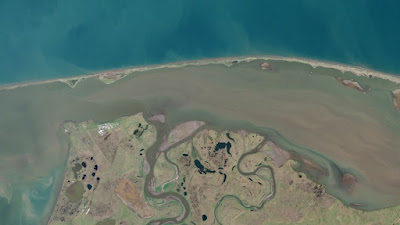
In recent satellite imagery captured by Planet, which operates the world's largest pack of Earth-observing satellites, large groups of walruses can be seen crowding Earth's coastlines, all the way from space. The image shows ambiguous, "distinctive red-brown" blobs decorating the Alaskan coastline. Previously, walruses would gather in groups of up to many thousands, called "haulouts," on Arctic sea ice far from the shore. But with sea ice melting at rapid speeds due to climate change, they have no choice but to gather on land. —Space.com, November 5, 2021


Thousands of walruses (called “haulouts”) gather
along Alaskan shores, spotted from space.
They’re resting ample bodies, but they’d rather
veg out on sea ice. Yet there’s not a trace
of frozen H2O. A satellite 
has taken photographs. How can they eat
or sleep now? Humans may create a fright.
Many will perish in their mad retreat,
tumbling en mass to the safety of the ocean.
Monitoring their populations might
show how, through climate change, they may persist.
Yet when at last they’re gone, will they be missed?
These mammals know this world is not all right.
These mammals know there is no magic potion.


Martin Elster, who never misses a beat, was for many years a percussionist with the Hartford Symphony Orchestra (now retired). He finds contentment in long woodland walks and writing poetry, often alluding to the creatures and plants he encounters. A full-length collection, Celestial Euphony, was published by Plum White Press in 2019.

Saturday, July 11, 2015

THE OPEN MIKE POET WHO READS A PASSIONATE PIECE IN ARABIC PROVIDING A BRIEF PROSE SUMMARY AFTER

by Alan Catlin


'The U.S. State Department on Tuesday punched a big hole in Israel-led efforts to induce the Obama administration to regard boycotts of settlements as identical to boycott of Israel proper. In doing so, it provided the Israeli government and the pro-Israel lobby with yet another painful lesson in the pitfalls of being too clever by half and biting off more than one should chew. A special statement issued by the State Department Press Office on Tuesday afternoon made clear that while the administration “strongly opposes” any boycott, divestment or sanctions against the State of Israel, it does not extend the same protection to “Israel-controlled territories.” Rather than weakening efforts to boycott Jewish settlements in the occupied territories, as Israel supporters had planned, the State Department was actually granting them unprecedented legitimacy.' —Haaretz, July 1, 2015; Photo: AL-JANIYA, (Palestinian Territories), October 30, 2014: Abbas Yusef points wistfully towards his olive trees, which are bearing their annual fruit. Yet again, the 70-year-old Palestinian farmer will be unable to make the autumn harvest. Yusef’s olive groves lie on land either side of an Israeli settlement in the northern occupied West Bank. For years, he has been denied access by the army, and the settlers have ploughed it, uprooting many of his trees. —Dawn


It’s a timeless story.
The speaker is a man.
A very angry man
with eight children and
another on the way.

He is a farmer but
is no longer able to work
the land that has been in
his family for a thousand years.

The occupiers prevent
anyone from working
the land.

He is so angry he can
barely speak.

The occupiers want to build
new settlements here,
right here, on my land.

The man is so angry because
he feels helpless.

How will we live?
he asks

How will we survive?


Author’s note: The poem is a based on a reading from this week by a young man, probably a high schooler, who read at an open mike. I’m not sure if he wrote the poem or not.  He was extremely shy and self-conscious, until he passionately read this dynamic piece  in his native language and tried to leave the stage without an explanation, but the moderator, a high school English teacher, gently prodded him to provide some kind of translation. I took some liberties with the translation, adding some details I think he was hinting at but could not provide as he didn’t have the words for them in English. 


Alan Catlin has published numerous chapbooks and full-length books of poetry and prose, the latest of which, from March Street Press, is Alien Nation.

Tuesday, November 04, 2014

TELEGENIC

by Erica Goss


A family’s shoes arranged by size, smallest first. The bones of a child’s foot. I write a poem for a man named Mark. He sits on the street and weeps. He’s seen the shoes, seen them filling up with blood. This summer grinds on. We congratulate ourselves, as if we didn’t know one piece of land is worth more than another, one child’s life is worth more than another’s. Death is telegenic and dead children most of all. Explosions branch through the ear and jaw but quiet, please, this game requires the world’s silence. Mark rakes the little bones together, collects the shoes in heaps all over the city. At night when they burn the fires smoke and sputter and then go out, smallest first.


Erica Goss is the Poet Laureate of Los Gatos, CA. She is the author of Wild Place (Finishing Line Press 2012) and Vibrant Words: Ideas and Inspirations for Poets (PushPen Press 2014). She won the 2011 Many Mountains Moving Poetry Contest and was nominated for the Pushcart Prize in 2010 and 2013. Recent work appears in Atticus Review, Lake Effect, The Red Wheelbarrow, Passager, Main Street Rag, Pearl, Rattle, Wild Violet, and Comstock Review.  

Thursday, September 04, 2014

ANNEXATION

by Stefanie Bennett


Israel appropriated a swath of 990 acres in the West Bank on Sunday and declared the Palestinian area south of Bethlehem to be Israeli "state lands," local media reported. --LA Times, August 31, 2014 (Image source: Peace Now)


In 'My Mother's House'
A deceptive land,
An impulse
Waxes lyric -,

While unencumbered
The axe-head
And wood-block lie
... Seen only
                   From
The bi-fold window.

There, time steps through
The filament's
Grasping squall, and
It's found

How I am, now -,
Twice as able
As once was

Cain...


Stefanie Bennett has published 18 books of poetry and 1 novel. Of mixed ancestry [Italian/Irish/Paugussett-Shawnee] she was born in Townsville, Queensland, Australia 1945. Stefanie's latest poetry title The Vanishing is due late this year from Walleah Press.

Monday, December 10, 2012

EXILED LIGHT

by B.Z. Niditch

Asylum-seekers back to where they started: A boat carrying asylum-seekers, believed to be from Sri Lanka, is intercepted off Christmas Island in June this year. Picture: Daniel Wilkins. Source: The Australian


Exiled light
held out
another dawn
a lamp
to another horizon
more certain
and human
than I believe
exists
returning
into a black sun
of memories,
lit up in love
with peace
for the visionary,
your tossed boat
between rough shores
of two continents
trembling for shelter,
to land in
a resting place


B.Z. Niditch, poet, playwright, fiction writer, and aphorist, is published widely throughout the U.S. and abroad. He is also the founder and artistic director of The Original Theatre, in Boston, which has presented original, experimental plays on contemporary social and political themes since 1990.