Guidelines


Submission Guidelines: Send 1-3 unpublished poems in the body of an email (NO ATTACHMENTS) to nvneditor[at]gmail.com. No simultaneous submissions. Use "Verse News Submission" as the subject line. Send a brief bio. No payment. Authors retain all rights after 1st-time appearance here. Scroll down the right sidebar for the fine print.
Showing posts with label radiation. Show all posts

Friday, August 23, 2024

MOUNTAINS OF AMBIGUITY

by Dick Altman


ALBUQUERQUE, N.M. (AP, August 16, 2024) — Watchdogs are raising new concerns about legacy contamination in Los Alamos, the birthplace of the atomic bomb and home to a renewed effort to manufacture key components for nuclear weapons. A Northern Arizona University professor emeritus who analyzed soil, water and vegetation samples taken along a popular hiking and biking trail in Acid Canyon said Thursday that there were more extreme concentrations of plutonium found there than at other publicly accessible sites he has researched in his decades-long career.


Northern New Mexico


How many daybreaks

have I risen

to the drum/chant/flute spirit

of high desert’s Jemez,

sacred Indigenous mountains,

dancing my western skyline?


I wanted to escape Manhattan’s

work encampments, 

false pinnacles of glass

and steel,

to find here, 

at seven thousand feet,

gifts of earth/air/water,

untrammeled 

by humanity’s heel. 


The breathtaking cleft

that serves as the gateway

into the Jemez—

like a canyon pathway 

into the clouds—

lofts me,

calls me 

into another world.


Nature’s handiwork in the Jemez

expresses itself 

in a thousand volcanos,

asleep for now,

fanning out from Valles Caldera,

planet’s largest,

grandeur that, 

across Rio Grande’s valley,

seems all mine.

My hiking ardor leaves

its imprint 

in that elk-abounding

encirclement, 

a trail of joy,

marking every season.


Yet not without sadness.

I have first to pass 

Oppenheimer Alley,

where the brain of man

explodes an idea,

whose remnants scatter

the countryside,

forces unseen

that torment the Jemez

without known end.


Los Alamos’ lights

at night snake downslope,

pointing at me,

atomic city’s

unrepentant reminder

that my escape

was less promise,

than dream.


Dick Altman writes in the high, thin, magical air of Santa Fe, NM, where, at 7,000 feet, reality and imagination often blur. He is published in Santa Fe Literary Review, American Journal of Poetry, Fredericksburg Literary Review, Foliate Oak, Landing Zone, Cathexis Northwest Press, Humana Obscura, Haunted Waters Press, Split Rock Review, The Ravens Perch, Beyond Words, The New Verse News, Wingless Dreamer, Blueline, Sky Island Journal, and others here and abroad.  His work also appears in the first edition of The New Mexico Anthology of Poetry published by the New Mexico Museum Press. Pushcart Prize nominee and poetry winner of Santa Fe New Mexican’s annual literary competition, he has authored some 250 poems, published on four continents.

Wednesday, April 05, 2023

NATIONAL PARK

by Jerome Berglund


Dogs roam the ghost town of Pripyat within the Chernobyl exclusion zone in Ukraine. Scientists have identified genetically distinct populations living in the area, including within the highly contaminated power plant. Credit: Dimitar Dilkoff/Agence France-Presse—Getty Images via The New York Times, March 3, 2023


The Dogs of Chernobyl Are Experiencing Rapid Evolution, Study Suggests 
Popular Mechanics, April 1, 2023


near fifty odd past,
generations of curs
in the fallout

plume rose up
into the air
but has it dissipated 

toys left behind
during hasty retreat 
from exclusion zone

through ruins 
of the power plant
feral strays mutating

irradiated populations
not eradicated
over the dog years

unmolested 
other kingdoms
time to flourish

the casualties
by necessity
continue evolving 

beneficial adaptations
can they be reabsorbed
into populations

tempering
for weathering 
this boiling world

roaming the wastes
admiring 
the many sunflowers 


Jerome Berglund, recently nominated for the Touchstone awards and Pushcart Prize, has many haiku, senryu, and tanka exhibited and forthcoming online and in print, including in the Asahi Shimbun, Bottle Rockets, Frogpond, and Modern Haiku.  His first full-length collection of poetry Bathtub Poems was just released by Setu Press.

Tuesday, March 22, 2022

OSTINATO

by Kay Newhouse


Count the time from lightning flash 
And multiply by distance till the thunder
Rolls its way inside the house and rattles all the dishes on the shelves.
In case of nuclear disaster, ready.gov says that there is time
(I read) To go inside
Rinse out your hair and eyes and mouth
Take off your clothes
Like napalm child whose scream in glossy magazines
Holds still for history (I should know her name)
(This is important now)

My neighbor hides her thyroid scars in wrinkles on her neck
And tells me my old dog is fat again
And daughters should wear pink not jeans
And English is not easy (she repeats) and she grew up not in Chernobyl 
But a hundred miles away or so where wind picked up the dust 
And brought it to her through the forests
Sifting ash across her clothes and hair and face and now finding her with cancer 
These so many miles and years ago—
But it doesn’t matter (she says) остинато
You can’t see a scar that has so many wrinkles to surround it 
What’s that flower on my driveway
And I answer her with just one word
“impatiens,” I repeat to her, a little louder now
“impatiens”


Kay Newhouse’s first byline was in Physical Review Letters, and most recent in Wildfire Magazine. She lives near Washington DC, where the cherry trees flower every spring, the fireworks are overrated, and people are more likely to talk to each others’ dogs than to each other. This is about the same as everywhere, more or less.

Monday, January 31, 2022

NUCLEAR WASTE

by Charles Rammelkamp


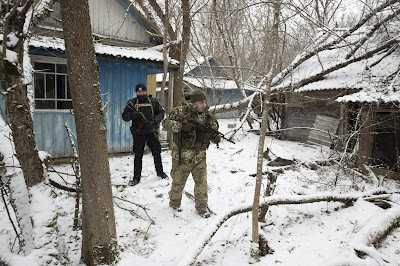
Ukraine has initiated a defensive strategy for the Chernobyl Exclusion Zone, one of the most radioactive places on Earth, which lies on the shortest path between Russia and Ukraine’s capital, Kyiv. Photo: A Ukrainian border guard on a joint patrol with the Ukrainian police inside the Chernobyl Exclusion Zone. —The New York Times, January 22, 2022


“It doesn’t matter if it’s contaminated,
or if nobody lives here,” Yuri declared,
responding to the unspoken skepticism 
in the sheen of the reporter’s dark eyes.
“It’s our territory, our country,
and we have to defend it.”
Shouldering his Kalashnikov, Yuri patrolled 
the snowy fields of the Chernobyl zone;
winter in northern Ukraine.

“I remember reading about the Soviets
parading the children on May Day 
through the swirl of radioactive dust
right after the accident 
to try to make us—and the world—believe 
nothing serious had happened.
Thank goodness I wasn’t alive then.

“Pripyat’s a ghost town now;
used to be the biggest city in the area.
You can still see the old Soviet propaganda –
a sign extolling the virtues of nuclear energy.
‘Let the atom be a worker, not a soldier.’”

Hunching his shoulders, as if to toss away his anger,
shifting the rifle, Yuri went on:
“Now we don’t know 
what will kill us first,
the virus, radiation, or Putin’s bombs.”
 

Charles Rammelkamp is Prose Editor for BrickHouse Books in Baltimore, where he lives with his wife Abby. He contributes a monthly book review to North of Oxford and is a frequent reviewer for The Lake, London Grip, Misfit Magazine, and The Compulsive Reader. A poetry chapbook, Mortal Coil, was published in 2021 by Clare Songbirds Publishing and another, Sparring Partners, by Moonstone Press. A full-length collection, The Field of Happiness, will be published in 2022 by Kelsay Books.

Thursday, May 05, 2016

EXCLUSION ZONE

by Joan Mazza


Evolutionary biologist Timothy Mousseau and his colleagues have published 90 studies that prove beyond all doubt the deleterious genetic and developmental effects on wildlife of exposure to radiation from both the Chernobyl and Fukushima nuclear disasters, writes Linda Pentz Gunter. But all that peer-reviewed science has done little to dampen the 'official' perception of Chernobyl's silent forests as a thriving nature reserve. —The Ecologist, April 25, 2016


Thirty years after Chernobyl’s accident
spilled radiation equal to twenty Hiroshimas,
wolves, roe deer, boar, bison, and moose thrive
between abandoned apartment buildings and once-
tended fields and gardens. Animals too contaminated
to eat. Appearing to be normal, they meander
within what is left of Pripyat. Tourists travel
to photograph the haunting beauty of decaying
buildings, trees flowering in spring, ignore long-term
threats of gamma particles that enter their bodies—
silent with their sinister destruction. This zone
is an unintentional wildlife sanctuary,

while Fukushima fallout spreads eastward
across the Pacific Ocean toward the west coast
of the Americas. Southern California seaweed
holds five times the normal radiation. What this
means for other foods, for long-term human
health, we don’t yet know. The ocean maps show
the field widening, contaminating fish, plankton,
and mammals, dumping tsunami debris on islands
along the way. Another natural experiment.
Perhaps another surprise nature reserve. We wait
to see what it brings, which of the fittest survives.
No one will be excluded from this test.


Joan Mazza has worked as a medical microbiologist, psychotherapist, seminar leader, and has been a Pushcart Prize and Best of the Net nominee. Author of six self-help psychology books, including Dreaming Your Real Self (Penguin/Putnam), her poetry has appeared in Rattle, Kestrel, The MacGuffin, Mezzo Cammin, Buddhist Poetry Review, and The Nation. She ran away from the hurricanes of South Florida to be surprised by the earthquakes and tornadoes of rural central Virginia, where she writes poetry and does fabric and paper art.

Monday, December 08, 2014

ELEGY FOR CLAUDIA EMERSON

by Joan Mazza


Claudia Emerson, Florida, 2008. Photo by Joan Mazza.


Even when your flame flickered, you still

shone in photos of the stitches of your

upper arm, broken when opening a jar.


Through surgeries and radiation, you coupled

your words with music, stanzas we entered

unafraid. You kept your smile when your hair


fell out, and showed us how to fall in love

with love again when you and Kent gazed

at each other. You said that when you were gone


women would line up around the block

with casseroles for Kent. He’s widowed

twice now. Another late wife.


Before your brain surgery, you wrote,

I hope I wake up! and you did.

How we’ll miss your light and words.


Joan Mazza has worked as a medical microbiologist, psychotherapist, seminar leader, and has been a Pushcart Prize nominee. Author of six books, including Dreaming Your Real Self (Penguin/Putnam), her poetry has appeared in Rattle, Kestrel, The MacGuffin, Mezzo Cammin, Buddhist Poetry Review, and The Nation. She ran away from the hurricanes of South Florida to be surprised by the earthquakes and tornadoes of rural central Virginia, where she writes poetry and does fabric and paper art.

Tuesday, November 26, 2013

THE PLAN

by Daniela Gioseffi


Two weeks of United Nations climate talks ended Saturday with a pair of last-minute deals keeping alive the hope that a global effort can ward off a ruinous rise in temperatures.  . . . Mohamed Adow, an activist with Christian Aid, said the deal showed that “countries have accepted the reality” of the effects of climate change, but that “they seem unwilling to take concrete actions to reduce the severity of these impacts.” --NY Times, November 23, 2013


The plan was for butterflies,
bees and bats to suck among flowers
gathering sweetness to live
as they carried pollen, seed to ova,
to bring fruit from need.

The plan was for waters
to run freshly through
wetland deltas, filtering streams
along their way from mountain tops
quenching thirst running clear
rivers to the sea bringing life to the lips of children,
blossoming from the need for love
from parents, two different animals united
into a new being, ecstatic with rebirth.

The plan was for forests to clean the air
for children's breath in symbiotic balance
using carbon dioxide expelled from animals
to give forth oxygen,
to photosynthesize food from need,
making green leaves that leaf and leaf again
to feed women's breasts, not mere objects of sex,
but factories of milk, first link
in the food chain for children's mouths
to suckle milk from leaves of grass
come from fertile mud for need.

But sheer greed for things
of plastic, polymers from petroleum:
acrylic, polyester, lucite, biogenetics,
nuclear radiation, poisons,
greed for too much meat full of steroids,
land laid waste grazing cattle,
carcinogens, plutonium, filth and waste,
killed the plan slowly, bit
by bit, until the water trickled
with foul waste of industries' mistakes
and what was needed food, water, breath
was suffocated to a barren death.

Bats, bees and butterflies
ceased to buzz around flowers
bearing fruit from their sexual union
and children had no food.
Forests chopped to dust
gave forth no oxygen
or photosynthesis
or atmospheric balance
as fluorocarbons and fuel emissions
opened holes in the ozone
and burned the earth
to a carbon crisp
and love,
which was God itself,
no longer breathed
in the eyes of children,
but was silenced from its song
and art, books, poems,
had no feelings to speak
as all seed,
through "market engineering,"
was lost
to greed.


Daniela Gioseffi is an American Book Award winning author of 16 books of poetry and prose. She is editor/publisher/webmaster of www.Eco-Poetry.org/, a website of poetry and commentary dealing with climate crisis concerns. She has been widely published in innumerable magazines such as The Nation, The Paris Reveiw, Chelsea, Choice, Prairie Schooner, Poetry East, and in anthologies from Oxford U. Press, Viking, Simon & Schuster, Harpers. Her latest book is Blood Autumn from VIA Folios / Bordighera Press. Her verse is etched in marble on a Wall of PENN Station with that of Walt Whitman and other poets.