Guidelines


Submission Guidelines: Send 1-3 unpublished poems in the body of an email (NO ATTACHMENTS) to nvneditor[at]gmail.com. No simultaneous submissions. Use "Verse News Submission" as the subject line. Send a brief bio. No payment. Authors retain all rights after 1st-time appearance here. Scroll down the right sidebar for the fine print.
Showing posts with label strike. Show all posts

Monday, September 29, 2025

MASS SHOOTING #5


by Ron Riekki


“the urge
to defy gravity    to dis-
arm another”
—Tarfia Faizullah,


“Journalist,” I say.  The police, polite, waves me over to parking.


I park.  I walk.  I feel sick.  I suspected there would be smoke, but

it’s not that.  The sickness comes from what has happened.  It’s one

dead, then two, then four, then five, reported on the news, last I’ve

heard.  Eight injured, last I’ve heard.  I walk towards the Church

of Jesus Christ of Latter-day Saints.  At about 10:45 a.m, the gunman

crashed his truck draped in American flags into the church.  I don’t go

to church, normally, rarely, but this morning I went late to 2|42

Community Church in Ann Arbor, so late that the service was over;


I’m guessing no one knew about the Grand Blanc shooting there, how

parishioners went to the truck to help, thinking it was an accident,

then realized it was done on purpose . . . Assault rifle.  A rifle made

for assault.  Sturmgewehr.  The origin, German.  Reportedly ‘assault

rifle’ comes from Hitler, from Nazi weapons production.  I walk


and I’m sick.  This is my sixth mass shooting I’ve gone to, but the first

time the numbers are in the double digits and the worry that it’s going

to turn out to be actually more.  I’m allowed to go further, where

the journalists are, and there are journalists.  Men behind cameras

that remind me of the David Van Driessen character in Beavis and

Butt-Head, a vibe of peace-loving pacifist, hipster, kind, quiet.  I talk

to some of them and they are soft-spoken.  Pointing cameras at super-

model females who are eloquent and efficient and focused; I don’t talk


to them and they don’t talk to me.  I scribble.  The building is hidden

by trees, but the sign is right there, the darkness lit up by police LED lights.

There’s little to see, except maybe five police vehicles, a fire engine,

but they very slowly keep leaving, until, by the end I stand there alone,

with about ten thin orange construction cones and a police officer


guarding the yellow-caution-tape entrance.  There’ve been six mass

shootings in the U.S. in the last three days— in Eagle Pass, TX;

both Southport and Raleigh, NC; both New Orleans and Alexandria, LA;

and here.  11 killed, 32 injured.  This is getting to be more and more normal.

More and more talk.  Less and less action to change things.  I scribble.

One of the last remaining telejournalists speaks to the cameraman:

“How about we do the bomb threats?”  She is laser focused on the lens,

speaks about “FBI” involvement now.  She speaks of “arson.”  I stay clear


of her shot.  Her Megyn Kelly vibe.  It’s 9:14 p.m.  The shootings happened

about ten-and-a-half hours ago.  They wrap up.  Two neighbors walk by.

There are houses.  A quiet neighborhood.  Middle-class.  Long one-

or two-story homes.  Simple.  Nice.  Not extravagant.  No Halloween

decorations.  I ask the two if they’ll talk to me.  They shake their heads no.


I ask a cop if he can answer some questions.  No.  But Dave, a “photo-

journalist” for a local CBS affiliate talks to me about the bomb threats,

lets me know that “multiple” churches in the area have been receiving

them recently.  He tells me of a “bomb squad” looking for “explosive

devices” in the vehicle.  The vehicle, I’m assuming, is just yards from us,

on the other side of the trees.  Or was.  I’m not sure if it was taken away.

He tells me that the “gunman was subdued by DNR,” says how strange

that is.  He’s working with camera equipment as he speaks, a talented


multitasker.  He moves into his faith.  I’m shocked at the transition,

but we’re standing in front of a church that’s just been attacked.  I ask

if he gets nervous, covering mass shootings, no, he says, “I have

a very strong faith.”  He tells me he’s good at “looking for things out

of place.”  He talks about Charlie Kirk and a “spiritual energy” he finds


emerging that’s unstoppable.  You sense he is affected by what’s just

happened, not burnt out by the job.  He talks about how “professional”

the police have been on-scene.  Oddly, he seems happy.  This is, after all,

his life, his profession, and you get the impression he’s good at what

he does.  Another cameraman sets up equipment nearby.  I was alone

for a bit, but new news crews move in.  Dave tells me of “people diving”

when the gunman entered and that, inside, parishioners were “doing things

courageously,” “being selfless,” “trying to save people.”  He talks of one


“evil” man, but multitudes of the brave.  He has to get back to work,

heading to the cones for a closer shot.  Walking away, I talk to another

photojournalist eating quickly.  He tells me “two more bodies” have

been discovered, says “two were shot” and “two not,” assuming they died

in the fire.  I ask if he feels unsafe covering mass shootings.  “You have


police presence,” he says.  He gives me advice, telling me to follow

whatever officers tell me to do.  “They have a tough job,” he says.

The police are all busy.  Staying in the journalist area, I’m ignored.

Getting near my car, I see a man broadcasting on his phone.  I tell him

journalists can go closer.  He says he’s not a journalist, but running

for Governor, that the police won’t allow him to go closer.  He tells me

he’s a trucker.  I see a live-stream feed on his phone on a tripod.

He holds a candle.  I ask him why he’s here.  He talks about how


he wants to reduce taxes.  It’s the main part of his platform.

I ask how to reduce gun violence.  Michelle, a person nearby,

says we need “free mental health.”  Six mass shootings with dozens

of people interviewed and she’s the first person to say “free mental health.”

I wonder why it doesn’t come up more.  The man who wants to be Governor


agrees.  I’m not sure how we stop taxes but then also have free mental health.

Michelle talks of how “domestic violence,” “alcoholism,” “crime” would all

be helped with “free mental health.”  She speaks with passion, how insurance

makes it unaffordable.  I ask if she has ever had mental health issues she’s

needed assistance with and couldn’t afford care.  She says, no, she doesn’t

have any mental health issues.  She takes out a vape and hits it.  I tell her

that counselors can help with tobacco use disorder.  She laughs.  I go

to get in my car.  94.7 FM plays Great White’s “Once Bitten, Twice Shy.”


The city we’re in—Grand Blanc—translates from the French as

Great White.  I think of the infamous Great White nightclub fire

in 2003 with 100 killed, 230 injured, after pyrotechnics caused

the building to catch fire.  I listen to the rest of the song, Jack Russell

singing “it’s the middle of the night on the open road” and it is


and the hospital comes up soon.  There are an unexpected mass

amount of tents set up around the hospital.  I walk to one of them.

I’m wondering if it’s a prayer vigil or tents set up for triaging

patients from earlier.  It’s neither.  I’m surprised to find out

it’s a strike.  Except most of the tents are abandoned with PRAYERS
FOR OUR COMMUNITY
 signs instead.  I approach a group of women

in a circle.  They don’t want to talk, point for me to try another tent.

I do.  Not far from an UNDERSTAFFED IS UNSAFE sign, the nurses


walk up to me.  Yes, they want to talk.  They tell me about ten-patients-

to-one-nurse ratios.  They tell me “we don’t have a psych ward” at

Henry Ford Health.  ProPublica lists HFH with a $4.5 billion revenue

in 2023, the CEO making over $3 million in salary.  The nurses talk

about safety.  They say they’re not interested in talking about pay, but,


rather, the safety of patient-to-nurse ratios, the safety of the patients with

reasonable nursing staff, and safety of keeping nurses from burnout.  They

say they were promised this, but Henry Ford Health ignored it.  History

keeps popping up.  The meaning of names.  The strange, again, connection

to Hitler, how Nazis were supposedly fans of Ford’s anti-Semitic writings.

It’s jarring, how Unhealthy that antisemitism is, but, yet, juxtaposing

Henry Ford + Health.  With three billboard-size signs with those three

words nearby.  I ignore bringing this up and instead ask for solutions.


Quickly, the conversation goes to “prayer.”  We talk about church.

I ask, why do mass shooters target schools and churches so frequently?

“For the innocent,” a nurse says.  I think about this.  It’s two places

where we’re supposed to have safety.  I hadn’t thought of that.

The five nurses semicircle around me.  They are open.  Almost open


wounds.  Hurting.  I tell one of the nurses I can feel her sadness.  She says,

“I’m not doing OK.”  I tell the other nurses to give her a hug.  They don’t.

They tell me that after COVID people got more distant, the worry is

that people are so distant nowadays, living in a “bubble.”  Even Christians,

they tell me.  “Befriend people who are loners, lonely,” one nurse says.

They tell me that the hospital here is understaffed, and that “other hospitals”

in the area are “overwhelmed.”  Before the shooting.  They expand this

to a nationwide problem.  I realize that the mass shooting happened


near a hospital with a nursing strike, how much worse this makes it.

They’re already understaffed; now add in that they’re on strike; and,

lastly, add in a mass shooting combined with the entire church catching fire.

A nurse says, “Satan.”  They tell me that they “just saw body recovery trucks.”

I ask when the strike will end.  They have no idea.  I realize there’s a national


issue with nursing understaffing and mass shootings.  Both.  Nationwide.

Why isn’t this on the news?  In fact, the news stories I’ve seen today,

this combination of nursing shortage, strike, mass shooting, and arson,

all combined, isn’t being talked about.  Instead, the word the news keeps

saying over and over and over, ad nauseum, is “veteran.”  One report

I heard said the shooter was in the Army.  Another says Marines.  The angle

the news outlets are going with is “veteran.”  I want to bring this up,

but the nurses are angry, for good reason, that the nursing shortage


shouldn’t even be happening, because, they tell me, there are “plenty”

of licensed nurses, but the problem is they don’t want to work, due to

the treatment they receive, the level of pay, and the patient ratios.

I ask if any of them has ever responded to a mass shooting.  None

of them have.  They tell me this hospital is level 3 trauma, that Flint


is prepped to respond to these sorts of incidents, not them.  I realize

we have the combination now of 1) nursing shortage, 2) current strike,

3) mass shooting, 4) arson with victims caught in the fire, and 5) this

hospital isn’t even a level 1 trauma hospital.  This feels straight out

of The Pitt, or maybe more of Antigone, that this is pure Greek tragedy

with hamartia and anagnorisis and the revelation is that the U.S. does

everything it can to be overloaded with guns and simultaneously

understaffed with hospitals.  What a hellish combo.  I feel I’m


exhausting the nurses after such a long day.  Leaving, I beg them

to give the one nurse who looks so sad a hug.  They do.  I walk up

to two nurses at the far end, alone, hanging out near a ten-foot tall

Halloween skeleton with a tiny American flag tucked into its hip.

One of the nurses is loquacious and the other, low-key.  The first


says she was “at the theater” all day.  I don’t know what this means.

Apparently, they turned a local theater into an MCI station.  Mass

Casualty Incident.  She says MTA buses took the parishioners there.

Why?  For “interviewing.”  For mental health?  Perhaps, but she says,

more as a crime scene.  But she adds “crisis counselors were there.”

She says they brought them “water, diapers, food, coloring books

for kids.”  I ask how she knew to go there if she was on strike.

“Facebook thread.”  Someone posted that there was “suspicion”


“with bombs.”  So she headed straight to the theater to help.

I ask what that was like.  “Crying, tearful.”  She witnessed

a wife being told that a “body was found,” the body being

her husband, and hearing “two kids scream” at the news and

“jumped into the arms of parents.”  She tells me of hearing


people asking if their loved ones were found.  She tells me of

“sister churches” coming to help people who were “shaking

and crying.”  I ask how this gets fixed, the solutions.  “I believe

it’s a mental health crisis.”  The mental health crisis is simple:

people can’t afford care or it’s not even available if you could

afford it.  She’s also upset with “so much hate in media,” saying

she’s sick of hearing the words “fascist” and “Hitler” and “Nazi”

and that sort of language “calls people to action.”  She says,


“Everything’s politicized” now and feels “gender or race”

isn’t the point, that the mental health crisis affects everyone.

She’s a vet.  Army.  She talks about PTSD and that “the military

does not help with that,” so vets turn to “drugs or alcohol.”

Overall, though, she says, “I do blame the news.”  I tell her


I’m the news.  She laughs.  I ask what I should do.  She says

we need "neutrality."  I don’t tell her The New Verse News

strongly leans left.  But, then, I also want to tell her that

true liberals are about diversity, of all viewpoints, that I’m

just collecting voices, ideas for solutions, from everyone

who’ll speak to me.  She reiterates this is about understaffing

for substance use disorders and mental health specifically.

She tells stories of how “we just stabilize them and toss them


out,” with no real treatment, if someone comes in with

a mental health disorder.  (I text a friend quickly: Still on

scene.  This is intense.)  She tells me of helping with gunshot

wounds in the military.  I realize she was on strike, couldn’t

help; but she tells me, no, nurses did try to go in and assist,


but “administration” told them “no, you need to leave,” so some

of the nurses headed to the theater and, the others, to the scene

of the shooting.  She says, “This is why I became a nurse,

to help people.”  She’s done this for thirty-seven years.

She’s tired.  It’s late.  I wave.  I walk by tents after tents

after tents after tents, many empty, signs of prayers, pleading

for funding, nurses alone by little heaters or a barrel with fire

inside, smoke in the air.  Waiting.  They just want to help people.


Ron Riekki co-edited Undocumented: Great Lakes Poets Laureate on Social Justice.

Monday, September 25, 2023

MY IMPROV TEACHER CANCELS CLASS TO JOIN THE PICKET LINES

by Ron Riekki


“I’m against picketing, but I don’t know how to show it.”

—Mitch Hedberg


“A nickel ain’t worth a dime anymore.”

—Yogi Berra


“Mary Barra makes twenty-nine million a year,” he says.

He’s sitting in front of the class.  He sits, because of his back.

He says he won’t be back for possibly infinity, that this

strike might put his family out, have to leave.  “And I’m from

Waterford too,” he says, “Where she was born.”  A student says,

“They put Ford into everything here—Ford River, Waterford.”

“Yeah, they put it right in the drinking water,” says another

student, “Trust me, I’m from Flint.”  The first day of class

he had us go around and say our names, what we do for

a living—roofer, firefighter, truck driver.  He stopped us,

said, “You guys have the hardest jobs.  What, is one of you

an oil rig worker?”  “I used to be,” said one of the students.

“What’re you all doing here?”  “We need some comedy

in our lives.”  I don’t tell the class this, but my PTSD

counselor recommended improv, said social connection

is better than counseling.  So I came.  One day, the teacher

asked for a suggestion, and someone shouted, “War!”

I froze up, couldn’t talk.  The teacher stood up, said,

“And this here’s the old town statue, unfortunately,

we’re gonna have to tear it down.  Bye, Robert E. Lee.”

And then a bunch of the class entered into the scene

as townspeople and they picked me up and hauled me

in the air across the stage.  Everybody was dying

laughing.  After, a student said, “You make a really

good Bobby E. Lee.”  More laughter.  I had started

to have a panic attack, but they brought me back, tore

it down.  And now we’re worried class is going to be

canceled.  An EMT in the class said COVID’s coming

back.  A guy who’s unemployed told us he was jealous

of our having work—and now our teacher doesn’t, says

it might go on forever, the strike, says he has to be out

on the line at 6 a.m., “but there’s no parking,” said he’s out

there in the rain.  “That sucks.”  “No,” he explains, “It’s

what I’ve been doing at GM my whole life.  We work

outside, every day.  Winter too.”  We sit there and stare,

silent, at the stage.  It’s empty.  Totally empty.  Black-

box theater.  But not even black boxes.  Nothing.  Just us.


Ron Riekki co-edited Undocumented: Great Lakes Poets Laureate on Social Justice (Michigan State University Press).

Friday, September 15, 2023

CAR PARTS

by Matt Witt


U.A.W. Halts Work at 3 Plants in Contract Fight With Automakers 
Ford, General Motors and Stellantis have all raised their pay raise proposals since their opening bids—but to no more than 20%, just half of the union's 40% ask, Fain said. The companies have also rejected the union's pension and retiree healthcare proposals, according to [UAW President Shawn] Fain. Other economic issues, including cost of living adjustments and profit sharing, remain points of contention. "We do not yet have offers on the table that reflect the sacrifice and contributions our members have made to these companies," Fain told union members. "To win, we'll likely have to take action." —NPR, September 13, 2023. "The Big Three CEOs saw their pay increase by 40% over the last four years, while our pay only went up by 6%," UAW President Shawn Fain said at a news conference last week. —NPR, September 14, 2023


I did a simple internet search
for “the major parts of a car”
 
And Google said the answer is
Chassis,
Engine,
Transmission system,
Car body,
Steering system, and
Braking system.
 
It left out each worker’s
Hands,
Arms
Back
Knees
Ears
Nerves, and
Lungs.
 
Another search found that
auto workers suffer
injuries and illnesses
at more than twice the rate
of other private industry.
 
Maybe next I will search:
What is the true cost of a car?
Who pays the price?
And who gets the profits?

 
Matt Witt is a writer and photographer in Talent, Oregon. His work may be found at MattWittPhotography.com.

Saturday, June 11, 2022

BEING ROOMMATES WITH A STRIPPER

by Jennifer Elise Wang


The picket line on Lankershim Boulevard in North Hollywood has been loud, energetic, flamboyant, and... costumed. The strippers from Star Gardens have organized for their protection and become a cause célèbre for other organizers and unions across the country. —People’s World, June 6, 2022


When your roommate is a stripper,
You discover who makes
The teeniest thong
You can legally get away with
And that 7-inch Pleasers
Are not too bad to walk in.
When your roommate is a stripper,
You start going to the gym more,
Not to have her body exactly
But to have the same gluteal control
In order to twerk along with her
In your at-home dance parties.
When your roommate is a stripper,
You see the stacks of 1s,
But not the 5s, 10s, or 20s
She has given to the house and staff.
When your roommate is a stripper,
You stop laughing at jokes about her job
Because her colleague was stalked
And another was threatened
While the bartender laughed
At the image of her possible demise.
Every night, it’s a flip of the coin
As to whether she’ll be assaulted.
When your roommate is a stripper,
You learn about misogynoir,
TERFs and SWERFs,
Labor rights and union-busting tactics,
And that it’s always “sex worker”
And never “prostitute” or the other word
That sounds more apropos for fishing.
When your roommate is a stripper,
You get advice on how to set boundaries
While still smiling at the customer.
When your roommate is a stripper
And getting ready for a night of picketing
While you’ve come home after overtime
And drink a beer with some Tylenol
For your Carpal tunnel and plantar fasciitis
And blink away your dry eyes,
You realize you are selling your body too. 


Jennifer Elise Wang (she/they) is a lab tech, burlesque dancer, drag king, and poet. She won First Prize for Open Poetry in the 2018 On My Own Time Art and Literary competition and has been published in The Gunpowder Review, Jerseyworks, and R2 Rice Review. In her free time, she likes to skateboard and volunteer at the animal shelter.

Sunday, January 30, 2022

CONFIRMATION TIME

by Jane Patten


The process begins—
But confirmation
Will depend
Upon its closeness to the midterms 
Or what it costs to send
A moderate to the court,
Saturn lying opposite
The Sun or
The last of the Super Moon
Shining bright, 
Agreement from the Right
And well-laid plans
To obstruct and strike again.


After retiring and moving to Huntsville, Jane Patten decided to write about her adventures, including growing up in Delaware and her career as a teacher in rural Georgia. Her writings have been published in Out Loud HSV: A Year in Review anthologies, The New Verse News, Reckon Women, and Reckon Honey.

Tuesday, January 11, 2022

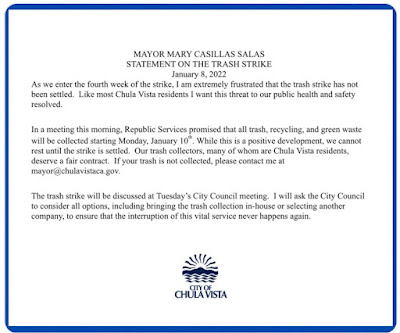
STRIKE

by Katie Kemple


We placed the blue trash can
and the green recycling bin
filled with the detritus
leading up to Christmas
in front of our townhouse
garage, like we always do,
and our neighbors too, and
they stayed there, all the way up to
and well past Christmas,
past New Years. The brown
cardboard boxes of mail-ordered
gifts stuck their tongues out
at us, papers glued like stickers
to the pavement courtesy
of the rain, and the sanitation
drivers never came. The neighbors
built cities of empty boxes.
Shrimp skins haunted us.
We wore yesterday's diapers.
The CEO of the sanitation
company makes 154 times
the pay of his average employee:
twelve-million dollars a year. 
Crows swung down to feast
on the new year's abundance. 


Katie Kemple (she/her) is a poet, parent, and consultant based in San Diego. Her work has appeared recently in Longleaf Review, The West Review, and The Shore Poetry. 

Wednesday, January 05, 2022

GLOBAL STRIKE!

by Katherine West


Geneva (AFP) – A man ended a 39-day-long hunger strike outside the Swiss parliament on Thursday, declaring "Victory!" after the MPs agreed to be briefed by scientists on the latest climate change research. Guillermo Fernandez, who says he has lost 20 kilos since launching his hunger strike on November 1 to push for Swiss MPs to take climate change seriously, ended his fast by gingerly eating a banana outside the parliament building. "Victory!!!!" he announced on Twitter… "Finally the parliament will be confronted with the truth!" His announcement came after the president of the lower house of parliament Irene Kalin, of the Green Party, announced that scientists had been invited to brief MPs on May 2, 2022 about the latest research from the Intergovernmental Panel for Climate Change (IPCC). —France 24, December 9, 2021


I had a dream the millions woke from their dream.  
There was no violence, just numbers.  
Quietly, the millions put down their tools and shut down their computers.  
Quietly, the millions said, "No."  
Quietly, they said, "We want to live."  
Quietly, they marched.  
Quietly, they sang as they marched.  
Quietly, they stood.  
Quietly, they sat. 
Before the capitals of state and country.  
Quietly, they stayed.  
Singing love of forest and river. 
Of life for children and grandchildren.  

Until power returned to the ones who work.  
Until Earth was put first. 


Katherine West lives in Southwest New Mexico, near Silver City. She hs written three collections of poetry: The Bone Train, Scimitar Dreams, and Riddle, as well as one novel, Lion Tamer.  Her poetry has appeared in journals such as Writing in a Woman's Voice, Lalitamba, Bombay Gin, The New Verse News, Tanka Journal, Splash!, Eucalypt, and Southwest Word Fiesta. The New Verse News nominated her poem "And Then the Sky" for a Pushcart Prize in 2019. In addition she has had poetry appear as part of art exhibitions at the Light Art Space gallery in Silver City, New Mexico and at the Windsor Museum in Windsor, Colorado. She is also an artist. 

Monday, July 15, 2019

BOXCUTTER BLUES

by Damian Balassone


They put me in these overalls
They put me in these shoes
Yeah, they put me in these overalls
They put me in these shoes
They handed me a Stanley knife
Said, ‘son it’s time to pay yer dues’

Well, the stock is rolling in
And the stock is rolling out
Yeah, the stock is rolling in
And the stock is rolling out
I’m walking like a branded slave
When all I wanna do is twist and shout

Well, mama get me outta here
This ain’t the life I choose
I said mama get me outta here
This ain’t the life I choose
I’m shackled to this factory
Lord, I got the boxcutter blues


Damian Balassone is an Australian poet whose work has appeared in over 100 publications, most notably in The New York Times.  He is the author of three volumes of poetry, including the forthcoming Strange Game in a Strange Land.

Monday, March 12, 2018

TEACHER MINERS OF WEST VIRGINIA

by Alejandro Escudé


The victorious strike by teachers in West Virginia did not only result in a long overdue pay raise. With the exuberance of a nine-day teach-in, the teachers and their supporters have taught the nation a compelling lesson on the historical role of a true resistance. Taking to the streets, picketing on the sidewalks, and charging into the Capitol itself, the strike turned the public commons into a counter space for “we the people.” One by one, the roughly 20,000 teachers in West Virginia essentially forced lawmakers – and the nation – to stop our daily routine and address the growing education crisis on the terms of those most devoted to ensuring the best outcomes for our children: our teachers. —The Guardian, March 10, 2018


The teachers are digging for coal;
They pour out of the mines, dark-drenched,
Unimpressed by the earth’s time tables,
The maps colored outside the lines.
They are heading home from the mines.

The teachers have received the cables
That mark their pay; their fists are clenched
Even grading papers, their precious ore
A losing industry. As the work clock chimes
Apocalypse, for health they pay the fines.

The teachers breathe fumes of a Stygian shoal
As they sail on—confused, wrecked and bled,
Their career an entanglement of labels.
Of their day’s take nothing survives.
They’re servants to the ironies and declines.

Like prophets, they cluster countless Babels,
Their clothes contain the prints of our kindred.
Yet, where gratitude should be, there’s a hole.
A relentless grind, their minds like stripped mines,
For expenses overdue, for quarrying lives.


Alejandro Escudé published his first full-length collection of poems My Earthbound Eye in September 2013. He holds a master’s degree in creative writing from UC Davis and teaches high school English. Originally from Argentina, Alejandro lives in Los Angeles with his wife and two children.

Monday, December 07, 2015

UNION RAT

by Joan Colby


KOHLER, WIS. — Talks have been resumed between the Kohler Co. and the union that's been on strike for nearly three weeks in Wisconsin. Tim Tayloe, president of Local 833 of the United Auto Workers, said in a text message Friday that the union and the company met this week, and will meet again next week. A Kohler representative confirmed to the Milwaukee Journal Sentinel that negotiations have resumed. Local 833 represents about 2,000 workers at Kohler's kitchen and bath-ware plant in the Village of Kohler and at a generator factory north of Sheboygan. The union went on strike Nov. 15. The union wants to do away with a two-tiered pay scale that it says unfairly limits new employees to roughly $13 an hour. Kohler has said its contract offer was fair. —The News & Observer, Dec. 5, 2015


The inflated rat sits outside the fence
Where strikers protest unfair wages
Or conditions no human would endure.
The rat has a pink snout, sharp fangs
And a large round eye, orange as a
Setting sun, lacking a pupil, soulless.
Its jaw is ajar, its claws
Like those of the wicked bosses
Who rip up contracts that say
Workmen deserve to make a living.

I wave, thumbs up, as I drive by.
My grandpa was a Wobbly,
Back in the copper mines, back in the day
When men were hung for protests
Like this one. I’d like to have a rat
To blow up every time I feel abused
By a misguided friend who thinks a fascist
Is what we need to restore law and order.
How satisfying it would be to park
That big ugly rodent in her driveway.
Better than just unfriending her on Facebook.


Joan Colby has published widely in journals such as Poetry, Atlanta Review, South Dakota Review, The Spoon River Poetry Review, New York Quarterly, the new renaissance, Grand Street, Epoch, and Prairie Schooner. Awards include two Illinois Arts Council Literary Awards, Rhino Poetry Award, the new renaissance Award for Poetry, and an Illinois Arts Council Fellowship in Literature. She was a finalist in the GSU Poetry Contest (2007), Nimrod International Pablo Neruda Prize (2009, 2012), and received honorable mentions in the North American Review's James Hearst Poetry Contest (2008, 2010). She is the editor of Illinois Racing News, and lives on a small horse farm in Northern Illinois. She has published 11 books including The Lonely Hearts Killers and How the Sky Begins to Fall (Spoon River Press), The Atrocity Book (Lynx House Press) and Dead Horses and Selected Poems from FutureCycle Press. Selected Poems received the 2013 FutureCycle Prize.  Properties of Matter was published in spring of 2014 by Aldrich Press (Kelsay Books). Two chapbooks are forthcoming in 2014: Bittersweet (Main Street Rag Press) and Ah Clio (Kattywompus Press). Colby is also an associate editor of Kentucky Review and FutureCycle Press. 

Friday, September 05, 2014

SPLIT SHIFT

by Michelle Marie


Protesters demand higher pay at the Tenleytown McDonald's. (WTOP/Savannah Simons)


this poem is sick but
goes home without pay

the bleach bucket, no
time for a scrub, scrub clean

these working conditions. scrub
this median wage of $10 per/hr
tips included//

this poem makes 44% less
than most poems, turn your head, scrub

clean that busted look on your
face & those
anxious demands

what it's about//the customer?
that can afford to eat out/ but
not tip? that busted

institution, the restaurant industry

your demands aren't better pay
benefits
pensions
citizenship

       but a different table
       lemon slices
       this poem's favorite thing on the menu
       an extra side of _____
       a raspberry vinaigrette
       the check, faster

though you couldn't have
eaten slower


Michelle Marie is author of countless protest letters archived at americanlemon.blogspot.com and a weird piece called "Fucking" in Bluestockings Magazine Issue 4.