Guidelines


Submission Guidelines: Send 1-3 unpublished poems in the body of an email (NO ATTACHMENTS) to nvneditor[at]gmail.com. No simultaneous submissions. Use "Verse News Submission" as the subject line. Send a brief bio. No payment. Authors retain all rights after 1st-time appearance here. Scroll down the right sidebar for the fine print.
Showing posts with label wildfire. Show all posts

Thursday, July 13, 2023

VERMONT FLOODWATER

by Melanie Choukas-Bradley


Shot on an angle by their dad from behind
My great niece and nephew stand in silence on a bridge over the Winooski River
Dressed for Taekwondo in red and white
Boy with hand on concrete rail, girl in form-ready pose
 
They are frozen in the video, like children in a painting
As the wild Winooski race-churns below, disregarding streets
Down from the mountains, wild brook to wild river, a New England water rodeo
Riding Vermont farm, village and town, with too much water from too much rain
 
Ten days ago their grandmother, my sister, texted a photo of Camel’s Hump
Wreathed in Canadian wildfire smoke, yesterday a video of her playful stream in murder mode
Tiny Vermont, in the climate crosshairs
Hill and hamlet no longer safe retreat
 
During Irene I watched the covered bridge of my childhood
Die an animal death on national television, falling wounded in seconds
I grew up drinking sap from the bucket
And long for the sweetness of Old Vermont
 

Melanie Choukas-Bradley is a naturalist and award-winning author of seven nature books, including City of Trees,  A Year in Rock Creek Park, Finding Solace at Theodore Roosevelt Islan,d and The Joy of Forest Bathing. She began writing poetry during the pandemic and has had several poems published by Beate Sigriddaughter’s Writing in a Woman’s Voice, including “How to Silence a Woman,” and “If I have loved you,” both of which won “Moon Prizes.” Earlier this year The New Verse News published her poem The Water Cooler following multiple mass shootings. Melanie grew up in Vermont wandering the woods and fields, and her heart aches for her family and friends who are dealing with catastrophic flooding in Vermont.

Tuesday, January 04, 2022

JANUARY 1, 2022

by Susan Delaney Spear


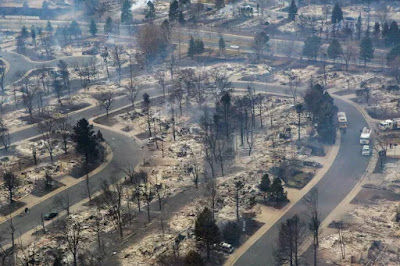
Aboard a Colorado National Guard helicopter, Gov. Jared Polis on Friday, Dec. 31, 2021, gets a flyover tour of Boulder County neighborhoods destroyed by wildfires the previous day. He was accompanied by Brig. Gen. Laura Clellan, Adjutant General of Colorado, and Boulder County Sheriff Joe Pelle. Colorado U.S. Sen. Michael Bennet and Rep. Joe Neguse also toured the area in a separate helicopter. (POOL: Hart Van Den Burg, CPR) —The Colorado Sun, January 1, 2022


Drop into this darkness.
A first-born charcoal sky
and fire-scorched land
smolder yet remain.
 
Today the sun’s detained.
A sparrow pecks
a pile of ashen snow
for sustenance.
.
Drop into this darkness.
Dig deep.
Light the wick within.
Let this year begin.
 
 
Susan Delaney Spear is an Associate Professor of English at Colorado Christian University in Lakewood. Her poetry collection Beyond All Bearing was published by Wipf & Stock in 2018.

Wednesday, October 28, 2020

GAIAN LAMENT

 by Catherine Gonick


            after the hypotheses of James Lovelock
 

The world is broken, the body of the single, gigantic animal
we have become is breaking, we don’t have much time.
The ancient organs and elements hold—
earth is still surface, water deeps, fire burns
in the center, and black space is encircled
by a ribbon of air—but it’s all sick
with wildfire fever, the atmosphere fills
with phlegm, the oceans with pharma,
indigestible soil starves and infects
flora and fauna, both wild and domestic,
our hearts ache, livers swell, lungs become fibrotic,
oxygen fails. Our science was too romantic,
our technology too rude. We looked out
as far as we were able but forgot
the unexpected we couldn’t measure.
The earth would do just fine without us,
and the other animals won’t care, unless perhaps
our dogs. Some of us always knew
we’d end badly, at the end of some endless
kalpa, the death of the last of five suns
carried by snakes of fire. But we expected
a respectable cosmic decline, not this mess
we designed. And yes, science has been
a disappointment. Who wanted to know
the limits of our filtering senses? How much further
we’d have to take our tools, if we can? Intelligence
would be better if purely artificial. Upright posture
and hands made us always want to leave home.

 
Catherine Gonick’s poetry has appeared in literary magazines including Notre Dame Review, Beltway Poetry Quarterly,  Lightwood, Forge, Sukoon, and PoetsArtists, and in anthologies including in plein air, Grabbed, and forthcoming, Poemas Antivirus. She was awarded the Ina Coolbrith Memorial Prize for Poetry and was a finalist in the National Ten-Minute Play Contest with the Actors Theatre of Louisville. She is part of a company that fights the effects of climate change.

Friday, September 18, 2020

YOU SHOULD WRITE A POEM, YIAYIA—MY GRANDCHILDREN TEXT ME

by Pamela Devereaux Wilson


our well stopped working five days ago
i hand-pump water from storage containers
boil for cleaning, food prep and drinking
flush toilet with a pail

the physical work, breathing hazardous wildfire ash
that coats and clogs my mask as temperatures reach 80
advised to stay indoors but i pray best under the old apple tree
today we are told we have the worst air quality in the world

500,000 people, a tenth of Oregon's population, evacuated
when they go home, will they find piles of smoldering ash
where their lives were once lived and fulfilled
22 missing at least 10 dead

millions of acres of Oregon's Cascades blackened for years
i may never see it green again nor walk forests of wade rivers
when rains come, hillsides will flow into rivers—crisis within crisis

many are water insecure - travel miles for water
dwindling or polluted sources
greed, corruption—survive every day without potable water

drenched in this heat, breathing ash-filled air
my dog won't go outside
my head aches constantly—i don't have water—I can't breathe

in tears i rage—i can't fix anything for anyone right now
do you know how much five gallons of Costco water costs

so i haul, pump, boil, cool and pour water
write this poem for my hopeful grandchildren
full of spunk, promise and joy yet I shall not
share the despair this poem sings --
                                                                                             without clean water
                                                                                          without breathable air life
                                                                                              stutters stumbles dies


Pamela Devereaux Wilson lives on acreage north of Corvallis in the Luckimute Watershed. There she gardens, continues to learn about herbal medicine and writes. As she ages, changes, uninvited and unforeseen have begun to shape her writing but the influence of her grandchildren has been a steady force.

Monday, July 17, 2017

DAY NINE OF THE WHITTIER FIRE

by Peg Quinn


Our differences burn away
now petty as air-borne ash
we stare, united by the dark
smoke-swallowed sky
The sun, reduced
by this raging fire
to a simple burning
red disk of anger

as we wonder what
happens next—
sundowner winds
breathing
with indifference
toward us, a lesson
in how lucky
we have been


Whittier fire photo by the poet.

Peg Quinn is a three-time Pushcart Prize nominee, mural and theatrical set painter and award-winning quilter.