by Alejandro Escudé
The cellphone in the mind rings.
No one there—
She cries
for the impermanence
of permanence
the way a person can climb
up on a stage
seeking wattage.
There’s no real age
for barbarism.
It haunts the elementary school
and the college;
it seeps into the corridors
of Congress.
It seeks only excess.
And is dead
to even the planned
execution
of betrayal.
The narration of a soul
is its final
dissolution.
You mustn’t give it
context.
Only the kernel
of a lasting impression
should breathe.
Alejandro Escudé published his first full-length collection of poems, My Earthbound Eye, in September 2013. He holds a master’s degree in creative writing from UC Davis and teaches high school English. Originally from Argentina, Alejandro lives in Los Angeles with his wife and two children.
Wednesday, July 15, 2015
Tuesday, July 14, 2015
DECISION
by William Aarnes

. . . where shall you listen
when all is become billboards, when, all, even silence, is spray-gunned?
--Charles Olson, “I, Maximus of Gloucester, to You”
Tonight, hunched
over his iPad,
your son will decide
whether to devote his life
to commerce
or killing—
already dreading
some corporate career
in throwaway crap,
already fancying
the euphoria
of wielding a bullpup.
He replays the video
of a capitalist
endorsing himself
by espousing bigoted blather.
He replays the video
of a jihadist
ambling into view
after executing sunbathers.
William Aarnes had recent work in Main Street Rag, Shark Reef, Empty Sink, and The New Verse News.

Abdel-Majed Abdel Bary via Daily Mail; Donald Trump via DonkeyHotey
. . . where shall you listen
when all is become billboards, when, all, even silence, is spray-gunned?
--Charles Olson, “I, Maximus of Gloucester, to You”
Tonight, hunched
over his iPad,
your son will decide
whether to devote his life
to commerce
or killing—
already dreading
some corporate career
in throwaway crap,
already fancying
the euphoria
of wielding a bullpup.
He replays the video
of a capitalist
endorsing himself
by espousing bigoted blather.
He replays the video
of a jihadist
ambling into view
after executing sunbathers.
William Aarnes had recent work in Main Street Rag, Shark Reef, Empty Sink, and The New Verse News.


Monday, July 13, 2015
TO JAMES TATE
by Martha Deed
To James Tate who died ‒ The New York Times and other places say
"after a long illness" at age 71, it is certain, Mr. Tate, that you are not dead
because the poet James Tate, the man this obit purports to bury
is a man wild with words and metaphors and would not "die after a long illness,"
but expire actually only after being hit by a meteor in broad daylight
while taking a break in a green, white, and yellow striped canvas covered, oak-
framed lawn chair purchased for a dollar at the very same tag sale where the coffee blender
was offered ‒ insultingly ‒ to anyone willing to take it off the crazy seller's hands
for free and now it appears that the coffee blender should have been accepted for the rotten
gift it seemed and no money should have changed hands over the lawn chair whose faded
cover harbored screws rusted at the core that sent the poet into oblivion just as he was
contemplating the next line in his next new poem the perfect nonsense of a next line replete
with toy guns and real ammunition unearthed by a small boy with dark skin and brown eyes
whose future would include 1600 on his college boards and admirable physics scores as well
who would grow up thinking a trip to Pluto was not out of the question whose inquisitive
nature matched James Tates' who cannot be dead at the premature age, barely biblical age,
of 71. We do not believe this, because we are great admirers of James Tate and we know
he does not have much truck with death and, in fact, he welcomes conversations with dead
men whom he meets at every opportunity and whom he challenges to live past their prime
even as they peer down his fevered throat and declare a person hopeless while extracting
every dime from their wallets and this in 1976 before the rest of us understood doctors
or invented Safe Patient Projects or petitioned Congress for relief which Tate already
knew ‒ before 1976 ‒ was at best a captious notion indeed, for Tate was a wise man
who understood it is every man for himself in this ungainly world and the women are smart
but the men are the drivers and often deaf to women who advise them to avoid the potholes
and bumps in the road and the men age and look gray and grumpy and finally the women
capitulate and love them anyhow because those silly old men remind them of Black-capped
Gnatcatchers rare in Arizona but cousins of a comfort commonplace Blue-gray Gnatcatcher
in the white birches in their front yard at home in North Tonawanda by the sea.
Martha Deed is the keeper of a tumblr blog Sporkworld and has published several poetry collections. Her most recent is Climate Change (Foothills Publishing, 2014).
 |
| Image source: Tin House |
To James Tate who died ‒ The New York Times and other places say
"after a long illness" at age 71, it is certain, Mr. Tate, that you are not dead
because the poet James Tate, the man this obit purports to bury
is a man wild with words and metaphors and would not "die after a long illness,"
but expire actually only after being hit by a meteor in broad daylight
while taking a break in a green, white, and yellow striped canvas covered, oak-
framed lawn chair purchased for a dollar at the very same tag sale where the coffee blender
was offered ‒ insultingly ‒ to anyone willing to take it off the crazy seller's hands
for free and now it appears that the coffee blender should have been accepted for the rotten
gift it seemed and no money should have changed hands over the lawn chair whose faded
cover harbored screws rusted at the core that sent the poet into oblivion just as he was
contemplating the next line in his next new poem the perfect nonsense of a next line replete
with toy guns and real ammunition unearthed by a small boy with dark skin and brown eyes
whose future would include 1600 on his college boards and admirable physics scores as well
who would grow up thinking a trip to Pluto was not out of the question whose inquisitive
nature matched James Tates' who cannot be dead at the premature age, barely biblical age,
of 71. We do not believe this, because we are great admirers of James Tate and we know
he does not have much truck with death and, in fact, he welcomes conversations with dead
men whom he meets at every opportunity and whom he challenges to live past their prime
even as they peer down his fevered throat and declare a person hopeless while extracting
every dime from their wallets and this in 1976 before the rest of us understood doctors
or invented Safe Patient Projects or petitioned Congress for relief which Tate already
knew ‒ before 1976 ‒ was at best a captious notion indeed, for Tate was a wise man
who understood it is every man for himself in this ungainly world and the women are smart
but the men are the drivers and often deaf to women who advise them to avoid the potholes
and bumps in the road and the men age and look gray and grumpy and finally the women
capitulate and love them anyhow because those silly old men remind them of Black-capped
Gnatcatchers rare in Arizona but cousins of a comfort commonplace Blue-gray Gnatcatcher
in the white birches in their front yard at home in North Tonawanda by the sea.
Martha Deed is the keeper of a tumblr blog Sporkworld and has published several poetry collections. Her most recent is Climate Change (Foothills Publishing, 2014).
Sunday, July 12, 2015
UP IN ARMS ABOUT A WORD
by Elbert Tavon Briggs
Author's note: This poem reflects my lifelong commitment to incorporate poetry, music, art, dance, and drama, to give voice to the voiceless.
Elbert Tavon Briggs was born 1952 in Minneapolis, Minnesota, raised in Omaha, Nebraska. Elbert studied at Northeastern Illinois University and currently resides in Chicago, Illinois. Currently creating with the Randolph Street Poets @ the Chicago Cultural Center and workshopping with Poets & Patrons. Elbert graduated from Arizona State University and served two years in AmeriCorps fighting the war on poverty in the Lower Delta.
 |
| Gun violence in Chicago over the Fourth of July weekend left 10 dead and 53 others wounded across the city. Amari Brown [pictured above], a 7-year-old boy on Chicago’s West Side, was the youngest of the fatalities. Amari had spent the day celebrating with family and riding his scooter up and down the block where he lived with his grandmother and several other relatives in Humboldt Park. Just before midnight, a gunman opened fire outside a relative's home where Amari and other children were playing, hitting both the 7-year-old and a 26-year-old woman in the chest. —The Huffington Post, July 5, 2015 |
‘There have been more than 200 killings so far this year in Chicago — up about 15 percent. And there have been more than 1,000 shootings. More Americans have been murdered in Chicago in the last 15 years than have died in Iraq and Afghanistan combined. Much of the mayhem happens on the South and West sides. The black and brown sides. What they call Chiraq. In the racial mathematics of America, a black person is six times more likely to be the victim of a murder than a white person, and eight times more likely to be the murderer.’ —Vice News, June 25, 2015
‘”Chi-raq" has been shrouded in mystery since news of the project first leaked in the spring, but a visit to director Spike Lee's film set this week revealed that much speculation about the movie — sparked largely by the title itself — has been off the mark. . . .Before a single frame was shot, the title became instantly polarizing — the term has been around for a few years now, equating gun violence in the city with that of the war zone in Iraq — and curiosity has been intense.’ —Chicago Tribune, July 9, 2015
friday to saturday
the end was not week
20 shot and wounded
one shot dead in ChiRaq
may have been another month
even an 80 something years young person
still thirstin for life
caught in the eye of multi-caliber storms
while multi-colored talking heads
curse a word
curse a word
spring 2015
a father placed his tiny son
in front of corner store mural
of the whole world
painted by teenage vato
young asphalt Picasso
pointed concrete brush towards graffiti verse
tell your story to the world
but the end was not week
urban street life painted
another view
father shielded son with hopes
january to june 2015
the end was not week
1050 shot and wounded
in ChiRaq
absurd blaming urban warfare on a word
mother’s scream
“not my baby”
“not my baby”
concrete asphalt actions
speak louder than words
.
children, teachers, parents and grandparents
getting shot down too
can’t shield violence with silence
urban combat is more than gang related
violence has many relatives
while multi-colored talking heads
curse a word
curse a word
while watching
saturday morning cartoons
before noon
taught grandson to stop-drop and roll
so the body count bell would not toll
July 4th 2015
53 shot
10 killed
7 year-old Amari Brown’s
tiny voice
is stilled
in ChiRaq
Author's note: This poem reflects my lifelong commitment to incorporate poetry, music, art, dance, and drama, to give voice to the voiceless.
Elbert Tavon Briggs was born 1952 in Minneapolis, Minnesota, raised in Omaha, Nebraska. Elbert studied at Northeastern Illinois University and currently resides in Chicago, Illinois. Currently creating with the Randolph Street Poets @ the Chicago Cultural Center and workshopping with Poets & Patrons. Elbert graduated from Arizona State University and served two years in AmeriCorps fighting the war on poverty in the Lower Delta.
JULY 5th
by Marjorie Maddox

All the flag-clad oohs and ahhs fizzle
just past midnight, a slight singe of burn
hovering over today: patriotic hangover
with stars and stripes banging about in brains
that never Ok’d reciting names and dates
in 4th grade History. Such a dazzling,
distracting explosion: all that reality behind
the pomp, so ceremoniously like that other
season’s parade: winter’s green/red (the frigid
red/white/blue) pa-rum-pa-pum-pummed
into “Little Drummer Boy” with only tepid recognition
of the day’s conviction. Holy Mother
of Jefferson, the fireworks’ dizzy outbursts
of Me! Me! Me! reveal our belief in nothing
but the day’s commemoration, the morning after’s
leftover hot dogs or eggnog a hodge-podge of forgotten births:
nation and God piped-in patriotically
as afterthought for the background.
Director of Creative Writing and professor of English at Lock Haven University, Marjorie Maddox has 9 books of poetry, most recently Local News from Someplace Else Wipf & Stock 2013), which focuses on living in an unsafe world, and an ebook of Perpendicular As I, winner of the 1994 Sandstone Book Award.

All the flag-clad oohs and ahhs fizzle
just past midnight, a slight singe of burn
hovering over today: patriotic hangover
with stars and stripes banging about in brains
that never Ok’d reciting names and dates
in 4th grade History. Such a dazzling,
distracting explosion: all that reality behind
the pomp, so ceremoniously like that other
season’s parade: winter’s green/red (the frigid
red/white/blue) pa-rum-pa-pum-pummed
into “Little Drummer Boy” with only tepid recognition
of the day’s conviction. Holy Mother
of Jefferson, the fireworks’ dizzy outbursts
of Me! Me! Me! reveal our belief in nothing
but the day’s commemoration, the morning after’s
leftover hot dogs or eggnog a hodge-podge of forgotten births:
nation and God piped-in patriotically
as afterthought for the background.
Director of Creative Writing and professor of English at Lock Haven University, Marjorie Maddox has 9 books of poetry, most recently Local News from Someplace Else Wipf & Stock 2013), which focuses on living in an unsafe world, and an ebook of Perpendicular As I, winner of the 1994 Sandstone Book Award.
I CELEBRATE MYSELF
by Jim Gustafson
I will place a rocket on my head, in a few moments I’ll be dead.
To celebrate myself, I’ll place a rocket on my head. I’ll strike a
match, light its fuse and let the sizzle climb my face. The rocket
will explode my brain and l spread my wisdom around the place.
People will scream as every atom which once belonged to me
will now belong to them. They will drip from their bottles, stick
in their hair. They will be sick because I took the dare. And when
they return to work, the holiday past, the smoke of my own breath
shall whisper.
Jim Gustafson’s most recent book, Driving Home, was published by Aldrich Press in 2013 and is a 2013 Pushcart Prize Nominee. He holds an MFA from University of Tampa and a M. Div., from Garrett Theological Seminary. He teaches at Florida Gulf Coast University and Florida Southwestern State College. His work has most recently appeared in Prick of the Spindle, Foliate Oak, Poetry Quarterly. He lives in Fort Myers, Florida, where he reads, writes, and pulls weeds.
 |
| CALAIS, Maine — A local man was killed instantly Saturday when he set off a fireworks mortar tube on his head, despite efforts his friends made to stop him, state police said Sunday. —Bangor Daily News July 5, 2015. Editor's note: The file photograph is NOT that of the victim in Maine, but of someone else deserving at least a Darwin Award Honorable Mention. |
with apologies to Walt Whitman
I will place a rocket on my head, in a few moments I’ll be dead.
To celebrate myself, I’ll place a rocket on my head. I’ll strike a
match, light its fuse and let the sizzle climb my face. The rocket
will explode my brain and l spread my wisdom around the place.
People will scream as every atom which once belonged to me
will now belong to them. They will drip from their bottles, stick
in their hair. They will be sick because I took the dare. And when
they return to work, the holiday past, the smoke of my own breath
shall whisper.
Jim Gustafson’s most recent book, Driving Home, was published by Aldrich Press in 2013 and is a 2013 Pushcart Prize Nominee. He holds an MFA from University of Tampa and a M. Div., from Garrett Theological Seminary. He teaches at Florida Gulf Coast University and Florida Southwestern State College. His work has most recently appeared in Prick of the Spindle, Foliate Oak, Poetry Quarterly. He lives in Fort Myers, Florida, where he reads, writes, and pulls weeds.
Saturday, July 11, 2015
SREBRENICA, A 20th ANNIVERSARY
by Sandra Sidman Larson
Place of silver,
place of bullets,
place of silver bullets.
Silently they tread dusty roads,
silently they climb into flatbed trucks,
silently they arrive at the wayside of their slaughter.
Place of silver,
place of bullets,
place of silver bullets.
Into the backs of young men and boy’s heads, the pop, pop
of silver bullets.
Into shallow roadside graves they are dumped,
their corpses shoveled over.
Place of silver,
place of bullets
place of silver bullets.
Under the ground of history they are stacked,
full of silver bullets,
another layer of bodies silently compressed
and we are left to harvest what will arise from this.
Sandra Sidman Larson, twice nominated for a Pushcart Prize, has three chapbooks to her credit: Whistling Girls and Cackling Hens, Over a Threshold of Roots, (both Pudding House Press Publications) and Weekend Weather: Calendar Poems. Recognized as a full-length manuscript finalist for the 2013 Lost Horse Press’ Idaho Prize for Poetry and the 2015 Trio House Press Trio Award, she was also a semi-finalist in the 2015 Concrete Press’ chapbook competition. Her poetry has been published in many venues such as the Atlanta Review, Grey Sparrow, Earth’s Daughters, and The New Verse News. She has been active in the social justice movement through her long career and over the years has attempted to use poetry as a way to communicate both political and personal concerns and aspirations. Holding an MSW, Sandra managed nonprofit organizations for a career, and, as a poet, she is an active member of The Loft Literary Center in Minneapolis and is currently hoping to see her manuscript, Distance in My Hands, published one of these days.
 |
| The bodies of dozens of victims of the Srebrenica massacre are being taken back to the Bosnian town for burial. The killing of some 8,000 Muslim men and boys in July 1995 by Bosnian Serb troops was the worst massacre in Europe since World War Two. A service to bury 136 newly-identified victims will take place on Saturday, 20 years to the day since the massacre began. Another 6,241 victims have already been identified. —BBC News, July 9, 2015 |
Place of silver,
place of bullets,
place of silver bullets.
Silently they tread dusty roads,
silently they climb into flatbed trucks,
silently they arrive at the wayside of their slaughter.
Place of silver,
place of bullets,
place of silver bullets.
Into the backs of young men and boy’s heads, the pop, pop
of silver bullets.
Into shallow roadside graves they are dumped,
their corpses shoveled over.
Place of silver,
place of bullets
place of silver bullets.
Under the ground of history they are stacked,
full of silver bullets,
another layer of bodies silently compressed
and we are left to harvest what will arise from this.
Sandra Sidman Larson, twice nominated for a Pushcart Prize, has three chapbooks to her credit: Whistling Girls and Cackling Hens, Over a Threshold of Roots, (both Pudding House Press Publications) and Weekend Weather: Calendar Poems. Recognized as a full-length manuscript finalist for the 2013 Lost Horse Press’ Idaho Prize for Poetry and the 2015 Trio House Press Trio Award, she was also a semi-finalist in the 2015 Concrete Press’ chapbook competition. Her poetry has been published in many venues such as the Atlanta Review, Grey Sparrow, Earth’s Daughters, and The New Verse News. She has been active in the social justice movement through her long career and over the years has attempted to use poetry as a way to communicate both political and personal concerns and aspirations. Holding an MSW, Sandra managed nonprofit organizations for a career, and, as a poet, she is an active member of The Loft Literary Center in Minneapolis and is currently hoping to see her manuscript, Distance in My Hands, published one of these days.
THE OPEN MIKE POET WHO READS A PASSIONATE PIECE IN ARABIC PROVIDING A BRIEF PROSE SUMMARY AFTER
by Alan Catlin
It’s a timeless story.
The speaker is a man.
A very angry man
with eight children and
another on the way.
He is a farmer but
is no longer able to work
the land that has been in
his family for a thousand years.
The occupiers prevent
anyone from working
the land.
He is so angry he can
barely speak.
The occupiers want to build
new settlements here,
right here, on my land.
The man is so angry because
he feels helpless.
How will we live?
he asks
How will we survive?
Author’s note: The poem is a based on a reading from this week by a young man, probably a high schooler, who read at an open mike. I’m not sure if he wrote the poem or not. He was extremely shy and self-conscious, until he passionately read this dynamic piece in his native language and tried to leave the stage without an explanation, but the moderator, a high school English teacher, gently prodded him to provide some kind of translation. I took some liberties with the translation, adding some details I think he was hinting at but could not provide as he didn’t have the words for them in English.
Alan Catlin has published numerous chapbooks and full-length books of poetry and prose, the latest of which, from March Street Press, is Alien Nation.
 |
| 'The U.S. State Department on Tuesday punched a big hole in Israel-led efforts to induce the Obama administration to regard boycotts of settlements as identical to boycott of Israel proper. In doing so, it provided the Israeli government and the pro-Israel lobby with yet another painful lesson in the pitfalls of being too clever by half and biting off more than one should chew. A special statement issued by the State Department Press Office on Tuesday afternoon made clear that while the administration “strongly opposes” any boycott, divestment or sanctions against the State of Israel, it does not extend the same protection to “Israel-controlled territories.” Rather than weakening efforts to boycott Jewish settlements in the occupied territories, as Israel supporters had planned, the State Department was actually granting them unprecedented legitimacy.' —Haaretz, July 1, 2015; Photo: AL-JANIYA, (Palestinian Territories), October 30, 2014: Abbas Yusef points wistfully towards his olive trees, which are bearing their annual fruit. Yet again, the 70-year-old Palestinian farmer will be unable to make the autumn harvest. Yusef’s olive groves lie on land either side of an Israeli settlement in the northern occupied West Bank. For years, he has been denied access by the army, and the settlers have ploughed it, uprooting many of his trees. —Dawn |
It’s a timeless story.
The speaker is a man.
A very angry man
with eight children and
another on the way.
He is a farmer but
is no longer able to work
the land that has been in
his family for a thousand years.
The occupiers prevent
anyone from working
the land.
He is so angry he can
barely speak.
The occupiers want to build
new settlements here,
right here, on my land.
The man is so angry because
he feels helpless.
How will we live?
he asks
How will we survive?
Author’s note: The poem is a based on a reading from this week by a young man, probably a high schooler, who read at an open mike. I’m not sure if he wrote the poem or not. He was extremely shy and self-conscious, until he passionately read this dynamic piece in his native language and tried to leave the stage without an explanation, but the moderator, a high school English teacher, gently prodded him to provide some kind of translation. I took some liberties with the translation, adding some details I think he was hinting at but could not provide as he didn’t have the words for them in English.
Alan Catlin has published numerous chapbooks and full-length books of poetry and prose, the latest of which, from March Street Press, is Alien Nation.
Friday, July 10, 2015
KILL THE FABULISTS
by Vivek Sharma
After proclaiming the authoritative
accept no other versions,
no translations, no revisions.
One story kills another.
Censor, silence the creative.
Millions merely memorize
paradigms, a few theorize.
Before a brother or a mother
weaves another narrative,
exterminate the alternative.
To preserve each belief
cherished in joy and grief
by your forefathers: KILL
the fabulists. Torch their quills.
Vivek Sharma's verses in English have appeared in Atlanta Review, Bateau, Poetry, The Cortland Review, Muse India, among others and in a collection titled The Saga of a Crumpled Piece of Paper (Writers Workshop, Calcutta, 2009). His Hindi articles and verses appear in Divya Himachal (Hindi newspaper, India), Himachal Mitra and Argala. Vivek is a Pushcart-nominated poet, is published as a scientist and he lives and teaches in Chicago.
 |
| Surprisingly, despite endless lazy moralizing commentary to the contrary, Greece has very little to do with the crisis that bears its name. To see why, it is best to follow the money—and those who bank it. The roots of the crisis lie far away from Greece; they lie in the architecture of European banking. —Mark Blyth, “A Pain in the Athens,” Foreign Affairs, July 7, 2015; Photo: Greece's finance minister at the London Conference of 1953, signing a treaty agreeing to cancel 50% of Germany's debt. |
After proclaiming the authoritative
accept no other versions,
no translations, no revisions.
One story kills another.
Censor, silence the creative.
Millions merely memorize
paradigms, a few theorize.
Before a brother or a mother
weaves another narrative,
exterminate the alternative.
To preserve each belief
cherished in joy and grief
by your forefathers: KILL
the fabulists. Torch their quills.
Vivek Sharma's verses in English have appeared in Atlanta Review, Bateau, Poetry, The Cortland Review, Muse India, among others and in a collection titled The Saga of a Crumpled Piece of Paper (Writers Workshop, Calcutta, 2009). His Hindi articles and verses appear in Divya Himachal (Hindi newspaper, India), Himachal Mitra and Argala. Vivek is a Pushcart-nominated poet, is published as a scientist and he lives and teaches in Chicago.
Thursday, July 09, 2015
CRUEL AND UNUSUAL
by Gil Hoy
A divided Supreme Court on Monday turned aside claims by death-row inmates that a drug to be used in their executions would lead to an unconstitutional level of suffering, a narrow but unequivocal ruling that made clear that states have leeway in carrying out the death penalty. —Wshington Post, June 29, 2015
Are some men
born evil,
and others
born good?
As some men
have brown eyes,
and others
have blue?
As some
are born weak,
and others
born strong?
Gil Hoy is a Boston trial lawyer, who first studied poetry at Boston University while receiving a B.A. in Philosophy and Political Science. Gil started writing his own poetry last year. Since then, his poems have been published most recently in The Potomac, The New Verse News, The Antarctica Journal, Third Wednesday, and To Hold A Moment Still, Harbinger Asylum’s 2014 Holidays Anthology.
A divided Supreme Court on Monday turned aside claims by death-row inmates that a drug to be used in their executions would lead to an unconstitutional level of suffering, a narrow but unequivocal ruling that made clear that states have leeway in carrying out the death penalty. —Wshington Post, June 29, 2015
"I would ask ... a more basic question:whether the death penalty violates the Constitution."--Justice Stephen Breyer in his dissent
Are some men
born evil,
and others
born good?
As some men
have brown eyes,
and others
have blue?
As some
are born weak,
and others
born strong?
Gil Hoy is a Boston trial lawyer, who first studied poetry at Boston University while receiving a B.A. in Philosophy and Political Science. Gil started writing his own poetry last year. Since then, his poems have been published most recently in The Potomac, The New Verse News, The Antarctica Journal, Third Wednesday, and To Hold A Moment Still, Harbinger Asylum’s 2014 Holidays Anthology.
THREE STRIKES NO MORE
by Claire Day
There used to be a row of firs
lined up against the fence
limbs outstretched to intertwine
and guard the narrow yard like jailers,
block access to the light
There are prisoners
who never move beyond the confines of their bars
and see the sun
they live in tiny spaces
meant to squash the soul
The trees are down now
their rule long gone
Grass sings
flowers surge in summer hues
grapes dally on the vine
And breathe the smell of freedom
Claire Day lives in western Massachusetts, in an area where writing is virtually a way of life. After writing prose for several decades and both participating in and facilitating writing workshops,she has discovered the joys of poetry. She enjoys its economy of words, its lack of distracting verbage, and most of all, its ability to enter the mind and heart.
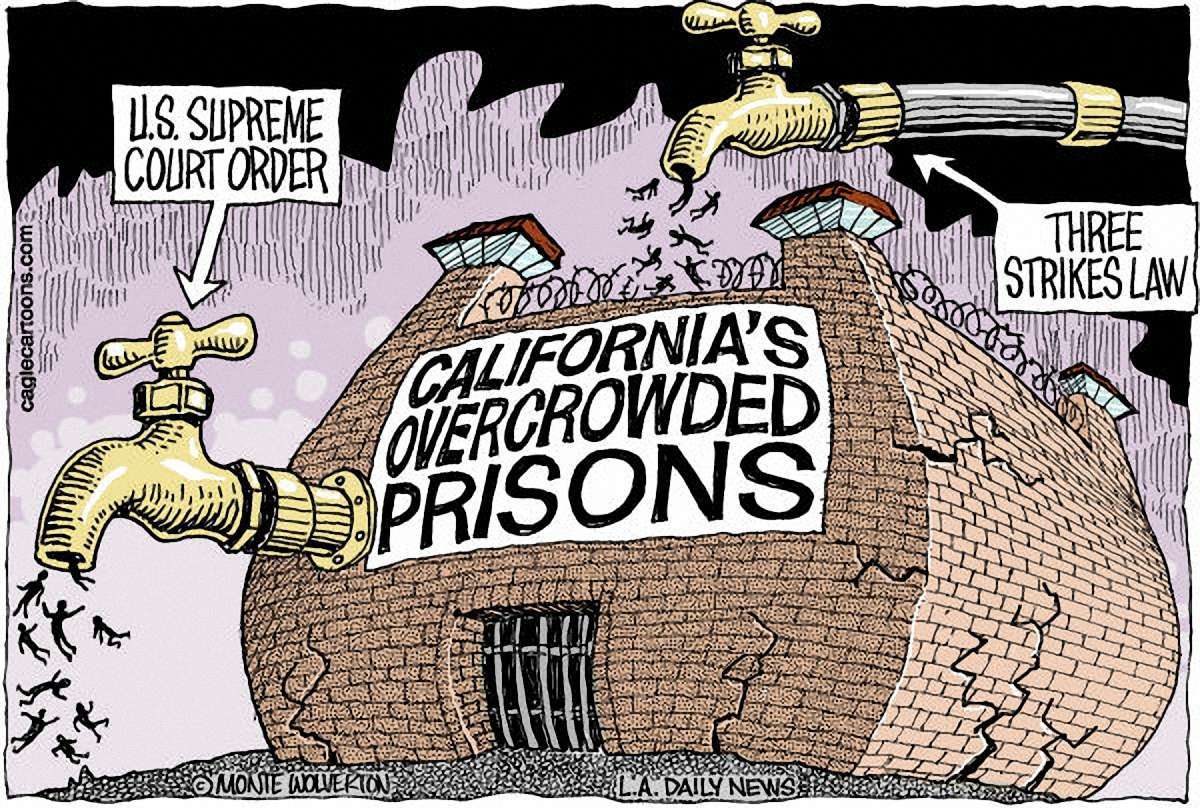 |
| On June 26, the United States Supreme Court ruled the federal Three-Strikes Law unconstitutional. In Johnson vs. United States, the Supreme Court held that the government violated Johnson’s due process by imposing an increased sentence under the Armed Career Criminal Act’s residual clause that was unconstitutionally vague, standard-less, and only enforceable arbitrarily. The ruling elaborated that two elements constitute the vagueness of the law: 1) by assessing risk of a case using fictitious crime rather than using real-world statistics, and 2) ambiguity regarding the amount of risk necessary to qualify a crime as a violent felony. In other words, assessment of risk of future violent crime by an individual is unpredictable and uncertain, and has not historically been applied consistently. Supreme Court Justice Scalia delivered the opinion of the Court, joined by Roberts, Ginsburg, Breyer, Sotomayor, and Kagan, while Kennedy and Thomas concurred in the judgment. Justice Alito filed the sole dissenting opinion. —National Center for Due Process, July 6, 2015 |
There used to be a row of firs
lined up against the fence
limbs outstretched to intertwine
and guard the narrow yard like jailers,
block access to the light
There are prisoners
who never move beyond the confines of their bars
and see the sun
they live in tiny spaces
meant to squash the soul
The trees are down now
their rule long gone
Grass sings
flowers surge in summer hues
grapes dally on the vine
And breathe the smell of freedom
Claire Day lives in western Massachusetts, in an area where writing is virtually a way of life. After writing prose for several decades and both participating in and facilitating writing workshops,she has discovered the joys of poetry. She enjoys its economy of words, its lack of distracting verbage, and most of all, its ability to enter the mind and heart.
JIGGERY-POKERY
by Max Gutmann
 |
| Image source: DonkeyHotey |
“Jiggery-pokery!
Now it's just SCOTUScare!”
Grumbled Scalia, en-
Raged at his peers.
“Unconstitutional
Somersaults. Applesauce!
Really! What next, people?
Marriage for queers?”
Max Gutmann has contributed to Folly and other publications.
Wednesday, July 08, 2015
THE FISH WAS BORN ON FRIDAY
by Clara B. Jones
I am Mexican, but my immigration status is none of your business. I am no rapist or murderer, but Donald Trump has my ticket. It was easy to cross the border at El Alberto. Even the patrol looked the other way. I hitched rides to Newark where my cousin, César, picked me up. He worked in a fancy restaurant in Brooklyn, washing dishes and, sometimes, peeling spuds. His best friend was an Irish guy nicknamed, The Fish, by his father because he was born on Friday. From the beginning, The Fish treated me like shit and told César I was only good for taking bags from the South Bronx to Harlem, the closer to 42nd Street the better. I didn't mind carrying cocaine, but one day the pack was heavier than usual, and I figured it must be a piece. The Fish fooled me; but, not for long. I called César and told him to meet me in the Prospect Park tunnel ahora mismo, and he showed up an hour later with The Fish at his side. When I pulled out the gun, The Fish yelled, “Stupid Spic!”, and lunged at my chest. It happened so fast, I didn't know what to do. But, as I was running away from the cops, I could see they left César's cap in the street.
Clara B. Jones is a retired scientist, currently practicing poetry in Asheville, NC. As a woman of color, she writes about social relations and the moral dimensions of power. Erbacce, CHEST, Ofi Literary Magazine, Transnational, PANK, and 34th Parallel are among the venues her poems and reviews have appeared or are forthcoming in, and she is the author of the weblog, Ferguson and Other Poems About Race: A Chapbook (2015). In the 1970s, Clara studied with Adrienne Rich and, more recently, with the poets Meghan Sterling and Eric Steineger.
 |
| Prospect Park tunnel by TurnoftheSue |
I am Mexican, but my immigration status is none of your business. I am no rapist or murderer, but Donald Trump has my ticket. It was easy to cross the border at El Alberto. Even the patrol looked the other way. I hitched rides to Newark where my cousin, César, picked me up. He worked in a fancy restaurant in Brooklyn, washing dishes and, sometimes, peeling spuds. His best friend was an Irish guy nicknamed, The Fish, by his father because he was born on Friday. From the beginning, The Fish treated me like shit and told César I was only good for taking bags from the South Bronx to Harlem, the closer to 42nd Street the better. I didn't mind carrying cocaine, but one day the pack was heavier than usual, and I figured it must be a piece. The Fish fooled me; but, not for long. I called César and told him to meet me in the Prospect Park tunnel ahora mismo, and he showed up an hour later with The Fish at his side. When I pulled out the gun, The Fish yelled, “Stupid Spic!”, and lunged at my chest. It happened so fast, I didn't know what to do. But, as I was running away from the cops, I could see they left César's cap in the street.
Clara B. Jones is a retired scientist, currently practicing poetry in Asheville, NC. As a woman of color, she writes about social relations and the moral dimensions of power. Erbacce, CHEST, Ofi Literary Magazine, Transnational, PANK, and 34th Parallel are among the venues her poems and reviews have appeared or are forthcoming in, and she is the author of the weblog, Ferguson and Other Poems About Race: A Chapbook (2015). In the 1970s, Clara studied with Adrienne Rich and, more recently, with the poets Meghan Sterling and Eric Steineger.
Tuesday, July 07, 2015
A NEWEST COUNTRY'S ABUSES
by Valerie Sonnenthal
where do spirits go
when they have left
reddened earth
violated bodies
Sudanese girls
mothers
women burned alive
their tukuls leave no trace
in ashes of violence
Tabit two-day spree
every man bent
metal beaten
wood hammered
every girl fouled
Nuba Mountains reverberate
bombs obliterate
schools mosques
health clinics crumble
water polluted
nothing for no one
no one the one
they were
yesterday
who counts atrocities
who counts
one war
one way
no where to flee
life simply
eviscerated
, but
where do the spirits go
are they free
must they bare witness
praying for the ancestors
please intervene
Valerie Sonnenthal joined the Cleaveland House Poets when she moved to Martha's Vineyard in 2006. She writes the Chilmark Town Column plus arts and lifestyle stories for the MV Times, Arts & Ideas magazine, and publishes Errata Editions' Books on Books series.
 |
| Photograph: Simon Maina/AFP/Getty . Rights investigators from the UN mission in the Republic of South Sudan (Unmiss) warned of “widespread human rights abuses”, including gang-rape and torture in a report based on 115 victims and eyewitnesses from the northern state of Unity, scene of some of the heaviest recent fighting in the 18-month-long civil war. —The Guardian, June 30, 2015 |
where do spirits go
when they have left
reddened earth
violated bodies
Sudanese girls
mothers
women burned alive
their tukuls leave no trace
in ashes of violence
Tabit two-day spree
every man bent
metal beaten
wood hammered
every girl fouled
Nuba Mountains reverberate
bombs obliterate
schools mosques
health clinics crumble
water polluted
nothing for no one
no one the one
they were
yesterday
who counts atrocities
who counts
one war
one way
no where to flee
life simply
eviscerated
, but
where do the spirits go
are they free
must they bare witness
praying for the ancestors
please intervene
Valerie Sonnenthal joined the Cleaveland House Poets when she moved to Martha's Vineyard in 2006. She writes the Chilmark Town Column plus arts and lifestyle stories for the MV Times, Arts & Ideas magazine, and publishes Errata Editions' Books on Books series.
Subscribe to:
Posts (Atom)