Guidelines


Submission Guidelines: Send 1-3 unpublished poems in the body of an email (NO ATTACHMENTS) to nvneditor[at]gmail.com. No simultaneous submissions. Use "Verse News Submission" as the subject line. Send a brief bio. No payment. Authors retain all rights after 1st-time appearance here. Scroll down the right sidebar for the fine print.
Showing posts with label Russian. Show all posts

Monday, February 16, 2026

THE WEEKEND NEWS

by Bonnie Naradzay


Crouching amid a pile of rubble that used to be his Gaza home, Mahmoud Hammad scoops dirt into a large sieve and shakes it, looking carefully before dumping it out. In recent days, tiny bones have appeared. Mr Hammad believes they belong to the unborn girl his pregnant wife was carrying when an Israeli air strike hit the family's building more than two years ago, killing his wife and their five children. —ABC (Australia) News, February 12, 2026

Israel used weapons in Gaza that made thousands of Palestinians evaporate. Al Jazeera investigation reveals how US-supplied thermal and thermobaric munitions burning at 3,500C have left no trace of nearly 3,000 Palestinians. Al Jazeera, February 10, 2026 

 On February 13, Russian troops attacked a hospital in Sumy where children are being treated. Two strikes were carried out on the medical facility with attack drones at intervals of about half an hour. —Top News in Ukraine, February 13, 2026 


Putin is targeting Ukrainian children now; we must not look away.
With a flour sifter, a father in Gaza searches for his incinerated family
while Putin’s precision drones obliterate schools, hospitals, daycares.
Using shovels, people helped the father locate the rubble of his home.
 
With a flour sifter, a father in Gaza searches for his incinerated family.
Praise be to God, he says, pointing to the pile of bone fragments.
Using shovels, people helped him locate the rubble of his home.
In Gaza, the living are surrounded by the dead.
 
Praise be to God, Hammad says, pointing to a pile of bone fragments.
Israel returned decomposed bodies showing severe mutilation, abuse.
In Gaza, the living are surrounded by the dead.
Israel has restricted the use of bulldozers to excavate the corpses.
 
Israel returned decomposed bodies showing severe mutilation, abuse.
Hammad keeps a photo of his family, smiling, when they were alive.
Israel has restricted the use of bulldozers to excavate the corpses.
Body parts returned in boxes contain only skulls and some bones.
 
Hammad has a photo of his family, smiling, when they were still alive,
while Putin’s precision drones obliterate schools, hospitals, daycares.
Body parts returned in 66 boxes contained only skulls and a few bones,
but Putin is targeting Ukrainian children now; we must not look away.


Bonnie Naradzay has been leading weekly poetry sessions for homeless people at Street Sense and at Miriam’s Kitchen and also at a retirement community, all in Washington, DC.  While at Harvard University in the late 1960s, she was in Robert Lowell’s class on “The King James Bible as English Literature.” In 2010 she was awarded the University of New Orleans Poetry Prize–-a month’s stay in Northern Italy–-in the South Tyrol castle of Ezra Pound’s daughter Mary. A 2017 graduate of the St John’s College (Annapolis) Graduate Institute, her book of poems Invited to the Feast was published by Slant Books in October 2025; three of the poems were nominated for Pushcart Prizes. 

Saturday, March 29, 2025

WE'RE SITTING AROUND A TABLE NOT FAR FROM THE RUSSIAN BORDER

by Ron Riekki


A Chinese artist, a Russian musician, and American poet,
and we talk about surveillance, sharing how dangerous it is
to be an artist, after speaking with a local who told us about
the tensions with Russia, how they're like a choking fog,
and the musician from Russia says it's all propaganda there,
says she doesn't care, that her voice will never be voiceless,
tells us about being taken in by the Russian police and how
she brutalized them with truth, was let go, and then let go
of her country, emigrating, immigrating, Euro-ricocheting around,
and hanging out with Pussy Riot, doing anti-war campaigns,
and we speak of the ten percent of the Russian population
being tortured, and she speaks of physical torture and
emotional torture and the torture of propaganda, and
the Chinese artist talks about holding up signs in Hong
Kong that were all white, not allowed to have signs with
actual words, so this haunting image, this effective image
of hundreds of artists and writers and protestors and students
holding up these white signs, ghost signs meant to haunt
politicians, and the American poet talks about being hunted
by the Trump administration for a pro-Islamic, pro-immigrant
tweet, how the administration administered paperwork to his
home, pages and pages and pages of warning, how watched
we are everywhere, he says, he thinks, he feels, and we are
near the Russian border, except it's shut down, too dangerous,
and here we are, doing art that is too dangerous, and having
this conversation that is too dangerous, so dangerous that
we turn off our phones to make sure we are not being listened
to, because we want to create the form of our words, rush
home and turn our conversations into lyrics and artwork
and this poem you are reading now, written near a border
that is rotting with worry, a border that lacks moonlight tonight.


Ron Riekki co-edited Undocumented: Great Lakes Poets Laureate on Social Justice.

Tuesday, January 02, 2024

SMALL VICTORIES

by M. Benjamin Thorne


Two Russian poets have been handed long jail sentences for taking part in a reading of anti-war poems in Moscow. A Moscow court gave Artyom Kamardin seven years and Yegor Shtovba five and a half years for "inciting hatred" against Russian troops and making "appeals against state security". Both had pleaded not guilty… A third poet who had taken part in the poetry reading, Nikolai Dayneko, was given a four-year sentence earlier this year after pleading guilty and co-operating with the investigation. —BBC, December 28, 2023. Photo: Russian poets Artyom Kamardin (L) and Yegor Shtovba (R) stand inside the defendants' glass cage as the verdict against them is announced at a court in Moscow, on December 28, 2023 [Alexander Nemenov/ AFP via AlJazeera]


Artyom Kamardin, the scuttling hands
of Putin’s comrade army clutched you away.  
Yegor Shtovba, they broke you in prison, brutally 

shoved their weakness inside you. 

Today they sought to silence freedom,
and tonight Akhmatova’s ghost screams.


All for the crime of poetry. A few words
that sat heavily in public, burning
like Chernobyl rubble, glowing in the dark.
What will their half-life be?
Already the rallied crowd shuffles
back into quiet anonymity.
Who bows their head lower now                  
in shame, them or Pushkin?
Where are the souls so moved
reciting Eugene Onegin from memory?
Where the fierce courageous applause
that followed Shostakovich and Yevtushenko?
Freedom is still a young and starving child,
will you like Tsvetaeva give her to the state to die?
Why grieve for fallen soldiers
when you murder them at home?

Perhaps their poems were as meaningless
as Soviet ration cards for milk past 10 am,
or victory claimed in a burned-out village.
One poem may not change the world.
But words are radioactive and once heard
can decay the most calcified mind’s
defenses. Perhaps the sense of resistance
is not to succeed, but inspire others to resist.
A poem may change the world for one person.


M. Benjamin Thorne is an Associate Professor of Modern European History at Wingate University. As an historian and poet, he is interested in what—and how—societies choose to remember and forget traumatic episodes from the past. He has poems forthcoming from Topical Poetry and The Main Street Rag.

Saturday, October 22, 2022

HOW NORMAL LIFE IS IN KHERSON!

by Bonnie Naradzay


Russian soldiers have shot dead a Ukrainian musician in his home after he refused to take part in a concert in occupied Kherson, according to the culture ministry in Kyiv. Conductor Yuriy Kerpatenko declined to take part in a concert “intended by the occupiers to demonstrate the so-called ‘improvement of peaceful life’ in Kherson”, the ministry said in a statement on its Facebook page. The concert on 1 October was intended to feature the Gileya chamber orchestra, of which Kerpatenko was the principal conductor, but he “categorically refused to cooperate with the occupants”, the statement said. —The Guardian, October 16, 2022


How normal life is in Kherson, 
ruled by Russian invaders since April!
A life of repression, kidnapping,
and mass detainment of its citizens.
How normal life is in Kherson!
with Russian invaders planning
a concert for the first of October
to show how normal life is in Kherson 
while deporting everyone to unknown 
locations from Kherson because
this is how normal life is in Kherson.  
The conductor for the concert, 
that the Russian invaders insisted on,
to show how normal and calm it was,
Yurii Kerpatenko, declined to take part .
So in true Soviet tradition the invaders
went to his home and murdered him, 
to prove how normal life is in Kherson.


Bonnie Naradzay’s poems are scheduled for publication in Crab Creek Review, Dappled Things, and The Birmingham Poetry Review, and appear in AGNI, New Letters (Pushcart Nomination), RHINO, Kenyon Review online, Tampa Review, Florida Review online, EPOCH, Pinch (Pushcart Nomination), American Journal of Poetry, Potomac Review, The Poetry Miscellany, and other places, and her essay on friendship was published recently in the anthology Deep Beauty. She leads weekly poetry sessions in day shelters for the homeless and at a retirement center.

Friday, April 22, 2022

350 PAGES

by Thomas J. Erickson


i


The battle for Madrid [during the Spanish Civil War]… was decided in lecture halls, laboratories, and classrooms at the sprawling campus of University City… Brigaders stacked books in the windows as shields from snipers; bullets usually did not penetrate past the 350th page, so they sought out the thickest tomes of German philosophy and Indian metaphysics. —Dan Kaufman, The New York Review, February 24, 2022, on The International Brigades by Giles Tremlett. 
 

If a book can stop a bullet
then it stands to reason that words
can unite a world in ways
that are surprising
to its sense of normalcy
 
On page 351, Tolstoy and Dostoevsky
and Grossman were just getting started
 
If only the power of the grand Russian novels
of war and peace and crime and punishment
and life and fate could prevail across the borders,
from east to west.
 
Of course, that’s not going to happen, I think,
as I lie in bed and check Babel’s Red Cavalry
for thickness.


Thomas J. Erickson is an attorney in Milwaukee.  His latest book is Cutting the Dusk in Half by Bent Paddle Press.

Sunday, April 17, 2022

SEA-TAC AT EASTER

by Jerry Krajnak


Fifty years ago, a boy returned
on a drizzly Easter Monday and found no one
to curse or kiss him. Holiday decorations
peeled from the walls as he lugged his duffel bag
to the gate of the final red-eye homeward flight.
On that eastbound plane no one asked
what he had done to earn that colorful ribbon
on his lapel or the metal pin on his hat.
Not wanting to hear about Vietnam, they looked
away from him as the plane sped on in the dark.
Only clinking ice cubes and the cry of a baby
welcomed him home on that dark United flight.
 
What kind of welcome will they receive next year,
all those young Russian soldiers, as they return
from afar? Uneasy and gone so long from home,
will they be thanked for their service to the state,
hear shouts of baby killer hurled, or worse,
arrive ignored by tired mothers and brothers
all sick of deprivation and numbed by broadcast
body counts that cannot be confirmed?
Will sisters and fathers and friends all cover their ears,
unwilling to hear what these young men would tell
about the distant place where they were sent
to do what leaders told them they must do?


Jerry Krajnak is a retired Vietnam veteran who lives in the North Carolina mountains. Recent poems appear in Plants and Poetry, Novus, Rat's Ass Review, Sublunary Review, and in the Flee to Spring anthology.

Tuesday, April 05, 2022

WHEN ALL ROADS LEAD TO MONSTERS


by Shelly Blankman


I

When all roads lead to monsters, where do you turn?
Plucked like a stinkweed from his family farm, a young
Ukrainian is trucked like freight to Nazi camps, where he
labors for the next 12 years in four concentration camps.
Like all captives, he will be stripped of warm clothes in 
frigid weather. He will be fed a half-slice of bread and 
watered-down soup before laboring in dark and dank
tunnels and mines with only stone cots on which to rest.
In quarries, he will hoist heavy boulders up hundreds of
steps and carry down corpses of those murdered by
Nazis for their frailities. And if he falters, he dies, too.
He survives. Sick, emaciated, bearing scars of abuse
and pain, but alive. 


II

He returns to Ukraine to rebuild his life. An apartment that is 
safe and warm. Clothes, food, medical care. A wife, children
and grandchildren. Most of all, he has a voice. He travels to
speak for those who have been silenced. Conferences, events,
memorials, and schools. People must remember. This must
never happen again. But his travels have now led to a wartorn
road with a dead end. Seventy-seven years after his nightmare
at the hands of Nazis has ended, Russian troops bomb his
apartment, killing him.


III

He now lies in a roadside cemetery. A few family members clustered 
around his coffin at his funeral. A stiff, cold wind snuffed out their 
lit candles quickly. A young Orthodox priest, bundled in a parka,
led a hasty service as bombs blasted in the distance. “He was patient
and kind,” he lamented as the coffin was lowered into the damp ground.

If only the world would be the same.


Shelly Blankman lives in Columbia, Maryland, where she and her husband have filled their empty nest with three rescue cats and a foster dog. Their sons, Richard and Joshua,  now live in New York and Texas (respectively). Following careers in journalism, public relations, and copy editing, Shelly now spends time writing poetry, scrapbooking and making cards. Her poetry has appeared in The Ekphrastic Review, Poetry Super Highway, Praxis Magazine, Halfway Down the Stairs, and Muddy River Review, among other publications. A couple of years ago, Richard and Joshua surprised Shelly by publishing her first book of poetry, Pumpkinhead.

Monday, March 07, 2022

ANTI-WAR RALLY

A Correspondence

by Phyllis Klein, Kathy Les, and Renée Schell


KYIV, Ukraine — Makeshift roadblocks have been installed throughout this capital to impede the movements of Russian troops snaking toward the city in a convoy about 15 miles away. On some strategic thruways, Ukrainians have parked trams and buses to restrict driving access. Checkpoints to inspect IDs have also been established to root out would-be saboteurs. “We have a lot of presents” for the Russians, Kyiv Mayor Vitali Klitschko said in an interview. “It’s not sweet. It’s very painful.” The extended 40-mile parade of Russian armored vehicles, tanks and towed artillery headed from the north on a path toward Kyiv has both alarmed and befuddled watchers of this expanding war. It’s not just its sheer size. It’s also because for days, it has not appreciably been moving. U.S. officials attribute the apparent stall in part to logistical failures on the Russian side, including food and fuel shortages, that have slowed Moscow’s advance through various parts of the country. They have also credited Ukrainian efforts to attack selected parts of the convoy with contributing to its slowdown. Still, officials warn that the Russians could regroup at any moment and continue to press forward. —The Washington Post, March 7, 2022


Dear Friends,

I send my love this spring as every
day a new trauma comes
to bury us just as we climb out 
of yesterday’s avalanche. Even here in 
the flatlands, sidewalks seem to turn
into wet clay, our feet leaving prints
that suck my shoes into glue-like cement.
My heart muscles out its love 
to your hearts as I struggle 
to take a walk, no way to avoid those
cruel neighborhoods of bad news. 
How bad news molders in the streets of tar
and disappointment. Flat tires
and tire irons so easy to weaponize.
Trees blighted, only crows left.
Love watches a plague of human heartlessness
trying to destroy it. Love begs 
for combat boots, stands on the fire escape
outside its tenement of low income love-fires.
I say, Let them burn. To kindle what is lovely 
I send you them, the embers.

—Phyllis

***

Whose Spring?

Lately I wonder 
for whose sake 
the flowers bud, 
the trees open. 
I watch the oak tree 
two houses away, 
how it plumes wider 
a little more each day, 
its pent-up exhilaration 
to burst forth, readiness 
for another year 
of leafy dress. 

Two continents away, 
a 40-mile convoy 
of armored trucks 
stalled in unison, greedy 
to penetrate a capital city 

that not two weeks ago 
populated itself with people 
awaiting their next spring, 
a chance to shed 
the heavy cold,
wet nights. 
 
Now those nights 
are filled with embers, 
blasts big enough,
red enough to douse 
whatever hope 

was had for a new year. 
Whose war is this anyway. 
Whose spring? 

—Kathy

***

Sister Cities

U.S. Sister Cities Sever Relationships to Counterparts in RussiaUkraine—Bloomberg, March 4, 2022

Whose spring? 
Whose war?
Here we planted a new 
word for spring:
Weaponize
A word I don’t want 
to taste in my mouth.
When did that appear?
Daily, hourly
wherever you look
fear is weaponized
water is weaponized
tire irons weaponized
words always.

Here, our spring
promise of ranunculus
sky of water vapor
sky of plumes
sky of smoke

A 40-mile convoy stalled, 
headlights and taillights
a rifle barrel’s width apart
a push, a threat, a smack.
There, even the roads 
are weaponized 
not our hearts
never let it be our hearts

There, hearts are strewn 
on the road 
like spent bullets.
When do we learn that there 
contains here?

—Renée 


Phyllis Klein, Kathy Les, and Renée Schell are widely published poets connected through a poetry crafting group meeting on Zoom. They live in Palo Alto, San Jose, and Sacramento, CA respectively.  This conversation poem is one of many collaborations they hope to have.

Sunday, March 06, 2022

I IMAGINE FIRST LEAVING THE HOSPITAL

by Ying Wu


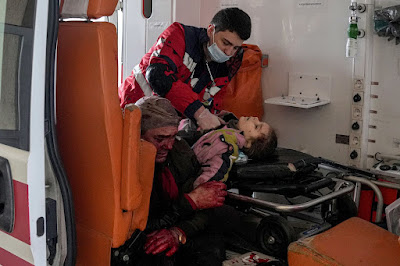
A wounded 6-year-old girl arrived at a hospital in Mariupol, Ukraine, on Sunday. Her mother wept outside the ambulance. Her father was at her side, covered in blood. The family was at a supermarket on the outskirts of the southeastern port city when Russian shelling started, according to the Associated Press. Now, a medical team was racing to save the young girl's life. "Take her out! Take her out! We can make it!" a hospital worker shouted. They placed her onto a gurney and wheeled her inside, where doctors and nurses fought to revive her. But she could not be saved. A doctor who was pumping oxygen into her looked into the camera of an Associated Press videojournalist in the room. "Show this to Putin," he said. "The eyes of this child, and crying doctors." Photo credit: Evgeniy Maloletka/AP —CNN, February 28, 2022


You step on the sidewalk.
 
Life breaks into pieces.
 
There are segments and thresholds.
 
Your child collapsed
when the missile exploded.
 
Your heel strikes the pavement.
 
Her body is there at the hospital, still—
but now, you’re outside.
 
Life crosses thresholds.
 
When your child was born,
you tasted forever.
 
But the sidewalk is sectioned.
Today, all the sections seem smaller.
 
Life is unknown.
It breaks into pieces—
 
and the space between heel strikes
can swallow you whole.


Ying Wu is a cognitive scientist at UC San Diego and executive editor of the Kids! San Diego Poetry Annual.  More examples of her work can be found online at Poetry & Art San Diego, Serving House Journal, Writers Resist, Poetry Pacific, and The New Verse News.  Her work is also featured in a permanent installation at the  San Diego Airport.  She leads research on insight, problem solving, and aesthetic experience and lives with her husband and daughter on a sailboat in the San Diego Bay. 

Tuesday, March 01, 2022

KYIV/SAN FRANCISCO

by Susan Gubernat


Tanks roll in again, wheels oiled by the slick substances
of nightmare. Across the street, thousands of miles away,
the flower stall opens this morning, spreads its wares
all the way to the curb. Yellow tulips, blue hydrangea.
The flower seller, Ukrainian, must know her business,
as she knows her politics. Once I thought she was 
Russian. I’ve eaten my mistake again and again, buying
her flowers in all seasons: poinsettia, Easter lilies—
expensive but they survive beyond the supermarket brand.
Around her shop the stores have been looted of jewels,
of toothbrushes and toilet paper, but no one has stolen
her orchids, their cat mouths yawning, or the tiny cacti 
in small clay vessels a child might hold up, beg for,
as if she could carry home a star. I don’t have words
for the shopkeeper. I want to bury my face in her shoulder
and weep or cry out. Instead, we talk about how dried
protea blooms can last. You string the fresh ones upside
down. Like bodies of tyrants, I think, in the marketplace.


Susan Gubernat's most recent book The Zoo at Night won the Prairie Schooner prize and was published by the University of Nebraska Press. She lives in San Francisco.

Friday, February 25, 2022

POEM FOR A RUSSIAN SOLDIER

by Jesse Dukes

Written on the Eve of the Invasion of Kyiv


A dead Russian soldier in Kharkiv, Ukraine. Credit: Tyler Hicks, The New York Times.


I believe you know right from wrong. Go back.
You polish your boots, oil your gun.
Watch dispatches from your blue-eyed master.
Brew tea with thyme in your uncle’s samovar.
Brought back from Afghanistan, in dead of winter.
Better drink it now, while it’s still warm.
 
It is cold in Donetsk. In your uncle’s house, it’s warm.
Do you think marching west will bring glory back?
Renew a once terrible empire, melt Russian winter?
Will you do something useful with that gun?
Nikita knew to stay close to the samovar
Who is more clever, master or Man?
 
You are a man who needs no master.
Your uncle’s house is already warm .
You have tea, lemon, an ancient samovar.
You have Tolstoy, Checkov, Lermontov. Back
Home, you have a madman.  On your mantle, he’s placed a gun.
He’s sent you to Ukraine in winter

But you are the French at Borodino, fighting the winter.
You are the Germans in Stalingrad, sent by their master.
Too far from home never firing their guns.
Dying forgetting the comfort of warmth.
Ukraine is no enemy. You can still go back
Find your uncle, fire the stove, fill his samovar.
 
You know the story, Vasily leaves the Samovar.
Plunges back into the very teeth of winter.
And when he realizes his danger, it’s too late to turn back.
And what kind of master would leave a man
Stranded in the cold, without a way to stay warm?
Do you mean to kill winter with a gun?
 
You still have a choice. The gun
May yet stay on the mantle. The samovar
May yet fill the house with steam and warmth.
You and your fellow soldiers cannot defeat winter.
But you can defeat your master, just a man.
You still have a choice. Go Back
 
Stay warm despite the winter.
Heat the samovar, heed no master
Take your gun and go back.


Author’s Note: I wrote this over dinner last night, thinking about Tolstoy's Master and Man, and "Checkov's Gun". I love Russian culture, Russian history, and the Russian people I've met, and I hope they'll find their way to the right path. 


Jesse Dukes is a Senior Producer of Podcasts at WBEZ, Chicago Public Media. Twitter: @CuriousDukes

Thursday, July 26, 2018

THE INTERPRETER’S TESTIMONY

by Rebecca Starks


“I shall be there when the wave has gone by.”
–Marianne Moore


How to put it . . . I don’t remember,
I doodle, I’ve done it since grade school—
pencil lines meaning one mood                     
or another, today vague,
yesterday wave; once friend,
now drug. Go ahead,

subpoena the narrow-ruled pages,
make what you can of the illuminated margins.
An eagle gutting a goose, a savage
spiral, a millipede uncurling,
a mushroom in the rain . . .
who’s to say it’s not shorthand for boredom?         
Besides, I’ve burned them.

In the moment it’s like psychosis,
you forget to notice
the voices never surprise you
unless you’re corrected—then it sticks
for a day or two. With them, the introductions,
Mr Man-of-the-Road—sorry, Mr Street-Smart—
shaking hands with Mr Exemplary—
sorry, Mr Winner—and I
the magician’s saw pulled one way
then the other, like the tide, Truth
the lady with the flexible spine.

What couldn’t I tell you
in confidence, which enjoys such nuance
in both tongues, including itself
and its opposite, which is how they sat,
as one must to feel attraction, or not,
Mr Winner offering to remove my jacket
and Mr Street-Smart asking,
was my necklace made of rawhide.
Otherwise I was invisible.

I was the vodka neither touched,
the puck sliding past bodyguards,
the shadow behind the lattice,
the fish hiding under stones,
the poet’s living and buried speech,             
the old man’s marlin stripped by the sea.
I was manly and hangdog, flattery and threat,
throat-clearing and chuckle and gleam,
collar and cufflink, the shakedown
comparing watches . . . I was there.

Do you think it matters what was said?
What was agreed upon?
You can hear it in the question.

When my son was two,
someone asked, watching him play,
Don’t you wish you knew what he’s thinking?
I laughed. He looked at shoes
and said Shoes, he looked at me
and said Up, he looked at nothing
and said More. A cup turned upside down
has no bottom. In truth

I was superfluous—
the two men spoke the same language,
every exchange translating roughly:
You could be useful to me. And also to me.

Though at one point Mr Winner spun a coin
saying In God We Trust, and when I was at a loss
Mr Street-Smart suggested ne doveryat' nikomu,
which means, more or less, go in peace,
as nevedenie means deniability.

Which reminds me that near the end
when I translated freedom, Mr S-S corrected, “freedom”—
as one parent might answer a child, forever
and the other, indefinitely.

What would I say? What wouldn’t I?
What is paranoia but whistling in the dark?
Or, if you prefer the Russian, ostentatious optimism?


Rebecca Starks lives in Vermont. She has poems and short fiction appearing or forthcoming in Baltimore Review, The Hopper, Crab Orchard Review, Ocean State Review, Tahoma Literary Review, Slice, and elsewhere. She is the recipient of Rattle’s 2018 Neil Postman Award for Metaphor, and her manuscript is a finalist for the 2018 Richard Snyder Memorial Publication Prize. 

Saturday, November 04, 2017

THE EYES OF CHECHEN AUTHORITIES WILL NEVER LET THEM FORGET WHAT THEY HAVE DONE

by David Hanlon


A leading Russian human rights group has expressed “serious fears” that a gay pop star may have been killed in Chechnya’s crackdown on gay people. Zelimkhan Bakayev, 26, went missing in August when he left his home in Moscow to visit the capital, Grozny, for his sister’s wedding. “When a person disappears and the police force refuse to investigate his disappearance, we have serious fears for the life of that person,” Oleg Orlov, from Memorial, Russia’s oldest civil rights group, told AFP on Friday. Russian NGOs and media outlets have raised concerns about the fate of Bakayev and speculated that Chechen police may have abducted him due to his sexual orientation. —The Guardian, October 27, 2017. Photo: Some time before his disappearance,  Zelimkhan Bakaev (right) posed with Chechnya's leader Ramzan Kadyrov. —Facebook


Even when they squeeze
them shut,

they’ll bulge
like fat camera reels

turning, projecting
the images on the backs

of their eyelids –
flesh screens

a silent,
black-and-white

horror movie
stuck

on repeat.


David Hanlon is from Cardiff, Wales. He is sickened by these atrocities that are still ongoing. With a leader who claims 'no gay men exist in Chechnya,' how can gay men ever feel safe within the republic again? Outside authorities need to intervene & put a stop to this inhumanity now!

Thursday, July 20, 2017

MATRYOSHKA DOLL

by Harold Oberman


Lawyers peel off the layers
Of suited smiling dolls,
The next one smaller,
Until they find
An orange
Infant
Tsar.


Harold Oberman is a lawyer working and writing in Charleston, SC.  He went to the University of Virginia where he took full advantage of the poets teaching in the English Department. 

Friday, January 08, 2016

PUTIN'S STRIDE

by Bill Petz


George W. Bush infamously claimed to have looked into Russian President Vladimir Putin’s eyes and gotten a “sense of his soul,” but perhaps he would have learned more by watching him walk. A recent paper in the British Medical Journal takes up the unexpected question of why Putin, as well as several of his subordinates, walk with an unusual gait, swinging the left arm normally but keeping the right arm close to the hip. Bastiaan R. Bloem, a neurologist at Radboud University Nijmegen Medical Centre in the Netherlands, says he was first tipped off to the strange gait by one of his former instructors, who noticed it in a video of the Russian president. For Bloem and his co-authors (all “movement disorder enthusiasts,” as he puts it), the video, and others in which Putin walks the same way, set off alarm bells since “unilaterally reduced arm swing” can be a sign of several neurological disorders, including Parkinson’s disease. . . . Videos of other senior Russian officials show the same unusual gait, including Prime Minister (and former president) Dmitry Medvedev, former defense minister Anatoly Serdyukov, and current chief of the presidential administration Sergei Ivanov. “The first thing that came to mind is, ‘What the heck? Is there a Parkinson’s epidemic in the Kremlin?’ ” says Bloem. Another possible explanation surfaced when one of Bloem’s colleagues found a KGB training manual, which instructs operatives that “[w]hen moving, it is absolutely necessary to keep your weapon against the chest or in the right hand. Moving forward should be done with one side, usually the left, turned somewhat in the direction of movement.” The authors have called the ex-KBG agent’s John Wayne–esque walk a “gunslinger’s gait.” This doesn’t mean, literally, that the president is packing. Putin probably never did much gunslinging in the KGB, where his job was to recruit potential operatives in East Germany, but the walk may be a tough-guy affectation akin to his often-coarse choice of language. “Putin is a macho leader who kept his gait to show that he is a KGB veteran,” Bloem says. --Slate, Dec. 15, 2015


Look at Putin's walk.
Right arm doesn't swing,
left does the usual thing.
Seems kinda awkward.

Dutch neurologists took a look.
Nothing new they say,
just a gunslinger's way.
It's in the KGB training book.

Faster to go for their guns.
It might just be,
but let's wait and see
if it's not Parkinson’s.

A loss of control,
dementia and depression
explain his aggression,
lack of soul.


Diagnosed with Parkinson's 10 years ago, Bill Petz' right arm doesn't swing without meds. He lives and writes in the mountains of western North Carolina. His work has been published in Status Hat, The Ashevillle Citizen-Times, The Chronicles of Higher Education, Artists & Writers Quarterly and TheNewVerse.News.

Friday, March 14, 2014

REMEMBER CHERNOBYL

by B.Z. Niditch


We watch the war hawks
in the media
with reckless rhetoric
and historic amnesia
getting in their last licks,
wishing to turn
their backs
on the clocks of 1986
at the horrific peril
of Chernobyl
when rains of death
spilled over the Ukraine
polluting our earth,
then missiles started
to dissolve
on Russian soil,
now the critics of peace
have resolved
to start shooting
even at the Kremlin
when we know our foil
is really about the oil
our citizens
choose peace
to ignore the breathless
lies for war.


B.Z. Niditch is a poet, playwright, fiction writer and teacher.  His work is widely published in journals and magazines throughout the world, including: Columbia: A Magazine of Poetry and Art; The Literary Review; Denver Quarterly; Hawaii Review; Kadmos (France); Prism International; Jejune (Czech Republic); Leopold Bloom (Budapest);  Le Guepard (France);  Antioch Review; and Prairie Schooner, among others. He lives in Brookline, Massachusetts.