Guidelines


Submission Guidelines: Send 1-3 unpublished poems in the body of an email (NO ATTACHMENTS) to nvneditor[at]gmail.com. No simultaneous submissions. Use "Verse News Submission" as the subject line. Send a brief bio. No payment. Authors retain all rights after 1st-time appearance here. Scroll down the right sidebar for the fine print.
Showing posts with label missile. Show all posts

Friday, September 12, 2025

DEBATE RESTS

by Chad Parenteau


Gang violence?

Missile drills 

by buzzwords.


Hard evidence.

Fingers fumble

to investigate. 


Cannot say

Now show me

another one.


Body already

set in place

as latest step 


next armchair

commander 

strides over. 


Chad Parenteau hosts Boston’s long-running Stone Soup Poetry series. His work has appeared in journals such as Résonancee, Molecule, Ibbetson Street, Pocket Lint, Cape Cod Poetry Review, Tell-Tale Inklings, Off The Coast, The Crossroads, The Skinny Poetry Journal, The New Verse News, dadakuku, Nixes Mate Review and The Ugly Monster. He has also been published in anthologies such as French Connections, Sounds of Wind, Reimagine America, and The Vagabond Lunar Collection. His newest collections are All's Well Isn't You and Cant Republic: Erasures and Blackouts. He serves as Associate Editor of the online journal Oddball Magazine and co-organizer of the annual Boston Poetry Marathon. He lives and works in Boston.

Wednesday, September 18, 2024

THE DAILY BRIEF

by Michal Rubin


Counting backwards. Day 318 of a war. 

Yesterday the yard flooded,

an email hollered at me-

“317 days of slaughter”.

I apologized.


Counting backwards. Day 303 of a war.

Ishaq starved to death. His motorcycle

remained under the rubble,

he loved it. The motorcycle. He didn’t holler.

I apologized.


Counting backwards. Day 300 of a war.

West of the city, carrying food on his

bike, Khaled rode too close 

to the missile. Burial site unknown.

I apologized.


.

.

.

.

.

.

.

.

.

.

.

.

.


.


.


Counting backwards. Day 36 of a war. 

I am at a conference. Unseasonably warm. 

I brought the wrong clothes. Elham 

dropped the embroidered bag when 

a sniper’s bullet reached her.

I apologized.


Counting backwards. Day 13 of a war.

In a poem Hiba wrote “We are not just

transients passing”. Her poems rippled

through the world, she was killed. 

At home. An airstrike.

I apologized.


In a beginning. Day 1 of this war.

Clear sky, a small pond, 

a gentle fall in SC. Horror

surges afar. No flutter in this pond.

I call home—

I don't apologize.


Michal Rubin is an Israeli, living in Columbia, SC. The impetus for her writing came from the years-long Israeli-Palestinian conflict. As a  psychotherapist, a Cantor and a poet, she brings forth the challenge of distinguishing truths from myths, awareness vs. denial, conformity vs. individuation. Her work was published in Psychotic Education,  The Art and Science of Psychotherapy, Wrath Bearing Tree journal,  Rise Up Journal, Topical Poetry,  Fall-Lines,  The Last Stanza Poetry Journal, Waxing & Waning: A Literary Journal,  South Carolina Bards Poetry Anthology 2023, Palestine-Israel Journal, Critical Muslim, and a chapbook published by Cathexis Northwest Press.

Monday, December 18, 2023

HAVOC

by William Aarnes


A Palestinian child stands among the rubble of buildings destroyed in Israeli attacks in Nuseirat refugee camp, Gaza. [Photo: Ashraf Amra/Anadolu] —AlJazeera, December 4, 2023


                        rubble, rubble
                                    rubble, rubble, rubble
 
children exist, children exist,
cheery children exist,
chasing each other
at a wedding chosen 
as the target for the missile
that’s seconds away
 
                        rubble, rubble
                                    rubble, rubble, rubble
 
children exist, infants
napping in the daycare
in the building the terrorist
chooses to bomb
 
                        rubble, rubble
                                    rubble, rubble, rubble
 
                                          children
exist, orphaned and maimed
but maybe recovering
in a children’s ward when men
with grandchildren choose
not to worry if the hospital
might be shelled
 
                        rubble, rubble
                                    rubble, rubble, rubble


William Aarnes lives in New York. The refrain of "Havoc" might be a spell uttered by the gods  of havoc, though you might also hear an echo of "Nothing" by The Fugs.

Wednesday, October 18, 2023

MY STEPSON IN TEL AVIV SENDS A SHORT VIDEO

by Catherine Gonick


At night, on a street near his house

neighbors follow as soldiers carry

a spent missile as if it were a body.

The weapon that landed, killing

only itself, is about the size

of a man, maybe six feet long,

one end twisted by impact.

It takes three men to carry the gray

corpse to wherever they are going.

I don’t know how it is in Hebrew

or Arabic, but in English, when we say 

a body, we know without being told

whether the body is dead or alive.


Catherine Gonick has published poetry in journals including Live Encounters, Notre Dame Review, Forge, Blue Heron Review,and Beltway Poetry Quarterly, and in anthologies including Support Ukraine, Grabbed, and Rumors, Secrets & Lies: Poems About Pregnancy, Abortion and Choice. She works in a company that slows the rate of global warming through projects that repair and restore the climate. 

Monday, October 09, 2023

TRAJECTORY

by Carol Dorf


The problem set gives us: a stone, force, an angle.
Given this, predict when the stone will hit the ground.
Outside the book this problem grows more complex
even if there are no dragons to interfere with the trajectory.
Imagine a missile. No don’t. There’s no need to imagine:
haven’t you opened the paper today? Imagine a war
where children’s bodies form the location of the necessary
violence. Don’t authorities always say necessary?

Imagine or don’t the intersection between a missile
and an apartment block. The shoes, the plates,
a shelf full of exploded books. Imagine a graveyard,
damp with morning fog, petrichor rising, pollinators
slipping past the plastic flowers hungry for something real.
Imagine picking up a stone, two stones, and placing them
on a grave, where the story of nothing special here
is more important than a name, than the dates below.


Carol Dorf is a Zoeglossia fellow, whose poetry has been published in several chapbooks and in journals that include The New Verse News, About Place, Cutthroat, Unlikely Stories, Rise Up Review, Great Weather For Media, Slipstream, The Mom Egg, Sin Fronteras, The Journal of Humanistic Mathematics, Scientific American, and Maintenant. They are founding poetry editor of Talking Writing, and taught math in Berkeley.

Saturday, May 07, 2022

WHAT IS THERE TO DO

by Jan Harris


Valeria Hlodan, her baby daughter Kira, and Valeria’s mother Liudmila died in the missile strike on 23 April. (Picture: @myroslavapetsa; Rex via Metro.)


after seeing the photograph from Odesa
of a mother and her new baby girl
killed by a missile-strike
 
but lay down the bread
your throat will no longer swallow
and rest your eyes
 
on the bird that alights
on the sweet-smelling lilac 
by your door,
 
notice his glossy black cap,
yellow breast glowing
in warm April sun,
 
how he stays for a moment,
how swiftly
he flickers away.
 
 
Jan Harris’s poetry has appeared in various literary journals, including Acumen, Atrium, and Poetry Wales, and in anthologies, including several e-books published by Poetry Kit. She received third place in the Wales Poetry Award, 2019. Her first collection, Mute Swans on the Cam, was published by Oversteps Books in July 2020.

Thursday, April 28, 2022

THE RELICS OF MARIUPOL

by Agnieszka Tworek


A Reuters photo shows the building of a theatre destroyed in the course of Ukraine-Russia conflict in the southern port city of Mariupol, Ukraine on April 10, 2022.


grey butterflies of ashes
rise and fall on Mariupol
after each missile or bomb
is dropped
 
bridges and roads
to safety are gone,
no way in or out
 
many can’t pass
the threshold to the other
world because even Death
is overwhelmed in Mariupol
 
ghosts help wounded
soldiers reload their guns
 
the lacerated land
bleeds into the sea
shadowed by the enemy fleet
 
sirens lull children
to sleep and wake them up
 
what is for breakfast?                         
a spoonful of air
 
what’s to drink?
a cup of rain
 
what is a house?                     
fire and smoke
 
what is a school?                    
a gaping hole
 
what are the walls?                
your mother’s arms
 
the city landmarks endure
on maps stored
in survivors’ hearts
 
grey butterflies of ashes
rise and fall on Mariupol
at dawn, noon, and dusk
 
a woman covered in dust
presses her hands on the ground,
as if trying to resuscitate
her hometown
 
wailing and blood
are spilling out
from the underground
 
does anybody know? 
everyone knows
does anybody come? 
nobody comes
except for bullets, rockets,
and bombs.


Agnieszka Tworek was born and raised in Poland. Her poems have been published in Ploughshares, The Sun, Best American Poetry, The Southern Review, Rattle (Poets Respond), and in other journals.  She lives on Staten Island.  

Saturday, March 12, 2022

WHEN WAR COMES

by Tricia Knoll


At first the war seemed far away from dying manatees, 
slaughtered wolves, prices at the pump, and bomb cyclones.  
 
Then I asked myself IF I had ever
            eaten from plastic boxes in an air-raid shelter
            witnessed the death of my children on Instagram
            slept in a subway station on one old blanket
            carried a bleeding pregnant woman from a bombed-out hospital
            met my neighbors for the first time in a shelter
            tried to explain why my dog should get food
            pushed twelve women and children into a minibus
            moved my grandmother in a wheelbarrow
            asked where all the shoes went in the shoe store
            lined up all my books—from Dante to Harry Potter
                        to Yeats and Dickinson as shields from bullets
            considered shooting a saboteur on my street
            sang a song to comfort strangers
            clutched my passport every minute of every day
            cooked for a soldier in the basement
            hoped there was enough water for bedtime
            decided to name a newborn as a missile fell
            realized I had to leave behind the family Bible
            worried about who is running the nuclear plant
            mixed a Molotov cocktail in yesterdays’ Chablis bottle
            tried to resurrect the footprint of my family’s home
            fled from ancestral graveyards
            appreciated bright stars in a black-out
 
in dark days for the globe—midst pandemic, 
climate change, aggression, lies, inflation, poverty,
and pollution. What song does the Earth sing today? 


Tricia Knoll understands concerns about rising gas prices and inflation. She is able to drive less, to stay home while others cannot and buy less. The televising of the war against Ukraine is ceaseless and compelling, She wishes we could act as if we are all residents of Earth, what destroys one hurts us all as citizens of this globe.

Sunday, March 06, 2022

I IMAGINE FIRST LEAVING THE HOSPITAL

by Ying Wu


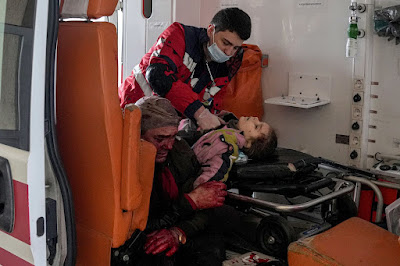
A wounded 6-year-old girl arrived at a hospital in Mariupol, Ukraine, on Sunday. Her mother wept outside the ambulance. Her father was at her side, covered in blood. The family was at a supermarket on the outskirts of the southeastern port city when Russian shelling started, according to the Associated Press. Now, a medical team was racing to save the young girl's life. "Take her out! Take her out! We can make it!" a hospital worker shouted. They placed her onto a gurney and wheeled her inside, where doctors and nurses fought to revive her. But she could not be saved. A doctor who was pumping oxygen into her looked into the camera of an Associated Press videojournalist in the room. "Show this to Putin," he said. "The eyes of this child, and crying doctors." Photo credit: Evgeniy Maloletka/AP —CNN, February 28, 2022


You step on the sidewalk.
 
Life breaks into pieces.
 
There are segments and thresholds.
 
Your child collapsed
when the missile exploded.
 
Your heel strikes the pavement.
 
Her body is there at the hospital, still—
but now, you’re outside.
 
Life crosses thresholds.
 
When your child was born,
you tasted forever.
 
But the sidewalk is sectioned.
Today, all the sections seem smaller.
 
Life is unknown.
It breaks into pieces—
 
and the space between heel strikes
can swallow you whole.


Ying Wu is a cognitive scientist at UC San Diego and executive editor of the Kids! San Diego Poetry Annual.  More examples of her work can be found online at Poetry & Art San Diego, Serving House Journal, Writers Resist, Poetry Pacific, and The New Verse News.  Her work is also featured in a permanent installation at the  San Diego Airport.  She leads research on insight, problem solving, and aesthetic experience and lives with her husband and daughter on a sailboat in the San Diego Bay. 

Tuesday, March 01, 2022

BABYN YAR 2.0

by Howard Richard Debs


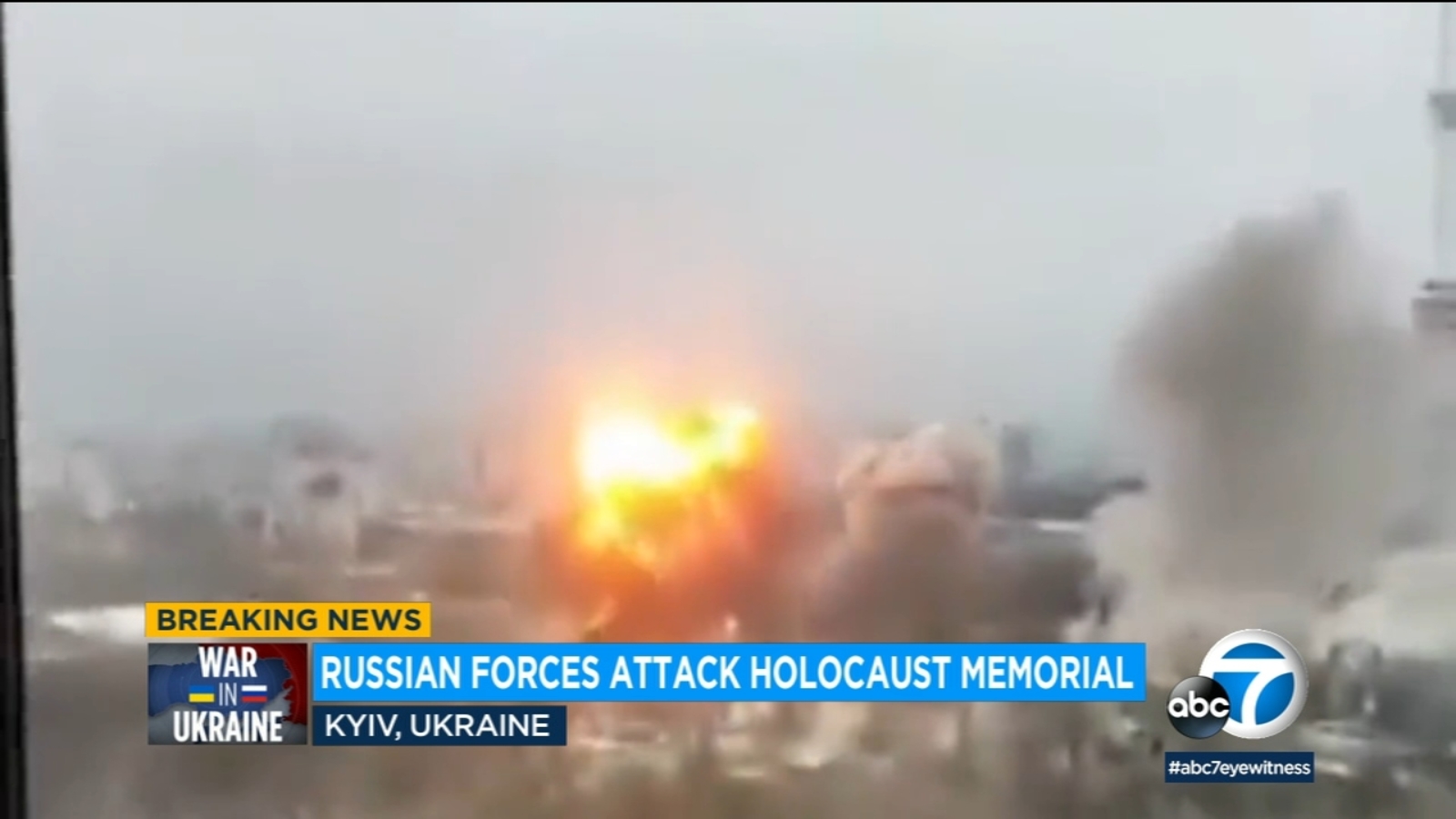
A Russian missile attack has
struck the TV tower in Kyiv.
All the TV channels are
off the air. Where?
Just outside the center
of the city. There is a park there.
 
 
A small park with some monuments
commemorating events from the past.


Howard Richard Debs is a recipient of the 2015 Anna Davidson Rosenberg Poetry Awards. His essays, fiction, and poetry appear internationally in numerous publications. His photography is featured in select publications, including in Rattle online as “Ekphrastic Challenge” artist and guest editor. His book Gallery: A Collection of Pictures and Words (Scarlet Leaf Publishing) is the recipient of a 2017 Best Book Award and 2018 Book Excellence Award. His latest work Political (Cyberwit Press) is the 2021 American Writing Awards winner in poetry. He is co-editor of New Voices: Contemporary Writers Confronting the Holocaust forthcoming from Vallentine Mitchell of London, publisher of the first English language edition of Anne Frank's diary. He is listed in the Poets & Writers Directory. Debs' maternal grandmother immigrated to the U.S. from Pryluky, Ukraine.

Thursday, November 18, 2021

TO BE IN EARTH'S ORBIT

by Rémy Dambron


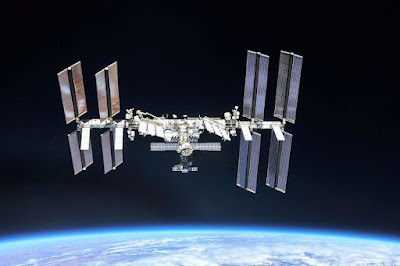
The US has condemned Russia for conducting a "dangerous and irresponsible" missile test that it says endangered the crew aboard the International Space Station (ISS). The test blew up one of Russia's own satellites, creating debris that forced the ISS crew to shelter in capsules. Astronauts on the ISS are increasingly having to take precautionary measures when fragments from old satellites and rockets come close. —BBC News, November 17, 2021


how far we’ve come

since our primitive wheels first rolled on dirt roads
and expanded our means of transit 

since our sails first met the unyielding winds of the sea 
sending us over entire oceans in search of new worlds

since we built the first railroads to journey across continents 
along iron paths only humans could pave

since our mechanical wings first presented us 
with the gift of flight
 
momentarily freeing us from the grounding force 
of earth’s gravitational pull

lifting us into lower skies to tour our globe and glide 
soaring beyond what the eye could see

since our first expedition to the moon 
launched by the thrusts of internal combustion

rockets powerful enough to achieve escape velocity 
and break through the comforts of our planet’s atmosphere 

propelling us into the perils of space 
where no soul had previously traveled 

merely dreamed...

how far we’ve come only to have become 
the very perils we feared

the very menaces we strived 
to mitigate

pieces of ourselves  
unapologetically returning to haunt us

unhesitant to disrupt our lives 
unsympathetic to our vulnerabilities 

our persistent flaws 
our stubborn mortality

an unmerciful reminder of our physiological limits
and the little chance they stand against our cerebral endlessness


Author’s note: To me this story was about more than the handful of lives that were put in harm's way as a direct result of typically destructive human behaviors. While I am relieved that the crew aboard the ISS is safe, this story was a sobering reminder that mankind remains its own greatest threat. We’ve entered a very dangerous era in our brief history as a species, where, in addition to our hazardous nature here on Earth, we have somehow managed to make space.. that cold and dark place with no water, no air, and no life, even more dangerous than it was before we got there. Where do we draw the line? When will we have gone too far?


Rémy Dambron is an English teacher and poet whose writing focuses on denouncing political corruption and advocating for social/environmental justice. With the help of his chief editor and loving wife, his works have appeared in What Rough Beast, Poets Reading the News, Writers Resist, Society of Classical Poets, Robot Butt, and The New Verse News

Saturday, January 11, 2020

SOWERS

by Alejandro Escudé


We’re on a passenger plane
On its way to Ukraine.

All of us on board—the ones
Who economically strain

To carry our beloved,
Unaware of the warlord

Below, strafing shrapnel,
Sower of discord,

Or planning assassination
As though it were a tea.

Who cares? It’s only people
Who have ceased to be.


Alejandro Escudé published his first full-length collection of poems My Earthbound Eye in September 2013. He holds a master’s degree in creative writing from UC Davis and teaches high school English. Originally from Argentina, Alejandro lives in Los Angeles with his wife and two children.

Sunday, August 18, 2019

TARZAN HAS A TAN

by Alejandro Escudé 


During a faculty meeting icebreaker, when I raise my hand to volunteer the song I’ve had stuck in my head, one man yells out: “Ahh. Sing it!” in front of my colleagues. I hear his voice as brassy, sarcastic-toned. Simultaneously, I think of the photograph on the news site today
of the three people (a family?) witnessing the nuclear explosion in Russia—the fire cloud off in the distance, like a huge, rotten orange. 

There are moments when 
you realize you’re job is like that too, a rotten orange. Only you’re stuck inside of it, pushing up against the rind. Or, maybe your job is like Russia and its oligarchs. And sometimes, you and your colleagues are like that family watching the explosion of a missile pregnant with a nuclear reactor. A whale carcass. A room with bones for support beams. Hanging flesh. 

We were asked, at the faculty meeting, to recall a song we had stuck in our heads this summer. And I said I had the Tarzan camp song repeating in my head; that call and response song I had to lead my second graders with— when I was a twenty-year-old camp counselor. 

“Tar … zan,” it began, and they repeated. “Swinging on a rubber band … Tar … zan … fell into a frying pan.” 
I sang it again with my daughter, seven years old, now that she’s in summer camp. The words have changed, slightly. But I think once more of that colleague who sarcastically yelled out that I, sing the song, 
as if I were telling some untruth, or trying too hard impress the room. 

Maybe, later on, someone informed that man that I had kids. That I’d just gotten divorced after seventeen years of marriage. That my kids visit me on weekends and it feels as though half my soul were missing from my body and I only become whole again when I am with them. 

But I don’t think 
anyone told him. He probably thought I was just trying to be cute. I guess, I’ve always tried to be cute. I guess the Russians are trying to be cute as well, installing nuclear reactors inside of missiles that have the ability to reach Alaska, and beyond. 

“Fell into a frying pan,” my daughter repeats. 
“Now Tarzan has a tan. Now Tarzan has a tan.”


Alejandro Escudé published his first full-length collection of poems My Earthbound Eye in September 2013. He holds a master’s degree in creative writing from UC Davis and teaches high school English. Originally from Argentina, Alejandro lives in Los Angeles with his wife and two children.

Sunday, March 04, 2018

WHAT THEY REALLY WANT

by Bill Meissner


Sen. Lindsey Graham (R-S.C.) this week said that a war with North Korea would be “worth it” in the long term. "All the damage that would come from a war would be worth it in terms of long-term stability and national security," the senator told CNN. —The Hill, March 2, 2018. Caricature via Pinterest.


What we want is to step over
the border and give our nearest neighbor a
black eye.
What we want is to gather up our rival countries like cards,
to stack them in a deck,
to shuffle or bend them whenever we wish.

We do not want trivialities, like hands holding other hands,
or a soft touch on the face, or peaceful encouraging voices.
We want our words to slap, to shout, to break knuckles, to cut the skin.
We want our words to weigh
down all other words, to suffocate them.

What we want is the power to press a
button and turn the lights out on a whole continent.
But what we want most
is to launch a missile that,
with its sharp nuclear warhead, will
stab the earth as if it were poking out an eye, blinding it
for once, and for all.


Bill Meissner is a teacher/writer and the author of four books of poems, two short story collections, and a novel Spirits in the Grass which won the Midwest Book Award.  He lives in Minnesota.  Visit his Facebook author page.

Sunday, July 30, 2017

DOG-WALKING IN THE SHADOW OF PYONGYANG

by Devon Balwit


We flip a coin over who walks
the dog, not tired, but edgy,
for the loser glances covertly
upward, listening for whistles,
siren-ready, side-eyeing each lot
for shelter. Somewhere in Pyongyang,
a finger hovers over a button, a head
cocks to catch the command
that will release the unmaker of worlds,
mine. The button-pusher is loyal,
me, reduced to caricature, and soon
to ash, all of us, web-stuck
in history. As with solar flares,
the big quake I’m told is coming,
or closer still, the millions arriving
next month to eclipse-gawk, my way
to cope is to deny, acting as if
and going about my business.
Kim Jong Un may render all
my insomniac panic moot—
aging, health-care, the planet,
my kids, my craft—a flame out sear
to trace elements in an open crater.


Devon Balwit is a writer/teacher from Portland, OR. Her poems have appeared in TheNewVerse.News, Poets Reading the News, Redbird Weekly Reads, Rise-Up Review, Rat's Ass Review, The Rising Phoenix Review, Mobius, What Rough Beast, and more.

Friday, April 21, 2017

DEAR LEADER I WORRIED HIM

by S.O.Fasrus

Image source: zazzle.com


There was Kim Jong-il
Kim Jong-un
turn up the telly
not much fun

Car on the road
masses of space
art on the wall
Kim Jong's face

Go to the shop
can't find one
There was Kim Jong-il
There was Kim Jong-un

Dear Leader Un
taking in the view
firing off a missile
fuse just blew

There was Kim Jong-il
Kim Jong-un
turn up the telly
but you can't turn it off


S.O.Fasrus has verses at LUPO and is currently writing a YA novel.

Friday, October 09, 2015

THE LIMITS OF POWER

by Michael Shorb


“Sen. McCain Expects A Permanent U.S. Presence In Afghanistan” —NPR headline, October 7, 2015. Photo: U.S. soldiers in Afghanistan walk away from a helicopter at Forward Operating Base Connelly in the eastern province of Nangarhar on Aug. 13. The U.S. formally ended combat operations in Afghanistan at the end of last year. But nearly 10,000 American troops remain in the country and the U.S. frequently carries out air sorties. Fourteen American military personnel have died in Afghanistan this year. Wakil Kohsar/AFP/Getty Images via NPR.


A king declared the stars
illegal, not to be seen,
each night thousands were
executed for seeing them,
the king ran out of people
before the sky ran out of stars.

21st century Samson’s
swinging a nuclear jawbone
over his head,
21st century Ahab
kills Moby Dick and lights
ten thousand lamps
ten thousand days.
21st century America’s
gonna control the middle east
with drone missile launchers
and federal air support.

I’m the news no-one listens to.
The TV droning on in a corner,
the politician proudly announcing:

“We’re in Afghanistan
for the long haul.”


Michael Shorb was a poet, fiction writer, editor, and children's book author. As an international poet, his poetry has been published in more than 100 magazines and anthologies, including TheNewVerse.News, Michigan Quarterly, The Nation, The Sun, Salzburg Poetry Review, and Kyoto Journal. He was the recipient of a PEN AWARD, won a Merit Award for the Franklin-Christoph Poetry Contest, and was nominated for a Pushcart Prize. He lived in and loved San Francisco. Michael succumbed to GIST, a rare form of cancer in 2012.


Editor’s Note: Michael’s widow Judith Grogan-Shorb sent TheNewVerse.News this eerily timely poem which Michael wrote soon after the United States first invaded Afghanistan.

Monday, July 21, 2014

ILL

by William Aarnes


He feared he was becoming ill
when, reading the news of the crime,

he could not only see the words
and, when he wanted his wife

to hear, say them aloud but could also
smell them— the gunpowdery musk

in separatists, that hint of antiseptic
in airliner, the electric whiff

in wreckage.   Grief and disbelief
and relief not only rhymed

but also shared the faint aroma
of rot in the refrigerator,

even the ands gone vinegary.
And after he stopped reading,

he could not escape the odors,  
the off-putting essence of altitude,  

the lingering perfume of doomed,
the metallic bouquet of evidence.  


 William Aarnes lives in South Carolina.  His work has appeared recently in Field, Heron Tree, and South 85.

Friday, May 02, 2014

A MASH NOTE TO HILLARY

by David Spicer


You’re an American pioneer.
A world warrior.
You scare the hell out of everybody.
Except your believers.

Why do you want this job?
Don’t give me patriotic bunk
You recite on Hardball.
You want what you want.

Is your ego the size of Texas and Ohio?
Are you Machiavelli’s spiritual great granddaughter?

Your lemon meringue pantsuit fails the fashion test.
That laugh could chop wood.
If I hear On Day One again,
I’ll yank out my bazooka and shoot the Milky Way.

You thought the job a divine right.
You owned the nomination.

Then along came Barack Obama,
Grinning like a llama.
A meteor that seduced a nation:
The Blessed Orator.
The Golden-Tongued Angel.
Smooth as peanut butter on fresh bread.
You'd  met your match.
You hated it.
Live with it.
               
You fight in the era of the last bastion
Of white males.
They resist, a phalanx poised
To confront and destroy you.
Don’t concede.

You’ve been reviled.
Caricatured. Pilloried.
You don’t care. You persevere.

You’re not our mother, our sister, our daughter,
Our girlfriend, our waitress, our opera escort,
But our leader.

And a cat with twenty lives.
Not in double digits yet.

Hillary, you’re my hero.
Tougher than the meanest missile in the world.

Answer this note.
Please.

What about Bill? you might ask.
Forget him, though you love the guy.
Divorce him on Day One.
(Remember, hell hath no fury . . .
He doesn’t want you President anyway.)
Throw him out on the steps with his humidor.

We’ll elope to the Ukraine.
The world our oyster.


David Spicer is  seeking a publisher crazy enough to print his manuscript American Maniac. He has had poems in The New Verse News, The Naugatuck River Review, Spudgun, Yellow Mama, and elsewhere.

Wednesday, July 31, 2013

MPG

by Dawn Corrigan


Oil Refineries at Night


For 6 years I didn’t own a car.
Then I bought a Jeep Cherokee.

It got 11 miles to the gallon.
As my friend Cameron said

when he took the job
at the missile factory

“I’m part of the problem now!”
Yet how quickly I settled

into driving again,
humming along

to Gnarls Barkley
on the 44-mile commute.

How the oil refineries
of North Salt Lake

glowed like enchanted castles
on the way home at night.

How snow packs formed
on the undercarriages

of the cars, then fell off
in blackened chunks

that dotted the highway
like sleeping birds.

How I imagined those birds
waking up, shaking the snow

from their feathers,
taking off for someplace else.


Dawn Corrigan's poetry and prose have appeared in a number of print and online journals, most recently at DIALOGIST, So to Speak, and Digital Americana.