Guidelines


Submission Guidelines: Send 1-3 unpublished poems in the body of an email (NO ATTACHMENTS) to nvneditor[at]gmail.com. No simultaneous submissions. Use "Verse News Submission" as the subject line. Send a brief bio. No payment. Authors retain all rights after 1st-time appearance here. Scroll down the right sidebar for the fine print.
Showing posts with label debris. Show all posts

Tuesday, August 12, 2025

AIR QUALITY ALERT

by Elizabeth Kerlikowske


The National Weather Service has issued an air quality alert for Aug. 11-12 for multiple northern Michigan counties because of smoke drifting south from Canadian wildfires. —Lansing State Journal, August 10, 2025


We’re in charge of so little. Less than an acre; a cat. Clearing debris from the street drain. The few things we control are so inconsequential, no one cares. Not even us. Take my lungs. Please. Take Canadian wildfire smoke. Their wilderness makes civilization  hard. Even deer here in Michigan wear masks. How do they get them on?  Last week, we found out we were made of plastic. Today particulate matter is coating our lungs with Teflon. Silver Beach is like the bottom of an ashtray half full of gin. Haze, the weather man says, trying to fool the tourists. Maple/bacon smoke rolls in, a plague from the Northwest, but we are so far gone, its smell only makes us hungry.


Elizabeth Kerlikowske’s latest chapbook is Falling Women, with painter Mary Hatch.

Saturday, November 02, 2024

A TEAR FALLS FROM THE MOON

by Richard L. Matta


AI-generated graphic by Shutterstock for The New Verse News.


Hideous weeds hide

in high grasses. Experts examine

lawns with satellites, surveil 

with drones, send in spies.

Intelligent eyes can’t locate 

the wild pests so tap-tap-tap 

go the buttons and neighborhoods 

are bombed and burned and stripped 

bare and young lingering eyes of flowers 

are cut off at the head.

I could ask a question of the wise 

pale moon in the thick evening heat 

but it’s dusted with debris. 

A speaker echoes…

         indiscriminately

                   inhumanity.

And I ask myself is this not a swarm

of bees in the making, generations 

of hate stewing, a turn of minority 

to majority, a dark legacy.


Richard L. Matta grew up in New York and now lives in San Diego. Some of his work is found in Ancient Paths, Dewdrop, San Pedro River Review, Third Wednesday, Slipstream, and many international haiku journals. 

Sunday, October 15, 2023

WAR, BY ALL MEANS

by Indran Amirthanayagam 


War. To end all wars. War. To squash, squeeze,

stamp out flea, bug, virus, hate-filled cur. War.

To avenge children, women, men, mowed

down by cars, in homes, gardens, streets.

War. Angels of doom, of death, thousands

of flares splashing the night sky, shot down,


blown up, debris falling aimlessly, thousand

injured, two thousand dead and counting. War.

Invasion. Unprovoked. Stoked. Warships

and aircraft carriers roaring towards the middle

of the Middle East, with sheikhs and princes,

and restless armies, drumming again, to defend,


to protect the right to exist? To live unbombed?

By a temple unbombed? School unbombed?

Agricultural cooperative, unbombed? War.

Peace. Yes bring the 'niks into the chat. Unify

the world before the horror and awe. Get

laws passed that will legalize the extra-


territorial execution. War. Times of War.

Times of throwing civic bones to dogs.

Dogs of war. Howling, yapping dogs

of war. Poor canines we steal for metaphors.

Metaphor. Cadence, Rhyme. Unreason:

War. Temporary Solution:War.


Indran Amirthanayagam is the translator of Origami: Selected Poems of Manuel Ulacia (Dialogos Books). Ten Thousand Steps Against the Tyrant (BroadstoneBooks) is the newest collection of Indran's own poems. Recently published is Blue Window (Ventana Azul), translated by Jennifer Rathbun. (Dialogos Books). In 2020, Indran produced a “world" record by publishing three new poetry books written in three languages: The Migrant States (Hanging Loose Press, New York), Sur l'île nostalgique (L’Harmattan, Paris) and Lírica a tiempo (Mesa Redonda, Lima). He edits The Beltway Poetry Quarterly and helps curate Ablucionistas. He won the Paterson Prize and received fellowships from The Foundation for the Contemporary Arts, New York Foundation for the Arts, US/Mexico Fund For Culture, and the MacDowell Colony. He hosts the Poetry Channel on YouTube and publishes poetry books with Sara Cahill Marron at Beltway Editions.

Wednesday, November 23, 2022

JANUARY 28, 1986

by Bonnie Proudfoot


All morning we waited, the January air frigid and clear, 

"Come see," I said, pointing at the tv. You settled your 

not-quite 3-year-old body beside me on the corduroy couch, 

my belly swelling with your little brother not yet born.

You were my playmate, usually you told me who to be, 

sometimes you were Robin Hood and I was Maid Marian, 

mostly we were Luke Skywalker and Princess Leia, 

but that day I called you the first spaceman, John Glenn, 

I was the first space woman, Christa McAuliffe, I pronounced, 

my teacher heart swelling, and then, you were leading me 

by the hand, into the capsule, we were waving to school children 

gathered to see the launch and even Tom Brokaw seemed 

to have his heart on his sleeve when he introduced 

mission control for the countdown, the lift off. 


On our couch from a mountaintop in West Virginia, 

surrounded only by the universe, we could almost see 

the Challenger capsule heading to that place beyond the sky, 

except, a jagged fork, that looked wrong, and then 

the waving stopped, hands covered mouths, children stood

in silence, and you looked up at me for answers 

I did not have. I'm sorry, I wanted to say. I'm sorry 

I called you over to watch with me, that you had 

to see this. Again and again, the tv replayed the lift off, 

as if, if they showed us once more, it would go differently. 


But no, the small streak of light, the speck of fire. Sometimes it takes 

so long to figure out what I want to tell you, even longer to know 

which words to use, and now, 35 years later, deep-sea divers find 

sets of Challenger tiles on the ocean floor, like pennies dropped 

into an infinite well. Oh, my boy, now man, now father, 

sometimes what you long for will disappoint you, and sometimes 

what you love will rise because of your love, and you'll rise too. 

All afternoon, on our little speck of earth, death walked 

beside us, his index finger waggling, a broken branch, 

and we did the only thing we could, we walked down the lane, 

gathered warm eggs from the hens, picked up limbs the wind

had flung onto the road, all eyes scanning the empty sky for signs


Bonnie Proudfoot has published fiction, poetry and essays. Her first novel Goshen Road (Swallow Press, 2020) was selected by the Women’s National Book Association for Great Group Reads, was long-listed for the PEN/ Hemingway Award, and received the WCONA Book of the Year Award. Her poetry chapbook Household Gods was published by Sheila-Na-Gig Editions in 2022. She lives in Athens, Ohio, and in her spare time she creates glass art and plays blues harmonica. 

Saturday, March 12, 2022

SONGS OF SURVIVAL

by Cristina M. R. Norcross


Pregnant women and children were caught in the bombing of the hospital in Mariupol. —The Mirror (UK), March 10, 2022

“Congress of Peoples for Peace" by Frida Kahlo (1952)


Debris, like ticker tape confetti,
still floats in the air, 
as the camera lens captures
a young mother’s silhouette,
protective hand holding her half-moon curve.
I spot the side of her cheek and eyebrow
dotted with streaks of blood,
where shards of glass or wood must have 
swept past her, mercifully missing 
her vulnerable nest within.
 
A Frida Kahlo painting appears on my screen,
while breaking news continues to drone.
Both moon and sun spheres glow on the canvas.
A tree of life, bursting with oranges,
grows before my eyes.
A mother hen sits impossibly on top,
as if keeping eggs warm on the highest branch.
 
The little girl’s song in the shelter 
lingers from last night, 
stays with me, as I walk through the house.
I hear her honeyed, hopeful voice 
even as I fall asleep. 
Her letting go of sound, word, voice, outcome
is the bravest note I have ever heard.
 
We sing ourselves into a new day,
an insistent melody
where sound itself holds the promise
of survival,
proof that beyond the bombs and tanks overhead,
rooted in the cellar of Ukraine’s earth,
is a chorus of people who believe. 


Cristina M. R. Norcross lives in Wisconsin and is the editor of Blue Heron Review. Author of 9 poetry collections, a multiple Pushcart Prize nominee, and an Eric Hoffer Book Award nominee, her most recent collection is The Sound of a Collective Pulse (Kelsay Books, 2021). Cristina’s work appears in: Visual Verse, Your Daily Poem, Poetry Hall, Verse-Virtual, The Ekphrastic Review, and Pirene’s Fountain, among others. Her work also appears in numerous print anthologies. Cristina has helped organize community art/poetry projects, has led writing workshops, and has hosted many open mic readings.  She is the co-founder of Random Acts of Poetry & Art Day.

Thursday, November 18, 2021

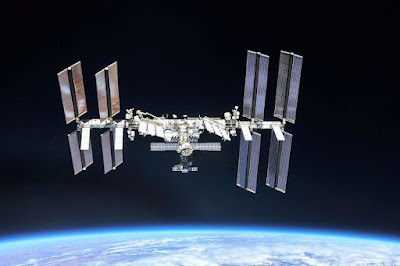
TO BE IN EARTH'S ORBIT

by Rémy Dambron


The US has condemned Russia for conducting a "dangerous and irresponsible" missile test that it says endangered the crew aboard the International Space Station (ISS). The test blew up one of Russia's own satellites, creating debris that forced the ISS crew to shelter in capsules. Astronauts on the ISS are increasingly having to take precautionary measures when fragments from old satellites and rockets come close. —BBC News, November 17, 2021


how far we’ve come

since our primitive wheels first rolled on dirt roads
and expanded our means of transit 

since our sails first met the unyielding winds of the sea 
sending us over entire oceans in search of new worlds

since we built the first railroads to journey across continents 
along iron paths only humans could pave

since our mechanical wings first presented us 
with the gift of flight
 
momentarily freeing us from the grounding force 
of earth’s gravitational pull

lifting us into lower skies to tour our globe and glide 
soaring beyond what the eye could see

since our first expedition to the moon 
launched by the thrusts of internal combustion

rockets powerful enough to achieve escape velocity 
and break through the comforts of our planet’s atmosphere 

propelling us into the perils of space 
where no soul had previously traveled 

merely dreamed...

how far we’ve come only to have become 
the very perils we feared

the very menaces we strived 
to mitigate

pieces of ourselves  
unapologetically returning to haunt us

unhesitant to disrupt our lives 
unsympathetic to our vulnerabilities 

our persistent flaws 
our stubborn mortality

an unmerciful reminder of our physiological limits
and the little chance they stand against our cerebral endlessness


Author’s note: To me this story was about more than the handful of lives that were put in harm's way as a direct result of typically destructive human behaviors. While I am relieved that the crew aboard the ISS is safe, this story was a sobering reminder that mankind remains its own greatest threat. We’ve entered a very dangerous era in our brief history as a species, where, in addition to our hazardous nature here on Earth, we have somehow managed to make space.. that cold and dark place with no water, no air, and no life, even more dangerous than it was before we got there. Where do we draw the line? When will we have gone too far?


Rémy Dambron is an English teacher and poet whose writing focuses on denouncing political corruption and advocating for social/environmental justice. With the help of his chief editor and loving wife, his works have appeared in What Rough Beast, Poets Reading the News, Writers Resist, Society of Classical Poets, Robot Butt, and The New Verse News. 

Monday, December 21, 2020

DEEP WINTER CLEANING

by Mary K O'Melveny 


Painting by Chris Austin via My Modern Met.


Our house always looks neat enough.
If you don’t stare into cupboards
or study drawers too closely. Our stuff
seems mostly under control, buffered
by simple messages, pristine lines.
Desires to peer to closely are aborted
by earnest visions, surfaces that shine.
 
Every now and then, something untidy
slips into view despite best plans,
forcing us to mop, sweep what might be
dust mites or cobwebs from doorjambs,
haul away plastic bags of trash
filled with threadbare linens, brown-edged
papers, dead tennis balls, a rash
of too small jackets, too high heels wedged
 
in closet corners. The birds benefit
from stale biscuits and limp popcorn.
A container of frozen food—whatever it
was now unknown—will not be mourned,
along with moldy bread and avocados.
We haul debris out to the bins.
A period of satisfaction follows
but prophylaxis never begins.
 
Eventually, our grimy shadows emerge,
widen once more. They lurk under chairs,
deep in cabinets, still a scourge
like monsters hidden beneath the stairs
to the basement.  A pandemic excused
us briefly from deep cleaning fits
as time marched forward and dust renewed,
but our shambolic state persists.
 
Now we are facing winter storms,
still surrounded by unexamined chaos.
Until we undertake sweeping reforms,
mops and brooms will be superfluous.
We need to unearth all our buried
secrets, those sordid truths we never found
time to tell, the hopes repeatedly miscarried.
Lay them bare on our snow-layered ground.


Mary K O'Melveny is a recently retired labor rights attorney who lives in Washington DC and Woodstock NY.  Her work has appeared in various print and on-line journals. Her first poetry chapbook A Woman of a Certain Age is available from Finishing Line Press. Mary’s poetry collection Merging Star Hypotheses was published by Finishing Line Press in January, 2020.

Saturday, May 30, 2020

THE WIND RIPS

by Daniel Lance Patrick


Protesters confront a row of police officers outside the White House in Washington, DC, on early May 30. Photographer: Eric Baradat/AFP via Getty Images at Bloomberg.


it rattles my windows as it picks up speed
gusting between apartments
as a wind tunnel

if I was the praying type I’d pray for the death
of the damaged leader
for what he has done and hasn’t
I wish it like a gale force

throwing what isn’t tied down

it’s not how Mama taught me—
but if there was a god it might agree

as the wind rips through the courtyard
I can hear the powerline banging against a pipe

and in all the debris that settles
I just might
find forgiveness


Daniel Lance Patrick is a poet, songwriter and musician. His poems have appeared in The Sandy River Review, The Northern New England Review, NPR, The Buffalo News, among others. He won an Emmy for his work during the London Olympics.

Sunday, May 22, 2016

THE RED SUITCASE

by Jill Crainshaw


she borrowed the suitcase from her cousin
a faded fake leather red one that
stood by the door all those weeks holding
a bathrobe and slippers and baby things ready
to go to the hospital when her first son was born
five years ago now so the suitcase was empty
and made to fit in the overhead
her aunt stuck a magazine in that front
zippered pocket at the last minute
just in case she was hungry for a taste of
home while dining in places far away

it bobs in wild waters now
with sixty-six others spilling out
blouses linen trousers a new blue jacket just in case
those pills she always took to help her sleep
handwritten sticky notes hotel receipts
hidden in the corner from
the trip before the last one
toiletries travel-sized
she planned on returning home
her aunt stares at the television screen
"vanished from radar"
"no survivors"
commentators talk on and on while
she watches wind-swept waves
longing
for something
even a flash of red


Jill Crainshaw is a professor at Wake Forest University School of Divinity in Winston-Salem, North Carolina.

Wednesday, September 10, 2014

AERIAL

by James Penha


At the 9/11 Museum in New York, a 47,000-pound chunk of the antenna from the north tower of the World Trade Center.


                                                                                  “Stasis in darkness.” --Sylvia Plath


Charred
tumbled
mangled
fractured
fingers reach out gravely wirelessly magnetically
more cathartically than in decades of prideful
programming
atop the tower
broadcasting
now its own elegant and meteoric
fall.


James Penha edits The New Verse News.