Guidelines


Submission Guidelines: Send 1-3 unpublished poems in the body of an email (NO ATTACHMENTS) to nvneditor[at]gmail.com. No simultaneous submissions. Use "Verse News Submission" as the subject line. Send a brief bio. No payment. Authors retain all rights after 1st-time appearance here. Scroll down the right sidebar for the fine print.
Showing posts with label storms. Show all posts

Wednesday, March 19, 2025

RED FLAG WARNING

by Laurence Musgrove


Cartoon by Tjeerd Royaards at Bluesky


The weather in our leader’s hot mind
set off sirens late in our beds last night
so we got dressed and gathered our dog
and walked downstairs with our neighbors 
and climbed into our cars in the parking garage
and then watched on our little phone screens
the waves of his anger, delusion, and greed,
blowing blame across our frightened land. 

This morning, my dog and I scout the damage,
the trash hanging in trees, wrapped around
sign posts, the early iron sky, horizon of dust,
stiff wind still whistling, dim puddles to jump,
and my little phone screen says to expect 
more storms from our leader overnight,
colder temperatures, then unwelcome snow. 
Each day it’s harder to predict the weather here.


Laurence Musgrove is the author of four poetry volumes: Local Bird (2015), The Bluebonnet Sutras (2019), A Stranger's Heart (2023), and The Dogs Of Alishan And Other Poems From Taiwan (2025). He is also editor of The Senior Class: 100 Poets On Aging (2024) and the online poetry journal Texas Poetry Assignment.

Thursday, January 19, 2023

OUR HOUSE INSPECTION

by Joseph Kleponis


Claytoonz by Clay Jones


Our house is set on a foundation
Hundreds of years old. The men who set it,
The foundation and the building, too, were wise.
They saw what had and had not worked elsewhere,
And so, they reinforced the foundation
With a seemingly simple substructure
Of beams that balanced and braced itself
To support the elegant edifice
They had dared to frame. It has weathered storms,
Abuses from within and from without,
But now the climate has begun to change,
We have noticed threats where there had been none—
A minor infestation in the basement—
Will the structure hold, or need amendment?


Joseph Kleponis lives north of Boston, Massachusetts. He’s had poems published in online and print journals nationally and internationally. His book Truth’s Truth was published by Kelsay Books in 2021.

Tuesday, December 28, 2021

FOR JOAN DIDION WHO

by Mary K O'Melveny


Told it like it is    Like it was
  if we had been paying better attention
Made us see what she saw   and be grateful
 
Stared into storms  wearing night vision goggles
  in case we missed some essential point
Exposed each slant of light    tone of voice   shadowed figure
 
Crafted a perfect sentence   Drafted a fine line
Saw that a paragraph can hold more weight than gold
  if it opened our eyes wider   and we did not blink
 
Spoke with timbre of choruses and echoing canyons
 we could hear her whispers cutting through darkness
  in case we lost the soundtrack of our own lives
 
Understood more than most   Less is more
  there is little room for error   restraint can be operatic
   understatement can be perfect   is often preferable
 
Laid out the sorrowful news that we will not survive
  recast such tales as memoir   you always lose what you need
Told us don’t bother to weep    Timing is everything


Mary K O'Melveny is a recently retired labor rights attorney who lives in Washington DC and Woodstock NY.  Her work has appeared in various print and on-line journals. Her first poetry chapbook A Woman of a Certain Age is available from Finishing Line Press. Mary’s poetry collection Merging Star Hypotheses was published by Finishing Line Press in January, 2020.

Friday, November 26, 2021

THANKSGIVING CLIMATE CHANGE SONG

by Melissa Balmain


with apologies to Lydia Maria Child


Over the river and through the woods
To Grandma’s we planned to go,
But floods rose all day
And the bridge washed away
And a Honda is hard to row.

Over to Amtrak we went, of course,
Which would have been just fine
If wildfires had not 
Occurred on the spot
To block the 4:09.

Over our budget, we caught a plane—
We’d soon take off, we knew!
But cyclones and swarms
Of tropical storms
Had stranded the whole damn crew.

Over and over we tried to Zoom:
Hail knocked the power dead.
No time to stay put,
We’ve departed on foot
For New Year’s Eve instead. 


Melissa Balmain edits Light, America's longest-running journal of comic poetry. Her newest book of verse is The Witch Demands a Retraction: Fairy Tale Reboots for Adults (Humorist Books). Twitter: @MelissaBalmain

Thursday, November 11, 2021

GHOST FORESTS EXPLAINED

by Mickey J. Corrigan


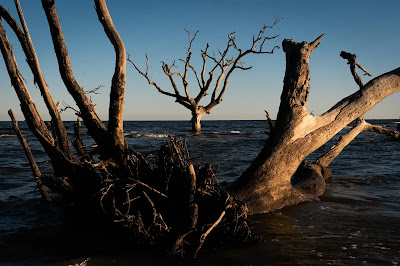
Ghost forests occur when high tides push seawater into forested areas and salt poisons the trees, turning them a bleached white. Ghost forests are currently appearing up and down the east coast of the US at an alarming rate. Photo: Cameron Pollack for NPR


The sun comes up
the sun goes down
the trees turn white
the beach looks skeletal.

The rain comes down
the sea comes in
the trees soak in salt
instead of fresh water.

The storms come up
the sea washes in
our forests poisoned
dead limbs in the sand.

We walk the beach
stuffing our sandbags
as storms come in
more storms come in
the tides rise up 
the tides rise higher... 

our bones flash white
littering the shore.


Originally from Boston, Mickey J. Corrigan writes tropical noir with a dark humor. Novels include the mystery pandemic tale Songs of the Maniacs (Salt Publishing, 2014), Project XX about a school shooting (Salt Publishing, 2017), and What I Did for Love, a spoof of Lolita (Bloodhound Books, 2019). In 2020, Grandma Moses Press released the poetry micro-chapbook Florida Man

Monday, December 21, 2020

DEEP WINTER CLEANING

by Mary K O'Melveny 


Painting by Chris Austin via My Modern Met.


Our house always looks neat enough.
If you don’t stare into cupboards
or study drawers too closely. Our stuff
seems mostly under control, buffered
by simple messages, pristine lines.
Desires to peer to closely are aborted
by earnest visions, surfaces that shine.
 
Every now and then, something untidy
slips into view despite best plans,
forcing us to mop, sweep what might be
dust mites or cobwebs from doorjambs,
haul away plastic bags of trash
filled with threadbare linens, brown-edged
papers, dead tennis balls, a rash
of too small jackets, too high heels wedged
 
in closet corners. The birds benefit
from stale biscuits and limp popcorn.
A container of frozen food—whatever it
was now unknown—will not be mourned,
along with moldy bread and avocados.
We haul debris out to the bins.
A period of satisfaction follows
but prophylaxis never begins.
 
Eventually, our grimy shadows emerge,
widen once more. They lurk under chairs,
deep in cabinets, still a scourge
like monsters hidden beneath the stairs
to the basement.  A pandemic excused
us briefly from deep cleaning fits
as time marched forward and dust renewed,
but our shambolic state persists.
 
Now we are facing winter storms,
still surrounded by unexamined chaos.
Until we undertake sweeping reforms,
mops and brooms will be superfluous.
We need to unearth all our buried
secrets, those sordid truths we never found
time to tell, the hopes repeatedly miscarried.
Lay them bare on our snow-layered ground.


Mary K O'Melveny is a recently retired labor rights attorney who lives in Washington DC and Woodstock NY.  Her work has appeared in various print and on-line journals. Her first poetry chapbook A Woman of a Certain Age is available from Finishing Line Press. Mary’s poetry collection Merging Star Hypotheses was published by Finishing Line Press in January, 2020.

Tuesday, August 11, 2020

WHAT STILL BELONGS TO US

by Sean J Mahoney


“Tangled Roots,” a painting by Wayne Doyle.


Offer the dark and far side of the house as stilled
prey to light and wind. Sky filled with weather
balloons, a story of openings and the dishrag
calamities of coming wars fought not between
soldiers but callous ideologies. My neighbors
crossing waters caught aflame, sown with
stench of powder, predatory hint of pheromone.
Those boat holds packed with coffins of kin.
Fragments of lovers. Loads of hurt, spray-painted
time, viral loss of speech coming fast, loose.

Clothed people with weathered skin, sitting and
waiting for apples and a humanity of eyebrows.
Decent beings most, stripped for their good deeds,
their mutual bonds and returns, for grid coordinates
of physical love and further acid rain bombs.
As though a brush stroke across the sky could
cure the vicissitudes of storms, of the prickly
aftermath where many headed in the days and
years that followed. Brush and slow stroke.
Spiritual tech and the uncaged graphic stations

of the body. This they say is art. Street magic.
Lord of hands digging trenches through rubble
and dirty clothing of unfamiliar beings. Postcards
of a land in better times; tourists, culture, and
radiant sunshine. Blue house on a block of narrow
mildewed homes. Bloated curbs and skinny
streetlamps illume familiar strain: a colored side
and the other side, a have side and a have next
to nothing side. Storm drains usher ill promises
and leprous iguanas to a cold sea amid tangles
of tree roots promulgated by water and by state.


Sean J Mahoney has had work published at Poets Reading the News, The Good Men Project, Nine Mile Literary Magazine, Antithesis Journal, Catamaran Literary Reader, and Wordgathering among others. He lives in Southern California with Dianne, her mother, 3 dogs, and 4 renters. There is a large garden and two trees with big, bitter oranges that look more lemon-like. Sean co-edited the 2nd and 3rd volumes of the MS benefit anthology series Something On Our Minds and he helps to run the Disability Literature Consortium booth at the annual AWP bookfair… lit by crips.

Wednesday, July 17, 2019

COLORING

by Laura Lee Washburn


This drawing is part of an exhibition in Tucson, AZ of original watercolors and other artworks by kids whose families have fled to the U.S. seeking asylum. Casa Alitas operates a refugee shelter in a former Benedictine Monastery and offers art-making classes to traumatized kids released from detention.


“It’s not what you look at that matters,
  it’s what you see.”
—Henry David Thoreau


In the blue pool with jogging women
every morning this month I’ve seen
in distant tree yellow busted balloon.

I have ridden the packed dirt
on a brown three-speed bike
almost into long black snake.

I have been to the marsh
where green leaves reflect
from brown tannin waters.
I will go there again.

I have felt unease, eaten
too much sugar, sagged
at the loneliness of bad friendships.

I’ve helped light one hundred and forty candles
after dark, listened to testimony, heard
the names of six dead migrant children:

Darlyn, Jakelin, Felipe, Juanito, Wilmer, Carlos.
I’ve read the judicial arguments on soap
and sleep, toothpaste, blankets.

When the green leaves blow,
I watch through bamboo blinds,
live action but dim impressions of bright.

I have driven in blind white
sun on the turnpike’s upward curve
and made it south enough to see again.

I have driven twenty in storm
shocking white water rains
when the pea-sized summer hail
begins to tap.
I have not turned
around at the lake in the road.
 —I have judged and been judged—

Stupid people    this local woman
hosted a vigil because of “images” she saw.
How does she know [How does she know?]
the images are really detention centers?
    people who serve the DARK!
    scum invading      disease and violence
our president taking down the evil
Stop believing or search for the truth
everything is really a lie!


Laura Lee Washburn has taught how to tell creditable sources from biased sources, has never been held in a cell, and donates her time to a Southeast Kansas organization that helps women in poverty resolve crises.

Tuesday, October 02, 2018

THE UNTHINKABLE

by Tricia Knoll


Firefighters from Brea, Calif., inspect and cut fireline on Aug. 1, 2018, as the Ranch Fire burns near Upper Lake, Calif. A day earlier, it and the River Fire totaled more than 74,000 acres. (Stuart W. Palley/For The Washington Post)


Last month, deep in a 500-page environmental impact statement, the Trump administration made a startling assumption: On its current course, the planet will warm a disastrous seven degrees by the end of this century. . . . But the administration did not offer this dire forecast, premised on the idea that the world will fail to cut its greenhouse gas emissions, as part of an argument to combat climate change. Just the opposite: The analysis assumes the planet’s fate is already sealed.  —The Washington Post, September 28, 2018


You suspect you had a brainstorm.
Lightning on the horizon,
a seizure of holy illumination.

You picture a future
of invisible footprints walking
the boundaries of ignorant blizzards.

For me, fear’s fire crackles
everything green to charcoal. 
I forget to breathe.

                    We dream in the same bed.

Two parents mourn over
the white casket of a kindergartner.
The shooter hears a tardy bell clang.

                    They pushed the panic bar on the same door.

Everyone talks.
No one listens.
Storms scream.

Chaos unbalances prediction.
Imagination wobbles
on an uneasy axis.

We try to anticipate
the never-know
consequences

of what we have done.


Tricia Knoll is a Vermont poet who wonders how many voices it will take to make everyone demand we address the climate crisis. Records of wind, rain, flood, fire, typhoons . . . The unthinkable is happening every day. All around us. She was a responder to Hurricane Katrina in New Orleans. Her most recent collection of poetry is How I Learned To Be White.

Tuesday, December 01, 2015

AS THE PARIS CLIMATE TALKS BEGIN

by Buff Whitman-Bradley


Place de la République on Sunday. Thousands of activists took to the streets of Paris ahead of climate summit, despite a ban on public demonstrations following the Nov. 13 attacks. (Eric Gaillard/Reuters via CBC News.


The weather has turned cold.
The sky is dirty white.
A crow caws without enthusiasm
From high up in a bare maple
As I scuffle through piles of leaves
On my way home from the post office.
The day is deeply still
As if holding its breath in anticipation
Of the massive storms
That have been predicted for this winter
After years of drought.
A sudden shower spatters the leaves
The decaying gardens, the pavement
Then stops abruptly
Leaving the ground barely wet
And the air smelling of winter rain.
I scan the clouds for signs of big weather
But see nothing that suggests
The downpour we so eagerly await
Not without some anxiety
Since heedless and profligate profiteering
Have so drastically mangled
The natural systems that have made the Earth
Habitable for us and others
And once the deluges begin
We cannot be certain that they will end
Before catastrophe.

We march in the streets
We block entrances and intersections
We interrupt and interfere with business as usual
Demanding an end to the toxic practices
That could mean the end of us.
But time is running out
And the ones with their hands on the throttles and gears
Act reluctantly
If at all.

I open my front door
And step inside the warm house
My morning's errands completed.
I have bought a few groceries
Returned a library book
And mailed a birthday gift to my daughter.
And now I settle down
With a magazine and a cup of tea
Glancing from time to time
Out the big front window
Wondering when it will rain.


Buff Whitman-Bradley's poetry has appeared in many print and online journals, including Atlanta Review, Bryant Literary Review, Concho River Review, Crannog, december, Hawai'i Review, Pinyon, Rockhurst Review, Solstice, Third Wednesday and others. He has published several collections of poems, most recently, To Get Our Bearings in this Wheeling World. His interviews with soldiers who refused to fight in Iraq and Afghanistan became the book About Face: Military Resisters Turn Against War. He lives in northern California with his wife Cynthia.

Thursday, August 20, 2015

HAIR AND THE HEALTH OF THE WORLD

by Kit Zak


the doctor clips
a few strands of my hair—
the adrenal fatigue test

I think about all that stresses
my gray head
            (not so many now that my children are fledged)
it’s their turn. Still

thoughts of hair seize my brain
            (not just the mineral deficiencies the test might show)
but candidate Trump’s coif
floating over his head
like a gold hairball
            (WHO has hair like that?)
Or like his devil-

interlocutor, Megan,
her honey tresses and
the talented stylists who make hair
their calling (card) and fortune.

Oh style
and the making of a President
while really
it’s Boeing and Lockheed Martin
dictating our future

such a  three-ringer
(circus): the Hawks’ war path
and the Republican guardians for coal plants

I stress
over the rising tides in coastal cities and
the killer storms (my kids in Norfolk and Miami)

American politics: it’s just entertainment and imagine
what the Europeans must think of our clowns

I await test results
and wonder about the cure


Kit Zak lives in Lewes, DE. She’s an activist who has published in various journals and anthologies.

Wednesday, November 13, 2013

THE TOMB OF THE UNKNOWNS

by Tricia Knoll


Memorial in the memory of all who died in 2004 Tsunami at the Kanyakumari Beach, India. This monument was designed and constructed by B. Kanagaraj Cangan. Image source:  Indiancorrector at English Wikipedia [Public domain], via Wikimedia Commons.


They all are, these monuments
to the unknowns, to each chance,
what more might have played out,
might have been said in the name of peace,
what more children born to cure disease,
walk for justice, lead the way, gaze at stars,
what poem written, what painting filled
in by bones buried under
the marble of war.

These tombs are everywhere
human hands have been.
Under the killer storms,
under the genocides,
and always at
histories shortened
under white marbles of war.


Tricia Knoll is a Portland, Oregon poet.