The New Verse News presents politically progressive poetry on current events and topical issues.
Guidelines
Submission Guidelines: Send 1-3 unpublished poems in the body of an email (NO ATTACHMENTS) to nvneditor[at]gmail.com. No simultaneous submissions. Use "Verse News Submission" as the subject line. Send a brief bio. No payment. Authors retain all rights after 1st-time appearance here. Scroll down the right sidebar for the fine print.
Mary Saracino is a novelist, memoir writer, and poet. Her book of poetry Motherlines was published by Pearlsong Press (February 2026). She is the author of four novels:
Heretics: A Love Story (Pearlsong Press 2014), The Singing of Swans (Pearlsong Press 2006),
No Matter What (Spinsters Ink 1993), and Finding Grace (Spinsters Ink 1999), and the memoir Voices of the Soft-bellied Warrior (Spinsters Ink 2001). She co-edited (with Mary Beth Moser) She Is Everywhere! Volume 3: An anthology of writings in womanist/feminist spirituality (iUniverse 2012), which earned the 2013 Enheduanna Award for Excellence in Women-Centered Literature from Sofia University.
The blindfold covering her eyes has been torn asunder.
She weeps with outrage.
She wails with sorrow.
She sees the abuse of power.
She calls us to resist.
And for the preservation of humankind
we must act
for love is a verb
and resistance is the antidote
to evil, to fear, to hatred,
the only medicine that
can heal
what festers deepest in the wounds of America's inglorious story.
No shining city on the hill,
a nation founded on unspeakable atrocities
must tourniquet its bleeding limbs
suture its oozing lesions
nurse its traumatized people back to wholeness.
Together we must embark on this
beautiful and necessary mending.
Or die trying.
Mary Saracino is a novelist, memoir writer, and poet. Her most recent novel Heretics: A Love Story (2014) was published by Pearlsong Press. Her novel The Singing of Swans (Pearlsong Press 2006) was named a 2007 Lambda Literary Awards finalist in the Spirituality category.
The President plays catch with former New York Yankees Hall of Fame pitcher Mariano Rivera as he greets youth baseball players on the South Lawn of the White House to mark Opening Day for Major League Baseball, Thursday, July 23, 2020, in Washington. (Drew Angerer/Getty Images via Chicago Tribune)
The lines are straight, votes streaming in
like a fastball from the hand of Larry Broerman.
That’s me at the plate. I am ten years old,
squaring around to bunt in fear. Notice
how the ball is coming in too fast for me to move.
Watch me catch it with my groin. See
the coaches and my parents run onto the field
and huddle round my crumpled, writhing form.
Watch my father unbutton my pants and say, “Breathe.”
I don’t care about my team. My only interest
is my stats. I bat in the low .200’s, but if you ask,
I’ll tell you about the double I once hit. Never mind
I make consistent errors in right field.
Occasionally, I catch one. But for now,
behold me as I stand. Gaze upon me
as I trot toward first base, even as my still-
unbuttoned pants fall from my waist, slide down my legs,
and drop onto the first base path. Consider
how the fans go wild. Listen to them cheer
as my short-lived, unaccomplished baseball career
comes to its ignominious end.
Mark Williams's poems have appeared in The Southern Review, Rattle, and The American Journal of Poetry. His poems in response to the current administration have appeared in The New Verse News, Writers Resist, Poets Reading the News, and Tuck Magazine. His baseball career ended in Evansville, Indiana, where he still lives.
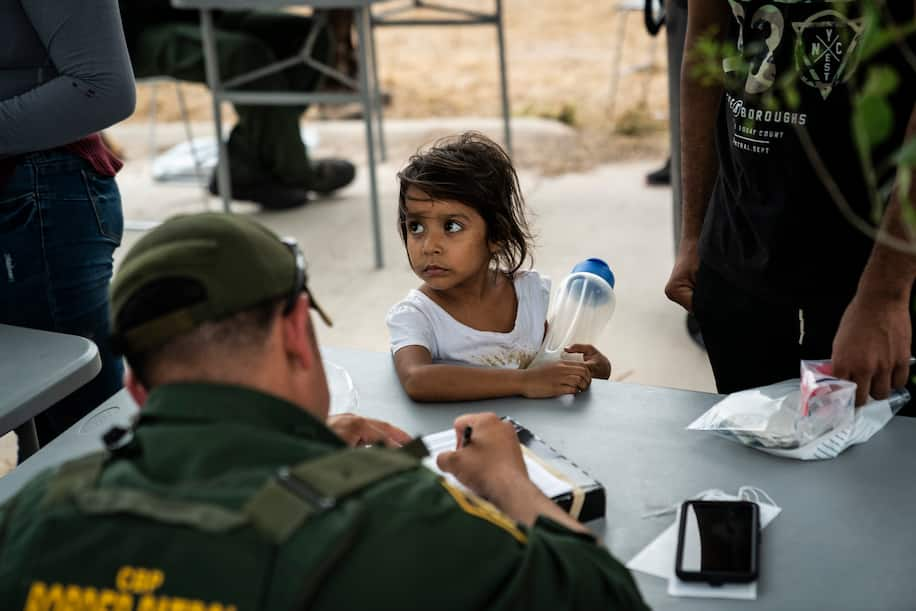
Immigrant families wait in May 2019 in Los Ebanos, Tex., to be searched and taken to a U.S. Border Patrol station after they were caught illegally crossing into the United States from Mexico. Credit: Jabin Botsford/The Washington Post, October 23, 2020
“Suffer little children, and forbid them not, to come unto me: for of such is the kingdom of heaven.” —Matthew 19:14
You put them in cages
and arm their enemies with AK47s
You take away their food
and say that it is for their own good
You dirty their air and water
and point to it as progress
You make their world uninhabitable
and call their cries a hoax
You let your police
murder them in their beds
and say they deserved it
You punish their governors
for standing up for them
You take away their families’ health insurance
and say it’s in service of freedom
You beat them in the streets
because they challenge your authority
You promise them relief
and present it to the rich
You insult their allies
and sell out their friends
You sit by as they die of a dread disease
saying it will just... go away
You defile and debase
the halls of their government
with petty criminals and yes men
You make their lives less sane, less safe, and less free
You think that their God is sleeping
do not be deceived
God will bring about his justice
through the least of things
Including teenage TikTokers
small dollar donations
absentee ballots
and subpoenas.
Julie Kramer is a molecular biologist, lay minister, marketer, and mom of three teenagers living in Madison, Wisconsin. In 2012, she made the unforeseen and disconcerting discovery that she is also a poet. Her themes include family, religion, #me too, and current events. She has had previous work published in the Journal of Women and Religion, and the Wisconsin UCC Conference newsletter.
Old white knights sit atop white steeds
believing blindly that their deeds
are God-ordained—a Christian right-
ness coupled with systemic white-
ness—ancient notions from the West.
They claim their weapons are the best.
Their helmets shield us from their faces.
Do they protect and serve all places?
Black knights have seen this all before:
refusing to bow before a Moor,
white knights wage wars to hold their power.
They raze our homes; their flames devour.
We must resist. We know it's right
to kneel. To raise one fist. To fight.
Scot Slaby's chapbooks include The Cards We've Drawn (Bright Hill Press, 2013) and Bugs Us All (Entasis Press, 2016). His poems have appeared in The Book of Forms: A Handbook of Poetics Including Odd and Invented Forms, Arcana: The Tarot Poetry Anthology, Like Light: 25 Years of Poetry & Prose by Bright Hill Poets & Authors, unsplendid, and elsewhere. An international educator, he divides his time between Shanghai, China and Minneapolis, Minnesota.
I know it's not
what you want,
but I can't live
if I can't get
inside of you.
To be precise,
I'm not really living
at all. I have no cellular
organelles, no DNA.
I can't grow on my own
and require your genetic
instructions to survive.
I can't continue to multiply
and thrive outside of you. Soap
and water are my kryptonite. Is it
selfish of me to want to exist?
I pray you don't really think so.
Even if what I have is not much
of a life. Please consider things
from my perspective. If I could,
I'd organize my fellow contagions.
Get us all together to create
a super Pac. I long to keep
the status quo. Both Biden
and Sanders, they scare me.
They listen to scientists. That
nescient man in the White House
doesn't understand what I'm about.
Which is fine with me. Think of me
as a microscopic, infective agent
just looking to blossom. Be kind,
be compassionate come November.
Let's keep our arrangement of quiet
indifference intact. Let's just leave
well enough alone.
Gil Hoy is a Boston poet, Democratic political activist, and semi-retired trial lawyer. He studied poetry at Boston University through its Evergreen program. Hoy received a B.A. in Philosophy and Political Science from Boston University, an M.A. in Government from Georgetown University, and a J.D. from the University of Virginia School of Law. He served as a Brookline, Massachusetts Selectman for four terms. Hoy’s poetry has appeared, or will be appearing, in TheNewVerse.News, Mobius: The Journal of Social Change, Tipton Poetry Journal, Chiron Review, Ariel Chart, MisfitMagazine, The Potomac, The Penmen Review, One Sentence Poems and elsewhere.
Robert West is the author of three chapbooks of poems, including Convalescent (Finishing Line Press, 2011); the co-editor of Succinct: The Broadstone Anthology of Short Poems (Broadstone Books, 2013); and the editor of both volumes of The Complete Poems of A. R. Ammons (W. W. Norton, 2017).
It is quiet now
In the corners
Where dust collects itself
And afternoon light
Relaxes its shoulders
As it prepares
For its daily departure.
All day it has been
Early October
Hot as August or July
And drier than dry—
But we are not fooled.
Look at the leaves
Teasing us
With the faintest hints
Of the russets and golds
And wild vermillions
That soon enough
Will inhabit the snug dwellings
Where their green sister chlorophyll
Has resided
Since the February arrival
Of spring.
Look at the long shadows
Falling across houses and streets
Lounging in parks and playgrounds,
Look at the honeyed light
Sprawling on manicured lawns
And fading gardens.
Feel the air,
Apologetically hot
And promising that this heat,
This spit-thickening dryness,
Will not last much longer,
That the familiar, reassuring chill
Of autumn
Will soon return to our evenings
To herald the arrival
Of the season of heavy rains.
But of course these days
With the climate being systematically mauled
By billionaire carbon-suckers
We can’t be sure
What the coming months
Will have in store for us.
And for that matter
We cannot even count on October
Remaining the October
We have always loved,
That paragon of months,
The crown jewel
In the year’s annular passage,
The golden door
Between summer and winter.
We must struggle and hope,
Defy and resist and disrupt
To defeat those who are ravaging
Our weather and our earth
And replace them
With our kind of folks,
The ones who believe in communities
Of mutual support and nourishment,
The ones who reject profit
As a way to measure human worth,
The ones whose furious spirits take flight
In October light.
Buff Whitman-Bradley's poems have appeared in many print and online journals. His most recent books are To Get Our Bearings in this Wheeling World and Cancer Cantata. With his wife Cynthia, he produced the award-winning documentary film Outside In and, with the MIRC film collective, made the film Por Que Venimos. His interviews with soldiers refusing to fight in Iraq and Afghanistan were made into the book About Face: Military Resisters Turn Against War. He lives in northern California. He podcasts at: thirdactpoems.podbean.com .
We are each but a minuscule dust mote
adrift for better or worse.
This earth is our bobbing lifeboat
in an alien universe.
So if T***p builds a Southern Wall
is of no consequence at all,
except for those on history's pages
who have their babies locked in cages.
Janice D. Soderling is widely published in print and online journals. Her work is included in the anthologies Nasty Women Poets and The Great American Wise Ass Poetry.
Justice is a pebble under the rug you trip over,
a slipped stitch on embroidery,
mail that fails to be delivered.
I want to give my kids life
so the gangs won’t rape
or kill them,
so we can buy food, not steal.
Does that make me a criminal?
It makes me unwanted.
I didn’t think we’d make it to the border
but we did, thirsty, filthy.
I thought the children would faint,
I carried the youngest.
Asylum: that was for the old days.
The stiff legged officers pace like dictators.
Some enjoy, some hate, their job.
All my children severed from my spine,
its sound like a building demolished.
Our pleading cries carry no weight,
our filled lungs don’t matter.
Will I hug empty air for the rest of my life?
I don’t know where they took my children,
I may never feel or smell them again.
The space between us is deeper than a grave.
How can people in uniforms rip out my soul?
This theft will be engraved in my children’s minds forever.
First starvation, then murder of our bond.
They send me home alone.
What will they do with my children,
who cares about them?
Asylum: a dream from the past,
democracy doesn’t exist.
The gangs are restless,
they know I am here,
they prowl.
Wendy Hoffman is a retired social worker. Karnac Books, London, published her memoirs in 2014 and 2015, and a co-authored book of essays, in 2017. Her books are now with Aeon Publishers in England and Routlege in New York. Her first book of poetry was published in 2016. A new memoir is forthcoming. She has a MFA in creative writing and lives on the Olympic Peninsula with her dog.
The shade is always drawn
bland as a meadow hiding from the sun
robin pecks at cracks in dirt
worms deep in hardened soil.
This poem could be about window shades
a meadow, a robin or worms but it isn’t.
Coffee maker gasps and chugs, good to the
last drop, I pour my morning fix. Sun is shy
today, humidity at 83%.
But this poem isn’t about a good cup of coffee
or the weather today.
On Wednesday I watched as the old man spoke
baggy eyes, drawn face. A serious man encircled
by the circus of sound bite panelists. He spoke
the truth, did not perform.
Not a hoax he said, integrity he said, obstruction
true he said, no conspiracy with the enemy he
said, contacts he said. Although there was a
sputter here and there, his just the facts response
reflected courage, the search for the truth.
The Russians are coming again in 2020 he said.
In this time of chicken-hawks, cowardly pols
self-important talking heads, this old man
pushed up the blind, let the sun in.
Down Pennsylvania Avenue, President Bone Spur
squints from the light, speaks of performance
distorts facts, criticizes the heroic old man whose
shoes he could never wear.
And so it is, moisture from the air seeps into the
ground, unrelenting robin hops and listens, plucks
a fat worm through the softened surface. Much as
the old man did on a Wednesday in July of 2019.
This drawing is part of an exhibition in Tucson, AZ of original watercolors and other artworks by kids whose families have fled to the U.S. seeking asylum. Casa Alitas operates a refugee shelter in a former Benedictine Monastery and offers art-making classes to traumatized kids released from detention.
“It’s not what you look at that matters,
it’s what you see.”
—Henry David Thoreau
In the blue pool with jogging women
every morning this month I’ve seen
in distant tree yellow busted balloon.
I have ridden the packed dirt
on a brown three-speed bike
almost into long black snake.
I have been to the marsh
where green leaves reflect
from brown tannin waters.
I will go there again.
I have felt unease, eaten
too much sugar, sagged
at the loneliness of bad friendships.
I’ve helped light one hundred and forty candles
after dark, listened to testimony, heard
the names of six dead migrant children:
Darlyn, Jakelin, Felipe, Juanito, Wilmer, Carlos.
I’ve read the judicial arguments on soap
and sleep, toothpaste, blankets.
When the green leaves blow,
I watch through bamboo blinds,
live action but dim impressions of bright.
I have driven in blind white
sun on the turnpike’s upward curve
and made it south enough to see again.
I have driven twenty in storm
shocking white water rains
when the pea-sized summer hail
begins to tap.
I have not turned
around at the lake in the road.
—I have judged and been judged—
Stupid people this local woman hosted a vigil because of “images” she saw. How does she know [How does she know?] the images are really detention centers? people who serve the DARK! scum invading disease and violence our president taking down the evil Stop believing or search for the truth everything is really a lie!
Laura Lee Washburn has taught how to tell creditable sources from biased sources, has never been held in a cell, and donates her time to a Southeast Kansas organization that helps women in poverty resolve crises.
We have to assume other people do his math.
Fill out the multiple lines on multiple forms
with different answers depending on to whom
he is giving his tax returns. Maybe he is even
math challenged and would never check
those figures for exaggerations. How would
he know one from the other; his life is base-ten
on bloat. We know he thinks parts per million
of CO2 in the atmosphere are not proportionate
with disturbing one fraction of a second of his time.
The military did the recent math for him,
he hadn’t asked until late in the game
about the rules: how many people could die
to balance the loss of a drone. He says
one hundred and fifty is too many.
Not proportionate. (And ludicrously
low we suspect.) So are they sitting
around right now trying to decide
what is the right proportion? A figure
that works for a world teetering
on the brink of another war disaster?
Math you can explain to a child
who can hold up two fingers
to tell his age?
He might be able to handle the old daisy oracle.
It’s pretty simple. Pluck a petal. Pluck a petal. He loves me. He loves me not.
Tricia Knoll is a Vermont poet whose work appears widely in journals and anthologies. She is spending a lot of time pulling up invasive species in a woods, thinking about math and probabilities.
"Redaction Distraction" by John McNamee posted at TheNib, February 10th, 2017
Article I: Congress shall make law prohibiting freedom of speech and petition of grievances. Article II: Necessary to keep arms. Article III: Consent of war to be prescribed by law. Article IV: Searches and seizures shall issue. Persons, things, to be seized. Article V: Persons held in jeopardy, compelled to witness against freedom without compensation. Article VI: Criminal prosecutions by the State shall be compulsory. Article VII: Suits shall exceed. Dollars shall be preserved. No fact shall be reexamined. Article VIII: Excessive bail shall be required; punishments inflicted. Article IX: The Constitution shall be construed to disparage the people. Article X: Power to the United States! Ed Werstein, a regional VP of the Wisconsin Fellowship of Poets, was awarded the 2018 Lorine Niedecker Prize for Poetry by the Council For Wisconsin Writers. His work has appeared in Stoneboat, Blue Collar Review, Gyroscope Review, among other publications, and is forthcoming in Rosebud. His 2018 book A Tar Pit To Dye In is available from Kelsay Books. His chapbook Who Are We Then? was published in 2013 by Partisan Press.
with priests and pastors who serve their own desire,
and conscience quiet in communities at war
with common sense. As once the drivers of slaves
claimed they were slaves themselves, is hypocrisy
the driver of our facts? We build on graves
of genocide and treat our history
as promised consummation, the end of days,
and claim our innocence has kept us free.
And if bare, battered Truth somehow appeared
would we have eyes to see or ears to hear?
Robert Darling has published two full-length collections of poetry,So FarandGleanings, three chapbooks of poems,Boundaries, The Craftsman’s Praise, andBreaking the Silence and a volume of criticism on the Australian poet A.D. Hope.He has contributed poems and reviews to over fifty magazines and articles in several reference books in the US, Great Britain, Canada, and Australia. He is Professor in Humanities and Fine Arts at Keuka College. The above poem is a response/updating of Shelley's "Sonnet: England in 1819."
"Empire" star Jussie Smollett was hospitalized after “a possible racially charged” and homophobic assault and battery, Chief Anthony Guglielmi of the Chicago Police Department said in a statement Tuesday. —USA Today, January 29, 2019
“People love you and you win, and when your son looks at you and says, ‘Mama, look, you won. Bullies don’t win.’ I said, ‘Baby, they don’t, because we’re going to go in there and we’re going to impeach the motherfucker.'”
They’re outside in their blue shirts with patches and neckerchiefs. Oh mama!
The Cub Scouts are out in the rain recycling the disrobed trees again. Look—
the little ones are struggling to lift and load those noble corpses! You
know I’m not going out there to help. No way-too cold. I think they’ve won
the War on Christmas, by the way, those little deconstructionist bullies
hauling away holiday cheer for a donation sealed in a Ziplock bag. I don’t
really care, though. I’m teasing, eating too much chocolate. And I can win
at other things. Like raising a glass before lunch, refreshing newsfeeds and
licking the rim of the eggnog carton. With the ornaments packed, I
can pour more vodka in my coffee, light my bowl and kick it. Someone said Be Best and you know I’m being and doing my best now, baby.
No one is paying or being paid, toilets overflow, the zoo is shut and they
say maybe it's really a strike. National emergency. Yeah, okay, chill. Don’t
you know smooth voiced 44 hit the Billboard charts? Yeah, that’s because
there is some karma left. And it dances, sings and swears. Now as we’re
forced into gingerbread cookie detox programs, I ain’t gonna
lie (like the king). This won’t be some “but-I-posted-about it” easy go.
Things get uglier before they get prettier. I had to put all the nutcrackers in
boxes that looked like coffins, pack up the merry-making, stack them there
in the garage 'til next Thanksgiving. The scouts are dragged out there, and
really, they just want to shoot arrows at camp. Go ahead, please, impeach
the Grinch, the happily-ever-privileged, the liars, the pussy grabbers, the—
never mind. I’m off to take a nap, hoping to sleep off this motherfucker.
Editor's Note: The Golden Shovel is a poetic form devised by Terrance Hayes in homage to Gwendolyn Brooks. ("Golden Shovel" is a reference to "Seven at the Golden Shovel" in the Brooks poem "We Real Cool" from which Hayes built the first Golden Shovel poem.) The last words of each line in a Golden Shovel poem are, in order, words from a line or lines taken often, but not invariably, from a Brooks poem.
Karen Shepherd lives with her husband and two teenagers in the Pacific Northwest of the United States where she enjoys walking in forests and listening to the rain. Her poetry and short fiction have been published in various journals including Constellate Literary Journal, The Literary Nest, Halfway Down the Stairs, Riddled With Arrows and Wales Haiku Journal.