Guidelines


Submission Guidelines: Send 1-3 unpublished poems in the body of an email (NO ATTACHMENTS) to nvneditor[at]gmail.com. No simultaneous submissions. Use "Verse News Submission" as the subject line. Send a brief bio. No payment. Authors retain all rights after 1st-time appearance here. Scroll down the right sidebar for the fine print.
Showing posts with label woman. Show all posts

Thursday, July 30, 2026

ONCE UPON A TIME IN THE OLD WEST

by Gale Naylor


AI-generated graphic by NightCafé for The New Verse News.


ice melting at the poles was our nightmare scenario—still is—but now it’s interrupted by ICE in masks, killing legal immigrants (and whoever gets in their way) like it’s eighteen-seventy-five—but here in twenty-twenty-six, it’s the lawmen who kill/terrorize/strut through the center of town—camo peacocks, daring the town folk to speak or act—but the peacocks forgot: bad guys wear masks, and that’s how you know this is more bad LSD trip than Sergio Leone or John Ford movie with a scripted ending—oh, no, we’re crowd-sourcing these final moments, and I hope in this film the town ejects the masked bandits, and the woman who runs the general store is persuaded to lead—though she only accepts if everyone pitches in—because this is when we live our Sunday best, this is when we can return to solving the bigger problems, this version is when we have a snowball’s chance in hell of finding a lasting solution to ice.


Poetry is how Gale Naylor makes sense of the world as a survivor of incest and sexual abuse; they hope their voice helps other survivors feel less alone. Gale's poems have appeared in Exposed BoneCalliope-on-the-WebS/He Speaks 4Jupiter ReviewThe Ekphrastic Review, and the California Poet Laureate’s “Our California” website. Gale received an MFA from Antioch University Los Angeles in 2026.


Thursday, February 12, 2026

BRANKS

by Julie Steiner

Images of Epstein victims as depicted in Feb. 8, 2026, Super Bowl ad. Image of branks from an oil painting by John Willie, pseudonym for John Alexander Scott Coutts, for Bizarre, a sadomasochism magazine published 1946–1959. Public domain, via Wikimedia Commons.


Brank/branks: A device formerly used to punish women judged to be noisy and quarrelsome, consisting of an iron curb for the tongue, held in place by a frame around the head. Also called a scold’s bridle.


You have to tell the truth, but tell it slant.
To lay it bare’s unbearable. You’ve tried.
You’d like to leave it buried, but you can’t.

Too few have cared to hear a woman rant
since Homer (“Sing, O Muse, of anger”) died.
You have to tell the truth; but tell it slant,

since, frankly, even Keats would have to grant
this truth’s no beauty. This, you’ve had to hide.
You’d like to leave it buried. But you can’t,

so Dickinson’s advice is relevant.
She’ll be your Virgil, your inferno-guide.
You have to “Tell [...] the truth, but tell it slant— ”

“Tell all the truth.” But don’t get adamant,
“Or every man be blind—,” she qualified.
You’d like to leave it bare. (Read: But you can’t.)

Loud girls get label-gagged: once, Termagant,

ViragoShrew; now, Bitch. Take that in stride.

(You have, to tell the truth.) But tell it—slant

or no—you must. Omit the bitter. Scant
the pathos. Cut the caustic. Snip the snide.
(You’d like to leave it, buried.) But you can’t

accuse the rich of rape, or lawyers chant,

“No, he’s the victim! She’s a slut who lied.”

You have to tell the truth, but tell it slant.
You’d like to leave it buried. But you can’t.


Julie Steiner is a pseudonym in San Diego, California. Besides The New Verse News, recent venues in which Julie's poetry has appeared include the Ekphrastic Review, Light, Lighten Up Online, and Snakeskin. See more on her Substack, Off-Piste on Mount Parnassus.

Tuesday, October 29, 2024

LESSONS FROM THE PAST


by Sally Zakariya


The New York TImes, October 17, 2024


Unearthed in Peru 
signs of a female sovereign
thirteen centuries ago

In the tomb painting
she’s wearing a crown
and holding court from
a power throne

We’ve had so far a very
masculine view of this
old civilization, say
archaeologists, devoted 
diggers of the past 

Could be we’ve had 
a pretty masculine view
of this new world, too

Could be the time
has come for another 
woman leader here 
in these Americas


Sally Zakariya’s poetry has appeared in some 100 publications and been nominated for the Pushcart Prize. Her publications include All Alive Together, Something Like a Life, Muslim Wife, The Unknowable Mystery of Other People, Personal Astronomy, and When You Escape. She edited and designed the poetry anthology Joys of the Table and blogs (occasionally) at www.butdoesitrhyme.com.

Monday, June 27, 2022

A PIVOT

by Imogen Arate


With me you 
have meaning
find purpose

A reflection of myself
an imprint
a ghost of the past

Your perpetual search
for mommy-

My forward motion
propelled by reenactment
of recurring cursed roles

you find reassurance
That devil you know
offers no surprises

I flee into the unknown
and you drag in fear
"Let’s go back”

You plead
“Let’s find comfort
in the familiar”

“Remember the good times”
“When I was the slave
and you the master”


Author's Note: I would like to acknowledge the influence Emma Rhodes’ “Johnny Depp Wins, and I Like So Many Others, Think of the Man Who Abused Me” had on my poem.


Imogen Arate is an award-winning Asian-American poet and writer and the Executive Producer and Host of Poets and Muses, a weekly poetry podcast that won second place at National Federation of Press Women's 2020 Communications Contest, where she has served as a national-level poetry judge in 2021 and 2022.  She often reacts to news in verse, which you can read here, on The New Verse News, as well as in other publications. You can find her @PoetsandMuses and @ImogenArate on Twitter and Instagram.

Friday, June 24, 2022

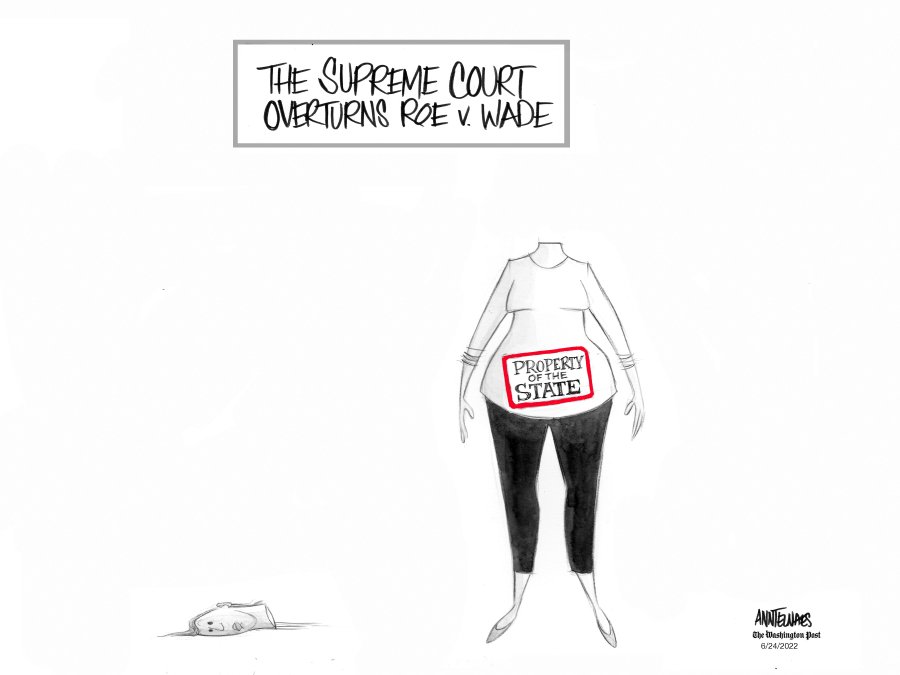
A LOADED GUN

by Ann E. Wallace

after Emily Dickinson


by C.B.


Had my life but stood 
a loaded gun, I might have 
roamed these sovereign states
with ease and in the open.
 
But though this woman’s body
may live longer than its lover,
or its foe, it receives no such 
constitutional protections.
 
We grant inalienable safeguards 
to our guns, as to the men who
cock and press the sacred trigger
with force and as they please.
 
If I were indeed that loaded gun, 
my liberty to choose, to carry 
or to abort, would be a right 
that is secured in perpetuity.


Ann E. Wallace is a poet and essayist from Jersey City, New Jersey. Follow her on Twitter @annwlace409 or on Instagram @annwallace409.

Wednesday, May 18, 2022

PRAYING FOR YOU, GOV

by Darrell Petska


Republican Gov. Pete Ricketts of Nebraska said Sunday that he will call a special session of his state's legislature to pass a total ban on abortion if the Supreme Court overturns Roe v. Wade this term. "Nebraska is a pro-life state. I believe life begins at conception, and those are babies too," Ricketts told CNN's Dana Bash on "State of the Union" when asked if he thought the state should require a young girl who was raped to carry the pregnancy to term. —CNN, May 15, 2022


Of course rape is evil,
but evil left to proliferate in a woman
tends to strike again and again in all its
suffocating helplessness, trauma, chronic
anxiety and nightmarish violation,
with all its attendant heartache.

Political one-upmanship and pietisms
that insist on allowing rape's evil to live on
by citing "directives" of god or bandying
emotionally fraught trigger words—
manipulating evil to sell one's agenda—
are beneath a purported man of god
and the yea-saying cadres of men sharing
narrow perceptions of a woman's uterus,
including its role in shaping cognitive
and emotional well-being and the drive
for self-determination—the latter a right
not reserved for men alone.

The shelf-life of your brand of religiosity
is short. We who espouse a more merciful,
compassionate religion pray that your efforts
to be both judge and executioner will fall
to the light, lest "Nebraska Nice" succumbs
to the politics clouding your heart and soul.


Darrell Petska lives and writes in Wisconsin, but part of his heart remains in his birth state of Nebraska.

Friday, May 06, 2022

HIS ABORTION POEM

by Dick Altman


Source: “Abortion” by John Bartlow Martin from the May 20, 1961, issue of the Saturday Evening Post.


he’s the golden boy
of parent/teacher/friend
the boy wanted on everyone’s side
the scholarship boy
the grad school boy
the golden boy
who in that familiar moment
of uncontrolled/youthful rapture
watches his golden prospects
for the future turn to dross
                      *
the Viet Nam draft
breathes down his neck
he still hasn’t found a job
(too educated, he’s told)
he’s not married
(though one day he will
marry the woman
he impregnated)
they are neither ready to marry
nor ready to have/support children
abortion is illegal
Roe vs. Wade is nowhere in sight
                       *
he reaches out to his composer father
who reaches out to friends
in the music business
an address and phone number
in Harlem surfaces
no names/no receipts
the golden boy borrows
from his father enough cash
to pay for a semester of college
the young couple agree
this is their only alternative
they discuss their mutual anxiety
she—they agree—must make
the decision
                         *
they never talk about what exactly
took place on the fourth floor
of the Harlem walk-up
she’s bleeding profusely by bed time—
in the emergency room by next morning
a spontaneous abortion the doctor calls it
knowing it wasn’t
whatever made the embryo abort
likely ended her/their prospects
of ever having children
Roe vs. Wade would not be decided
for another nine years
Politico’s revelation the Supreme Court
may overturn the decision
shatters him to tears
 

Dick Altman writes from New Mexico. His work has been widely published in the United States and beyond.

Thursday, May 05, 2022

WAR, ENDLESS

by Lisa Seidenberg


Tanks in fearsome formation
Slide up her southern flanks 
As troops assemble 
On her outlying appendages
While handheld missile launchers
take precisioned aim
At her twin ovaries
A soft but critical target
The containers of fragile munitions 
When was a woman’s body not a battleground?
Balancing fertility 
With freedom
Since time began
She withstands the exterior onslaught
To her interior 
Again and again
Territories taken and retaken
A war that never ends


Lisa Seidenberg is a filmmaker and writer whose documentary and experimental film work are shown in intern film festivals and arts venues.

Wednesday, December 08, 2021

AFTER THE SUPREME COURT HEARS TESTIMONY ABOUT MISSISSIPPI’S LEGISLATION RESTRICTING A WOMAN’S RIGHT TO CHOOSE

by Katie Kemple


Cartoon by Walt Handelsman, The Advocate


I dream I’m in an auditorium about to see
a show. To the far left, in the dark, sits
Gloria Steinem, her signature straight
hair beneath the twin stems of her aviator
glasses, so calm and beautiful. Even the host
makes eyes at her, tries to grab her attention.
On stage, they roll out a gurney, the lower
half of a woman’s body. I can't see her face.
Others gather around—men from all over
the world, a type of ceremony. I find
my mother and sit behind her, slide
my arm through the space between chairs
to interlock fingers with her. I whisper:
"Gloria is here." But my mother has been
dead for seven years. I'm afraid of what
we're about to see. It's so dark. I can't see. 


Katie Kemple (she/her) writes to make sense of the world. Her work has appeared recently on Longleaf Review, Matter, and The West Review.

Thursday, October 28, 2021

LIPSTICK

by Mary K O’Melveny


Col. Wang Yaping is a pilot in the People’s Liberation Army’s Air Force. She is a space veteran, now making her second trip into orbit. She is set in the coming weeks to be the first Chinese woman to walk in space as China’s space station glides around Earth at 17,100 miles per hour. And yet, as she began a six-month mission last week at the core of China’s ambitious space program, official and news media attention fixated as much on the comparative physiology of men and women, menstruation cycles, and the 5-year-old daughter she has left behind, as they did on her accomplishments. (No one asked about the children of her two male colleagues.) Shortly before the launch, Pang Zhihao, an official with the China National Space Administration, let it be known that a cargo capsule had supplied the orbiting space station with sanitary napkins and cosmetics. “Female astronauts may be in better condition after putting on makeup,” he said in remarks shown on CCTV, the state television network. Photo: Col. Wang Yaping, center, with Col. Ye Guangfu, left, and Maj. Gen. Zhai Zhigang at a pre-launch ceremony on Oct. 15 at the Jiuquan Satellite Launch Center in China. Credit: Kevin Frayer/Getty Images —The New York Times, October 23, 2021


If one puts lipstick on an astronaut,
can she still blaze through arid
atmospheres, dangle wildly from a line 
that tethers her to the mothership 
even as she kicks up her heels 
and pirouettes out into star space?
 
It seems makeup is a juggernaut 
that enhances our reality. Some added
emphasis, a glowing image to re-define
a star-struck traveler, to make her trip
seem normal, like any mom who feels
a need to exit might arguably face.
 
There is nothing to be feared. We ought
to be glad some girl wearing a padded
suit has figured out she can still shine, 
even if she must give her family the slip.
Perhaps pancake isn’t so perfidious, but conceals
a dream or two that she might still embrace.


Mary K O'Melveny is a recently retired labor rights attorney who lives in Washington DC and Woodstock NY.  Her work has appeared in various print and on-line journals. Her first poetry chapbook A Woman of a Certain Age is available from Finishing Line Press. Mary’s poetry collection Merging Star Hypotheses was published by Finishing Line Press in January, 2020. Her latest poetry collection Dispatches From The Memory Care Museum has just been published by Kelsay Books.  

Wednesday, April 29, 2020

DOUBLE TRITINA ON THE DEATH OF EAVAN BOLAND DURING A WORLDWIDE PANDEMIC

by Jenna Le


In Eavan Boland’s poem “Quarantine,”
there’s much to be admired: how she rhymes
slant, rhyming 1847 with woman,

say, or how the perished man and woman
in the three lines that start with line 18
are dignified, like headstones touched with rime,

by strict iambic beats. The point that rhymes
most richly with me, living as a woman
in a world starved gray by quarantine

in this year of our Lord COVID-19,
however, is the way that Boland’s rhymes
affirm love’s primacy: I’m not the woman

her poem describes, the starving Irish woman
whose feet, for lack of shoes of soft sateen,
molded themselves against her husband’s grime-

dark chest; yet Boland’s poem reminds me I’m
a member of the cult of man and woman,
built like a virus from the same protein.


Jenna Le is the author of Six Rivers (NYQ Books, 2011) and A History of the Cetacean American Diaspora (Indolent Books, 2017), a Second Place winner in the Elgin Awards. She was selected by Marilyn Nelson as winner of Poetry By The Sea’s inaugural sonnet competition and by Julie Kane as winner of Poetry By The Sea’s sonnet crown competition the following year. Her poetry appears or is forthcoming in AGNI, Denver Quarterly, Los Angeles Review, Massachusetts Review, Michigan Quarterly Review, Pleiades, Poet Lore, and West Branch

Tuesday, February 25, 2020

QUESTIONS TO THE ELECTORATE

by Jennifer Martelli


                        The Catholic Church is [not] monolithic in its teachings on abortion. 
 Geraldine Ferraro, 1984


Is a man a monolith?
Can you decorate a monolith with sprigs of nutmeg, rue,
            pennyroyal, a garden of abortifacients?
Can you grow savin, squills, ergot of rye around the monolith?
Can you dig down far enough so the roots will embed?

Can I rule as a monolith?
Can I rule as a woman who’s had not one but two,
two abortions? And still is not sad?
Can I rule as a woman who is not sad at all?

Can we drape the monolith with pearls, chunky fake gems?
Can we polish its flat dark marble surface until it shines
like the tombstones in the Italian cemetery? Will you circle the monolith?
Will you join hands with me and dance and dance and dance?


Jennifer Martelli is the author of My Tarantella (Bordighera Press), awarded an Honorable Mention from the Italian-American Studies Association, selected as a 2019 “Must Read” by the Massachusetts Center for the Book, and named as a finalist for the Housatonic Book Award. Her chapbook After Bird was the winner of the Grey Book Press open reading, 2016. Her work has appeared or will appear in Verse Daily, Iron Horse Review (winner, Photo Finish contest), The Sycamore Review, and POETRY. Jennifer Martelli has twice received grants from the Massachusetts Cultural Council Grant for her poetry. She is co-poetry editor for Mom Egg Review and co-curates the Italian-American Writers Series.

Thursday, May 16, 2019

SACRED

by George Held


The governor’s statement places
the key word, “God,” in the place

of emphasis, at the end, where
it makes the most of her pious case

but most offends those who question
when a fetus has become a “life”

or even doubt there is a god,
at least one who can give sacred gifts,

and those who believe that a woman’s life
is her own to join in sex with whomever

she wants and once pregnant whether
or not to delete that tiny comma without

the intervention of the almighty state.
What sort of Handmaid’s Tale

is ‘Bama spinning here now that its Senate
and the Court are packed with Medieval

men of the Right who consign women
to the stove and the marital bed,

where all conception is authorized
by a Fundamentalist Godhead.

What country is this where theocracy
struts its stuff in public and democracy

hides under the bed to avoid
a vengeful thrashing? My count-

try, ’tis of me, I sing, sweet place
of Liberty, of thee I sing . . .


George Held, a frequent contributor to TheNewVerse.News and other periodicals, has received ten Pushcart Prize nominations and published or edited twenty-two poetry books.

Saturday, November 12, 2016

CHELSEA MANNING, NOT JUST HERSELF

by Devon Balwit


Chelsea Manning tried to commit suicide last month as she was starting a week of solitary confinement at the prison barracks at Fort Leavenworth, Kan., her punishment for a previous attempt to end her life in July. —The New York Times, November 4, 2016. Photo: Elijah Nouvelage/Reuters/Newscom via The Intercept.


The constraints are multiple:
Chelsea jailed inside Bradley,
Bradley penned inside the military,
a deployed soldier inside a perimeter

The voices are multiple:
of wrongness, of rage, of never
belonging, of DADT, her security
clearance no security.

The postures are multiple:
curled over a desk, curled fetal,
clenching fists, crying, screaming,
flipping tables, flipping the bird.

The labels are multiple:
MOS, 35F, PFC, Specialist,
gay, trans, gender dysphoric
traitor, victim, hero, woman.

The reactions are multiple:
bullying, scorn, vilification,
compassion, incomprehension,
indifference, pity, respect.

The wishes are multiple:
to move on from being traitor
or whistleblower, to die, to live,
to be heard, to define herself.


Devon Balwit is a poet and educator in Portland, OR.  Her work has appeared before in TheNewVerse.News and elsewhere, in places such as Unlikely Stories Mark V, Five 2 One, The Rising Phoenix Review, and Rattle.

Wednesday, August 03, 2016

AT A BASEBALL GAME ON A HOT SUMMER NIGHT

by Jill Crainshaw


Image source: MiLB.com


class a farm team
a mid-sized southern city
girl in yellow crocs
toddler size 11
“Oh, say can you see?”

her hand over her heart
scrutinizing a standard star-showered
stalwart and still
while summer cicadas whirred and thrummed
“What so proudly we hailed.”

my phone buzzed
glass dome fragmenting
“first woman nominated by a major party”
while a hometown soprano soloed
“At the twilight’s last gleaming.”

does she see, this croc-clad citizen?
the spangled signpost unfurling
a wished-upon possibility too-long postponed
“O’er the land of the free
and the home of the brave.”

“Madam President” i whispered
into the breeze of the soaring anthem
and a girl in yellow crocs jumped up and down
as fans cheered the first batter up


Jill Crainshaw is a professor at Wake Forest University School of Divinity and a Presbyterian minister. Her work has appeared in Star 82 Review, Mused: Bella Online Literary Review, and Panoplyzine. She is a frequent contributor to the Unfundamentalist Christians blog.

Saturday, November 07, 2015

RADICALIZED

Editor's Note: We are pleased to repost this poem, originally published in TheNewVerse.News on Sunday, March 8, 2015. It is one of our 2015 Pushcart Prize nominees.

RADICALIZED
by Elizabeth McMunn-Tetangco


Image source: RCOG Globeal Network International Women’s Day Page


The main thing was, she
listened. A
cliché.

So we told her
everything: how we cared

how we couldn’t
stand

watching all the news, how sad we felt.

She said we’re right. We told her
more: little

slips like pretty dolls
with long loose hair

laid on their backs –

here: the teacher
who won’t look
at us

my mother’s glass of brandy
every night,
her soft red cheeks.

She said the answer and it was
the one we wanted.

On the big plane
looking down
at the dark world we held

our coats wrapped tight
as love

around our ribs. The future waited like a bear,
still asleep.


Elizabeth McMunn-Tetangco lives in California's Central Valley, where she works as a librarian. Her poems have appeared in Word Riot, Hobart, decomP, The Tule Review, and Right Hand Pointing, among others.

Sunday, March 08, 2015

RADICALIZED

by Elizabeth McMunn-Tetangco


Image source: RCOG Globeal Network International Women’s Day Page


The main thing was, she
listened. A
cliché.

So we told her
everything: how we cared

how we couldn’t
stand

watching all the news, how sad we felt.

She said we’re right. We told her
more: little

slips like pretty dolls
with long loose hair

laid on their backs –

here: the teacher
who won’t look
at us

my mother’s glass of brandy
every night,
her soft red cheeks.

She said the answer and it was
the one we wanted.

On the big plane
looking down
at the dark world we held

our coats wrapped tight
as love

around our ribs. The future waited like a bear,
still asleep.


Elizabeth McMunn-Tetangco lives in California's Central Valley, where she works as a librarian. Her poems have appeared in Word Riot, Hobart, decomP, The Tule Review, and Right Hand Pointing, among others.

Friday, September 26, 2014

AUTUMN EQUINOX

by Howie Good


Image source: Country Wives


A swirling cloud of rocks & gravel
sweeps along the ground,
& before I have time to develop
a plausible theory about it,

the woman staggers up to me,
an eye missing, a hand gone,
a brittle blue flower tucked saucily
behind her remaining ear,
& I suddenly know of what the future consists:

a certain unrest in all there has been,

the desire to rescue scrap
& then serve celebratory champagne
to saints & alcoholics,

an unpremeditated encounter
at the breakfast table with an apple, pears,
a heart cut with a cake knife.


Howie Good's latest book of poetry is The Complete Absence of Twilight (2014) from MadHat Press.

Saturday, March 30, 2013

MOVING THE QUEEN

by Tricia Knoll


All she wanted when she fled up
north was to keep her child and man --
she hummed her song all along.   
All she wanted from mother’s day
was for her son and another
mother’s boy let each other live.

All she wanted from her locked chain
on the White House fence was to vote 
for a man for President.
All she wanted from a wheelchair
rolling her body to the voter’s booth
was a death with dignity.

All she wants running for office
is to oust the jerks who tell her
to do more with less and love it.   
All she wants from her website
is for Muslim and Jewish women
to read each other’s poetry.

All she wants from a pink t-shirt
is to walk with womenfolk
who celebrate survival.
All she wants from bumper stickers
is for neighbors to know
she yearns to marry Isabelle.

All she wants to find online
is work that lets her feed her twins
more than macaroni and cheese.
All I want from holding the queen
is to slide her fleet-foot fury
to checkmate the cross-head king. 


Tricia Knoll is a Portland, Oregon poet. She never burned a bra but she walked in a Yale graduation in 1970 without one.

Saturday, March 09, 2013

ATMA ADITI ACHUTA

by Rasma Haidri


U.S. first lady Michelle Obama and U.S. Secretary of State John Kerry hosted the International Women of Courage awards ceremony at the State Department March 8, 2013 in Washington, DC. In celebration of the 102nd International Women’s Day, the State Department honored nine women from around the world with the International Women of Courage Award, including the 23-year-old Indian woman known only as “Nirbhaya,” who died from injuries she received after being gang raped by six men last December in Delhi.


India is a woman
with bangles of gold, yellow silk
draped over a bronze arm
fingers elegant and long
at the end of a hand
lying in the dust, chopped
so the bangles fell off, one by one
like bloodstained fetters.

India is a woman
with slender long limbs
sheathed in folds of softest cotton
that lift and stretch and bend
as she steps into a rickshaw
where two men already seated
smile and wag their heads
and make room for her
between them.

India is a woman
partitioned by a retreating army
into East and West, Us and Them
split along the red rape line
where her blood, like a river,
would have carried sons into the world
and daughters.

India is a woman
who trusts the strength of men
put in position to protect her
but again and again she is flung
like pieces of meat between them
her golden brown body devoured, ripped
by their white gnashing teeth, smiling
like jackals.


Rasma Haidri is an American poet of South Asian descent living on the arctic seacoast of Norway. Besides previous publication in New Verse News, her poems have appeared in journals and anthologies in the US, UK, Hong Kong, Canada and India.