Guidelines


Submission Guidelines: Send 1-3 unpublished poems in the body of an email (NO ATTACHMENTS) to nvneditor[at]gmail.com. No simultaneous submissions. Use "Verse News Submission" as the subject line. Send a brief bio. No payment. Authors retain all rights after 1st-time appearance here. Scroll down the right sidebar for the fine print.

Sunday, July 14, 2013

HOW TO RULE

by William Aarnes

G20 2013 Heads of Government - Caricatures

In your decrees seem as warm
and distant as the sun.

Keep moony doubts to yourself.

Corrupt the reliable bureaucrats;
let judges know they are judged.

Accept that good intelligence
surpasses wisdom:
much as you need savvy counselors,
in time you’ll have them jailed.

For maybe a decade,
count on the people’s ability
to confuse the flaunting of wealth
with the sharing of wealth.

Understand that a palace is no place
for living with a disaffected spouse,
that even a lover’s cottage becomes public.

Treat zealots as traitors.

Once they fill the squares.
you can’t control the crowds
(but, to keep the guard loyal,
acquiesce to carnage).

Keep those moony doubts to yourself.

If (when) the coup comes,
be somewhere else,
basking in the sun.


William Aarnes lives and writes in South Carolina.

Saturday, July 13, 2013

SIX WOMEN IN SEARCH OF WISDOM

by Earl J Wilcox


Without a doubt, by any reasonable standards,
the defendant will not be tried by a jury of his peers---
an Hispanic man at the mercy of six women,
all white save one, sequestered, mute even to each other
until the lawyers have their say. These women—eyes
blindfolded, unseen by millions on TV, seek justice
to life’s queries: what is guilt? Innocence?
Who is my brother’s keeper?


Earl J. Wilcox writes about aging, baseball, literary icons, politics, and southern culture. His work appears in more than two dozen journals; he is a regular contributor to TheNew Verse News. More of Earl's poetry appears at his blog, Writing by Earl.

CUTBACKS

by Catherine McGuire


Cartoon by Politico's Matt Wuerker


“It’s gotten hard,” he said, shaking out a Lucky
from the pack, lighting, sucking nicotine.
“Bank slammed us with overdrafts, landlord
wants us out. Two jobs folded –
there’s nothing in this county. Nothing.”

Drizzle feathers his worn shearling coat.
He glances at me, away.
Under the anger, terror. At thirty,
strong, skilled, he chases two-bit jobs, like mine.
Between rabbits, he tells me of the farms shut down,
or selling out, of the rattle-trap car too complex
for him to fix. The job forms, the ad in Craigs List,
the silence. He dispatches the second rabbit,
cuts short its squeal with practiced aim.

He shrugs. “Might have to leave. Alaska,
shale fields… but moving costs money – what if
there’s nothing there?”
I give him five bucks, offer him a rabbit,
let him have his pick of homemade jams.
No welfare for single white men.
Let them work, the Lear jet crowd sneers.
or let them starve.


Catherine McGuire has had almost 300 poems published in venues such as: Adagio, Avocet, Folio, Fireweed, FutureCycle, Green Fuse, Main Street Rag, New Verse News, Nibble, Portland Lights Anthology and Tapjoe. Her chapbook, Palimpsests, was released by Uttered Chaos in 2011. She has three self-published chapbooks.

Friday, July 12, 2013

UNEMPLOYED

by David Radavich


Cartoon by Jen Sorensen

WASHINGTON — Republicans muscled a pared-back agriculture bill through the House on Thursday, stripping out the food stamp program to satisfy recalcitrant conservatives but losing what little Democratic support the bill had when it failed last month. It was the first time food stamps had not been a part of the farm bill since 1973. --NY Times, July 11, 2013


The only thing
I can withhold
is my body.

If there’s nothing
to take home,
no living wage,

no mortgage
no health care
no schooling,

the fat cats
will need to eat
their own gold.

Work for sawdust
is a transaction
I refuse.

As the sun
goes down
alone

I can live
and breathe
my blood

so long
as it lasts.


David Radavich’s recent collections include America Bound: An Epic for Our Time (2007), Canonicals: Love’s Hours (2009), and Middle-East Mezze (2011).  His plays have been performed across the U.S., including six Off-Off-Broadway, and in Europe.  His new collection, The Countries We Live In, will come out later this year.

Thursday, July 11, 2013

MOURNING THE BEES

by Tricia Knoll


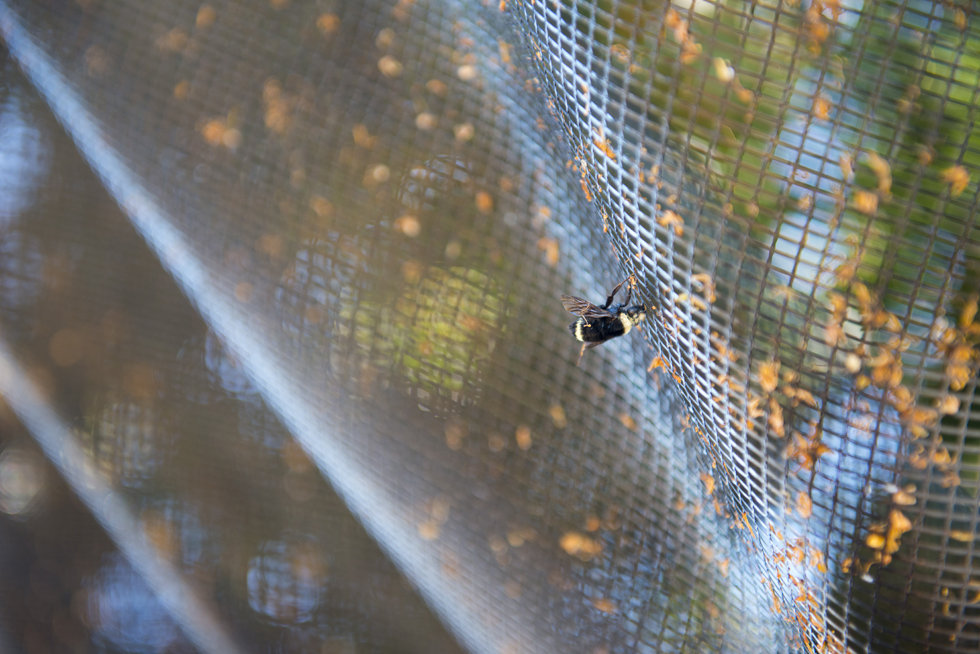
WILSONVILLE, OREGON - June 30, 2013 - A bumblebee is caught in the protective netting draping the trees in a Wilsonville Target parking lot. An estimated 50,000 bees were killed when the trees in the parking lot were sprayed with the insecticide Safari on June 15. Molly J. Smith/The Oregonian, June 30, 2013.


Fifty-thousand is a medium-sized town
     Loveland, Colorado
     Pocatello, Idaho
     Lacrosse, Wisconsin
     Milford, Connecticut
wiping out any one is a slaughter

for bees,
50,000 might be five hives,
maybe one.

Dead bees dry up like cicada husks,
furred legs pump,
torsos circle directing
toward a hive they’ll never go home to.

They came for linden pollen,
the heart-shaped leaves, abundance.
and writhed in piles in a Target parking lot
wanderers, sojourners, victims
of Safari sprayed for aphids no one worried about.
The scientists wrapped the trees in baggies,
closing the juice bar
after the liquor turned lethal.

The people worried on those pollinators,
the canaries, busy-bodies on fruit.
Come to Target to mourn, carry your signs
Bee The Change
for bees who feed us

not knowing poison
as convenience.
Poison as death knell,
the dripping of our tears.

We have so little time
without the bees.


Tricia Knoll is a Portland, Oregon poet. As a master gardener who specializes in native plants, she grows some plants just for the pollinators. A righteous bunch of pearly everlasting is in bloom right now.

Wednesday, July 10, 2013

COST ANALYSIS

by Ed Bennett


When the Senate passed an expensive border-security measure two weeks ago, the fate of immigration reform in that chamber was all but sealed. The amendment made the overhaul easier to swallow for some Senate Republicans, paving the way for its passage last week. But the added measures also mean the government won't be saving as much money as first thought, according to a new Congressional Budget Office estimate. --Niraj Chokshi, National Journal, July 3, 2013


It’s all over, as they say,
except for the shouting.

Sixty votes obtained
on the contrails of the last election, the promise of presidents to come;

but shout they will
with every word and sentiment
aimed at brown skins and accents, that brave new world of inclusion.

Lets do the math:
six billion to open the door,
forty five thousand per head
to keep out the rest,
twelve million votes, give or take,
new to this canvas of electoral politics.

If you cannot stop the rush of history
or the perfidy of the Upper House,
do the math,
run the numbers,
call the count until the figures
roll up against a frail economy
to ask the question:
“Can we afford?”
“Dare we spend?”

Then we will digitize them,
distill their humanity into dollars and cents,
(they will be easier to ignore that way)
and our knock about faith
will be justified with numbers
as smooth as the cash count
at a teller’s window,

as empty as a hypocrite heaven
on an unexpected judgement day.


Ed Bennett is a poet and reviewer living in Las Vegas, NV. His works have appeared in The Externalist, Touch: The Journal of Healing, The Lavender Review, Quill and Parchment and Lilipo. He is a staff editor for Quill and Parchment Magazine, the recipient of a Pushcart Nomination and the author of “A Transit of Venus”.

Tuesday, July 09, 2013

FIDDLING WHILE NIGERIA BURNS

by Lucille Gang Shulklapper


“Nigeria has ordered the closure of all secondary schools in Yobe state after Islamic extremists massacred 42 people at a boarding school in the region.” --The Independent (UK), 8 July 2013


Do you smell the stench, America?  in the vessels of fuel by Islamic extremists, in their vessels  of dried and fresh blood?  of burning flesh? of children at school? of wounded skin and bone? of ruptured tissue? of spilled brains? of a father's torment?  of seeing his two sons? who,  fleeing  fires of  Hell  are shot to death? hacked to pieces? do you hear their cries? smell embered hearts?  or is it a headline? buried with children? in fireworks of a different sort? the kind of American explosion in the sky? on the fourth of July? when we shoot the stars in bursts? when stepping  over ashes of Western civilization, we light our fires? fiddle with grills?  barbecue ribs buried in  smoky sauce? and  sniff the stifled air?   

 
Lucille Gang Shulklapper is a poet, fiction writer, workshop leader mother, and grandmother.

Monday, July 08, 2013

HE LEFT CONGRESS ATWITTER, BUT HE'S BACK

by James Cronin


                            “Mr. Weiner has once again upended popular conceptions
                            about him, vaulting to the front of the race for mayor.”

                                                            --New York Times, July 9, 2013

                              “Man is the only animal that blushes. Or needs to.”

                                                                                           --Mark Twain


Does foolish scandal have a “use by” date?
Weiner hopes so; he’s on top of a poll,
for mayor. Does victimless sin conflate
with time served to grant a type of parole?

Talking heads, in the past, his sins did bare
and hid their joy.  For hot ratings, Weiner’s
folly was just the stuff they loved to air.
Forget policies, his misdemeanors

were desired: the wry dirt, the sexy tweets,
photos of bare chest and tumescent briefs.
For all the smoke, no fire, no dirty sheets;
it was a mating dance for all its grief,

a bunny hop of humiliation
for the cocksure.  But Twain is not correct.
Like rutting sheep, the rep of the nation
banged his brain blue with no blush to detect.

Recall his nervous, callow demeanor.
When he bared all to the media crush,
remorse only left a sallow Weiner.
Foreplay, not shame, creates the rosy blush.

It can be light, even the slightest touch
can pink the cheeks of an Austen jeune fille
or it can be heavy, even too much,
Yeats’ laid back Leda in feathery glee. 

The risk of exposure will not suffice.
Rumpole’s author knew he had to stick to
the law, but prized sex outdoors for that spice—
cold assets in flagrante delicto.

The need to record is poetic writ.
Anne Carson sings of her little behind,
red with desire, baboon-like, to do it,
finding her soul between bawdy and mind.

Buddha knew pain was rooted in desire,
we want and it hurts, it holds us in thrall,
but we need that rush of blood, that fire.
Unlike the beasts and man before the Fall

we know the grim dance that’s after the ball.


 After a four decade career in the law, James Cronin has returned to his first loves, literary studies and writing.

Sunday, July 07, 2013

FOUR EPIGRAMS

by Richard O'Connell


Quick Canonization

Instant sainthood's the chic ideal  
Broadcast from Rome of late;
I prefer the conventional spiel
When they sat a Devil's Advocate.*

*The office of Advocatus Diaboli was abolished by 
Pope John Paul II.


Retromartyr

Bruno never did repent
But died in flames for heresy.
The Church retracts an ancient wrong  
And promulgates apology.


Less Said

The Laceademonians,* famous for few words,
Demonstrated their gruff, laconic gift  
When Philip of Macedonia threatened them: 
"If I enter Laconia, I'll burn it to the ground."
To which the Lacedaemonians responded: "If."

* Spartans


Poltically Correct

Nerva never publishes or recites.
For fear of Nero, Nerva never writes.
              Martial, VIII,70


Richard O'Connell lives in Hillsboro Beach, Florida. Collections of his poetry include RetroWorlds, Simulations, Voyages, and The Bright Tower, all published by the University of Salzburg Press (now Poetry Salzburg). His poems have appeared in The New Yorker, Measure, Trinacria The Atlantic Monthly, National Review, Margie, The Texas Review, Acumen, The Formalist, Light.

Saturday, July 06, 2013

PYROTECHNICS

by Martin Elster


The heavens effervesced with smoke and noise
as spiders, peonies, and palms enthralled
the mobs of men and women, girls and boys,

but shocked the foxes, rabbits, deer, and mauled
the air like ack-ack fire. It spooked the bats
while coons abandoned kits and field mice crawled

down burrows. Even butterflies and gnats
behaved as if huge bolides overhead
were quaking space-time. Humans have their spats,

but this seemed more like war. Some birds dropped dead,
some lost their hearing; dogs were hit by cars
or disappeared, while other creatures bled,

pulled through and lived, disfigured, etched with scars
to face anew this fête beneath the stars.


Martin Elster lives in West Hartford, CT. His poems have appeared in journals including 
Eye to the Telescope, The Flea, Mindflights, The Speculative Edge, Thema, Victorian Violet Press, and in the anthologies Taking Turns: Sonnets from Eratosphere and New Sun Rising: Stories for Japan. His poetry has been nominated for a Pushcart Prize and a Rhysling Poetry Award.

Thursday, July 04, 2013

REST IN PEACE
DEPENDING ON WHERE AND WHEN YOU FALL

by Tricia Knoll


“Mummies are a non-renewable resource” - the curator of the Mummies of the World exhibit in Portland, Oregon. Source: The Oregonian.

In Burlington, around Ethan Allen’s grave,
metal rifles fence him in side by side with plaques
honoring the Green Mountain boys.

But all is not well there in that boneyard.
Stern Vermont winters crack
the stones severing moth
from -er, a caretaker stacks
white marble pieces like poker chips.
In one photo, my shadow
looms at the top of the heap.

Or drape the caskets of the war dead
in flags, honor them off the planes
to the waiting hands of family,
palms cooled on steel. The rolls
of the dead renew themselves
in war, in genocide.

We say rest in peace
as if we mean it
and fight over the bones
the tribal first people
claim as Kennewick man.
Carry the eagle feather
where they walked.
There is no guaranteed right
to bury our dead.

Or, become an amateur
mummiologist,
view Germany’s collection
of preserved mummies collected
from all over the world
lost during World War II
but now on loan
to museums near you.
They are old, dried out,
they are the dead.
That woman who holds
two baby teeth, one in the palm
of each wrapped hand --

ask if she is at peace.


Tricia Knoll is a Portland, Oregon poet whose poems have appeared in a variety of journals. She is neither anti-science or anti-education -- "but if these remains belonged to North American first people, she says, I do not believe they could be displayed in this way in this country."

Wednesday, July 03, 2013

IF GOD GOT US TO IT, HE'LL GET US THROUGH IT, SAID THE MUFFIN PAN TO THE BACON PRESS

 by Laura Lee Washburn


Image source: John Darkow/Columbia [MO] Daily Tribune


You like your muffin pan with butter.
You eat it whole so the cups don’t stick
in your throat.  The butter helps.
You like your waiters black in white face.

You like stock still dark black men with trays for a party.
You drink iced tea with mint.  You smile
and belch a champagne-coated muffin tin burp.
You’re like a cookbook with hand drawings

of the Skyline drive, Smithfield ham on buttered
biscuits.  The muffin tin constipates you
a little bit.  China will manage spiral-cut hams
with your face on their packages.  China
makes your muffin tins bigger every year.

You eat muffin tins for lunch.  You eat
muffin tins, buttered, for breakfast.
You keep the cast iron bacon press greased
with bacon fat.  Nothing sticks in your craw.

The cast iron bacon press tastes like Tennessee
in 1963.  Your little monkey cooks it best.
Everything’s so hard to pass these days,
goes down easy, but sticks and stinks, a black
hard stool in your soft pink bowels.


Laura Lee Washburn is the Director of Creative Writing at Pittsburg State University in Kansas, and the author of This Good Warm Place: 10th Anniversary Expanded Edition (March Street) and Watching the Contortionists (Palanquin Chapbook Prize).  Her poetry has appeared in such journals as Cavalier Literary Couture, Carolina Quarterly, Ninth Letter, The Sun, Red Rock Review, and Valparaiso Review.  Born in Virginia Beach, Virginia, she has also lived and worked in Arizona and in Missouri.  She is married to the writer Roland Sodowsky.

Tuesday, July 02, 2013

RESERVE

by William Aarnes


Image source: UniteWomen.org


She lies on their bed,
still dressed.  She tells him.

that in this country,
if—a big if—

the penis and clitoris
are private parts,

 the uterus is not.
“My womb,” she explains,

patting her abdomen,
“is public domain,

one of millions of reserves
set aside to attest

to some people’s belief
that any fetus

has more sanctity
than any mother.”

She rubs her brow.
“Gives me a headache.”


William Aarnes lives and writes in South Carolina.

Monday, July 01, 2013

THE ENDURING PRESENCE

by Rick Gray


Archbishop Tutu ordered pumpernickel from the 9th Avenue deli
near the Anglican Rectory of Chelsea.

Still hot, he blessed the bread, his eyes going sly as he
broke the black loaf into little white bites.

I kept my eyes down, relieved for once to have
Ritual to contain my modern fear of miracle

As when, two years earlier, I stepped into Mandela’s empty prison cell,
Now a museum, and was boxed with a presence so enduring

I crossed myself defensively, and fled the ring.
Raising my eyes, I saw Tutu offering a cup of blood
                    
To wash down the dark flesh,
His eyes belly laughing at my little trembling.


Rick Gray served in the Peace Corps in Kenya and currently teaches at the American University of Afghanistan in Kabul. He was a finalist for the Editor's Award at Margie, and has an essay that will be appearing in the forthcoming book, Neither Here Nor There: An Anthology of Reverse Culture Shock. When not in Kabul, he lives with his wife Ghizlane and twin daughters Rania and Maria in Florida.