Guidelines


Submission Guidelines: Send 1-3 unpublished poems in the body of an email (NO ATTACHMENTS) to nvneditor[at]gmail.com. No simultaneous submissions. Use "Verse News Submission" as the subject line. Send a brief bio. No payment. Authors retain all rights after 1st-time appearance here. Scroll down the right sidebar for the fine print.
Showing posts with label Nigeria. Show all posts

Thursday, August 08, 2024

WE THE PEOPLE

 by Anayo Dioha


“Why are Nigerians protesting? Young people were roused by events in Kenya.” —The Guardian, August 3, 2024


You and your peeps pillage the purse of the people;
State proceeds hang beyond the reach of the people.
 
Passing frivolous bills, paying frivolous bills;
A despot’s impunity in full glare of the people.
 
Yesterday, presidential yacht. Today, presidential jet.
What frivolity awaits tomorrow? ponder the people.
 
A new SUV to distinguish a senator. A new 
Minimum wage? Uncalled for; can’t pay the people!
 
In this theatre of independence, the noose of nostalgia
Dares favour the colonist’s over the anthem of the people!
 
And now the streets rage with chants of hunger,
Tell, who can quell the anger of the people.
 
Certainly not those traditional stools that have stood
As stooges. Not those episcopal enemies of the people.
 
Why buy the institutions and become a monopolist
When you could buy hearts and be a man of the people?
 
On where lays your heart, Lord? Where else 
Do your feet stand but on the ground of the people?


Anayo Dioha is a Nigerian and has been previously published in the The New Verse News among other online and print literary journals.

Monday, April 17, 2023

CHIMAMANDA’S VOICE IS CAUGHT IN THE WAR OF TRIBES

by Anayo Dioha


Here, you hardly distinguish the hangman
from his victim. It’s like having red Roses
and Ranunculuses thrive in the same garden;
both capable of smothering life, one much
renowned, the other, unknown, as potent,
as lethal. How the conversation always
metamorphosed from a failed public
process and a couple of dashed personal
hopes to who’s from where? has always
been the bone which these unscrupulous
termites continue to wittingly crunch.
For a courageous truth, there stands in
repel, a garrison of a hundred thousand
armed-to-the-brain blindfolded Tribal
Security Watch. The wool of patriotism
has grown so lean it can’t warm off the
blizzards of ethnocentricism, and a
country’s heart beats rapidly from a
race towards an ever-hungry grave.


Author’s Note: Nigeria is a country which has hugely fragmented, over the years, across certain sentimental lines among which is ethnicity. There are over three hundred and fifty (350) ethnic groups in Nigeria, although the most prominent are Hausa/Fulani, Igbo and Yoruba. It has become a norm that serious issues of national importance often lose their grit in the cloud of such societal sentiments as tribalism or ethnicity. And this is what is witnessed in the responses following the 2023 presidential election in the country, which has been widely criticized by observers as heavily flawed with electoral malpractices. The major candidates at that election are Atiku Abubakar (Hausa/Fulani) of the People’s Democratic Party (PDP), Peter Obi (Igbo) of the Labour Party (LP) and Bola Tinubu (Yoruba) of the ruling All Progressives Congress (APC), the declared winner. However, most Nigerians believe Obi won at the polls. Chimamanda Adichie (Igbo) wrote in The Atlantic with respect to the perception felt about the process of the election in general and not necessarily because of the candidacy of Obi. But this soon spiraled into a squabble about the tribes, as Wole Soyinka (Yoruba) also granted an interview where he gave his candid opinions regarding the process and conducts of the key players. Things degenerated with some figures in Lagos—a city in western Nigeria dominated by the Yorubas—declaring, with threats of violence—some of which were actually mated—that Igbo residents in the city should go back to their home towns mostly in the south-eastern part of the country. The use of “obidiots” by the responder in the tweet headlining this poem is an incendiary reference to the self-styled supporters of the Peter Obi presidential campaign, the Obi-dients.


Anayo Dioha is a Nigerian Igbo-born writer and lawyer whose work is forthcoming in Queens Quarterly. He is currently a PhD researcher at the Odumegwu Ojukwu University. He spends most mornings counting squirrels and reveling in the tunes of waxbills.

Monday, February 14, 2022

FOR VAL I GIFT YOU—YOU

by Joseph Hope


For Val I gift you a country 
without a government: without a place (segregation) 
for black or white or color riot. A song as soft as the snow.
I gift you rain in the desert. A bow without an arrow, 
so you don't hunt. I gift you a heart as big as Asia. 
A smile as warm as Summer. A will as strong as Africa. 
I gift you meditation as deep as the oceans of Europe. 
For Val, I gift you the pain of childbirth. The giggling that comes afterward. 
The innocence of a thousand childhoods. The riches of the earth. 
I gift your friendship. The (im)perfect family. Cry. Laugh. Cry. Laugh. 
I gift you the reasons to go on and on 
and never quit to try again and again. 
I gift you the rain and the bow; rainbow. 
The songs of the ancient. The hope of the future. 
I gift you miracle. Goodnews. 
For Val, I gift you—you.


Joseph Hope writes from Nigeria, West Africa. He believes he's a metaphor for what can be, what is possible. His works are forthcoming or already published in Reckoning Press, Timber ghost press, Evening Street Press, Zoetic Press, The New Verse News, Praxis Magazine, Ubu, AfroPoetry, Gemini Spice Magazine, Spillwords, SprinNG, Writers Space Africa, anthologies, and more. He's a reader for reckoning press. He was a fellow in the 2021 SprinNG Writing Fellowship. He tweets @ItzJoe9 & IG: _hope_joseph

Thursday, October 21, 2021

WHAT IT TAKES TO LIVE HERE

by Joseph Hope


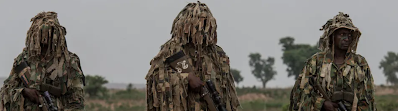
Gunmen have killed at least 30 people in northwest Nigeria in the latest round of violence in which hundreds have been killed so far this year and thousands more displaced. —The Washington Post, October 18, 2021. Photo: Some members of the Nigerian Armed Forces Sniper Unit. Stefan Heunis/AFP via Getty Images via The Conversation, October 18, 2021


What it takes to live here.
                 Numb. Wait for the news:
unknown gun men killed an 
             unknown number of people, 
go to bed and hope there is 
             tomorrow, of course there is 
always tomorrow 
                       and aways bad news, 
a man named Naira 
                       fell from it high horse 
and broke more than a neck. 
                         The president said shoot 
the protesters, No, 
                      the Army chief did, No, 
an unknown fraternity bigger 
than the government gave the command, 
we don't know who fired 
                                 but we know who died. 

Pretend. Pretend you're happy 
and unhurt, riddled with holes and alive. 

Try to live on unpaid  
                               salaries for months 
and save enough to buy a house 
                          from unpaid pensions. 
Understand to plan your future  
                           on nothing but prayer, a lot of it 
that the church overflows and spill
into the street                         like chemical waste. 
                  Understand ghost walking, 
understand the rhythm of bullets, 
                          understand the many ways you could 
die gradually until blood              looks like red paint, 
                  until bodies piled like groundnut 
pyramid appear 
              as a necessity.
                       It would take more than 
the blood of children drooling from the altar 
                       of terrorism to 
inflate your already               deflated emotion. 
The superpower           of being a Nigerian 
is that you can              make comic of death, 
dance in anger,             and swallow grief 
like your daily                  vitamin supplement.


Joseph Hope is a student of Usman Danfodio University, Sokoto, Nigeria. He is currently studying applied chemistry. His works are forthcoming or already published in Reckoning Press, Evening Street Press, Zoetic Press, The New Verse News, Praxis Magazine, AfroPoetry, Gemini Spice Magazine, Spillwords, SprinNG, Writers Space Africa, Nthanda Magazine, 5th Chinua Achebe Anthology, Ariel Chart, Best "New" African Poets 2019 Anthology, and more. He's a reader for Reckoning Press. He was a fellow in the 2021 SprinNG Writing Fellowship. He tweets @ItzJoe9 & IG: _hope_joseph

Monday, April 05, 2021

THE DIRECTOR'S CUTS YOU DIDN'T SEE

by Joseph Hope


The United States Country Report on Human Rights Practice in Nigeria, published on March 31, 2021, tepidly states that “On October 20, members of the security forces enforced curfew by firing shots into the air to disperse protesters, who had gathered at the Lekki Toll Gate in Lagos to protest abusive practices by the Nigerian Police Force’s Special Anti-Robbery Squad (SARS). Accurate information on fatalities resulting from the shooting was not available at year’s end. Amnesty International reported 10 persons died during the event, but the government disputed Amnesty’s report, and no other organization was able to verify the claim.” The US government report is seriously at odds with the CNN report reproduced above. 

A subsequent CNN report documents how the Nigerian government edited a key piece of video evidence. "The Lagos State government's security camera footage of the Lekki toll gate shooting did not capture everything."


We don't have evidence
but we have our truth.
We don't have evidence,
because it was ripped away from us 
with guns aimed at our heads.
People were shot and taken away to unmarked graves.
We have their faces crested on our hearts,
the nameless uncounted for.
Protesters waving their flags were shot in their heads
in their guts
in their backs
in all the places that could kill a man.
The numbers of the dead increases by enough.
A bullet goes through a youth's  
throat like hypens 
silencing the anthem in his mouth.
Mustapha is down. John too.
How many brothers do I have to bury 
to know how hard it is to dig a grave?
Peace and bullets ain't mixable, 
Don't you agree? 
Our blood is also red like the blood of Abel.
The dead are restless.
The dead  were shamed:
Their bodies were washed off the cameras, 
washed off the internet, 
washed down the filthy drains like shit
by the unremorseful ruling monsters?
But the dead have many tongues: so listen 
to me, you proprietor of death—
This is our Homeland!
It's our right to sing, 
think, and talk.
We will not yield
even if you level us like fields, 
and cut us away from our names and identity.
Turn us to organic manures 
and we will still grow trees 
whose adventurous roots will infiltrate your resorts (Aso Rock)
to strangle you 
and your ignoble generals.
We are too stubborn
to be wiped off clean.
We'll continue to speak underneath the earth 
until someone up there hears us.


Joseph Hope is writing from Nigeria, a student of Usman Danfodio University. His works are either forthcoming or already published in Reckoning Press, Evening Street Press, Praxis Magazine, Gemini Spice Magazine, Spillwords, SprinNG, Writers Space Africa, Nthanda Magazine, 5th Chinua Achebe Anthology, Ariel Chart, Best "New" African Poets 2019 Anthology, and many more. He's a young man running away from his name. How absurd!

Monday, March 08, 2021

INTERNATIONAL WOMEN’S DAY 2021:
A LIST POEM

by Mary K O’Melveny


I.  Jalalabad, Afghanistan
 
Mursal Waheedi
Saadia Sadat
Shahnaz Raufi
 
Buried in fresh graves
along with their hopes
Journalists without portfolio
 
Peace flags at half staff tonight
 
II.  Mandalay, Myanmar
 
Ma Kyal Sin
a/k/a “Angel”
Age 18
 
At the protest front lines
Garbed in bright red lipstick
her black t-shirt emblazoned
 
“Everything will be all right.”
 
III.  Bangalore, India
 
Disha Ravi
Climate advocate
Age 22
 
Helping farmers on Fridays
turns seditious
toolkits tied to treason
 
Democracy’s promise reviled
 
IV.  Rochester NY
 
Unnamed girl
“Person in crisis”
Age 9
Pepper spray
even in handcuffs
antidote for “family troubles”
 
Cops say “You’re acting like a child”
 
V.  Rochester NY
 
Unnamed woman
with unnamed toddler
Age 3
 
Allegations of shoplifting
More pepper spray
New policy questions
 
‘I didn’t steal nothing” she said tearfully
 
VI. Pentagon, Arlington VA
 
Unnamed women
Service members
Ages varied
 
Sexual assaults
reported – more than 7,800
unreported – 20,000
 
“You’re more likely to be raped by
someone in your uniform as shot by the enemy”
 
VII.  Washington DC
 
Unnamed women
formerly working
Ages varied
 
2.3 million departed
from the workplace in just one year
140,000 in December alone
 
70 cents per male dollar --“Motherhood penalty”
 
VIII.  Yambio, South Sudan
 
Margaret Raman
Single mother of five
Age 38
 
Beans and ground nuts
for sale at Masiya Market
now rotting in noonday sun
 
business stifled by COVID’s legacy
 
IX.  Maiduguri, Nigeria
 
Hundreds of schoolgirls
kidnapped by gunmen
Ages 12-18
 
Bandits in uniforms
barefoot children
education turns life-threatening
 
“Abduction is a growth industry”
 
X.  Indiana, Montana, South Carolina, Kansas, Wyoming, Tennessee
 
Anxious women
seeking autonomy
Ages unknown
 
Bills passed or pending
legislators emboldened by extreme
agendas and judicial appointments
 
Choices determined by geography


Mary K O'Melveny is a recently retired labor rights attorney who lives in Washington DC and Woodstock NY.  Her work has appeared in various print and on-line journals. Her first poetry chapbook A Woman of a Certain Age is available from Finishing Line Press. Mary’s poetry collection Merging Star Hypotheses was published by Finishing Line Press in January, 2020.

Wednesday, February 10, 2021

LUXURIOUS FEAR

by Rebecca Leet


Source: We Do Geek


My head sinks into the pillow
and fear floats forward
like a ghoul set to stalk my dreams
 
so easy to keep ghosts
tautly moored when sun shines,
before night ingests hope.
 
I worry past the present pandemic
past the wild, sad souls ensnared
by visions of prurient perfidies
 
to a time closer than we dare declare
when swelling seas, infernos of forests,
acres of arid, fallow farmlands
 
push civilization to survival of the fittest
and my newborn grandchild, one day,
must claw over others or succumb.
 
Then morning comes and as I sip tea
news reports speak of children suffocating
from poison gas in Syria        girls kidnapped
 
by Boko Haram in Nigeria      a boy killed
in a random shooting five miles away.
And I realize my fear, today, is a luxury.
 

Rebecca Leet lives a stone's throw from Washington, DC.  Her collection Living with the Doors Wide Open was published in 2018.

Tuesday, February 05, 2019

SEIZURE

by Laura Rodley


Officials in Hong Kong said on Friday that they had intercepted a shipment of nine tons of scales from pangolins, the largest seizure the city has ever made of products from one of the most frequently trafficked mammals in the world. A thousand elephant tusks were in the same shipment, officials said. The scales and tusks were seized on Jan. 16, said the customs authorities, who displayed the contraband for reporters. They were found hidden under slabs of frozen meat on a cargo ship that had stopped in Hong Kong on its way to Vietnam from Nigeria, said officials, who estimated the shipment’s value at nearly $8 million. —The New York Times, February 1, 2019


Minding their own business
pangolins slurp up termites
drawing squirming bugs into their stomach
with their tongues that begin in their stomach,
not the back of their mouths.

Minding their own business,
they do not smell the poachers or the poachers’ dogs,
poachers that cover their boots with pangolin musk
and the murky water they trudge through
to reach the pangolins emerged from their burrows at night.

Not even completely dead, poachers scrape away
pangolin scales, layered like pine cone fingernails on their backs
with sharp triangle blades that could but do not
cut the poachers’ hands, as they wear thick gloves,
poachers who consume the pulverized scales themselves

to combat pain of arthritis, asthma or rheumatism
that they have gained carrying baskets of scales out of the woods.
They have no awe of the stretched out beauty
of the pangolin’s body, peacock length with no feathers,
no awe of the babies that ride on their tails,

no fear of the way pangolins fight back—by rolling into a ball
around their young who just finished drinking their milk, easy to capture,
dismantle their scales, maybe carry some back alive to raise more.
They only think of their business, harvesting
the bounty, nine tons of scales seized mid January

in a Hong Kong port, amassed from nearly 14,000
rolled up balls expired, gasping, left behind,
so the razor edge of their scales can strengthen
someone’s bones, ease their pain. What about their conscience,
Does the eight million price tag cancel that?


Laura Rodley was a Pushcart Prize winner for her New Verse News poem "Resurrection." Finishing Line Press nominated her books Your Left Front Wheel Is Coming Loose and Rappelling Blue Light for the Mass Book Award. Former co-curator of the Collected Poets Series, Rodley teaches the As You Write It memoir class and has edited and published As You Write It, A Franklin County Anthology volumes I-VI. Latest books: Turn Left at Normal by Big Table Publishing and Counter Point by Prolific Press. 

Sunday, December 31, 2017

CHASING THE AMERICAN DREAM

by Lind Grant-Oyeye


“Unpresidented,” by Sue Cole at the Galerie St. Etienne via The New Yorker, January 1, 2017

Forty thousand [immigrants] had come [to the U.S. since January] from Nigeria, Mr. Trump added. Once they had seen the United States, they would never “go back to their huts” in Africa, recalled the two officials, who asked for anonymity to discuss a sensitive conversation in the Oval Office. —The New York Times, December 23, 2017


Some day, a hut hurting someplace—
from creaked bolts, jolts and thunder bolts
may find sunshine, side by side the spire
of Mar-a-Largo—a dream.

After the settling of rain, hurricanes and all,
then would they embrace what is left
of the saltiness of seas and foreign sand left
on shore or savor jointly, the after taste of sea weed.

After the atmosphere has rested from pouring rain,
side by side still, they will behold clearly the combined smiles
of gods which used to hide behind layers and layers
of pretentious stratopheric ozone—

After the smiling of gods,
side by side still, they will pour out whatever soot is left
in their bellies as contrite offerings to the gods—
the joint confessional and thanksgiving of immigrant houses,
made welcome.


Lind Grant-Oyeye, a winner of the Universal Human Rights Student Network human rights poetry award, was born in Nigeria. She has work in several literary magazines world wide.

Sunday, December 06, 2015

A COIN OR A COMB

by Laura M Kaminski


"We can't continue to play the ostrich game anymore, especially 
for those of us who still insist on being called POETS..."
— Chiedu Ezeanah


Who will pay me for a poem, read
one and be moved to action? Who
will open their ears and remove
the deafening silence? Who will
pay a coin of attention, enough
for a pack of combs, a book of
poems, and add to a small stipend
for a volunteer to go and read
to orphans while they learn to
pick and braid each other's hair?

Do you not remember when you
yourself were small, the feel
of your mother's hands upon
your head? Do you not recall
your impatience on occasions
when you were eager to be on
your way, finished with this
process? But when you left,
did you not carry the sense
of her affection with you,
the confidence that she would
not have loosed you until
you were your most presentable?

Who will pay me for a poem,
send a coin or a comb? And
who will take time to visit
orphaned children, offer them
the reassurance of adult
affection, let them know they
are not forgotten, that an
entire nation is present
to serve as surrogates for
parents they have lost? But
there is so much silence.

Are we afraid to face their
destitution and their grief?
Do we believe there are too
many for us to make a real
difference, and afraid of
failure, fail to even try?
Is there no path from silence
into action? What use is a poet
who will not be a beacon? If
there is no path, then let
the poets set the course
with words and wear it with
their feet, don't let the words
be empty. Let the poets lead.


Laura M Kaminski grew up in northern Nigeria, went to school in New Orleans, and currently lives in rural Missouri. She is an Associate Editor at Right Hand Pointing, and the author of several poetry chapbooks and collections, most recently Dance Here (Origami Books, an imprint of Parrésia Publishers Ltd, Lagos, Nigeria).  

SUPPOSE

by Carolyn Dack Maki 


A Kalamazoo woman facing a deportation to war torn Nigeria breathed a sigh of relief Monday as immigration officials decided to extend her order of supervision until May 4, 2016. The hearing in Detroit was the last chance for Rejoice Musa and Frederick, her 3 year old, American-born son. She had exhausted every other appeal to stay in the country, but this time came with the names of hundreds of people who signed a petition over the weekend and the support of Michigan Senators Peters and Stabenow. Now Musa will wait with millions of other undocumented parents in the US as the Supreme Court rules on the President’s action to help immigrants in her position. —Michigan United, Nov. 24, 2015


Suppose
that Rejoice didn’t have an electronic tether slapped on
by immigration agents whose best advice was to get married
and prevent deportation to Nigeria.
Her family’s arms are not open to her.

What if
three-year-old son Frederick born out of wedlock wasn’t a US citizen.
Nothing about him resembles “anchor baby.”
This gregarious child loved by all carries a death sentence.
Mother’s indiscretion and Western education are condemned.

And
that Rejoice wasn’t admitted to a graduate aviation program
that she didn’t have family-supporting employment
that the job anticipated through her high-ranking uncle now comes
with a calling card from Boko Haram’s midnight murder squads.

Suppose
that she wasn’t trying to abide by US law pleading for asylum.
Now she must report for detention and deportation
rampant under US policy she’s dispassionately told.
Tonight she sits with a bottle of Tylenol wondering is this is an answer.

Consider
that tomorrow she might approach a casual acquaintance
with a marriage proposal. Please, she will beg, I’ll support you.
Yes, I am using you. You can use me.
So contrary to her Christian faith.

Suppose
that she would be successful in saving their lives,
that her birth name is prophetic,
that their future could mean joy.
Just suppose.


Carolyn Dack Maki is a resident of Southwest Michigan.  A retired speech/language pathologist she is passionate about politics and public discourse.  She studies poetry at the Kalamazoo Institute of Art.

Monday, June 29, 2015

A CLASP

by George Held


So as I left the hygienist’s chair, white-clad Reesha
Said she’d taken a cruise to Turks and Bermuda
And, despite sunscreen, her tawny skin had turned
Black as the Nigerian queen Amina’s,

And I said, “Look at my sad white skin,”
Reddened and pebbled by actinic keratoses
(and smeared with cream to spare it from cancer)
And then I said what was on my mind about

Charleston, the city of Charles (whose name isn’t even
In the Bible), where white-racist hatred had burst
From a gun barrel and killed Pastor Pinckney
And his prayer-meeting sisters and brethren,

And I thought of all the black forbearance, the black
Sympathy, the black nobility that has steadied
A course that might have burst into whirlwind, war
And more deaths of worthy men and women,

And we two, Reesha and I, standing face to face
In the cramped space between high-tech dentistry
And the human race, the only race, clasped hands
And said to each other that in our own history

We at least are friends as I hoped that I was not
Just a superannuated white man
Deluded that he was without the taint
Of racial prejudice.


George Held, a regular contributor to The New Verse News, has a new book out from Poets Wear Prada, Culling: New & Selected Nature Poems.

Monday, March 23, 2015

MENTAL SLAVERY

by Abraham Adonduwa


Nigerians displaced by Boko Haram wait to get their villages back as new military alliance begins to make progress. Image source: The Independent, March 23, 2015


Politics is a dirty game
It involves grown up men abandoning decorum
For personal aggrandisement
Men in suits, Agbada, Babanriga
Taking off the inhibitors
To make it easier for them to roll in the dirt
It involves the death of conscience and the birth of pragmatism
So that when 219 girls are abducted you stay above the fray
score cheap political points against the opposition
Who are only breathing life to a figment of their imagination
go on a dance jamboree
When a bus park is blown to bits because
They are only trying to undermine your leadership
Indeed politics is meant for pigs
And rabid dogs that bark more than they bite
Covered in teak and filth
Because how can you claim to be a farmer
And have no grime under your fingernails
A surgeon and have no blood on your hands?
Politics is for men and women
ready to jettison their faith in God
For the only true religion: money, power and respect
Ready to increase their wealth by collecting bribes
And inflating contracts
And looking the other way when confronted with the harsh realities
Of the ever hungry streets
Grateful to finally belong to the cabal

Sometimes I detach myself from the daily Boko Haram attacks
Because after all, they are happening in the far North East
Where I have never visited
I clip my tongue from running loose
Grit my teeth and thank God
they aren’t extending to these parts of the country
but it is this sort of silence in the face of tyranny
this sort of lackadaisical aloofness
that is the onset of mental slavery.


Abraham Adonduwa is a Nigerian writer and poet who has been published in Origami, Ontherusk, Indiana Voice, Sentinel Quarterly amongst others. He is an emerging voice burning with passion for the written and spoken word and is currently hard at work on a collection of short stories.

Monday, January 19, 2015

BAZAAR

by Janice D. Soderling


At least 19 people have been killed and several injured by a bomb strapped to a girl reported to be aged about 10 in north-eastern Nigeria.—BBC News, January 10, 2015. Photo: NY Daily News


Weep, weep, weep,
for small fishes in the bay
caught in nets of intricate knots
where they only came to play.

Let fall a tear for hedgehogs
caught in a guileless snare;
duped by an innocent carrot,
and hoisted in the air.

Past cinnamon and saffron,
she glides with modest grace;
bundled nails and shrapnel,
brief inches from her face.

Weep, weep, weep,
for humankind's tragic flaw:
it feeds its tender brethren
into godhood's dimpled maw.


Janice D. Soderling is a previous contributor to The New Verse News.

Tuesday, October 28, 2014

I AM

by Paula Schulz


Boko Haram gunmen kidnapped at least 30 boys and girls from a village in northeast Nigeria during the weekend. The abductions appear to be the latest in a string of recent kidnappings by Boko Haram that dims hope for the anticipated release of 219 schoolgirls ‎held by the group since April following a controversial ceasefire declared by Nigerian authorities. --CNN, October 27, 2014

Women and girls abducted by the Islamist group Boko Haram are forced to marry, convert, and endure physical and psychological abuse, forced labor, and rape in captivity, Human Rights Watch said in a report released today. The group has abducted more than 500 women and girls since 2009, and intensified abductions since May 2013, when Nigeria imposed a state of emergency in areas where Boko Haram is most active. Human Rights Watch, October 27, 2014


I am

forgotten by all but a few wasp-like
men, evil by design, who live only

to make more evil. And now their evil
is in me. I feel it. Daily I am

hollowed out as they build their lair
beneath my ribs, one cell at a time.

Fear buzzes in my brain. To my body
also they do what they want. 100

days and more of doing. They want
to remake me in their image, fill me

with mud and crumble. I spend my days
sweeping them away, cleaning all

the paper chambers of the heart.


Paula Schulz works daily in a 3K setting, sits for grandchildren and grieves for these children and their families.

Tuesday, July 29, 2014

3 MONTHS, 200 NIGERIAN SCHOOLGIRLS

by Paula Schulz


In the 3 months since 200 schoolgirls
were kidnapped, 11 parents have died.
The town of Chibok is just 1 village
cut off from the world, from all mercy,
by Boko Haram. What Haram’s taken--
how to imagine the wear on parents,

the misery of loving fathers
who could not keep their own girls
safe from violent men. The taken
have taken others with them to death’s
doorway. And beyond. 7 fathers could not escape the merci-
less attack on Kautakari village.

4 more have died of heart failure or illness. A village
themselves, they are the grief-broken parents
of the missing. Life showed no mercy
to the father, coma-like and repeating his girls’
names “until life left him”. Until he died,
to say it plainly. So much has been taken

from these families. The school girls taken,
their fathers taken. Powerless villages
of Nigeria pray for life, expect death.
Waiting is hardest for the parents:
all they can think of is their little girls,
children who are merciful, gentle. No mercy

seems likely for them. What kind of mercy
can be found in mobs who burn cars, have taken
airlines out of service. The 57 girls
who ran home found help in their villages.
Grief and rape counselors for themselves, their families.
Now will food shortages mean death?

Chibuk village, the taken girls, their parents:
it can’t be told in numbers, this story
of impending death, this story without mercy.


Editor’s note: This poem is based on reporting in the AP story 11 “Parents of Nigeria’s Abducted Girls Die" by Michelle Faul, July 22, 2014.


Paula Schulz works daily in a 3K setting, sits for grandchildren and grieves for these children and their families.

Tuesday, July 09, 2013

FIDDLING WHILE NIGERIA BURNS

by Lucille Gang Shulklapper


“Nigeria has ordered the closure of all secondary schools in Yobe state after Islamic extremists massacred 42 people at a boarding school in the region.” --The Independent (UK), 8 July 2013


Do you smell the stench, America?  in the vessels of fuel by Islamic extremists, in their vessels  of dried and fresh blood?  of burning flesh? of children at school? of wounded skin and bone? of ruptured tissue? of spilled brains? of a father's torment?  of seeing his two sons? who,  fleeing  fires of  Hell  are shot to death? hacked to pieces? do you hear their cries? smell embered hearts?  or is it a headline? buried with children? in fireworks of a different sort? the kind of American explosion in the sky? on the fourth of July? when we shoot the stars in bursts? when stepping  over ashes of Western civilization, we light our fires? fiddle with grills?  barbecue ribs buried in  smoky sauce? and  sniff the stifled air?   

 
Lucille Gang Shulklapper is a poet, fiction writer, workshop leader mother, and grandmother.

Tuesday, February 12, 2013

SHELL OIL IN NIGERIA

by B.Z. Niditch

Mixed Decision for Shell in Nigeria Oil Spill Suits --NY Times, January 30, 2013;
Image source: Aljazeera January 31, 2013


In gutted morning
of the Ogoni villagers
the poor wake up
as we earth friends
of the Niger delta
hold faithful pencils
and write
of your struggle,
knowing each bruise
on the assembled
gathering to hear
the radio
with battered lilies
from years of pollution
in the injustice
of acid rain
dulled by hunger
without fishing grounds
under the rope
of tar skies
oil once filled
the delta
as Aaron's beard,
in the name and life
of Ken Saro-Wiwa
you are not abandoned
to the huge profits
of yet another
international corporation.


B.Z. Niditch is a poet, playwright, fiction writer and teacher. His work is widely published in journals and magazines throughout the world, including: Columbia: A Magazine of Poetry and Art; The Literary Review; Denver Quarterly; Hawaii Review; Le Guepard (France); Kadmos (France); Prism International; Jejune (Czech Republic); Leopold Bloom (Budapest);  Antioch Review; and Prairie Schooner, among others.  He lives in Brookline, Massachusetts.