Guidelines


Submission Guidelines: Send 1-3 unpublished poems in the body of an email (NO ATTACHMENTS) to nvneditor[at]gmail.com. No simultaneous submissions. Use "Verse News Submission" as the subject line. Send a brief bio. No payment. Authors retain all rights after 1st-time appearance here. Scroll down the right sidebar for the fine print.

Thursday, July 09, 2015

CRUEL AND UNUSUAL

by Gil Hoy


A divided Supreme Court on Monday turned aside claims by death-row inmates that a drug to be used in their executions would lead to an unconstitutional level of suffering, a narrow but unequivocal ruling that made clear that states have leeway in carrying out the death penalty. —Wshington Post, June 29, 2015

"I would ask ... a more basic question:whether the death penalty violates the Constitution."--Justice Stephen Breyer in his dissent

Are some men
born evil,

and others
born good?

As some men
have brown eyes,

and others
have blue?

As some
are born weak,

and others
born strong?


Gil Hoy is a Boston trial lawyer, who first studied poetry at Boston University while receiving a B.A. in Philosophy and Political Science. Gil started writing his own poetry last year. Since then, his poems have been published most recently in The Potomac, The New Verse News, The Antarctica Journal, Third Wednesday, and To Hold A Moment Still, Harbinger Asylum’s 2014 Holidays Anthology.

THREE STRIKES NO MORE

by Claire Day


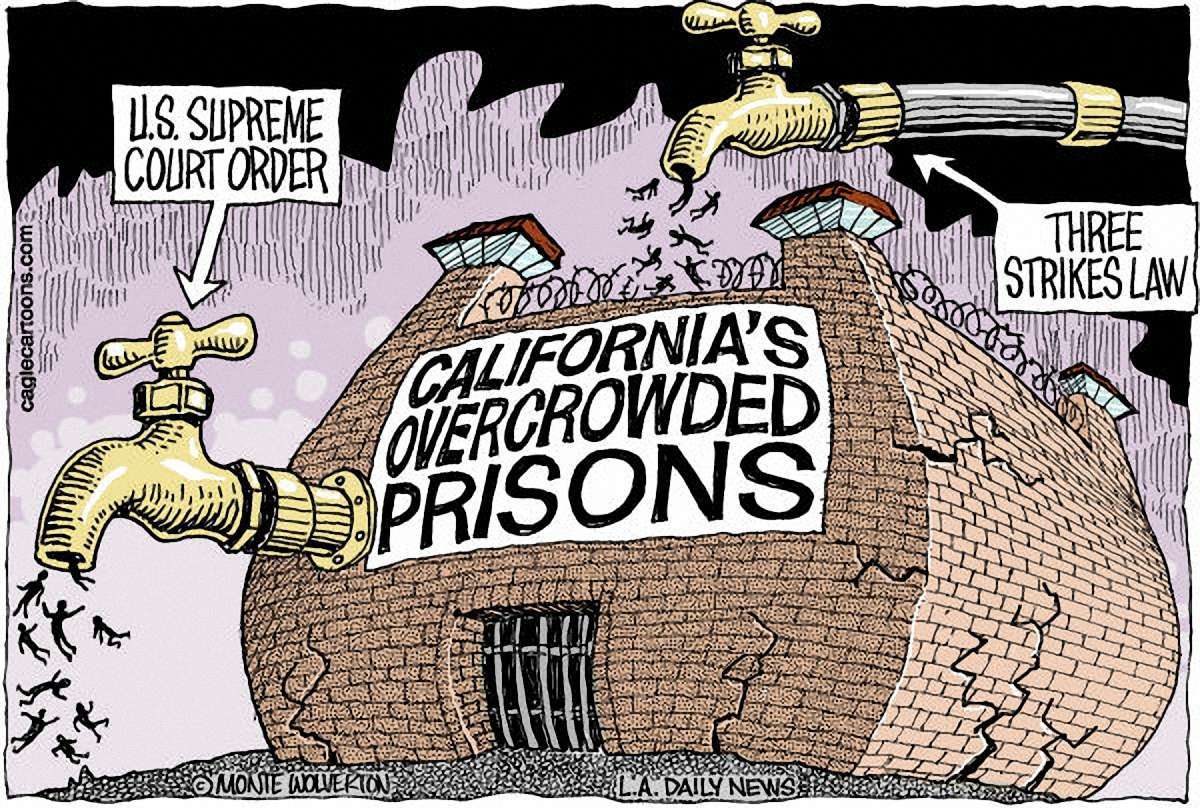
On June 26, the United States Supreme Court ruled the federal Three-Strikes Law unconstitutional. In Johnson vs. United States, the Supreme Court held that the government violated Johnson’s due process by imposing an increased sentence under the Armed Career Criminal Act’s residual clause that was unconstitutionally vague, standard-less, and only enforceable arbitrarily. The ruling elaborated that two elements constitute the vagueness of the law: 1) by assessing risk of a case using fictitious crime rather than using real-world statistics, and 2) ambiguity regarding the amount of risk necessary to qualify a crime as a violent felony. In other words, assessment of risk of future violent crime by an individual is unpredictable and uncertain, and has not historically been applied consistently. Supreme Court Justice Scalia delivered the opinion of the Court, joined by Roberts, Ginsburg, Breyer, Sotomayor, and Kagan, while Kennedy and Thomas concurred in the judgment. Justice Alito filed the sole dissenting opinion. —National Center for Due Process, July 6, 2015


There used to be a row of firs
lined up against the fence
limbs outstretched to intertwine
and guard the narrow yard like jailers,
block access to the light

There are prisoners
who never move beyond the confines of their bars
and see the sun
they live in tiny spaces
meant to squash the soul

The trees are down now
their rule long gone

Grass sings
flowers surge in summer hues
grapes dally on the vine

And breathe the smell of freedom


Claire Day lives in western Massachusetts, in an area where writing is virtually a way of life. After writing prose for several decades and both participating in and facilitating writing workshops,she has discovered the joys of poetry. She enjoys its economy of words, its lack of distracting verbage, and most of all, its ability to enter the mind and heart.

JIGGERY-POKERY

by Max Gutmann


Image source: DonkeyHotey


“Jiggery-pokery!
Now it's just SCOTUScare!”
Grumbled Scalia, en-
Raged at his peers.

“Unconstitutional
Somersaults. Applesauce!
Really! What next, people?
Marriage for queers?”


Max Gutmann has contributed to Folly and other publications.

Wednesday, July 08, 2015

THE FISH WAS BORN ON FRIDAY

by Clara B. Jones


Prospect Park tunnel by TurnoftheSue


I am Mexican, but my immigration status is none of your business. I am no rapist or murderer, but Donald Trump has my ticket. It was easy to cross the border at El Alberto. Even the patrol looked the other way. I hitched rides to Newark where my cousin, César, picked me up. He worked in a fancy restaurant in Brooklyn, washing dishes and, sometimes, peeling spuds. His best friend was an Irish guy nicknamed, The Fish, by his father because he was born on Friday. From the beginning, The Fish treated me like shit and told César I was only good for taking bags from the South Bronx to Harlem, the closer to 42nd Street the better. I didn't mind carrying cocaine, but one day the pack was heavier than usual, and I figured it must be a piece. The Fish fooled me; but, not for long. I called César and told him to meet me in the Prospect Park tunnel ahora mismo, and he showed up an hour later with The Fish at his side. When I pulled out the gun, The Fish yelled, “Stupid Spic!”, and lunged at my chest. It happened so fast, I didn't know what to do. But, as I was running away from the cops, I could see they left César's cap in the street.


Clara B. Jones is a retired scientist, currently practicing poetry in Asheville, NC. As a woman of color, she writes about social relations and the moral dimensions of power. Erbacce, CHEST, Ofi Literary Magazine, Transnational, PANK, and 34th Parallel are among the venues her poems and reviews have appeared or are forthcoming in, and she is the author of the weblog, Ferguson and Other Poems About Race: A Chapbook (2015). In the 1970s, Clara studied with Adrienne Rich and, more recently, with the poets Meghan Sterling and Eric Steineger.

Tuesday, July 07, 2015

A NEWEST COUNTRY'S ABUSES

by Valerie Sonnenthal


Photograph: Simon Maina/AFP/Getty . Rights investigators from the UN mission in the Republic of South Sudan (Unmiss) warned of “widespread human rights abuses”, including gang-rape and torture in a report based on 115 victims and eyewitnesses from the northern state of Unity, scene of some of the heaviest recent fighting in the 18-month-long civil war. —The Guardian, June 30, 2015


where do spirits go
when they have left
reddened earth
violated bodies
Sudanese girls
mothers
women burned alive
their tukuls leave no trace
in ashes of violence
Tabit two-day spree
every man bent
metal beaten
wood hammered
every girl fouled

Nuba Mountains reverberate
bombs obliterate
schools   mosques
health clinics   crumble
water  polluted
nothing  for no one
no one  the one
they were
yesterday

who counts atrocities
who counts
one war
one way
no where to flee
life simply
eviscerated
, but
where do the spirits go
are they free
must they bare witness
praying for the ancestors
please intervene


Valerie Sonnenthal joined the Cleaveland House Poets when she moved to Martha's Vineyard in 2006. She writes the Chilmark Town Column plus arts and lifestyle stories for the MV Times, Arts & Ideas magazine, and  publishes Errata Editions' Books on Books series. 

THE PAINTED FACES

by Vidya Panicker


It was business as usual at brothel 59 in Delhi's GB Road, which houses more than 4,000 sex workers. What was unusual on the night of June 23 was the deliberate gait of Sameer Tyagi, a regular client of this brothel. Sameer appeared a bit jaded, busy on the phone, scanning the faces of about 20 odd garishly painted faces of women as they waited around for the next deal. It was 10pm, humid and a Bollywood number was playing loudly. —Anasuya Basu, Daily O, July 3, 2015; Image: Oil painting of a prostitute from Lahore's Red Light District, by Iqbal Hussain. Source: The Express Tribune (Pakistan) Blogs.


Here, and there,
the women behind the curtains
do not strip for you.

Through the folds of their
saree, and the pinched
fabric of their blouse
you occasionally catch a glimpse
of a sagging breast
or a tummy with overlapping stretch marks.

Foreplay:
you ask the one you choose.

She smirks at you
with her betel red lips
which she wipes with her palm,
pinches out two condoms from a tray,
lifts her saree and skirt up in a swift motion
and spread her tired legs on you.

Your desperate self is ready
needing no foreplay, apparently.
You lay back, relax
imagine the shudders
are a jolly lorry ride to Ladakh
or something better
while she works on you.

In about two minutes, or less
you zip up your pants
and walk out of the door.
Someone else quickly moves in
for his turn.

The painted face smirks again.

There is a daily quota;
a number signified
by the missing condoms on the tray
and later, she would run
like the rest of them—

Run home
to a sleeping child or a drunk husband
or a pimp who smacks his lips
but more often,
just to pee, and to cry out loud when the warm salty
liquid touches the bruises
that are never left to heal.


Based in the God's own country of Kerala, Vidya Panicker’s poems have appeared in The Feminist Review, So to Speak, Shot Glass Journal, One sentence Poetry, Three Line poetry, Aberration Labyrinth, Bangalore Review, and 4and20 Poetry.

Monday, July 06, 2015

FORMALITY

by Peleg Held


Upon a bench one long sought June
a court has crawled from its cocoon
in a winged deliberation

if water should despise the dam,
if wool should curl out from the lamb,
if wood should burn against the cold,
if youth should pulse beneath the old,
if push should starving come to shove
if those that simply do may love.


Peleg Held lives in Portland, Maine with his partner and his dog Emitt. There is also the semi-feral cat, Smudge. And a kid or two. He writes poetry, does woodworking and lately, dreams of the summer. pelegheld(at)gmail.com

AUTUMN LEAVES

by Lind Grant-Oyeye


Image source: It's okay, to be a flaming homosexual


Like the rainbow, seasons to speak
Like the sun, seasons to tell
Like the moon, tides and seasons to speak
Like the bear, seasons to tell

Like the heart, seasons to dream
Like dreams, colors to wish.


Lind Grant-Oyeye is an Irish-Nigerian poet and has work published in several countries. Her work discusses issues related to culture, social justice and equality.

Sunday, July 05, 2015

AFTER THE ESCAPE FROM PRISON IN DANNEMORA

by Alejandro Escudé


New York Gov. Andrew Cuomo, left, and Vermont Gov. Peter Shumlin hold a news conference in front of the Clinton Correctional Facility in Dannemora, N.Y. Shumlin said his state is ready if the escaped prisoners are found hiding there. —SETH WENIG/AP via NY Daily News, June 10, 2015


Raw world,  animal transfiguration,

Governor         at a podium,
acetone square,  enforcement, 

his word,         forest of 
microphones, gulps of blood, 

mere prey, pair of stags 
stalked for weeks,

footprints

pride, mystery,  a wall a god, 

law, scripture,         a man like deer 

sprints  for the treeline.


Alejandro Escudé published his first full-length collection of poems, My Earthbound Eye, in September 2013. He holds a master’s degree in creative writing from UC Davis and teaches high school English. Originally from Argentina, Alejandro lives in Los Angeles with his wife and two children.

Saturday, July 04, 2015

MY FLAG

by Marilyn Peretti


At the mic on the sidewalk
some kids say justice
is the meaning of the Fourth,
some say fireworks, some
some say cookouts,
but some say justice.

Did they mean fairness,
decency, moral rightness,
equity, abiding by law?
Is this taught to children now?
Fourth of July means justice?

Maybe these wise children know
that the Fourth does not mean
burning churches of black folks,
battering a man in a police van,
giving up on finding prison escapees,
denying the poor health insurance,
or shooting pray-ers inside a church.

I wave my American flag
for what the children have learned.


Marilyn Peretti, Glen Ellyn, Illinois, is published by The New Verse News and by various journals; nominated for Pushcart Prize; and publishes poetry books on www.blurb.com/bookstore. She writes with fellow poets in Chicago's western suburbs. 

BOMBS BURSTING IN AIR

by Jean L. Kreiling


You gasp and smile at bright chrysanthemums
that bloom for just a moment in the sky,
and hardly give a thought to what becomes
of them, the black ash falling as they die.
But sometimes, buffeted by mighty booms
that follow flares of patriotic pride,
you think of patriots who met their dooms
amid such noise—red-white-and-blue’s dark side.
Why do we want to watch bombs burst in air?
Did Mr. Key imagine that we would?
That we’d perpetuate the din and glare
of combat?  Maybe we’ve misunderstood.
His anthem hailed a hard-won victory;
we’ve prettified the fires of tragedy.


Jean L. Kreiling is the author of the recently published collection, The Truth in Dissonance (Kelsay Books, 2014). Her work has appeared widely in print and online journals, including American Arts Quarterly, Angle, The Evansville Review, Measure, and Mezzo Cammin, and in several anthologies.  Kreiling is a past winner of the String Poet Prize and the Able Muse Write Prize, and she has been a finalist for the Frost Farm Prize, the Howard Nemerov Sonnet Award, and the Richard Wilbur Poetry Award.

Thursday, July 02, 2015

WHAT THE 4TH OF JULY MEANS TO ME

by George Salamon


Myths chain our minds.
Shibboleths cull our words.
Cynicism corrodes our expectations.
Lassitude lulls our vigilance.

A free people surrendered to lobbyists,
To hucksters of Wall Street,
To gurus of management,
To an elite empowered by degrees from institutions
Worshipping the con of the market and
Bowing to the mandate from Return On Investment.

Freedom's choices confined to
The aisles of Walmart and Target,
We make do with civic life as theater, its
Message acted out by pompous poseurs
Talking of "folks" and "freedoms"
Abandoned in the sewers of D.C.

"The system works," they proclaim periodically,
Insisting that a blind pig's stumbling upon a truffle
Reveals democracy at work.

And we continue to fool ourselves.


George Salamon taught German language and literature at several East Coast colleges, served as staff reporter on the St. Louis Business Journal and senior editor on Defense Systems Review. He published a reader in German history and a study of Arnold Zweig's novels on World War I. He contributes to the Gateway Journalism Review, Jewish Currents and The New Verse News from St. Louis, MO.

KLANSMEN

by William Ruleman


The self-proclaimed largest Ku Klux Klan group in America plans to rally outside the South Carolina statehouse next month, state officials confirmed. --The Washington Post, June 30, 2015


Good Christian men in white
Ride into the night
To keep their women pure
And families secure.

Good Christian men in white
Know that they are right
But tend to wait till dark
Before they will embark

(Good Christian men in white),
For their own brand of might
Tends not to thrive by day
On what mild judges say.

Good Christian men in white
Wake to see dawn light,
Their white robes stained in mud,
Stallions’ foam, and blood.


William Ruleman’s poems have appeared in many journals, including The Galway Review, The New English Review, The New Verse News, The Pennsylvania Review, The Recusant, The Road Not Taken, Rubies in the Darkness, The Sonnet Scroll, and Trinacria. His books include two collections of his own poems (A Palpable Presence and Sacred and Profane Loves, both from Feather Books), as well as translations of poems from Rilke’s Neue Gedichte (WillHall Books, 2003), of Stefan Zweig’s fiction in Vienna Spring: Early Novellas and Stories (Ariadne Press, 2010), of prose and poems by Zweig in A Girl and the Weather (Cedar Springs Books, 2014), and of poems by the German Romantics in Verse for the Journey: Poems on the Wandering Life (also from Cedar Springs Books). He is Professor of English at Tennessee Wesleyan College.

Wednesday, July 01, 2015

TRANS PACIFIC PARTNERSHIP

by F.I. Goldhaber


Image source: The Journal of Personal Cyberconsciousness


First Abraham Lincoln let them live longer than people.
Then the U.S. Supremes gave them personhood and freedom.
Privileges of citizenship -- free speech and the pretense of religion
-- to gain tax reductions and eliminate workers' rights.

The president wants to allow their interests to supersede
sovereign nations' ability to serve their people.
Laws protecting safety, clean air, public health, will be waived
if it's possible they'll inhibit corporate profits.

Protection of corporate revenue will usurp all
individual rights to free expression, privacy,
due process, and the ability to afford housing,
food, medical care, education, transit, internet.

Forget about human rights. Only corporate power
carries any weight. They bought the U.S. government and
many of the world's leaders, jailing any who speak out.
They negotiate in secret to take away more rights.


As a reporter, editor, business writer, and marketing communications consultant, F.I. Goldhaber produced news stories, feature articles, essays, editorial columns, and reviews for newspapers, corporations, governments, and non-profits in five states. Now, her poems, short stories, novelettes, essays, and reviews appear in paper, electronic, and audio magazines, ezines, newspapers, calendars, and anthologies.  Her latest book of poetry, Subversive Verse, collects poems about corporate cruelty, gender grievances, supreme shambles, political perversion, and race relations.