Guidelines


Submission Guidelines: Send 1-3 unpublished poems in the body of an email (NO ATTACHMENTS) to nvneditor[at]gmail.com. No simultaneous submissions. Use "Verse News Submission" as the subject line. Send a brief bio. No payment. Authors retain all rights after 1st-time appearance here. Scroll down the right sidebar for the fine print.
Showing posts with label control. Show all posts

Thursday, July 23, 2026

WHAT HE DID FOR THEM

by Marge Piercy


The Epstein files reveal how

the very rich relate entirely

to each other. They live 

in hermetic opulence.


Epstein was not only pimp 

but connector. He gave

the rich and powerful what

they wanted, forbidden


sex, a sense of always

being in control, someone

they wanted to hang out

with: the connector.


We’re way beneath their

gaze, their understanding

any more than we know 

intricacies of ant life.


Too small for us to notice,

we step on them casually

as we go on our way, just

as the rich do to us.


Marge Piercy is the author of twenty one poetry collections and seventeen novels, including Woman at the Edge of Time and SEX WARS. A lifelong feminist, socialist, and anti-war activist, her writing has been exploring labor, environmental justice, and the struggle for a more equitable world over the last five decades. 

Saturday, March 08, 2025

DOES IT UPSET YOU?

by Mariam Saidan

After Audre Lorde’s “A Woman Speaks”


I have been woman
for a long time
youth was fragile
scary at times
most of the times
nonadjustable to 
the shape I was becoming.
Misunderstood I was.
Out of mind, troubled
when I didn’t quite like 
the safety of home, 
control or harassment. 
I died many deaths  
each time returning
with a new survivor in me.
Fear no longer suited me. 
I’ve grown into a 
thousand-year-old tree.
They cut a branch,
take a leaf,
it grows back.
It always grows back.
Try and take the sun out
of day. 
There are birds living in me,
one always sings,
and a fox curled up on the shed
just a stone’s throw away in 
my garden, looks at me.

Under my living room where 
I keep vases in different shapes 
and colours, painted and 
filled with wildflowers, 
there’s a cellar
and below that,
an ocean,
pounding.
With every tide 
I become water.
Offending waves.
Dramatic drops.
Vast freedom.
Bewildering imagination.
There’s no end to this thirst.

I’m not scared of pain,
it makes things interesting.
My eyes sometimes
look into yours,
but no, not asking to be
touched.
I’m here
to live this life
like no one but
the woman I have
become. 
I’m not ashamed to
drown in this sea.


Mariam Saidan is a Specialist Advocate for Women’s Rights and has worked as a Children’s Rights Advocate, studied Human Rights Law at Nottingham University (LLM) and Creative Writing at Kent University. She is Iranian, based in London, and has lived in Iran, France, and the UK. She wrote her first journal at 8 years old while living through the Iran-Iraq war.

Saturday, October 12, 2024

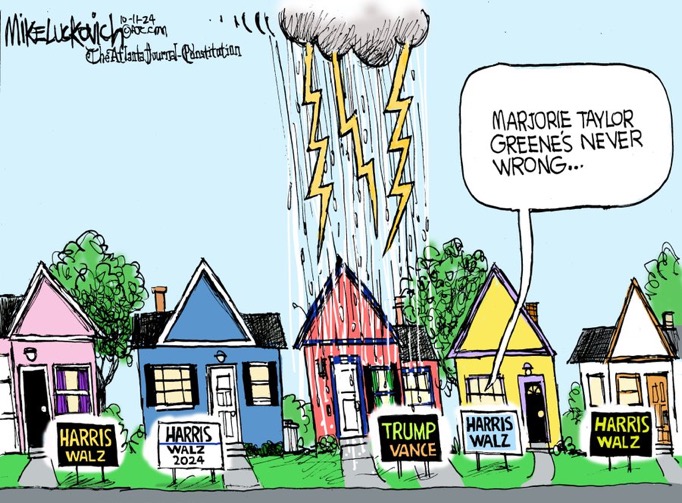
ZEUS REDUX

by Steve Deutsch


We do it by ionizing

the radiation and shifting

the polarization of the earth’s

magnetic core


millions of times per second.

We control it

from a basement apartment

in Hoboken—


that bluest of blue towns,

paid for by the DNC.

The four of us

do the weathering


on two old Apple laptops.

Our biggest concern

is the intermittent loss of the internet.

Damn Comcast.


We do our best

to make the heat and storms

believable—

blamable on climate change.


What a hoax.

Few have noticed

it is only the red areas

suffering the ill effects.


But now, one or two of the wise

have picked up on it,

I assure you that will end

with completion of our next project.


Lightening bolts.


Steve Deutsch is poetry editor of Centered Magazine and was the first poet in residence at the Bellefonte Art Museum. Steve was nominated three times for the Pushcart Prize and once for The Best of the Net Anthology. He has published six books of poetry. One, Brooklyn, was awarded the Sinclair Poetry Prize from Evening Street Press.

Saturday, January 21, 2023

BETTER MOMENTS

by Joel Savishinsky


Federal regulators said Wednesday that they will begin penalizing nursing homes that give residents a false label of schizophrenia, a practice that many facilities have used to skirt restrictions on antipsychotic drugs, which can be especially dangerous for older people. —The New York Times, January 18, 2023. Photo: Yvonne Blakeney’s husband, David, a dementia patient, was diagnosed with schizophrenia shortly after arriving at a nursing home. Credit: Sean Rayford for The New York Times.


In my better moments, 
I know my head’s not 
right… but this is wrong.
 
There are dark caves inside my mouth, 
where their blind stupidity
is not my disability, 
spaces that enable me to
hide their pills inside my cheek, 
under my tongue, 
back in the recess behind 
my lower right molar. 
 
I am not dumb. 
I’ve read the text, 
and know the fate 
of those who’d fly 
over the cuckoo’s nest. 
I’ll sit right here and 
won’t take flight, but 
find refuge in a 
remnant of integrity.
 
In my better moments, 
I know my rights.

 
Joel Savishinsky, a retired professor of anthropology and gerontology, is the author of The Ends of Time: Life and Work in a Nursing Home and Breaking the Watch: The Meanings of Retirement in America, both of which won the Gerontological Society of America’s book-of-the-year prize. His collection Our Aching Bones, Our Breaking Hearts: Poems on Aging, will be published by The Poetry Box in 2023.

Thursday, November 17, 2022

MISGUIDED: A SOUTHEASTERN OHIO TRAGEDY

by Renee Williams


On October 29th, while on a gravel bike ride in Vinton County, Ohio, three unleashed, uncontained pit bulls attacked Eva Simons, pinned and mauled her. Thankfully, three Good Samaritans happened to drive by and were able to save her life. Eva underwent emergency surgery and the amputation of the left leg above the knee. She has a long road ahead and will require multiple surgeries to reconstruct the remaining leg. —from the Gofundme for Eva Simons


An innocent,
walking down a rural road, alone, away from the other bicyclists, 
wanting to get back to her vehicle to fix a flat, 
when she became quarry to three unchained pit bulls, 
knowing no other way than to attack, 
their so-called area invaded, 
by an unknown person, diminutive, vulnerable.
Barking, growling, snarling, 
incisors like blades,
biting,
tearing, ripping, slicing skin,
feasting on flesh from bone, savoring the salty taste of blood,
chewing, gorging, vivisecting,
mauling, mangling,
destroying, devouring, dismembering, 
eating her alive 
like pack of lions in the veld, gnawing an impala,
for twenty minutes
in a delightful game of mere response, 
base, vile, predatory instincts kicking in, 
untrained,
reacting.
 
The owners,
at a bustling urban hospital, so far from the country lane, 
a newborn child, sick.
Did the dogs offer protection in the depths of the forest, 
or the illusion of power, toughness, 
as we human animals fall prey
to the intoxicating allure 
of controlling what shouldn’t be controlled
like domesticating a lion or tiger, leading it, guiding it, exerting dominance?
Or, perhaps the first dog was taken in, alone, afraid, desperate for care,
mirroring the pitied human discards of Appalachia,
victims of a poor economy, limited employment options, and no place to call home.
It’s said that bad choices make great stories.
But why do you need three pit bulls?
Unwanted dogs multiply like rabbits,
and who has the time to tend to a dog that wasn’t wanted in the first place,
that was dumped in front of the house, 
and the kids wouldn’t stop crying until it was taken in, 
but it has killer instincts, jaws that could snap a bone in a heartbeat,
and work is calling because someone is sick with this damned Covid,
the kids have that new math homework to be done,
and the refrigerator just went on the fritz
for the second time this month?
 
Pit bulls, bred for fighting, vicious, beastly
can be caring, loving pets.
Yet the stereotype is perpetuated,
again, and again…
 
Just another country road,
in another county township,
sycamore leaves falling,
sunlight waning,
gunshots from the sheriff’s pistol. 


Renee Williams is a retired English professor, who has written for Guitar Digest, Alien Buddha Press, and Fevers of the Mind.

Tuesday, August 23, 2022

LIZARD DAYS

by Alejandro Escudé


A lizard, small, on my walk along 
the largest airport in the country,
dead, curled, fetus-like, so swift
they are as they shoot back toward
the ivy mounds. At times I imagine
how many trash bins would the 
lizards fill if they were all collected
from the overgrowth—so I take
with my iPhone a photo of him,
Cretaceous little being, extinct, 
and think about the latest warning
issued to all Apple users, a hack
where they could take control,
absolute control, the newscaster
asserts, of your phone. I yearn
for a return to those lizard days
when I couldn’t carry around
a sea of digital pirates, both legal
and illegal, a neon mind-maze,
yet enough data to assume society’s 
panoptic perch. I choose to keep 
from running another space race
with my phone, contemplate
the deadness of a dead lizard
on the sidewalk as monolithic 
shadows of planes, like the foot-
prints of a dinosaur accelerated 
in time, mesh onward to the west.


Alejandro Escudé published his first full-length collection of poems My Earthbound Eye in September 2013. He holds a master’s degree in creative writing from UC Davis and teaches high school English. Originally from Argentina, Alejandro lives in Los Angeles with his wife and two children.

Thursday, June 30, 2022

SCREE

by Akua Lezli Hope


The five-justice Supreme Court bloc that overturned a half century of women's abortion rights on Friday had coalesced less than two years. But they had found their moment and they seized it. 
CNN, June 25, 2022


This is insane, jackboot, psychic rape
The Supreme Court struck down Roe v. Wade
another way the inane U.S. of A
reminds it's not for most of us
already thrown under the careening bus
of a twisted, hegemonic, male patriarchy
 
We’re flattened again into oppressed dust
made to adhere to perverted needs
the worst of pornographic politics
their insatiable soul-robbing greed
to control another’s body
There's no daycare, scant maternity leave,
 
and yes, human trafficking is on the rise… 
 
They are on the take, ensuring innocent’s demise
States have their say over our reproduction
 
Those who don’t give a damn, limit our care
already so much less than what is fair
I pay 5 grand a year for nothing,
fight each and every month for access
to protective gear, bandages, dressings
 
Regressive, life threatening government decisions—
we feel the genteel violence of head in sand inaction
the incessant roar of entertainments’ self-indulgent distractions
who cares if one multimillionaire berates another
 
They build on sliding mountaintops and buy
their own fresh water, their own fresh air
their wild caught this and free range that
we communicate instantly these mounting tragedies
ever less and less and less free


Akua Lezli Hope is a creator and wisdom seeker who uses sound, words, fiber, glass, metal, and wire to create poems, patterns, stories, music,  sculpture, and peace.  A paraplegic, third-generation New Yorker, her honors include the NEA, two NYFAs, SFPA, Rhysling and Pushcart Prize nominations.

Friday, February 18, 2022

ON THE EVE OF THE RUSSIAN INVASION

by David Radavich


They amass at the border
as giant snakes and roaches,
men and their killing
machines, poised
to overrun the resistant
creatures of democracy.
 
Every weapon developed
by man is turned toward
usurpation and control,
as if that could solve
anyone’s need,
historic or personal.
 
Imagine the soldiers
in their invented cause
testing the firing pins,
adjusting the angles, feeding
the first ammunition.
 
Imagine the potential 
victims, defiant, sure 
of their innocence, 
not wanting to be yoked
like pliant oxen
at the master's gate
 
Imagine when the war
happens, its final destruction,
random death, a quagmire
of duty and egos in mud
doing battle like scorpions.
 
We wait with mental
swords drawn to cut what?—
air with our hopes
and expectations that cross
before us against the sun.


Among David Radavich's poetry collections are two epics, America Bound and America Abroad, as well as Middle-East Mezze and The Countries We Live In.  His latest book is Unter der Sonne / Under the Sun: German and English Poems from Deutscher Lyrik Verlag (2022).

Sunday, September 12, 2021

KĀKOLŪKĪYAM

by Nicholas Katsanis


An Afghan soldier pops up from his tank to signal a U.S. warplane bombing Al Qaeda fighters in the White Mountains of Tora Bora in Afghanistan on Dec. 10, 2001.(David Guttenfelder / Associated Press via the Los Angeles Times)


The owls and the crows are at war
Embroiled in bitter struggle for control of their dominion
Ill-defined by borders and perceived advantages

The owls are old and therefore wise
Or so they tell themselves to make-belief
Convince their childrens’ children of their superiority
Supremacy of poise and purpose, they persist
Until foibles morph into fact,
Poorly begotten truth whose tangled roots are lost—conveniently—in antiquity

The crows are young, confident, energetic
The skies’ embrace belong to them, they preach
For they are fast and nimble
Intimidating in their murder, or so they teach their children
Schooling them in the virtue of their virility, their singularity of purpose

The owls and crows are at war
Bickering over holes in trees
Despite the endless forest that surrounds them

Beak on beak and claw on claw
They decimate each other’s numbers
Each pointless victory and defeat
Treated by triumphalism and defiance in equal measure

The owls’ corpses are offered eternal absolution
The crows’ mangled bodies heavenly promise of peace and honey
Both declaring divine providence over the Final Rights
Both bereft of true wisdom

The owls and the crows were at war
Embroiled in bitter struggle for control of their dominion
Until the lightning in the forest burned
And the rain fell upon the smoldering stumps

And there was nothing left to war over


Author’s Note: Inspired by the Panchatantra collection of classic Indian fables, this adaptation examines the current/perpetual secular and religious tension in Afghanistan post-collapse.


Nicholas Katsanis is an author and poet of magical realism. You can find some of his micro fiction (50-word stories, stories in 100 words) as well upcoming pieces in Literary Stories and elsewhere (including magazines that do not have the word ‘Story’ in their titles). He lives and works in southern Florida. Follow him on Twitter @nicholaskatsan1

Friday, July 10, 2020

A THURSDAY EVENING IN JULY

by Marc Swan


Two couples, one deck, no masks,
seated at separate tables
six feet apart drinking chilled white wine,
eating snacks from separate trays—
crackers, bleu cheese, olives, carrots, celery.
Conversation starts with tomato plants—
kind, size, growing patterns, anticipation
of the fruit called by some a vegetable
that will soon burst through on this deck.
Dusk settles, conversation shifts to the virus—
what we know, what we believe, what
we want the future to hold for us, for our
families. Subject moves on to politics—
a litany of those things we can’t control,
think about, worry about, and here we are
once again saying it out loud. Hopeful
on one level, pessimistic on another.
The take down of a society, principles
and values, by one man and his motley crew
in less than four years. Good thoughts
on fruit ripening replaced by anger, confusion,
hopelessness. Thunder jolts the air, rain
falls in heavy pelts against the umbrellas.
We’re invited inside, not sure the best plan,
but here we are socially distanced, no masks,
a fresh glass of white wine in hand,
conversation shifts to what we can control
or at least think we can.


Marc Swan’s latest collection all it would take was published in May 2020. Poems forthcoming in Gargoyle, The Stony Thursday Book, Channel Magazine, among others. He lives in coastal Maine 
with his wife Dd.

Thursday, August 01, 2013

THE PENIS

by Cally Conan-Davies


I don't have one, or rather the one I have
hides discreetly in its little hood. As they should.
A piquant pea, appropriately kept to weather
all kinds of climates hot to chill, with folds
and layers to peel back. And a hook. When laid bare
it won't grow to a tree for all the world to see,
unless of course I'm really a spotted hyena
in which case it would serve a multitude
of purposeful functions: pee, nooky, parturition
(apparently, mine warms to big words though);
and it could be that because it doesn't grow
to industrial proportions, it's easier to ignore it,
easier to relieve it whether anyone is looking or not
and much easier to tell it no, no, no.


Cally Conan-Davies is an Australian writer and teacher who moved to the United States in 2012. Her poems have appeared, and are forthcoming, in Poetry, The New Criterion, The Hudson Review, The Virginia Quarterly Review, The Raintown Review, The Sewanee Review and The Southwest Review, among others. She lives mostly in Oregon.