Guidelines


Submission Guidelines: Send 1-3 unpublished poems in the body of an email (NO ATTACHMENTS) to nvneditor[at]gmail.com. No simultaneous submissions. Use "Verse News Submission" as the subject line. Send a brief bio. No payment. Authors retain all rights after 1st-time appearance here. Scroll down the right sidebar for the fine print.
Showing posts with label privilege. Show all posts

Monday, June 02, 2025

TRAVEL ADVISORY

by Shalmi Barman


"A visa is not a right. It's a privilege," [US Secretary of State Marco] Rubio said on Tuesday. Trump administration officials have said student visa and green card holders are subject to deportation over their support for Palestinians and criticism of Israel's conduct in the war on Gaza, calling their actions a threat to U.S. foreign policy and accusing them of being pro-Hamas. —Reuters, May 21, 2025

The State Department has told U.S. consulates and embassies to immediately begin reviewing the social media accounts of Harvard’s student visa applicants for antisemitism in what it called a pilot program that could be rolled out for colleges nationwide. —Politico, May 30, 2025


Counselors who work with foreign students eager to attend college in the U.S. are advising them to purge their social media accounts of posts that could attract the attention of U.S. State Department officials. —CBS News, May 39, 2025


To demonstrate that I don’t pose a threat,
I strip the stickers from my laptop case,
purge the Kindle reader, ctrl-shift-del
my browsing history as if the past
two, ten, eighty years had never been.
 
We’re experts here at inoffensiveness,
smalltalk savants, the brightest and the best
arriving on these shores to earn our keep,
inflate the GDP and pay our dues—
the price of entry to the winners’ club—
in labor, taxes, learned neutrality.
 
A privilege, not a right. In Khan Younis
the going rate for a sack of gritty rice
exceeds my weekly wage. Faucets frothing
overrun my glass. A legless child
plucks maggots from his wounds. I sink a knife
deep in the turkey, utter ritual thanks
for innocence far from the blasted plains
of Gaza, Yemen, Iraq, Lebanon…
 
Purpose of visit? To become just like you,
I want to tell the agent matching my name
against a neutered profile. To shop at Target
on the Fourth of July, pledging allegiance
like a marriage vow. For this I stand in line,
bereft of fluids, jacket, shoes, and shame,
not-thinking of checkpoints a world away,
asking smilingly how much? how high?


Shalmi Barman is a South Asian national, a holder of a student visa, and a newly minted PhD. She spent several years at the University of Virginia writing a dissertation on class and labor in Victorian fiction, and doing other things that would likely be deportable offenses today. Her poetry has previously appeared in The New Verse News and also recently in BoudinBlue UnicornEcoTheo ReviewGyroscope Review, and elsewhere.

Thursday, January 09, 2025

KRONOS EATS HIS CHILDREN

by Susan McLean


Kronos rules a golden age.
A.I. fulfills his every whim.
He fracks to fuel his leverage.
He won't let regulations trim
his profits or his privilege.

Kronos drives an SUV:
it's comfortable; he needs his room.
When there's a place he wants to be,
his private jet can save him time,
and time is money, naturally.

You can't eat money, though, so when
the ice caps melt, the oceans warm,
droughts, floods, and hurricanes pile on,
and all the crops dry up or drown,

his kids will find he's eaten them.


Susan McLean, a retired English professor from Southwest Minnesota State University, taught a course in Greek myth and literature for thirty years, and finds that those myths continue to resonate with what's happening now.

Wednesday, December 11, 2024

WE LOVE GENDER-AFFIRMING CARE

by Cecil Morris


Supreme Court seems ready to uphold ban on gender-affirming care for minors. —NPR, December 4, 2024


Here’s gender-affirming care in my hometown: 

We give our boys some guns—long guns like ARs 
and shotguns and semi-auto handguns—
which, at first, are really just pointer fingers
and sticks and trigger-controlled hose nozzles
and, really, anything vaguely phallic.

We give our girls baby dolls and plush toys
and encourage them to hug and comfort,
to placate and coo, and, later, aprons
and play kitchens with miniature pots and pans.

We give our boys hammers and nails (of course)
and drills and fucking big four-wheel drive trucks
and dump trucks and fire trucks with screaming sirens
and teach them privilege and damage control
and the righteousness of conquest and noise.

We give our girls sixty watts of light and need
and teach them the virtues of silence and grace
and a thousand and one ways to cook a chicken,
to make repairs, and to turn tears on and off.

We teach them all manifest destiny.


Cecil Morris, a retired high school English teacher and Pushcart and Best of the Net nominee, has poems appearing in The Ekphrastic ReviewHole in the Head ReviewNew Verse NewsRust + Moth, and elsewhere. His debut poetry collection At Work in the Garden of Possibilities (Main Street Rag) will come out in 2025.  He and his partner, mother of their children, divide their year between the cool coast of Oregon and the relatively hot Central Valley of California.

Friday, April 26, 2024

A LOOK BACK FROM AGING

by Tricia Knoll


I wore a peace symbol bandana on my arm

when I received a professional degree 

from the Yale graduate school in 1970. 

I marched with candles in California,

put my butt down in an administrator’s office

at Stanford. I did not know then the extent

of my privilege. 


We walked. We assembled, chanted

simple words to a drumbeat. We saw

villages destroyed, lives ripped from

ancestral homes. Some of our parents

agreed with what we were doing, but

not all. Not mine. Despite the deaths,

the endlessness of destruction,

hopelessness, despair. 


I began to teach high school and met 

refugees. The first to arrive spoke

French, English and Vietnamese. 

A teen described the airlift from the embassy.

How he left his white dog behind. Later

I met Hmong and Mien whose lives

started harder.  


I cannot assume that to be pro-Palestinian

is to be an anti-Semite. I’m old enough

to know that flinging slurs gets us nowhere. 

I cry over young children starving to death

in Gaza, mothers giving birth in rubble. 

The clashing words of our leaders seem weak.

Money speaks, what must say do not kill

any more innocents. Insist money be spent

for humans wrapped inside carnage to live, 

eat, shelter, sleep, learn, grow. Open

the walls to food, good food.  


Arresting the protesting young enflames.

Horses, soldiers in camo, zip ties. Gaza

is filled with tent cities. Torn tents. 


I live in Vermont. My electeds oppose spending

more money for lethal weapons for Israel.

I thank them. When we hear support for Israel

is ironclad—that must not mean only bombs

and guns, the weapons of metal. Our mettle

must stand for the children, the men and women

who have nowhere to go, yet hear threats

that more and worse is yet to come.


Tricia Knollan aging Vermont poet, understands what drives campus protests. Her poetry collections often focus on eco-poetry (One Bent Twig) or personal responses to feminism and privilege (How I Learned to be White and The Unknown Daughter).

Tuesday, June 14, 2022

HOW I WILL RAISE MY SON SO HE DOESN’T BECOME THE NEXT MASS SHOOTER

by Jared Povanda


I will shower him with love. 

I will listen to him
and encourage him to cry
while teaching him how to 
use the potty.

I will read to him about 
kind animals: the mouse and the rabbit 
and how they’ve never hurt a soul.

I will only let him play E-rated video games, 
and I will explain to him the privilege 
of being white and male and how that 
doesn’t make him better than anyone else.

I will monitor his time online.
I will know who his friends are.
I won’t let him watch TV or 
movies where guns are present.

I will show him how to vent his anger
through needlepoint. 
Or drawing or writing poems. Picking dandelions 
until his soft palms yellow with pollen 
like a rabbit’s twitching mouth.

But this is all conjecture.
I will never have a son.

I know nothing about being 
a parent in a world designed for violence 
and manipulative, racist indoctrination 
of which none of us are wholly immune.
Least of all myself.

But if I did know everything, I would
do all of these things to save my son.

And it still might not be enough. 


Jared Povanda is a writer, poet, and freelance editor from upstate New York. His work has been published or is forthcoming in numerous literary journals including Wigleaf, The Citron Review, and Uncharted Magazine. You can find him online @JaredPovanda and in the Poets & Writers Directory. 

Friday, December 03, 2021

CONJOINT

by Imogen Arate


When the waves come
you will remember my name
When the mountains melt
in the blaze of your misdeeds
you’ll beg for another chance
though you squandered them
in your privileged stance

calling your destruction 
into being you sealed every
egress to my escape and
annihilate yourself in turn
Then our gaze will meet again
and you’ll recognize your
anguish in my eyes


Imogen Arate is an award-winning Asian-American poet and writer and the Executive Producer and Host of Poets and Muses (https://poetsandmuses.com), a weekly poetry podcast that won second place at National Federation of Press Women's 2020 Communications Contest. She has written in four languages and published in two. Her works were most recently published on The New Verse News and in Consilience and Rigorous. You can find her @PoetsandMuses on Twitter and Instagram.

Wednesday, September 16, 2020

WESTERN BLUEBIRDS, AMERICAN ROBINS

at the Peace & Justice 2020 (virtual) Fair (Vancouver, U.S.A.)


by Gwendolyn Morgan


Gwendolyn Morgan reads her poem in this video.


this is how it begins
first Light: cheerio song of Robins
loops of blue sky between stars
Eagle whistles before anyone wakes up
prayers in Arabic, Spanish, Hebrew
Chuukese, Cambodian, Russian, Swahili
100 languages spoken here as
the alphabet arcs toward aleph
alleluia of red-breasted Robins
golden dome of Sikh temple
Celtic Cross of Catholic, Presbyterian & Unity Church
Methodist or Lutheran hymns, so many Christians
the Bahá'í and UUs have every symbol represented
even the Pagans are putting peanut butter & raspberry jam
on whole wheat toast before you
who is putting honey on sopapillas, honeycrisp apples,
drinking Masala chai or sweet tea?
who has lost their homes due to fires?
looking at privilege:  who was evicted this week?
who was arrested?
Break it down like the U.S. census
the unmarked car outside the housing complex
“No solicitors” sign outside the apartment door
“I’m not soliciting” the ICE agent says
flashes a gold star or badge with implicit bias
scan the skin color, then license plate
drinking an Americano while they wait for you
Wait! this isn’t justice
the peace & justice fair is on Saturday every year
Sabbath day of rest for everyone
who goes to a synagogue or is Seventh Day
Rainbow Flags flying next to Black Lives Matter
upside down Americana
the Western Bluebirds gather at the river
singing their own prayers, plain song
1000 languages, songs of other species, intersectionality
the watershed of white fragility, white supremacy
unspoken privilege of having more than enough
when the child in front of you hasn’t had breakfast
no money in the purse for groceries, no savings account
no internet access, maybe a chrome book from school
with a sticker of a white llama on it
this child is hungry for more than justice
losing their breath for peace
this is how it begins.


Gwendolyn Morgan is a Pacific Northwest poet and artist who serves in interfaith Spiritual Care in a medical center in the midst of COVID19.  The Clark County Poet Laureate 2018-2020 in Washington State, her third book of poetry Before the Sun Rises is a Nautilus Silver Winner in Poetry. Gwendolyn and her spouse Judy A. Rose focused on poetry and music during a Winter 2020 Centrum Artist Residency. As a multiracial family in a multispecies watershed, they are committed to equity work and inclusion for all.

Saturday, August 08, 2020

PENGUIN: FAMILY SPENISCIDAE

by Gwendolyn Morgan


aquatic flightless birds
they     like us              have adapted to their environment
adopted flippers for swimming in icy water
in Chile, Argentina, South Africa

We are a black and white same gendered multiracial family
intersectionality of lens          lock and intersect
race      ethnicity          gender              orientation
privilege          power              white and black witness feathers

Our neighbor a white man swerved at us         intentionally
a sandy brown vehicle like the burnt umber sand at the edge of Ushuaia
where you can take a boat to see three species of penguins
his Toyota 4Runner once and another black SUV again
revved at us     make the black woman            jump    again
and her partner            jump    to our neighbor’s green and brown grass
the couple moved here from another state
moved here a few years ago   now still shocked by the behavior
of well-educated mostly white privileged neighbors who in this time of COVID
pack guns, rev engines, use anti-kindness vernacular
we watch brothers, fathers, sisters, mothers die in the pandemic
while our neighbors watch microaggression after macroaggression
directed at my beloved            like guns, tear gas and a palette of vehicles
rainbow of colors, the neighborhood children walk here too

I could write for days
about what it means to live here         in black and white
how we have plush penguins and carved wooden penguins
on our fireplace hearth            
along with sage, sweetgrass, feathers,
ashes, vigil candles, gifts from our elders. 


Gwendolyn Morgan is a Pacific Northwest poet and artist who serves in interfaith Spiritual Care in a medical center in the midst of COVID19.  The Clark County Poet Laureate 2018-2020 in Washington State, her third book of poetry, Before the Sun Rises is a Nautilus Silver Winner in Poetry. Gwendolyn and her spouse Judy A. Rose focused on poetry and music during a Winter 2020 Centrum Artist Residency. As a multiracial family in a multispecies watershed, they are committed to equity work and inclusion for all. 

Wednesday, June 03, 2020

THERE IS A SOUND

by James Bettendorf 


There is a sound in Minneapolis
Like the tearing of heavy cloth
Where laws favor groups, that oppress
Others to their knees, that rip
Opportunities from small hands,
That flatten hopes, crush
Dreams under their heels
Red tipped white canes are broken
Pieces thrown in the gutter

There is a sound in Minnesota
Like the tearing of heavy cloth
Where angry men and women are bent
Their backs used as stepping stones
Feeling powerless in the face of money
Neighbors denied rights
Darkness isn’t dispelled
By the light of reason

There is a sound in America
Like the tearing of heavy cloth
Eyes of honest people
Covered with blindfolds
Made from the flag
Tower babbling deafens
Knees and backs
Bent by heavy wooden crosses
And more coal is shoveled
Into the furnaces of the wealthy

There is a sound in the world
Like the tearing of heavy cloth


James Bettendorf taught math for 34 years at various levels and in his retirement begin writing classes at the Loft in Minneapolis, MN.  He was accepted for a two year poetry internship in the Loft Master Track program in 2006 and has been working on a manuscript with his mentor/advisor, Thomas R. Smith.  He has had poems published in TheNewVerse.News. Rockhurst Review, Light Quarterly, Ottertail Review, Talking Stick Vols. 18 - 23, and Free Verse.

Friday, May 22, 2020

IN WATERLOO

by Anne Myles


A Laredo man living in Iowa is critically ill with COVID-19, and thanks to a co-worker who refused to give up, he has reconnected with his family. "I just feel like I made a Facebook post, answered a few messages and calls, but it was everyone's efforts that came together. It was the small things that added up to one big thing and that was getting to find Jose's family." Zach Medhaug and Jose Ayala, a Laredo native, are among the dozens of Tyson employees who tested positive for COVID-19 after an alleged outbreak at their Waterloo, Iowa facility. —KGNS.tv, May 4, 2020


there’s a wild, forgotten greenbelt
wrapping the creeks for miles.
The trees are close and full of quiet;
they open to still mirror pools.
Breath, footsteps, birdsong,
deer-dash, otter-splash.
In May, a sea of Virginia bluebells,
light purplish spume above deep leaves,
floods the woods to the edge of sight.

In Waterloo we watch the waves
of a century’s migrations break:
Black, Mexican, Bosnian,
Burmese, Congolese, Micronesian.
City of refugees and of no refuge,
city of industries here and gone
where the remnant of Rath Packing
still looms downtown, a darkened shell.
Scarred city river-riven—east side,
west side—half-sutured by ten bridges,
the Cedar silted, shallow, shining.

In Waterloo four green goddesses
from atop a long-demolished courthouse
cling to the brick roof of River Plaza:
Agriculture, Science, Justice, Knowledge.
They pose, holding vague implements,
blank faces still, almost compassionate.
Their skin burns hot in prairie sun.

*

In Waterloo, at the far edge of town,
sprawls the Tyson plant. Neighbors
of many languages work side by side
in the chill, the clang, the cutting, the flesh,
the coughing, the fevers, the fear.
The line for testing coils around the lot;
over a thousand positive, they’re living
the consequences of all that makes us.

At Tyson, maintenance worker Zach
made friends with self-contained José.
Zach got the virus but was barely sick;
José’s ventilated and unresponsive.
Zach calls every day to talk to him,
play music. He posted José’s picture
and found his family back in Laredo.
They’re fighting for him together now
in Waterloo, not giving up faint hope.

The plant closed, but has reopened.
Outside, the typical scraggly rally.
We line up by the drive at shift-change,
waving, holding signs: Protect Workers.
Estamos Con Ustedes. Capitalism
is the Pandemic. Through car windows
masked faces glance back quickly,
difficult to read. A few hands lift.
We hear faint screaming: pigs or gears?
Grass flares, the sky throbs blue,
everything’s sliced hard against it.

*

And now a long-ago lover phones
to ask if I’m okay. She’s seen Waterloo
on Maddow, CNN. I say I’m fine,
safe as can be. I tell her walking
the trails here makes me happy.
I tell her I see my privilege;
I didn’t even know about the plant
twelve minutes from my house.
I try to explain, it’s like I married
a city instead of a person, so far
from where I started, my own diaspora,
but after decades I still don’t know it.
I say, it’s more than what you hear.
I say, our bluebells are so beautiful.


Anne Myles retired from the University of Northern Iowa, where she was an Associate Professor of English. She is working on an MFA in poetry at the Vermont College of Fine Arts. Her poems have appeared in journals including North American Review, Friends Journal, Lavender Review, Gyroscope Review, Green Briar Review, and Whale Road Review.

Sunday, October 06, 2019

NOTES ON HUMAN PRIVILEGE

by Diane Elayne Dees


After being taken from their mother, calves’ cries can be so intense that their throats become irritated. —farmsanctuary


You beat me and made me work
until I collapsed, dead or near-dead,
and they called you a criminal.
You did this to someone with hooves,
and they called you an entertainer.

You set a trap to disable my leg,
forced a prod through my body,
destroyed me with deadly volts of electricity,
and they called you a monster.
You did this to someone with fur,
and they called you the fashion industry.

You poured acid in my eyes
and poison down my throat;
you shackled me and shot me in the head,
and they called you a psychopath.
You did this to someone with a tail,
and they called you a scientist.

You confined me so that I could not
lie down or turn around, force-fed
me until my legs almost broke,
cut off parts of my body, beat me,
and stole my new-born children,
and they called you the very definition of evil.
You did this to someone with four legs,
and they called you a farmer.

We are all animals.
I speak for the billions who have no voice,
except for the constant moaning,
the final blood-curdling screams.


Diane Elayne Dees’s chapbook I Can’t Recall Exactly When I Died is forthcoming from Clare Songbirds Publishing House; also forthcoming from Kelsay Books is her chapbook Coronary Truth. Diane also publishes Women Who Serve, a blog that delivers news and commentary on women’s professional tennis throughout the world.

Monday, November 26, 2018

THE COLOR OF LIES

by Peter Witt


via GIPHY


White lies are weak and promote privilege
Black lies darken the history of a proud people
Brown lies hold back migrants
Yellow lies are evil in intent
Red lies abandon truth for power
Orange lies hold back a nation

All lies matter whatever their color
They twist our perceptions
Divide us, create angst and tears
Demean our welfare
Trap us in darkness


Peter Witt is a retired professor who now writes poetry and family history. He is the uthor of numerous articles and books on youth development, and a biography, through the Texas A&M Press, about the WWII Red Cross service and progressive life of his aunt, Edith Witt.

Wednesday, July 19, 2017

LET OBAMACARE FAIL

by Jeremy Thelbert Bryant


“Let Obamacare fail,” he says
like “Let them eat cake”
like privilege is universal
like old folks don’t get older, sicker
like men don’t have prostates
like women don’t have breasts
like cancer is fake news
like kids don’t break
like everyone stays in a tower
like all inherit their daddies’ money
like no lives matter
like the leader of a country doesn’t care


Jeremy Thelbert Bryant is a poet and a writer of creative nonfiction. He is a graduate of the low residency MFA program at West Virginia Wesleyan College. When he is not teaching English, he is burning incense, listening to music, drinking coffee, and writing. His work may be found in Pikeville Review and Prism. He finds inspiration in the red of cardinals, in the honesty of Frida Kahlo’s artwork, and in the frankness of Tori Amos’ lyrics.

Monday, May 15, 2017

VANILLANELLE

by Susan McLean


Consistency is our delight.
Don’t make us try exotic flavors.
We want it plain; we want it white.

We think that blend-ins are a blight.
Your nuts or fudge do us no favors.
Consistency is our delight.

Our preferences are watertight.
Our love of sameness never wavers.
We want it plain; we want it white.

We shun sensations that excite
odd leanings or untoward behaviors.
Consistency is our delight.

We’re not repentant or contrite.
Change isn’t what the public savors.
We want it plain; we want it white.

Enough!  We have no appetite
for new ideas or dusky saviors.
Consistency is our delight.
We want it plain; we want it white.


Susan McLean is an English professor at Southwest Minnesota State University.  Her satirical poems have appeared in The New York Times, The Washington Post, Light, Lighten Up Online, and The Spectator (UK).

Saturday, November 05, 2016

LO & BEHOLD

by A.S. Coomer


The stick in the shit stirs,
swirling curdling fascinations,
condensing confections of confusion,
mingling malice with malignancies
so potent the stirrer wears a mask,
a mask of indifference,
a mask of superiority,
a mask haloed orange like the burnt offering,
some poor hamster caught, killed and propped up as a sacrifice
atop the altar of jingoism,
we all feel uncomfortable seeing,
a mask bought & sold & held over our heads
higher than our grubby, working hands can reach.
A mask atop a mask atop a mask.
I’ll turn my bare face to the sun before I wear one.

The stick in the shit stirs,
the stained hand is attached to a stained arm
and the poison courses deep through the veins of a man
in thousand dollar suits, a shark’s grin & puckered lips,
eyes seeing only various shades of green & red,
a man in a mask with a stick in his hand,
selling shit cakes to the empty bellied, to the disenfranchised,
to the misinformed & the uninformed, to the belligerent,
to those holding onto the last vestiges of power by the skin
of their privileged, primered nails.
Shit cakes. For one & all. Shit cakes by the dozens. Thousands. Millions.
I’ll take my turn at the soup lines before I have one.


A.S. Coomer is a native Kentuckian serving out a purgatorial existence somewhere in the Midwest. His work has appeared in over thirty publications. He’s got a handful of novels that need good homes. He also runs a “record label” for poetry.

Monday, June 13, 2016

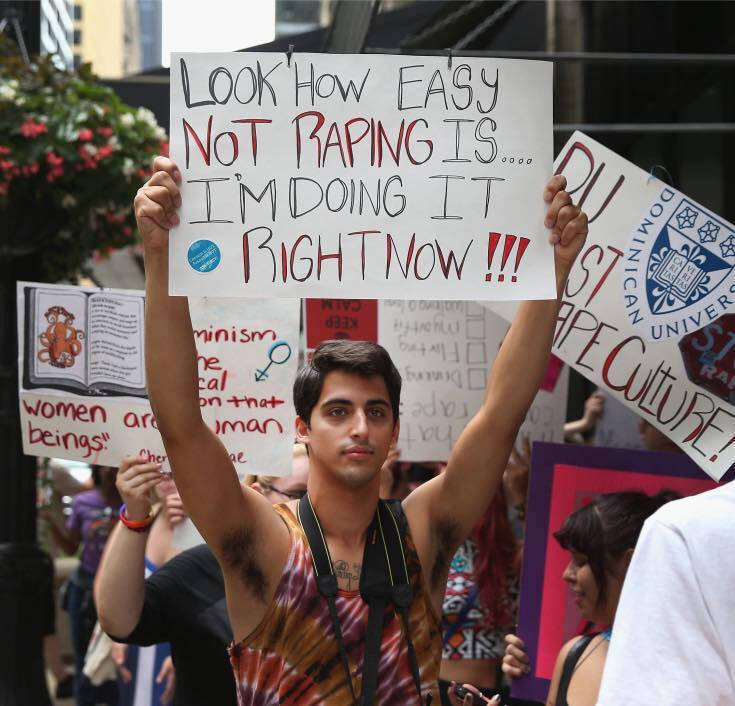
READING ABOUT BROCK TURNER DECADES AFTER MY RAPE

by Larina Warnock


Image source: The Other 98%


I feel that I should be silent because this isn’t about me.
Don’t misunderstand: It is not that I believe our society
should leave each person to themselves, but that I respect
a woman’s right to her tragedy without others hanging
the weight of their own rape upon it. I am afraid
of appropriating someone else’s pain. And I want to forget.

Yet, I have woken in a cold, terrified sweat night after night
for days. There is only one sure way to not be afraid: Justice.
But a judge says justice only matters for wealthy, white men,
even when  jury says otherwise. And the most frightening
part is knowing that this means my daughters live in the same
world I did when it happened to me. Sidenote:

This is the essence of PTSD. Reading someone else’s case
and reliving one of the worst days of your life over and over
and over. You know that it is not rational, that these things are
years and years behind you, that it is unlikely that a Brock Turner
act-alike is waiting outside the door (though not impossible).
You understand clearly that the more you think about it, read
about it, get angry about it, the more afraid you will be, but you
are completely, utterly incapable of turning away, of
re-appropriating the rational person you were yesterday.

But back to my daughters. I take a deep breath and another look.
The voices of men, many men, are rising, and they are not
frightening. They are saying, “This is not okay.” They are saying,
“This is not her fault.” They are saying, “Rape is rape and this man
bears the blame. Alcohol does not a rapist make.” This is not the same
world I grew up in. This is a better place. I want to thank these men
I can trust to be just to my daughters.

I am torn between silence and gratitude and an inability to forget.


Larina Warnock teaches in Roseburg, Oregon. Her poetry, fiction, and nonfiction has appeared in Space & Time Magazine, The Oregonian, Touch: The Journal of Healing, Wheelhouse Magazine, Poets Market 2011, and others. She is currently working on her EdD in Education Leadership from Creighton University. 

Friday, February 26, 2016

MY WHITE FRAGILITY

by James Brock
The New Yorker Daily Cartoon, Feb. 23, 2016
                     
“I have a great relationship with the blacks.”—Donald J. Trump


Rather, I will reboot this poem about the blacks
with a quote from Virginia Woolf:
For she was a child, throwing bread to the ducks,
between her parents who stood by the lake,
holding her life in her arms which, as she neared
them, grew larger and larger in her arms, until
it became a whole life, a complete life,
which she put down by them and said, "This
is what I have made of it! This!"
And what had she made of it? What, indeed?

And thinking of the blacks, their mattering
lives, I look at my whole white life, my bookshelf.
See?  There’s Audre Lorde and Harriett Jacobs
and Kevin Young and Yusef Komunyakaa and Richard
Wright and Ralph Ellison, all their February words!
And I look at my white, complete life, and say,
“I have done nothing wrong.”

In Florida, the best hanging tree is the live oak,
with its big low-limbed girth.  At the Lee County
Courthouse a live oak has been made into a chainsaw
sculpture of an American bald eagle in flight.  On my commute
to school, with my black president and my black
boss man, I go along Michigan Avenue,
right through the black heart of Dunbar.  My neighbor
is anxious.  Someone has given the Asian food
delivery guy the building’s passcode.  He’s
probably on probation.  Our Sheriff shaves
his head, wears his green uniform, says how
we are not willing to face our problems.
He says I should have a registered gun in my glove
compartment.  I should keep a gun in my desk
drawer, packing heat in my classroom.  The evangelist
at my university shouts through his bullhorn
how my students are going to hell, all of them
texting their next booty call.  I think how language
is dripping in the blackness.  It’s like that tar baby.
Elvis’s hips, Beyoncè’s X, are they not black, too?

When I think black I think cinder black.  Or my
one black kiss—Jesus, she was a cheerleader at Idaho
State, straight out of Pocatello—which was for me
for being sweet. I am a nice guy. I like
Kendrick Lamar.  I like his pyrotechnics. When I think black
I think the earth cindered, all that burning,
my life cindered, desiccated, to the whitest, white ash.


James Brock has published four books of poetry, and he is currently writing plays for Ghostbird Theatre Company in Fort Myers, Florida.  He also teaches writing and literature at Florida Gulf Coast University.