Guidelines


Submission Guidelines: Send 1-3 unpublished poems in the body of an email (NO ATTACHMENTS) to nvneditor[at]gmail.com. No simultaneous submissions. Use "Verse News Submission" as the subject line. Send a brief bio. No payment. Authors retain all rights after 1st-time appearance here. Scroll down the right sidebar for the fine print.

Tuesday, July 14, 2020

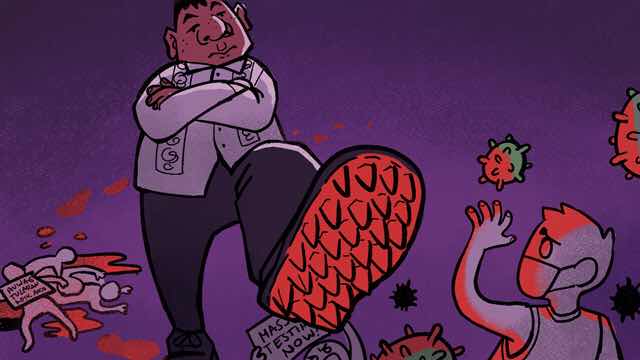
PRIORITIES OF A TYRANT WANNABE IN THE TIME OF CORONAVIRUS

unfinished notes from the Philippines 
by Leo Cosmiano Baltar


wordplay (or what to name incompetence)
a. lockdown
b. community quarantine 
c. enhanced community quarantine 
d. modified enhanced community quarantine 
e. general community quarantine 
f. modified general community quarantine


travel ban (except China) 


 ̶f̶a̶c̶e̶ masking his political intentions 


police and military over medical frontliners


Bayanihan to Heal as One Act 
(or more special powers that will be abused) 


mass t̶e̶s̶t̶i̶n̶g̶ arresting 


COVID-19 public address past 1 am 
(or late night tantrums on televisions 
with unlimited cursing) 


social [class] distancing 


money money money 
(or public funds that did not materialize 
& other trillions of debt)


mañanita fiasco: a party gathering 
involving a police chief and his 
cops even when it is not allowed 
but they will not be arrested 
according to the president


jeepney phase out under the 
guise of modernization


[not] listening to doctors & experts


taxing online sellers


more cops to shoot the virus


 ̶c̶o̶n̶t̶a̶c̶t̶ tracing the communists 
(or red-tagging advocates & activists) 


media  c r a  c k d o  w n 
exhibit a: ABS-CBN network 
exhibit b: Rappler 
exhibit c: alternative media


anti-terror law (or daily martial law) 


House Bill 4953, declaring the balangay 
as the national boat of the Philippines


̶f̶l̶a̶t̶t̶e̶n̶i̶n̶g̶ ̶t̶h̶e̶ ̶c̶u̶r̶v̶e̶  & other delusions


changing an airport's name 


bullying effective local leaders


quarantining basic civil and human rights 
& other fascist dreams


Leo Cosmiano Baltar is a Filipino writer, a poet, and an activist. He is currently taking his bachelor's degree in journalism at the University of the Philippines Diliman. When he is not writing, he is thinking of what to write next. 

Monday, July 13, 2020

THE PANDEMONIUM AT FREEDOMLAND

by Rick Mullin


Please Scream Inside Your Heart,’ Japanese
Amusement Park Tells Thrill-Seekers                          

—National Public Radio, July 9, 2020


We’d ask you, please, to scream inside your heart.
Consider others and the outcomes of your actions.
Secure yourself. The ride’s about to start.

The mechanism of this rocket cart
will get thrown off by any loud distractions.
We’d ask you, please, to scream inside your heart.

In Freedomland, survival is the art
of navigating obstacles and factions.
Secure yourself. The ride’s about to start.

The dark comes fast. It’s difficult to chart
the course of cannon shots and counteractions.
We’d ask you, please, to scream inside your heart.

It’s quiet now. I feel we’ve grown apart
composing our corrections and retractions.
Secure yourself. The ride’s about to start.

Democracy, the Slide of Bonaparte…
forget those rusty Freedomland attractions.
We’d ask you, please, to scream inside your heart.
Secure yourself. The ride’s about to start.


Rick Mullin's newest poetry collection is Lullaby and Wheel.

FOUR YEARS BEFORE THE MAST

by Devon Balwit


A brokenness in need of fixing, we carom, 
blowing out sail after sail. At the helm 
gapes a hole the shape of a captain 
in love with his flail. We keep eyes 
to our holystones, thinner with each 
fretful pass, and scrub fore and aft. 
In sight of shore, we hoist a false flag, 
gilded with import. All know our master’s 
true master, his fathomless coffers 
deep in the hold. Our sad tongues 
misremember the taste of fresh water, 
the tartness of greens as we bleed 
from both ends. Weeping awakens the sleepers 
in the fo'c'sle. We ourselves 
may be its source. Without a hand 
to our throat, there’s no knowing.


Devon Balwit's most recent collection is titled A Brief Way to Identify a Body (Ursus Americanus Press). Her individual poems can be found in here as well as in Jet Fuel, The Worcester Review, The Cincinnati Review, Tampa Review, Apt (long-form issue), Tule Review, Grist, and Rattle among others.

Sunday, July 12, 2020

HOW TO

by Bonnie Naradzay


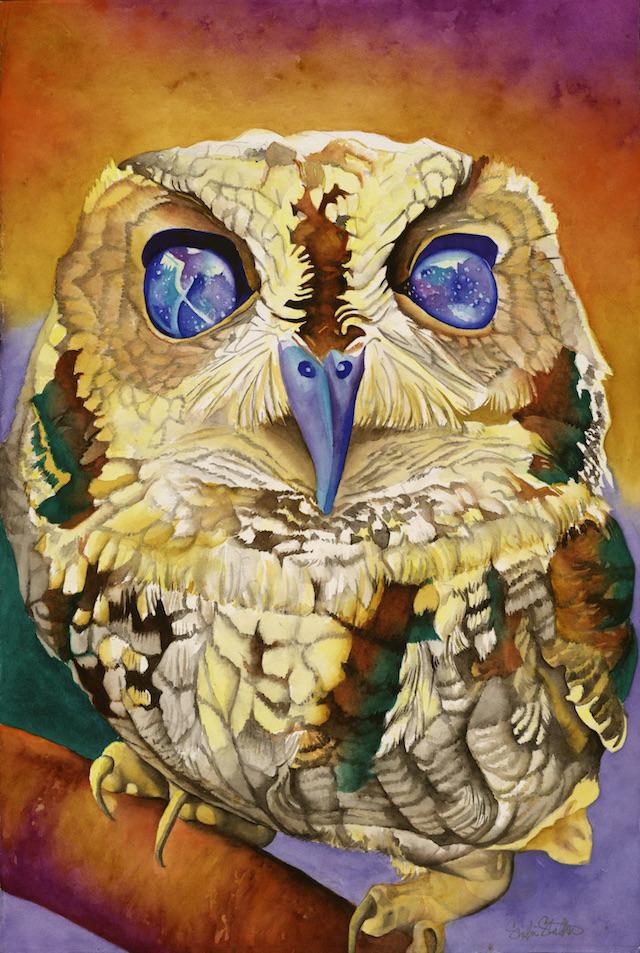
"Zeus the Blind Owl" The original watercolor painting is by Artist Sinclair Stratton.


This morning we loaded cardboard boxes of vegetables
into the trunks of cars. In each box, we put a card:
"How to: Broccoli," in tiny print, one side in Spanish.
How to choose fresh broccoli. But it had been chosen.

Families stayed in cars for hours in July's fierce heat.
In church we have prayed for the virus to go away.
You can buy human remains pouches on Amazon.
The zipper locks are guaranteed to keep the liquid in.

A man in the car line going up the hill stood outside,
bent over his battered Dodge Caravan, hood up, trunk held
in place with Bungee cords. Steam rose from the radiator.
The Great Pretender said he'd save the statue of Christ in Rio.

Last week, no form, no advice on Broccoli. Today,
to receive the USDA box, they must fill out a form:
name, address, the number in each family group.
The rule: one box per family, no matter how many.

How to eat it raw with a dip, how to stir fry, steam.
But we have seven in our family, one man pleaded.
Our group gave him two. A small boy waved at us
from the back seat.  I saw the careful handwriting,

apartments disclosed, streets, so painstakingly done,
 all for a box of surplus white mushrooms, broccoli,
head of iceberg lettuce.... Some boxes sagged.
There’s a Gaelic name for victims of bubonic plague

entombed in an Irish burial mound.  A plague hill.
Who sees the forms? One woman said, "We are illegal.
We don't want to put our names down on anything."
The young man in the passenger seat looked ahead.

In church we now regard the virus as a wake-up call.
I nodded, put two boxes in the trunk of her small blue car
that sputtered, set to break down.  Mute me on Zoom.
The Pharisees held out for handwashing, we were told.

The virus wants our lungs. Hart Island is our Potters Field.
Camus said we are owls blinded by too much light.
She told us the truth, and the truth will set us free.
Then my eyes stung; I could hardly see.


Bonnie Naradzay’s poems have appeared most recently in American Journal of Poetry, New Letters (Pushcart nomination), Kenyon Review Online, RHINO, EPOCH, The Tampa Review, Tar River Poetry, TheNewVerse.News, Ekphrastic Review, One; and poems are slated to appear later this year in AGNI and others.  In 2017 she graduated from St John’s College (the Graduate Institute), in Annapolis, Maryland.  For many years she has led poetry workshops at a day shelter for the homeless (Miriam’s Kitchen) and at a retirement center, both in Washington, DC.

DEAR GOVERNOR OF ARIZONA

a Double Dactyl
by Susan Vespoli


Clusterfuck, muster pluck.
Wake up, Doug Ducey,
COVID is killing us,
viralling doom.

Listen to doctors; don't
unjustifiably
sacrifice kids and staff
back in classrooms.


Susan Vespoli writes from Arizona, the COVID hotspot where our governor shrugs. She's had work published in spots such as TheNewVerse.News, Rattle, Nasty Women Poets, and Nailed Magazine.

Saturday, July 11, 2020

LAST SUMMER

by Jeremy Thelbert Bryant


A sign in Myrtle Beach, S.C., Thursday, June 18, 2020, asks people to maintain social distancing on the beach. People are flocking to South Carolina’s beaches for vacation after being cooped up by COVID-19 for months. But the virus is taking no vacation as the state has rocketed into the top five in the country. —WBTW, July 6, 2020


Asked whether leaders along the Grand Strand have discussed limiting visitors due to a spike in COVID-19 cases, Myrtle Beach Mayor Brenda Bethune told CNN on Monday “not yet, not at this time.”


Not at this time, the mayor says
as though a pandemic is not in the mix
of suntan lotion, bikinis, and waterboards,
as though 1,324 South Carolina bodies aren’t in the hospital,
as though sunshine and sea salt are tonics
against ventilators and final wishes.
How quickly beach towels become hospital
blankets. How quickly sun-christened boomboxes
are replaced with machines that beep out of rhythm.
Visitors will not be reduced at this time,
but will they be reduced in two weeks, reduced
and struggling to survive that one last beach trip?


Jeremy Thelbert Bryant is a poet and a writer of creative nonfiction. He is a graduate of the low residency MFA program at West Virginia Wesleyan College. His work may be found in TheNewVerse.News, Pikeville Review, EAOGH, Anima Magazine, and Prism. He finds inspiration in the red of cardinals, in the honesty of Frida Kahlo’s artwork, and in the frankness of Tori Amos’ lyrics.

Friday, July 10, 2020

WHERE THE MUSE LIES HIDDEN

by Michael Hogan


The taste of chocolate is cloying; the odor of burnt coffee clings to the kitchen.
The dog has given up for the day and lies sprawled against the tiles.
Netflix no longer beckons; you cannot bear another second-rate novel
or even “literature” which somehow today seems pretentious.
The garden planted, the house clean, dog fed and sleeping.
Exercise? Mindfulness? Facebook? emails?
Check, check, check, and CHECK!
And now here comes Boredom!
Like a dark nimbus cloud on a late afternoon
when the air is still as a vacuum
and you cannot divorce yourself from Self
It comes like a flood of viscosity, like mental syrup
clogging all the synapses with its oleaginous tentacles
signaling, I am here to stay, and you will be terribly unhappy
all the anchors of your sanity will disappear, and you will be adrift and bewildered
on a dreamlike sea, still awake but helpless.

There will be no thunderclap of relief in the stifling afternoon
no flash of lightning.
Just this
a slight urge to pick up a pen, a brush, an instrument
to write or paint or strike a chord.
And this is how the world begins again
how the light finds the trees and sparkles on the river
and a sudden shower lacquers the rose petals
and you create the world again.

Ignore it, and something dies, and something else will never be born.


Michael Hogan is the author of twenty-six books including the Irish Soldiers of Mexico which was the basis for an MGM film starring Tom Berenger and three documentaries. His work has appeared in numerous journals including The Paris Review, The Harvard Review, The Ohio Review, American Poetry Review, the Agni Review, New Letters, and others.  He currently lives in Guadalajara, Mexico with the textile artist Lucinda Mayo and their Dutch Shepherd, Lola.

A THURSDAY EVENING IN JULY

by Marc Swan


Two couples, one deck, no masks,
seated at separate tables
six feet apart drinking chilled white wine,
eating snacks from separate trays—
crackers, bleu cheese, olives, carrots, celery.
Conversation starts with tomato plants—
kind, size, growing patterns, anticipation
of the fruit called by some a vegetable
that will soon burst through on this deck.
Dusk settles, conversation shifts to the virus—
what we know, what we believe, what
we want the future to hold for us, for our
families. Subject moves on to politics—
a litany of those things we can’t control,
think about, worry about, and here we are
once again saying it out loud. Hopeful
on one level, pessimistic on another.
The take down of a society, principles
and values, by one man and his motley crew
in less than four years. Good thoughts
on fruit ripening replaced by anger, confusion,
hopelessness. Thunder jolts the air, rain
falls in heavy pelts against the umbrellas.
We’re invited inside, not sure the best plan,
but here we are socially distanced, no masks,
a fresh glass of white wine in hand,
conversation shifts to what we can control
or at least think we can.


Marc Swan’s latest collection all it would take was published in May 2020. Poems forthcoming in Gargoyle, The Stony Thursday Book, Channel Magazine, among others. He lives in coastal Maine 
with his wife Dd.

Thursday, July 09, 2020

DEMOCRACY AS A WAY OF LIFE

by George Salamon


"We need to save democracy from capitalism, and save capitalism from itself." —Kevin J. Delaney, “American Workers Deserve to Live With Dignity,” The New York Times, July 5, 2020


Let us pretend this leopard can
Change its spots, let us dream
The impossible dream once more.
Not this old boy, who's not ready
For one more plunge into an
Unfulfillable dream to overturn
The one created by our Indian-
Killing, slave-owning heroes by
Our greed-consumed wheelers
And dealers and salesmen from
The Frontier to Silicon Valley, a
Dream without roots in democracy
But in the cult of Mammon and Mars,
Talking the big lie, the bigger promise,
But walking in the bloody footsteps of
Absurdities and atrocities committed
Against the humanism no magician or
Leader can inject into the heart of our
Homegrown capitalism.
We can "save" democracy in America
By making it our way of life, democracy
With its own culture grown from the
Essential democratic truths about the
Values of human life, beginning with the
Long march of democracy, sustained by
The new American Dream, through the
"Unprecedented waves and storms" our
Poet of democracy predicted and, with
Grit, patience and luck reach that "city
Upon a hill" as it morphs from myth into
A place of democratic life.


George Salamon, inspired by Whitman, in St. Louis, MO.

Wednesday, July 08, 2020

WHEN NOTHING IS OKAY

by Jen Schneider


From San Francisco to South Carolina, a spate of shootings claimed the lives of people celebrating or just taking a drive over the Fourth of July weekend. Chicago saw one of its bloodiest holiday weekends in memory, with 17 killed and 70 wounded by gunfire. The incidents come amid fears the coronavirus pandemic, protests against racism, rising gun sales and an election year could make for a particularly deadly summer. —AP, July 6, 2020.


“Baby, I think I’m in trouble”
“It’s going to be okay.” 

The words fluttered off pale, water-starved lips that puckered and pursed at a rate quicker than my brain neurons could process what had just happened and what was about to occur. Beeps and blips punctured the air. My heart first guided, then pulled, and ultimately produced speech. Mine.

“It’s going to be okay,” I repeated. In case he didn’t hear it the first time.

Uttered in a place and a time where there was no room for reason, and no chance to undo what was already done, I spoke. Again.

“You’re alright.”

As I heard myself utter letter after letter and form a string of syllables meant to carry but only served to tangle. The sounds of my own voice echoed in the broken chamber of my mind.

Ten, nine, eight. My breath paused and his became more labored.

One final squeeze—hard, then harder, harder still. His. Then nothing.

Formerly intertwined fingers fell limp. My own muscles turned to stone as tears fell.

I continue to whisper—It’s going to be okay.

As reality took on new life. Repetition does not—will not—cannot
turn a lie into truth.

Nothing is going to be okay.

Thick arms clothed in heavy blue cotton touched, then grasped, my shoulders.
“M’am. Let’s go. Step back.”

I resisted. Turning right, then left. Right again. Only nothing was right. The sheer lacey fabric of my skirt tore as my knee shifted and my body gave way to the organized resistance. The skirt was a gift. He bought it for me on a whim, after he caught my gaze settle on the window mannequin. So different from my usual taste. Far beyond our usual budget. His eyes twinkled as I unwrapped the red satin bow, lifted the cardboard box top, and fingered the pink and purple tissue paper. Finally, finding the skirt.

I know not why I chose today to pull the skirt of my closet hanger that day. The weatherman forecasted falling temps. The skirt called to me, nonetheless.

He was pleased. All those years and I could still make him smile without even trying.

“Looking good, girl.” he stated and then let out a long, low whistle. “Let’s get out of here.”

We took the apartment steps by two and ventured downtown.
Walking. Talking. Laughing. Until the pop.
Pop. Pop. Pop. Silence.
Hustle. Bustle. Quick. Tape
wrapped wounds as
blood continued to spray.
“Baby?” Silence.

What then does one do
when the world stops
beating yet the sun
continues to rise?

Sheer cotton fabric
soaks tears
of love and loss.

I close my eyes
and see the world
only as I wish
it to be.


Jen Schneider is an educator, attorney, and writer. She lives, writes, and works in small spaces throughout Philadelphia. Her work appears in The Popular Culture Studies Journal, unstamatic, Zingara Poetry Review, Streetlight Magazine, Chaleur Magazine, LSE Review of Books, and other literary and scholarly journals.

KYUSHU RAIN

by Elizabeth Poreba


The Kuma River
churned in her bones
and rain became
a planetary
condition
gravity visible
as grey opacity,
swallowing
ceaselessly,
an event sealed
from any sense
of a time
outside its presence,
so that even
in the high room
above the storm
in her bones
anything safe,
any object —
carpet, dry sheets,
solid bed —became
a temporary
event.


A retired New York City high school English teacher and long-time resident of the Lower East Side of Manhattan, Elizabeth Poreba’s poems have appeared in several journals, including Poetry East, Ducts, and Commonweal. Finishing Line Press published her chapbook The Family Calling. Wipf and Stock has published two collections of her work, Vexed and Self Help: A Guide for the Retiring.

GHOSTS

by Steven Croft


Syrian pro-government forces and their jihadist opponents flagrantly violated the laws of war during the battle for Idlib province, UN investigators say. Civilians endured "unfathomable suffering" when the Syrian military launched a campaign late last year to retake the area, according to a report. They were subjected to indiscriminate air strikes and ground shelling, as well as arrests, torture and pillaging. Hundreds of civilians were killed before a ceasefire was agreed in March. Almost one million were displaced by the fighting and many were forced to live in dire conditions in overcrowded camps or open fields. Now, the investigators warn, "a perfect storm is in the making" as the war-torn country faces both the coronavirus pandemic and an economic crisis. More than 380,000 people have been killed and 13.2 million others - half of Syria's pre-war population - have been displaced inside and outside the country since an uprising against President Bashar al-Assad began in 2011. —BBC, July 7, 2020


In a Syria that should have died of its wounds
years ago, still, the white noise howl of low-flying jets
bombing the rubble for any survivors

In a basement a mother cradles a child and screams
to the percussive palsy of cold dark stones
The jets pound the ground with deafening fists

Wanting to soothe her crying baby's fear, only screams
slip past her tongue, wails of surrender, she tastes
tears from lips, the corners of her mouth

These screams an echo of others, today's question:
"Who said I must lose this child, who?!"  The demons
of war give, again, yesterday's answer: BAROOOM!!!


Steven Croft lives on a barrier island off the coast of Georgia.  He has recent poems in San Pedro River Review, Red Eft Review, Poets Reading the News, TheNewVerse.News, Synchronized Chaos, Gyroscope Review, Anti-Heroin Chic, and other places.

Tuesday, July 07, 2020

UNTITLED FOURTH OF JULY POEM

by Roberta Santlofer


Full "Buck" Moon and penumbral eclipse July 4-5, 2020.


It is after midnight
But I wouldn’t know it here
For staying stuck in my apartment
In bed with depression

Bus went –––––
I was just glancing out
My half-open bathroom window
After a warm July day

I often glance out at night
See into the towers along my street
See the low room stuck in
Behind my neighbor’s fallen tree
The branches dividing the light

Yet the brightness
Even more important
& personal
Being low

A lantern
Put up in
The air party
Maybe the moon
Did come down
Stayed in
Helped branches
Avoid the night’s blasting
Bright skies
Lit with Fourth of July fireworks

The moon feeling a little
Tame / timid / small
Among the blasting spectrum
Of color

But the true story of light—
The moon has discreetly mastered it


Roberta “Bobby” Santlofer (1943-2020) was a mother of sons, an avid reader, and a poet. A posthumous collection of her poetry is forthcoming.

WHAT IS THE AIR?

by Ralph James Savarese


Source: The New York Times archive


An elderly person said, “What is the air?” gasping as much
     with her arms as with her lungs.
How could I answer this woman? I do not know what it is
     any more than she.

I guess it must be a mother feeding her babes little morsels
     of oxygen. A clear, blue bib.

Or I guess it’s the wind taking a nap, the clouds a comforter
     letting dreams rain down.

Or I guess the air is itself an elderly person, death’s new
     confidante. What has it heard?

Or maybe it’s a commuter on the breathing Tube. (The rasping
     sounds like medieval German.)
“Stand away from the doors.”

Stand away from each other! The virus is sprouting in broad
     zones and narrow zones, growing among black folks
     as among white (more among black folks).
“I give them the same, I receive them the same,” a super-
     spreader says.

Perhaps the air is a bathhouse for lungs. All the panting they
     could want!
The Right once denounced promiscuous mingling yet now
     promiscuously mingles itself.

The air, madam, is an unregistered weapon. In America
     everyone carries.


Ralph James Savarese is the author of two books of prose, Reasonable People and See It Feelingly, and one collection of poetry, Republican Fathers, due out in October.