Guidelines


Submission Guidelines: Send 1-3 unpublished poems in the body of an email (NO ATTACHMENTS) to nvneditor[at]gmail.com. No simultaneous submissions. Use "Verse News Submission" as the subject line. Send a brief bio. No payment. Authors retain all rights after 1st-time appearance here. Scroll down the right sidebar for the fine print.

Monday, December 20, 2021

ACCOUNTABILITY

by Michaela Mayer


if you slip through the thin curtain between 
this world and another, you will see him:
Ahmadi lifting jugs of clean water to the lips
of children gulping thirstily in the Afghan
heat. not standard procedure, but then,
these things are allowed those blown to bits
by American payload. or so I like to imagine.
the real Ahmadi is red mist and sharp shards
of bone on the tarmac in Kabul, and the children
too. all we get of them are a few dark pixels
on our news sites. meanwhile, the men
whose game condemned them lean back,
hands behind heads, and acquit themselves:
a righteous strike. pay the families a few 
dollars for their grief. slaps on the back,
handshakes. America, our carnivorous country, 
feeds on remains—flesh hanging from
its ghastly mouth, and us behind our screens,
gaping at scraps wedged in its teeth—our minds
slipping back and forth between the two worlds.


Michaela Mayer (she/her) is a 26-year-old elementary school teacher and poet from Virginia. Her works have been previously published in Feral, Barren Magazine, Perhappened, Claw & Blossom, and others. She has forthcoming poems with Olit, Monstering Mag, MAYDAY, and The Lickety~Split, and can be found on Twitter@mswannmayer5.

Sunday, December 19, 2021

KNIFE

by Katherine Smith
(Ann Telnaes/The Washington Post)


I asked the apple tree
how can you live, knowing?
and the trees answered
scattering brown fruit for deer.

I asked the field sectioned off with black tarp
how can you live, knowing?
And the grass answered
cracking the sidewalk with green.

I asked the mother
how can you live, knowing?
And she answered
holding her child in her lap.

I asked the smiling family posing
with their guns, how can you live, knowing?
And they offered 
silent smiles glittering like knives.


Katherine Smith’s recent poetry publications include appearances in Boulevard, North American Review, Mezzo Cammin, Cincinnati Review, Missouri Review, Ploughshares, Southern Review, and many other journals. Her short fiction has appeared in Fiction International and Gargoyle. Her first book Argument by Design (Washington Writers’ Publishing House) appeared in 2003. Her second book of poems Woman Alone on the Mountain (Iris Press) appeared in 2014. She works at Montgomery College in Maryland.

Saturday, December 18, 2021

YOU WALKED OUT OF MY LIFE

by Susan Terris


You   my mother's cousin
Single    were like another mother
 
We talked   read   played games
Knitted scarves   until you met
 
Davy   age 10   Down Syndrome
Son of David   widower who proposed
 
I was 13   needed you   but you said
Yes   became Davy's mother
 
And I never again saw you
Then   today   looked   found only
 
Obituaries   David's from '88
Davy 1994   you    25+ years ago


Susan Terris is a freelance editor and the author of 7 books of poetry, 17 chapbooks, 3 artist's books, and 2 plays. Journals include The Southern Review, Georgia Review, Prairie Schooner, Blackbird, The New Verse News, and Ploughshares. She has had poems published both in Pushcart Prize and in Best American Poetry. Her most recent book Dream Fragments won the Swan Scythe Press Award.

Friday, December 17, 2021

WINGS

by Tricia Knoll


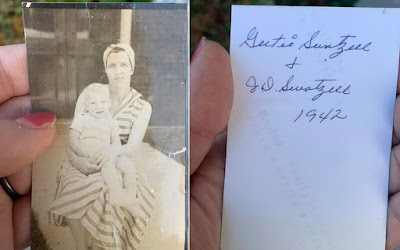
This photo combo shows Katie Posten holding the front and back of a photograph she found stuck to her car's windshield on Dec. 11 in New Albany, Ind. The photo is from a tornado-damaged home in Kentucky that landed almost 130 miles away in Indiana. The photograph was among dozens of personal items to turn up far from home in the aftermath of the tornadoes that sowed a path of destruction across six states. Photographs, by far, were the most common find. In major storms, they’re often carried the furthest, said John Knox, an associate professor of geography at the University of Georgia. “They’re like little wings when they go up into the air,” he said. (AP via The Washington Post, December 12, 2021)


I archive my family’s wings
    letters Union soldier William Lewis wrote home during the Civil War
    my grandmother’s photo holding my squirming mother
    my mother in her fancy hat leaning against my dad’s black Buick
    my mother rocking my newborn daughter
    my daughter holding her newborn
 I have no idea where they go next. 
 
I cannot forget    
    I found the photo of an altar boy wearing a halo
    and a white gown in a driveway in the Ninth Ward
    in New Orleans after Hurricane Katrina. 
I never knew whose angel he was. 
 
What hurricane wind tears apart
    flies, lives that shift from black and white
    to battered color. Wings beating birds 
    to refuge on a windshield,
    a mud puddle. Stuck in the twig
    of a naked sycamore. 
 
Angel memories try to find
    a way home. I believe
    the only thing my mother feared
    was the hurricanes in Florida. 
    I have no pictures of her fear.


Author's note: I am the archivist of most of the Civil War memorabilia of my great-grandfather William Lewis who served in an Indiana regiment. I never heard back from the historical societies in Indiana when I offered them the 65 letters he and his friends wrote to my great grandmother. Some of what he said is included in my book of poetry How I Learned to Be White.


Tricia Knoll lives in Vermont which catches the tail end of most weather systems that flow from west to east. Her poetry appears widely in journals, anthologies and five collections. Most recent is Checkered Mates, a chapbook out from Kelsay Books. Her next collection entitled Let's Hear It for the Horses—love song poems to horses—is on pre-sale discount from The Poetry Box publishing house through December 31 for its release on February 1. 

Thursday, December 16, 2021

NO COUNTRY FOR OLD KENTUCKY HOMES

by M. N. O'Brien


In an interview Sunday morning on CNN’s “State of the Union,” FEMA Administrator Deanne Criswell said the agency is preparing for severe weather events of similar magnitude. “This is going to be our new normal, and the effects that we’re seeing from climate change are the crisis of our generation,” she said. —The Washington Post, December 13, 2021


Echoes of memories: the crunching gravel
under departing tire trucks drowned out
by a howling freight train. Gnashing
through the house, using its churning debris,
corpses of livelihoods to kill more. Leaving
only the warm December stones behind.

In the distance, coal is exhumed
with Kentucky's unbridled spirit.


M. N. O'Brien received his B.A. from Roanoke College, where his work was published in On Concept's Edge and received the Charles C. Wise Poetry Award. His work has appeared in SOFTBLOW, Right Hand Pointing, and The Ekphrasis Review. He currently lives in Christiansburg, Virginia, taking seasonal jobs that do not interfere with writing poetry. He despises writing about himself in the third person.

Wednesday, December 15, 2021

THE MOST POWERFUL NATION

by Imogen Arate


South Dakota teachers scramble for dollar bills in ‘demeaning’ game. Company behind the competition apologises after footage showing teachers stuffing notes into clothing to fund classrooms goes viral —The Guardian, December 13, 2021


The right to forego education is ours

the privilege to flaunt ignorance

Ogling teachers battling for dollars

we buy their dignity white-knuckling

desperately craving flexible seats


Luxuriating under quilts of greenbacks

stitching our bellyful laughs Oh look 

at that guy who's cramming his hat with

the pocket change we've let loose to

buy goodwill (tax credits) We pat our-

selves for our Xmas good deeds x’ed

out for the extreme sport of debasing 

grown adults to their hands and knees


What chumps would do for dedication

amirite

Am I right

Are We Right


Imogen Arate is an award-winning Asian-American poet and writer and the Executive Producer and Host of Poets and Muses (https://poetsandmuses.com), a weekly poetry podcast that won second place at National Federation of Press Women's 2020 Communications Contest. She has written in four languages and published in two. Her works were most recently published on The New Verse News and in Consilience and Rigorous. You can find her @PoetsandMuses on Twitter and Instagram.

Tuesday, December 14, 2021

A STEPH CURRY HAIKU

Photo: Golden State Warriors guard Stephen Curry celebrates after breaking surpassing Ray Allen's NBA record for most career three-pointers. (Mary Altaffer/AP via The Washington Post)


A poet of several styles, Earl Wilcox find the art of haiku poetry fulfills special needs for sports moments.


MAYFIELD

by Donna Katzin


In this photo taken by a drone, buildings are demolished in downtown Mayfield, Ky., on Saturday, Dec. 11, 2021, after a tornado traveled through the region Friday night. Ryan C. Hermens/Lexington Herald-Leader via AP


Where cold and warming winds collide,
twisters—minions of an angry earth—                    
lash out in pain, flatten farms, homes,
houses of work and worship in their paths.
As roofs rain bricks in darkness,                               
mothers, fathers, sons, daughters,
sisters, brothers sit in cellars,                                               
making calls never returned.
 
When the wild ones have gone, survivors pick
through mauled metal, shredded remains.       
A bus lies on its back—a turtle shell
with the body sucked out.
Splintered ghost trunks rise  
like hands to heaven.
There are no voices now.
Even wind has no words.
 
Cadaver dogs sniff through rubble.
Crews root around the clock
for what is left of men and women
who worked the late shift,
even after alarms screamed,
for twelve dollars an hour
making candles to light consumers’ holidays       
at the factory now extinguished.                   
 
On Sunday morning, faithful gather,
console and hold each other,
interrogate the Almighty,
sing hymns of hope
to staunch despair.  
A few pray for the mother
planet we torture at our own peril—
who will not be patient forever.
 
 
Donna Katzin is the founding and previous executive director of Shared Interest, a fund that mobilizes the human and financial resources of low-income communities of color in South and Southern Africa.  A board member of Community Change in the U.S., and co-coordinator of Tipitapa Partners working in Nicaragua, she has written extensively about South Africa, community development and impact investing.  Published in journals and sites including The New Verse News and The Mom Egg, she is the author of With the Hands, a book of poems and photographs about post-apartheid South Africa’s process of giving birth to itself.

SATURDAY

by John Guzlowski


Mayfield, KY Daylight Drone Footage Aftermath - December 11, 2021


Where I sit, the world 
is quiet, unassuming.  
Snow falls & becomes 
rain, rain falls 
& becomes snow.  

I write on a pad of paper 
& think of the tea  
steeping in the cup next to me.

200 miles away in Kentucky 
The wind shook the world
And my friends died.


John Guzlowski's poems and stories have appeared in North American Review, Ontario Review, Rattle, Atlanta Review, Nimrod, Crab Orchard Review. Garrison Keillor read his poem “What My Father Believed” on his program, The Writers Almanac.  Guzlowski's poetry book Echoes of Tattered Tongues won the Eric Hoffer/Montaigne Award for most thought provoking book 2017. He’s also the author of the Hank and Marvin mysteries. Now settled in Virginia, Guzlowski lived in Kentucky for a while.

Monday, December 13, 2021

BEFORE ROE V. WADE

by Marsha Owens


i knew that girl
who rode my bus,
raped by her uncle
who told us dirty jokes.
neighbor women whispered...
only twelve, gone to the home.
 
i knew the home
out of town
on the highway, for girls
who got themselves pregnant
like they caught a cold
for not wearing a jacket.
 
i didn’t know
the girl i passed downtown,
defiant chin lifted to catch
cooling air in the wrinkles
of her shiny black neck,
like road tar melting
on a hot july day, baby
in her 14-year-old belly.
 
i knew my whiter-than-white
neighborhood looked away
as i hung my white blouse 
in the closet,
coat hangers jangling
impatience like little girls
who just want to go outside
and play.
 
 
Author's Note: I came of age in the 1960s, and suddenly the world was upended... Vietnam, birth control, and in the 70s, RvW. The 1950s seemed like ancient history in many ways. I grew up in the South in a white neighborhood, but we didn’t use the word ‘segregated.’ Black people lived ‘downtown’ or ‘in the country.’ Now I feel like I’m living in a time warp as Roe v. Wade is, apparently, about to be overturned, and African Americans are once again, being lynched. 


Marsha Owens is a retired teacher who lives and writes in Richmond, VA, and at times, along the banks of the beautiful Chesapeake Bay. Her essays and poetry have appeared in both print and online publications including The Sun, The Dead Mule, Huffington Post, Wild Word Anthology, Rat’s Ass Review, Rise Up Review, PoetsReadingtheNews, and The New Verse News. She is a co-editor of the poetry anthology Lingering in the Margins, and her chapbook She Watered Her Flowers in the Morning is forthcoming from Finishing Line Press.

Sunday, December 12, 2021

Remembering Michael Nesmith
(December 30, 1942 – December 10, 2021)

by Jeannie E. Roberts


The Monkees Farewell Tour with Michael Nesmith & Micky Dolenz
Sunday, November 14, 2021, The Greek Theatre, Los Angeles CA


It was 1967, the year deafening screams overpowered the St. Paul 
Auditorium as The Monkees performed for us and thousands 

of other teeny boppers. I was eleven and lucky enough to attend 
the concert with my older sister, Mary, and our neighbor friends, 

Linda and Lisa. I recall wearing a mod-style dress, a shapeless 
shift with vertical stripes in red and yellow. My purse matched 

and attached to a faux gold, chain-link handle. I felt hip 
in my tween-modernness as I waited to hear my favorite song 

“Daydream Believer.” Instead, an audience of shrieking girls 
made inaudible the four young men on stage. Even so, 

their goofy antics offered a visual component to the performance. 
Like their TV show, the band members wore capes 

as they leapt across the proscenium with youthful effervescence. 
After an hour or more of ear-piercing noise, 

our hearing wasn’t quite the same. Still, it was worth it. 
I liked Michael, the tall, introspective Monkee, the 12-string 

electric guitar player who wore a forest green wool hat 
with pompom. Hired for his vast musical talent, he was also a poet. 

To me, Michael Nesmith seemed kind, thoughtful, and authentic, 
in the end, qualities that really matter.


Jeannie E. Roberts lives in Wisconsin, where she writes, draws and paints, and often photographs her natural surroundings. She’s authored seven books, five poetry collections and two illustrated children's books. Her newest collection, As If Labyrinth - Pandemic Inspired Poems, was released by Kelsay Books in April of 2021. Her poems appear in Anti-Heroin Chic, Sky Island Journal, The New Verse News, and elsewhere. She’s an animal lover, a nature enthusiast, a Best of the Net award nominee, and a poetry editor of the online literary magazine Halfway Down the Stairs

Saturday, December 11, 2021

DELIVERED

by Julian Matthews


“Dinner With Friends” Painting by Victoria Coleman


A poem on our first meeting after being in a writing workshop on Zoom for six weeks, and in various lockdowns for a year and ten months.


And so we sit at the table partaking of a meal,
the home-made, home-cooked, home-delivered
a gathering of friends, new and old,
unmuted, unzoomed, live, in-person, fully embodied,
greeting each other like refugees
meeting on the dock, our boats having survived
the treacherous crossing of middle class suburbia
and stepping back onto the shores of human connection again, 
wetting our cold feet and lapping up warm chatter about pets, 
pasta, pastries, prices, politics and the pandemic, always the 
     pandemic,
and, thankfully, of our common love of books, and writing and 
     poetry
and missing sitting in darkened theatres with strangers, to watch 
     a movie,
or a play or just chilling with a warm-up, pre-concert cocktail, 
     perhaps a long island tea, 
or two, before listening to an orchestra, fingers fondling keys, 
     bows caressing strings,
lips pressed against mouthpieces, hugging tubas, the tsk-chizz 
     of sticks on cymbals, 
being enveloped by the sensurround sounds of music played by 
     real, in-the-flesh humans...

And in the end there is laughter, ribbing and the teasing out
of each other's backgrounds, our reasons for being, why the 
     need to put words
on rectangular screens, this unboxing of the isolation inside us, 
     this shedding of thickened skins,
double-vaxxed, immunized, and unmasked, fully ensconced in 
     that most singular of human acts,
the Art of Conversation, manifesting our ancestral DNA of 
     gathering around the embers of dying
fires under stars, trading stories, sharing opinions and yes, even 
     gossiping,
just to know we are alive, 
we are still alive.


Julian Matthews is a former journalist finding new ways to express himself in the pandemic through poetry, short stories and essays. He is published in Beltway Poetry Quarterly, Nine Cloud Journal, Poor Yorick Journal, Borderless Journal, Second Chance Lit, Poetry and Covid, the anthology Unmasked: Reflections on Virus-time (curated by Shamini Flint), cc&d magazine, a Scars Publication, and forthcoming in the American Journal of Poetry. He is based in Malaysia.

Friday, December 10, 2021

THE USUAL AMERICAN ELEGY

by William Doreski


In Michigan, another school
shot up by vain disgruntlement.
The freshly dead were tossed aside
by the rush of unbridled history.
I’ve never fondled a gun
with the affection that’s its due.
 
I’ve never savored the death
of a twelve-point white-tail stag
or even a rabbit hopping
toward its fate in a tasty stew.
The boy who fired that pistol
wanted to kill for reasons
 
I probably shared at his age.
But the guns my great-uncles gave me
to make a man of me remained
unloaded, unloved in my closet.
Later I gave them to an aunt
who liked to kill small animals.
 
Today the wind ruffles the pines
with affection absent from life.
The cold challenges my parka
with its warped and stubborn zipper.
I should wander deep in the woods
with orange safety vest averting
 
bullets from careless hunters.
A hundred people shot to death
every day in our enchanted world.
I keep an empty brass cartridge
on my desk to remind me that
like Mayakovski I could shoot
 
myself anytime I wish.
I don’t wish. The blowing dawn
brings a pale layer of blue,
and the ruined families of the dead
face another day of absence
indifferent to the winter sun. 


William Doreski lives in Peterborough, New Hampshire. He has taught at several colleges and universities. His most recent book of poetry is Mist in Their Eyes (2021). He has published three critical studies, including Robert Lowell’s Shifting Colors. His essays, poetry, fiction, and reviews have appeared in various journals.

Thursday, December 09, 2021

FAMILY PHOTO

by Rémy Dambron


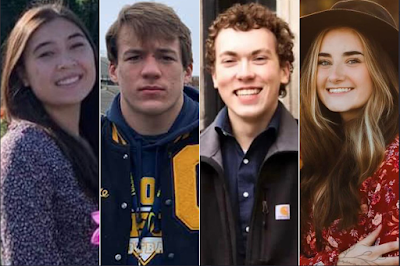
The following poem comments on the deranged photos of Republican politicians and their children holding weapons of war.  We shall not post these photos. Instead, in union with  MeidasTouch.com, we memorialize the teens who were murdered recently in Michigan due to the Fascist fetishization of guns: Hana St. Juliana, 14, Tate Myre, 16, Justin Shilling, 17, Madisyn Baldwin, 17.


this year 
for christmas
a family poses 
in front of their sparkling tree

for a holiday picture with their loved ones:

mr. m60 as head of household
mrs. thompson semi-auto as his loyal wife
m16, m4, ar-15 as their model children
and of course their youngest, 
little uzi.

their white teeth shining 
through their grins with pride 
wishing us more than just a

“merry christmas”

their eyes ecstatic 
their appetites indulged
their hearts content  

together, their stockings waiting to be filled,
they ask santa:

“please bring us ammo”

together, fully loaded, 
their bullets will number in the hundreds.

together, fully loaded,
they can unleash holy hell in a matter of seconds.

together, unloading on our gaze,
they gloat 
they glorify
they galvanize.

merely days after the latest killing 
spree school day

together, for christmas,
they remind us

this is america.


Rémy Dambron is an English teacher and poet whose writing focuses on denouncing political corruption and advocating for social/environmental justice. With the help of his chief editor and loving wife, his works have appeared in What Rough Beast, Poets Reading the News, Writers Resist, Society of Classical Poets, Robot Butt, and New Verse News.