Guidelines


Submission Guidelines: Send 1-3 unpublished poems in the body of an email (NO ATTACHMENTS) to nvneditor[at]gmail.com. No simultaneous submissions. Use "Verse News Submission" as the subject line. Send a brief bio. No payment. Authors retain all rights after 1st-time appearance here. Scroll down the right sidebar for the fine print.

Sunday, April 17, 2022

SEA-TAC AT EASTER

by Jerry Krajnak


Fifty years ago, a boy returned
on a drizzly Easter Monday and found no one
to curse or kiss him. Holiday decorations
peeled from the walls as he lugged his duffel bag
to the gate of the final red-eye homeward flight.
On that eastbound plane no one asked
what he had done to earn that colorful ribbon
on his lapel or the metal pin on his hat.
Not wanting to hear about Vietnam, they looked
away from him as the plane sped on in the dark.
Only clinking ice cubes and the cry of a baby
welcomed him home on that dark United flight.
 
What kind of welcome will they receive next year,
all those young Russian soldiers, as they return
from afar? Uneasy and gone so long from home,
will they be thanked for their service to the state,
hear shouts of baby killer hurled, or worse,
arrive ignored by tired mothers and brothers
all sick of deprivation and numbed by broadcast
body counts that cannot be confirmed?
Will sisters and fathers and friends all cover their ears,
unwilling to hear what these young men would tell
about the distant place where they were sent
to do what leaders told them they must do?


Jerry Krajnak is a retired Vietnam veteran who lives in the North Carolina mountains. Recent poems appear in Plants and Poetry, Novus, Rat's Ass Review, Sublunary Review, and in the Flee to Spring anthology.

Saturday, April 16, 2022

OH, BLACKBERRY WINTER

by Earl J. Wilcox


Late last night, you creep upon us—
cold, chilly rain, winds whipping
across Georgia & Carolinas.
Our pretty in pink peach orchards
shuddered, ready to eat (almost)
strawberries huddle under plastic tarps.
Bright purple and yellow pansies
still hopeful of weeks yet to shine
before the wilting suns of summer.
Our most beloved children—azaleas
and dogwoods—both already dressed
in their Easter bonnets. cringe, nearly
freeze in the cold winter-like night.
Oh precious and sacrosanct blackberry
cobbler, we shall miss your bubbly sauce,
your savory aroma fresh from our ovens.
Hurry along, children, summer time—
when the living comes easy—already
peeps from behind her humid clouds.
Tomorrow she will likely hum her hymn,
teach cat fish to jump.
 
 
Earl Wilcox writes from South Carolina where all flowering creatures are in bloom.

Friday, April 15, 2022

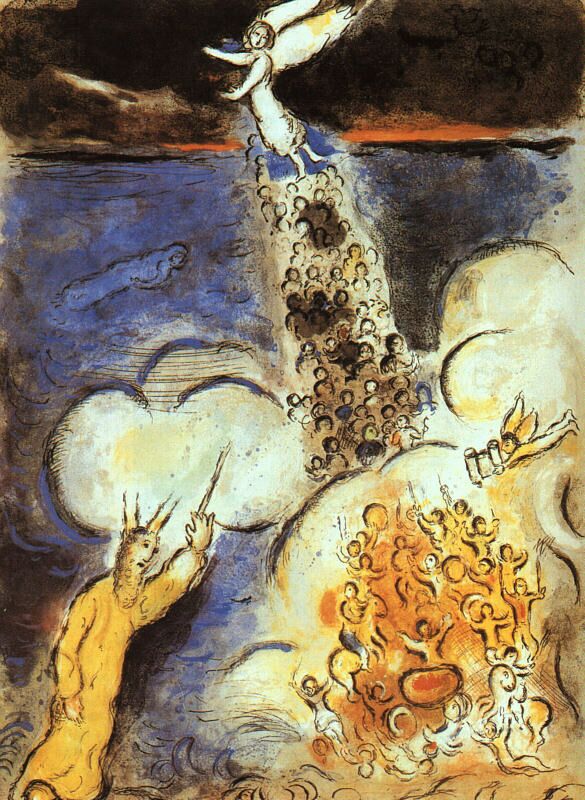
ARE WE THERE YET?

Passover 2022
by Anita S. Pulier


Marc Chagall's "Passover Haggadah"


Celebrate forty years of wandering.
40 years of searching.

Read Haggadah to the children,
give thanks,

sing praises
for the tribe surviving.

Focus on the ancients,
not the news.

Ignore ICE, as it issues
this warning: if officers

view you as Other,
hear a foreign accent,

take notice of shabby clothes,
you will be wrangled

like cattle into pens
and, paperless or not, deported.

To where? Weep, explain
you have lived here

since you were two,
this is your home.

Your wife, your children,
your aged mother

may never see you again.
Glory be to what?

Listen! Angry screams nurtured
by hatred, drown out the cries

of kids in Florida, or Texas, or next door.
How many more will be force fed this poison

in the name of a merciless God
punishing the sin of survival?

Tonight, we Jews co-opt words;
suffering, pain, freedom.

I imagine the day that
anyone’s God

will deliver enlightenment,
angels will sing,

heavenly light will shine
on the cruel irony of the self-righteous,

the day each of us will be revealed
as the supplicant,

each of us the Other.
The day our ancient journey,

our Passover celebration,
will not fall so woefully short

of the promised land.


Anita S. Pulier’s chapbooks Perfect Diet, The Lovely Mundane, and Sounds of Morning and her books The Butcher's Diamond and Toast were published by Finishing Line Press. Anita’s poems have appeared in many journals and her work is included in nine print anthologies. Anita has been a featured poet on The Writer's Almanac.

Thursday, April 14, 2022

MAP MAKING

by Robin Wright


Draw lines that represent countries.
Go further, pen buildings
whole and firm, houses
with sunflowers, children’s toys
in the yard, bicycle leaning
against a tree, a bench in front
of a library. Populate with people
eating ice cream, strolling the streets.
 
Hold the map close.
 
Soldiers tear it away,
draw guns, tanks,
bodies on the ground
carpeted with blood,
crushed buildings,
landmines meant to erase.
 
Snatch it back,
ink blue sky, yellow sun
above people, buildings,
a child’s future.


Robin Wright lives in Southern Indiana. Her work has appeared in Bombfire Lit, One Art, Young Ravens Literary Review, Olney Magazine, As it Ought to Be, Rat’s Ass Review, Sledgehammer Lit, Muddy River Poetry Review, Sanctuary, and others. She is a Pushcart Prize nominee, and her first chapbook, Ready or Not, was published by Finishing Line Press in October of 2020.

Wednesday, April 13, 2022

ATROCIOUS NEWS

by Madlynn Haber


The story of atrocities screams out from the front page
until the end of the column of words. The story continues
on page five. In between, is the weather report. I stop
to follow the progress of early spring’s longer days,
full sunshine, warming temperatures. Delightful. Turning
pages, today’s atrocities pick up with images of rubble,
devastation, tears running down children’s pale faces.
A cartoon follows for our amusement, then notices
of upcoming fun, fairs, and festivals.
 
The word atrocity repeats until it is familiar, so
commonplace it almost loses its meaning.
It’s just another atrocity, one might say.
Red is the color of blood as it spills across
the globe from bodies whose skin tones reflect
a spectrum of hues from light to dark.
Today’s crumpled headlines continue screaming
with news as the paper is thrown on a pile going back
to the beginning of time.


Madlynn Haber lives with her dog, Ozzie, in a cohousing community in Northampton, Massachusetts. Her work has been published in the anthology Adult Children (Wishing Up Press, 2021), Random Sample, Borrowed Solace, Buddhist Poetry Review, Muddy River Poetry Review, Poetica Magazine, and other journals.

ABEL ASKS HIS BROTHER WHAT CAME OVER HIM

by Bonnie Naradzay


CAIN ET ABEL (CAIN AND ABEL), 1960, an original color lithograph by Marc Chagall designed for and published by VERVE for the volume Dessins pour La Bible.


If I gave the best when I offered my sheep
while your harvest fell short of the mark,
why turn against me? There was still time–
 
Now my blood cries out from the ground
you have claimed as your own. You know
the land mine you rigged to me will explode.
 
Alas, the loaf of bread I’d held, this pool of blood.
How could you choose to bludgeon my cows,
to wreak your vengeance against them too?
 
We are brothers; yet you attacked my humanity,
dragged me with your arms. Let me feel the snow
fall across my face as I say goodbye to life.  


Bonnie Naradzay’s poems have appeared in AGNI, New Letters (Pushcart nomination), RHINO, Kenyon Review Online, Tampa Review, Florida Review Online, EPOCH, Pinch (Pushcart nomination), Potomac Review, and others. Her essay on friendship was published in 2020 in the anthology Deep Beauty. For many years she has convened poetry salons with homeless people and with residents of retirement communities in the Washington DC area.

Tuesday, April 12, 2022

LIBRARIAN/HAPPY EASTER/X

by Annie Cowell


“Twenty-two years after a pair of notebooks filled with Charles Darwin’s early musings went missing from the Cambridge University Library, they were anonymously returned in good condition last month along with a note to the elated librarian: ‘Happy Easter.’” —The New York Times, April 5, 2022. Photo: One of the returned notebooks included Charles Darwin’s famous “tree of life” drawing, which maps out how related species could diverge from a common ancestor. Credit: Cambridge University Library via The New York Times


It wasn’t just the fatty bloom of ancient leather
(although my fingers itched to touch it),
but more the lignin laden bibliosmia
which wafts from the wrinkled patina.
Vanilla essence of Darwin.
What lay inside mattered less to me
than the shadow of the procreator,
of the man whose mind gave Life to the Tree.
An aura which goes beyond the scientific,
of ink-stained fingers lacing 
his beard with brown and grey before 
penning those spindly branches. 
Two decades, I have been their guardian.
Whilst they were presumed missing
mislaid, misfiled, misplaced,
I have inhaled Darwin; stared at the covers
through half-closed eyes,
felt his ghostly hands on mine. 
It is only when he whispers
the books are overdue,
that I know I must return them.
The librarian looks a jolly sort so 
I choose a pink gift bag
and leave them with a note,
happy to have played a part 
in the mystery
of the Origins of Life.


Author’s Note: This poem was inspired by the return of Darwin’s notebooks to Cambridge University. I wanted to imagine what had motivated both the taking and the returning of them.


Annie Cowell is a former teacher living in Cyprus. She has poems forthcoming in a number of publications. @AnnieCowell3

Monday, April 11, 2022

PREGNANT AND TRAPPED IN MARIUPOL, UKRAINE

by Claire Matturro


“Pregnant women moved from Mariupol hospital were sheltering in bombed theatre.” —Sky News, March 26, 2022. Photo: Mariana Vishegirskaya, an injured pregnant woman walks downstairs in a maternity hospital damaged by shelling in Mariupol, Ukraine, Wednesday, March 9, 2022. (AP Photo/Evgeniy Maloletka)


At first we acted brave as we hurried
Inside the theater to flee mortars.
We had food and water, but I worried
Heavy with child if I’d make the border
If buses didn’t come. We sang bold songs,
then our food ran out, the water was gone.
Missiles crushed the walls, so we ran for trees,
as if feeble branches could stop the siege.
My baby kicks as an old man stopping
By me in the forest offers toffee.
He says “don’t chew it. It is the last one.
Let it melt slowly upon your tongue.
Chocolate and mint, a bit of sweet cream,
like the bold songs we used to bravely sing.” 


Author's Note: This sonnet is a heart-felt response to recent news stories about the continuing ordeal of people in Mariupol. The first eight lines are based upon direct news accounts—including the shelling of the theater where many took refuge and the wait for the humanitarian relief via the Red Cross buses. However, the last six lines, after the turn in the sonnet about the man offering the pregnant woman the last piece of candy, are wholly imagined. I wanted to show something of the kindness and courage of the Ukrainian people, which is so often reflected in news stories, and to offer at least a hint of hope. 


Claire Matturro has been a journalist, a lawyer, and a legal writing teacher at Florida State University and University of Oregon. She is the author of seven novels, including a legal thriller series published by HarperCollins, and is the co-author of a recent novel. She is an associate editor at Southern Literary Review and lives in Florida.

A TANKA FOR THE TWO PEOPLE KILLED IN KHARKIV BY A RUSSIAN MORTAR SHELL

"A loaf of bread on a park bench, collecting snow. A puddle of blood nearby. Those were the traces of two lives lost this past week, two people killed as they sat sharing a late lunch or an early dinner, or maybe just feeding pigeons. No one seemed to know their names. They died at around 5:30 in the afternoon on Sunday in the southeastern Slobidskyi district of Kharkiv from a mortar strike, residents said, describing the victims as an older woman and a middle-aged man." —Thomas Gibbons-Neff and Natalia Yermak, The New York Times, April 6, 2022. Original photo by Tyler Hicks/The New York Times


Jimmy Pappas is the Zoom moderator for the Poetry Society of New Hampshire.

Sunday, April 10, 2022

FRONT LINES

by Eileen Ivey Sirota


The governor of Alabama on Friday signed into law two controversial bills: one that criminalizes healthcare providers who offer gender-affirming care to transgender youth and another that requires students to use bathrooms that match the gender on their birth certificates. Kay Ivey, a Republican, said she “believed very strongly that if the Good Lord made you a boy, you are a boy, and if he made you a girl, you are a girl”. The anti-gender-affirming care bill, described as the first legislation of its kind in the US, makes it a felony punishable by up to 10 years in prison to provide medical care including hormone treatment and puberty blockers to minors. It also includes bans on gender-affirming surgeries for transgender youth, which are extremely rare, and compels school personnel to disclose to a parent or guardian that a “minor’s perception of his or her gender or sex is inconsistent with the minor’s sex”. —The Guardian, April 8, 2022


We will fight them on the
beaches    we will fight them in
 
the sandbox    these tiny
terrorists, the little boys
 
with nail polish, a spangly pony
and a special Barbie.
 
We have God on our side
He who surely must have sanctified
 
the hand of the doctor filling out
the birth certificate.  We have
 
George Orwell on our side to
inspire our marketing team.
 
We’ll call it de-nazification, no,
we’ll call it parental support, no,
 
wait, we’ll call it The Vulnerable Child
Compassion and Protection Act.
 
No more shelter in the demilitarized
school nurse’s office.  We’ll make It a crime
 
to slow the inexorable hands of time
bringing forth an unwanted body.
 
In this holy war
No prisoners are too small.


Eileen Ivey Sirota is a psychotherapist and a poet.  Her chapbook Out of Order was published by Finishing Line Press in 2020.  Her poems have been published in District Lines, Beltway Poetry Quarterly, Lighten Up, The New Verse News, Ekphrastic Review, The Poeming Pigeon, Calyx, and Voices:  The Art and Science of Psychotherapy. She lives in Bethesda, MD with her husband and an ever-shifting blend of rage and wonder.

Saturday, April 09, 2022

FAIRY TALES

by W. Luther Jett


Satellite images show bodies lay in Bucha for weeks, despite Russian claims. —The New York Times, April 4, 2022


Let’s pretend the moon
is made from cheese, and bees
go there when they die,
and the river runs backward
on alternate weeks, and, oh,
the tallest peaks
are covered in ice cream—
you could climb them in just
ten giant steps—or fly.
Yes, let’s pretend that we
can fly. Also, let’s pretend
that summer will have no end.
The rifle isn’t loaded. Those
are not dead bodies there,
bloating in the city square.


W. Luther Jett is a native of Montgomery County, Maryland and a retired special educator. His poetry has been published in numerous journals as well as several anthologies. He is the author of four poetry chapbooks: Not Quite: Poems Written in Search of My Father (Finishing Line Press 2015), Our Situation (Prolific Press 2018), Everyone Disappears (Finishing Line Press 2020), and Little Wars (Kelsay Books 2021).

Friday, April 08, 2022

TRUE COLORS

by Julie Steiner


"Refugees Welcome" by Omar Ab Abdallat


A Haitian family's asylum case shows double standard at the border: It took three doctors, a small team of lawyers and multiple nonprofits on both sides of the border to get an exemption for a Haitian family seeking asylum in the United States… Border officials have routinely granted exemptions to Ukrainian nationals while subjecting asylum seekers from other countries to much more scrutiny. That included the Haitian family, who had to wait almost four months to get an exemption. Advocates said their case underscores just how arbitrary and unfair the country’s asylum system is right now. —KPBS, April 5, 2022


We’re opening our hearts and homes and wallets.
We’ve got donations piling up on pallets
for families in flight from bombs and bullets—
their frightened faces traumatized and pale. It’s

inspiring, seeing decency at work.
It’s proof the world’s not totally berzerk.
When strangers need our help, we never shirk
our duty. (If their faces aren’t too dark.)


Julie Steiner is a pseudonym in San Diego, California. Besides The New Verse News, the venues in which Julie's poetry has appeared include the Able Muse Review, Rattle, Light, and The Asses of Parnassus.

THE WORLD IS FULL OF WAR AGAIN

by Penelope Scambly Schott


More than 100 people have drowned in the Central Mediterranean in one week while at least 130 others have been forcibly returned to Libya. In the same week, MSF teams rescued 113 people from a rubber boat that was taking on water. Médecins Sans Frontières (MSF) condemns Italy and Malta’s failure to assist boats in distress and urges Frontex and other European vessels in the area to reveal the circumstances of these tragic events.  —Médecins Sans Frontières, April 6, 2022


No, the world is always full of war.
The thing is, this time it’s white people
killing white people, so we pay attention.
When it’s those people with darker skin
and we’re not sure exactly where they live,
we pay less attention. Can you point
to Ethiopia on a map? But really,
what good does our attention do? I mail
my pittance to Doctors Without Borders
on my way to shop at Safeway. Am I being
cruel? Yesterday I listened to my friend
lament for an hour on the phone.
I brought homemade bread to the neighbor
who calls it date night at the cemetery
when he brings a chair to his wife’s grave.
And look at me here with my fresh coffee
in a mug with dancing dogs. Don’t I think
I'm just so goddamn kind?


Penelope Scambly Schott is a past recipient of the Oregon Book Award for Poetry. Her newest book is On Dufur Hill, poems about the cycle of the year in a small wheat-growing town.

THE SPECTRUM

by Peter Neil Carroll


“Spectrum I” painting by Ellsworth Kelly (1953) San Francisco Museum of Modern Art, the Doris and Donald Fisher Collection at the San Francisco Museum of Modern Art, and promised gift of Helen and Charles Schwab


War began as predicted, a vision of fire.
I pulled the blanket over my head, safe,
thousands of miles from personal tragedy.
 
Maybe I should send my blanket to the Red
Cross, they could forward it to a child in
Ukraine. Surely that’s the least I could do.
 
Not enough, though. Maybe tomorrow I will
purchase a box of soft diapers for a children’s
hospital in Kyiv or a can of condensed milk.
 
I saw a photo of a woman weeping in the street,
her arms bare, blood on her naked legs, shoeless.
Clothing. That’s what she needs, a little warmth.
 
Yes, I realize, the wounded need bandages, anti-
biotics, plain aspirin in an emergency. It’s okay
to send medical aid. They call it humanitarian.
 
I know there are many Doctors without Borders
already there, and volunteer cooks boiling soups,
and stews to nourish folks who have lost kitchens.
 
Those helpers are so brave, sincere, real menschen.
I should support them, too, but will money arrive
in time to save a country? Can I buy an ambulance?
 
Can I drive an ambulance? That’s a peaceful way
to help strangers trapped in a war. It would be good
for my conscience. But can one person matter?
 
What the soldiers who are fighting really want are
more weapons and ammunition or, better still, tanks
and rockets. They could use airplanes and bombs.
 
But stop there. They must be only old-fashioned bombs
built on TNT. Not atom bombs or hydrogen bombs
because that could kill too many people plus animals.
 
Where does it end? What is it the right thing to send,
to help someone in trouble? Or a whole country? As if
I could draw a red line on a spectrum or cross over it.

 
Peter Neil Carroll is currently Poetry Moderator of Portside.org. His latest collection of poetry is  Talking to Strangers (Turning Point Press). Forthcoming is This Land, These People: 50 States of the Nation, winner of the Prize Americana. Earlier titles include Something is Bound to Break and Fracking Dakota.  He is also the author of the memoir Keeping Time (Georgia).